AI Governance in iGaming: How to Separate Policy, Prediction and Generation
A practical framework for governing player-facing AI across policy, prediction, generation, human oversight and auditable decision-making.
16mins
·
November 9, 2026
A practical framework for governing player-facing AI across policy, prediction, generation, human oversight and auditable decision-making.
AI governance is often reduced to a set of prohibited prompts, an internal approval document or a requirement that someone reviews generated content. Those controls matter, but they do not answer the harder operational question: which part of an AI system is allowed to make which decision?
That question becomes more important as AI moves from internal productivity tools into player-facing support, recommendation, retention, fraud, player protection and operational decision-making. The UNLV International Gaming Institute and KPMG’s 2026 State of AI in Gaming study found that governance was the weakest dimension of industry AI maturity, scoring 30 out of 100, while only one in five surveyed companies reported a dedicated AI governance role. The same research found generative AI use was already widespread. In other words, deployment is moving faster than formal governance.
The practical risk is not only that a model may produce a bad answer. It is that different kinds of authority become mixed inside one system. A generative model may begin deciding eligibility. A propensity score may effectively determine a player-facing restriction. A support assistant may improvise around a policy that should have been deterministic. A recommendation model may optimise commercial relevance without knowing that another system has already raised a protection or account-control condition.
A stronger governance model separates those jobs before selecting the AI technology.
The principle is simple:
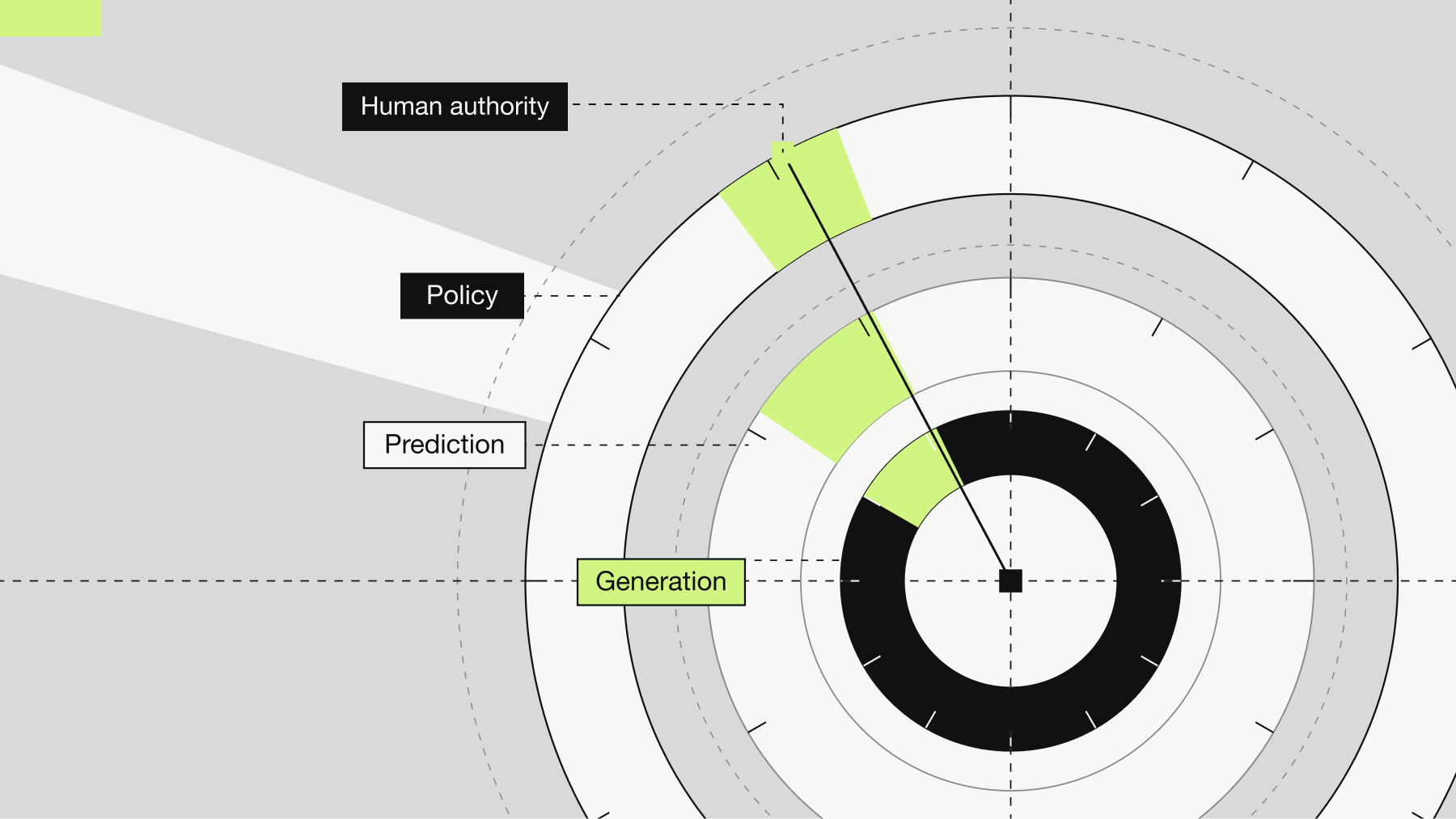
Rules decide what is allowed. Predictive models estimate what is likely. Generative models formulate how to communicate or assist. Humans retain authority where the impact or uncertainty requires it.
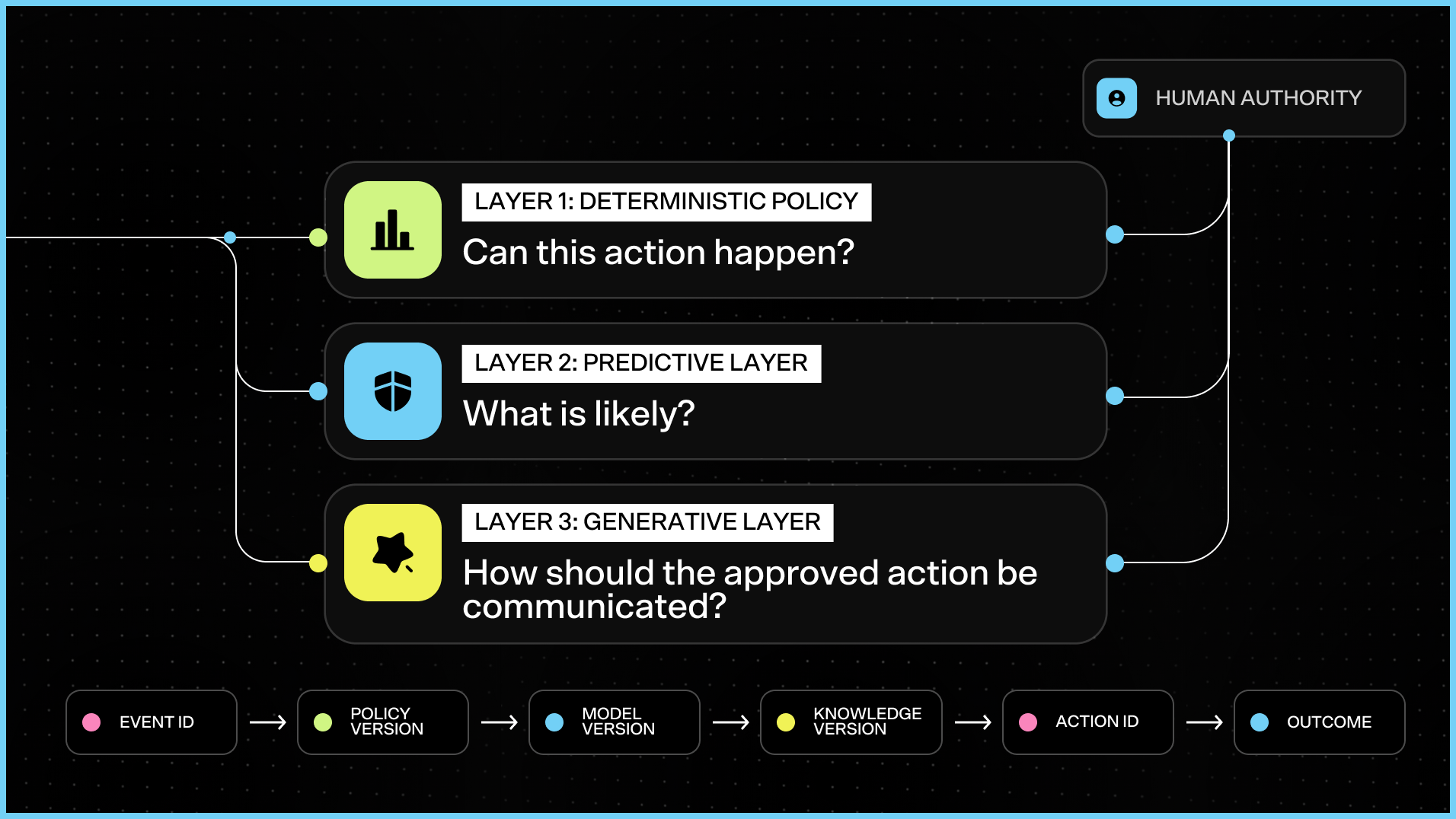
The Slotsense field report uses the same architectural distinction. It separates deterministic policy, predictive models and generative AI, then connects them through an audit spine that records the event, policy version, model version, knowledge version, action and outcome.
AI governance in iGaming is the operating system of rules, ownership, technical controls, review processes and evidence that determines how AI systems are allowed to influence player and operational outcomes.
It is broader than model governance. A production AI system may contain deterministic rules, machine-learning scores, retrieval systems, generative models, CRM logic, player-state APIs and human escalation. Governance needs to define the boundaries between them, not simply approve the model at the centre.
For an operator, effective AI governance should answer a small set of recurring questions. What is the system trying to achieve? Which data may it use? Which decisions are deterministic? Which outputs are predictions rather than facts? What can generative AI formulate? What must be suppressed? When should the system abstain? Who can override it? Which version produced the action? What evidence is retained? How is performance evaluated after deployment?
The Malta Gaming Authority made this topic more concrete in September 2026 when it launched its AI Gaming Charter with the Malta Digital Innovation Authority. The voluntary, principles-based framework is intended to support responsible, transparent and accountable AI use across gaming operations and explicitly highlights governance, human oversight and ethical considerations. It complements rather than replaces existing legal and regulatory requirements, including the EU AI Act.
That regulatory direction matters because AI governance is no longer only an internal engineering concern. It increasingly sits across Product, Data, Compliance, Responsible Gaming, CRM, Support, Legal and executive accountability.
Operators can create unnecessary complexity by using “AI governance” as one broad label for every control around AI. In practice, several governance jobs need to be separated.
AI policy defines organisational boundaries. It can specify approved use cases, prohibited practices, procurement requirements, data rules, review ownership and minimum controls.
Model governance focuses on the predictive or machine-learning component itself. It asks whether the model has an appropriate purpose, adequate data, acceptable performance, monitoring, versioning and review.
Decision governance sits one level higher. It asks how model outputs are converted into actual actions. A churn score, relevance score or risk signal should not automatically become a player-facing treatment without eligibility, objective, threshold and escalation logic.
Generative governance controls what an LLM or similar system may say, retrieve, summarise or formulate. It includes approved knowledge, source grounding, confidence fallback and restrictions on making unsupported claims.
Human oversight defines where people have authority to review, override, contest, escalate or make the final decision.
These controls overlap, but they are not interchangeable. A well-governed model can still sit inside a poorly governed decision process. A well-written prompt cannot compensate for missing eligibility controls. A human reviewer also does not automatically solve governance if the person only rubber-stamps an automated recommendation without enough context or authority to change it.
The governance problem therefore needs an architecture, not only a policy document.
A single AI model is attractive because it appears to simplify the system. The same assistant could interpret the player’s question, inspect account context, decide what the player needs, recommend the next action, explain it and determine whether escalation is necessary.
That simplicity is deceptive.
Different decisions require different evidence, failure tolerances and ownership. Whether a game is available in a jurisdiction is not a probabilistic language task. Whether a player has consented to a marketing interaction should not be guessed. Whether a known support question matches an approved answer may be a retrieval problem. Whether a player is likely to prefer one eligible game over another may be a predictive ranking problem. How to explain the selected option in clear language may be a generative task.
The field report expresses this separation as three layers that should not be mixed: deterministic policy for eligibility and controls, predictive models for relevance and likelihood, and generative AI for conversation and explanation. It also places player protection, KYC, AML, consent, limits and frequency rules ahead of commercial decisioning.
This separation reduces the authority given to probabilistic components. It also makes failures easier to diagnose. If an ineligible action reaches the player, the governance team can inspect the policy layer. If the action was permitted but poorly ranked, the predictive layer becomes the focus. If the selected action was correct but the explanation was inaccurate, the generative layer can be investigated without redesigning eligibility logic.
A practical player-facing AI governance architecture can be expressed as:
Deterministic Policy → Predictive Layer → Generative Layer → Audit Spine
A separate human-authority path sits across the system where the operator requires manual review, approval, dispute handling or escalation.
The deterministic layer handles conditions where the operator already knows the rule and does not need probabilistic interpretation. Depending on the use case, this may include jurisdiction, product availability, consent, self-exclusion, account state, KYC or AML conditions, player-protection rules, financial limits, frequency caps and approved action allowlists.
These controls should normally filter the decision environment before a predictive or generative model gets to optimise anything. If a promotional action is not eligible, its relevance score should not matter. If a game cannot be offered in the market, it should never reach the recommendation model’s final candidate set. If a support case needs human authority, the LLM should not be permitted to resolve it simply because it can formulate a plausible response.
This does not mean every policy is simple. Rules can depend on several systems and may need to change by jurisdiction, brand, product or player state. But the function remains deterministic: is this action permitted under the operator’s current policy?
The UK Gambling Commission provides a concrete example of this precedence in player protection. For remote operators in Great Britain, strong indicators of harm must trigger timely automated processes, marketing and new bonus take-up must be prevented in specified circumstances, and automated processes must be subject to the required manual review and customer contest mechanisms.
Great Britain is one concrete regulatory example, not a universal standard. Other markets have their own requirements and require local operator-side validation.
Once deterministic rules define what is allowed, predictive models can help estimate what is likely to be relevant, useful, risky or valuable.
The model may estimate recommendation relevance, churn propensity, likely intent, routing priority, probability of a support escalation, likely response to an eligible action or confidence that a behavioural pattern deserves further review. These outputs are estimates, not facts.
That distinction needs to remain visible throughout the system. A 0.78 relevance score is not a policy. A churn probability is not a mandate to offer a bonus. A risk signal is not necessarily the final player-protection action. A predicted intent should not override an explicit player request.
The governance layer should therefore define how each score may be used, what threshold matters, what other evidence is required and what happens when confidence is weak. Some scores may only rank an already eligible set. Others may trigger a review. Some should never directly create a player-facing action.
A useful design question is:
If this prediction is wrong, what can happen next?
The higher the cost of a wrong action, the less authority the prediction should have without additional control.
Generative AI is strongest when the system already knows the permitted objective, approved knowledge and action boundary.
It can explain a payment status in clearer language, summarise a support conversation for a human agent, translate a technical error into an understandable next step, ask a clarifying question, formulate a recommendation explanation or retrieve and summarise approved bonus terms.
What it should not do is quietly become the policy engine.
If the model is asked whether a player is eligible for a bonus based only on natural-language context, governance has already failed upstream. If it invents a withdrawal ETA because the authoritative system has no estimate, the problem is not tone. If it decides that an account restriction should be removed, generation has crossed into an authority domain it should not own.
The field report describes the generative layer as conversation, explanation, summarisation and retrieval from approved knowledge. That is a useful boundary because it places language generation after policy and prediction instead of allowing the LLM to define the business rules itself.
The EU AI Act adds a separate transparency consideration. The European Commission states that certain AI systems, including chatbots, are subject to transparency obligations so people can be made aware when they are interacting with a machine. Those transparency rules became applicable in August 2026.
Governance becomes operational only when a team can reconstruct what actually happened.
A useful audit record should connect the original event to the state used for the decision, the policy version, the model or scoring version, the approved knowledge version where relevant, the selected action, any suppression or escalation reason and the downstream outcome.
The field report expresses this as:
event_id → policy_version → model_version → knowledge_version → action_id → outcome window.
This is more useful than keeping an isolated LLM transcript. The transcript can show what the system said. The audit spine explains why that response was allowed, which decision environment produced it and what happened afterwards.
Without that chain, incident review quickly becomes guesswork. A team may know that a player saw an incorrect recommendation but not whether the catalog changed, the eligibility service failed, the model version drifted or the final response used outdated knowledge.
Situation: A first-deposit player has not yet launched a game and the product wants to reduce discovery friction.
Deterministic policy: Market availability, account status, consent where relevant, product restrictions and any player-protection conditions define which actions and games are eligible.
Predictive layer: A ranking model estimates which eligible category or game is most relevant from available preferences and live context.
Generative layer: The assistant explains two or three recommendations in concise language or asks one clarifying question when preference confidence is low.
Human authority: No human review is required for a routine, low-impact recommendation unless another policy condition triggers escalation.
Audit outcome: The operator records eligible candidates, model confidence, selected recommendation, explanation version, player response and downstream launch or wager event.
This is a governed recommendation because the model ranks inside an approved action set. It does not invent availability or define the policy.
Situation: A player receives a payment decline and makes several attempts.
Deterministic policy: Payment state, available methods, attempt limits, account restrictions and player-protection or fraud conditions determine which recovery routes remain available.
Predictive layer: A model may estimate the likely support intent or route priority, but it does not decide whether a restricted payment action becomes permitted.
Generative layer: The assistant translates the verified decline state into neutral language and explains the approved next step. It does not invent a reason that the PSP did not provide.
Human authority: Fraud, disputed payment, KYC or sensitive account cases move to the appropriate human or specialist process.
Audit outcome: The system records the decline event, policy state, explanation source, selected recovery route and whether the issue resolved.
The governance value appears when the system knows the difference between explaining a transaction and authorising one.
Situation: A player asks why a withdrawal is still processing.
Deterministic policy: The system can expose only the verified withdrawal status and approved account information available through authorised APIs.
Predictive layer: Intent classification helps distinguish a simple status request from a complaint, KYC question, disputed transaction or escalation request.
Generative layer: The AI summarises the known state, explains whether an action is required and offers the approved next step. It does not invent an ETA when the source system has none.
Human authority: Disputes, complex KYC decisions and cases requiring account-level authority move to a trained agent.
Audit outcome: The system records the data source, knowledge version, response, escalation decision and repeat-contact outcome.
The support answer is useful precisely because generation is constrained by verified state and approved knowledge.
Situation: A player’s behaviour produces a strong indicator under the operator’s player-protection process.
Deterministic policy: The required protection policy defines immediate restrictions, suppression and escalation rules.
Predictive layer: Validated models may contribute risk indicators or prioritisation, but the commercial decision environment is already constrained by the protection state.
Generative layer: Where the operator permits an automated player-facing explanation, the language layer communicates the approved protective action. It does not negotiate away the underlying restriction.
Human authority: Relevant cases receive the required manual review and the player must have access to the applicable contest or review mechanisms.
Audit outcome: The operator records the indicators, automated action, policy version, review and subsequent evaluation.
The UKGC’s remote customer interaction requirements illustrate why this separation matters. The framework uses an ongoing identify → act → evaluate process and requires operators to assess whether interventions are effective, rather than treating detection as the end of the process.
AI systems are often evaluated by answer rate, automation rate or the percentage of interactions they can complete without a human. Those metrics can create the wrong incentive.
A well-governed system should be allowed to say that it does not have enough evidence to act.
The field report defines the confidence fallback explicitly: ask, abstain or hand off — never improvise. It also gives human authority to disputes, KYC, withdrawals and high-risk interactions rather than treating full automation as the default objective.
Abstention can take several forms. A recommendation engine can wait when confidence is weak. A support assistant can ask one clarifying question. A generative system can return the approved source instead of summarising uncertain content. A transaction flow can hand off to support. A protection system can apply an immediate deterministic control and route the case for manual review.
This is not model failure. It is part of the decision policy.
The governance question should therefore be:
When is the system required not to decide?
That threshold deserves as much design attention as model accuracy.
The market increasingly offers “responsible AI,” model monitoring, guardrails, LLM observability and governance dashboards as product categories. Operators should ignore the label long enough to test whether the surrounding operating controls match the decisions AI will actually influence.
The Malta Gaming Authority’s new AI Gaming Charter reflects this direction at sector level. Its official launch describes a framework intended to help gaming organisations understand where AI is being used, manage associated risks and preserve accountability and human oversight.
The 2026 iGaming conversation is changing because AI is no longer confined to low-impact internal experimentation. Player protection, customer interaction, fraud detection, recommendations and operational decision-making increasingly contain AI components. The MGA explicitly identifies those as active use areas in the sector.
At the same time, the UNLV/KPMG benchmark suggests governance maturity is behind strategic ambition. The research covered 83 gambling companies and 113 regulators and found governance to be the lowest-scoring organisational maturity dimension.
That changes the buyer’s question. “Does the platform use AI?” is becoming less useful than “What decisions does the AI actually control, what constrains those decisions and what evidence exists after deployment?”
The EU regulatory environment pushes in the same direction. The AI Act is now generally applicable, with transparency obligations applying from August 2026 and specific disclosure expectations around interactions with AI systems such as chatbots. GDPR also remains relevant where automated processing produces legal or similarly significant effects; the European Commission highlights safeguards including information about automated decision-making, human intervention and the ability to contest applicable decisions.
These frameworks do not make every player-facing AI use case legally identical. They do reinforce a common operating principle: organisations need to know what their AI is doing, what authority it has and who remains accountable.
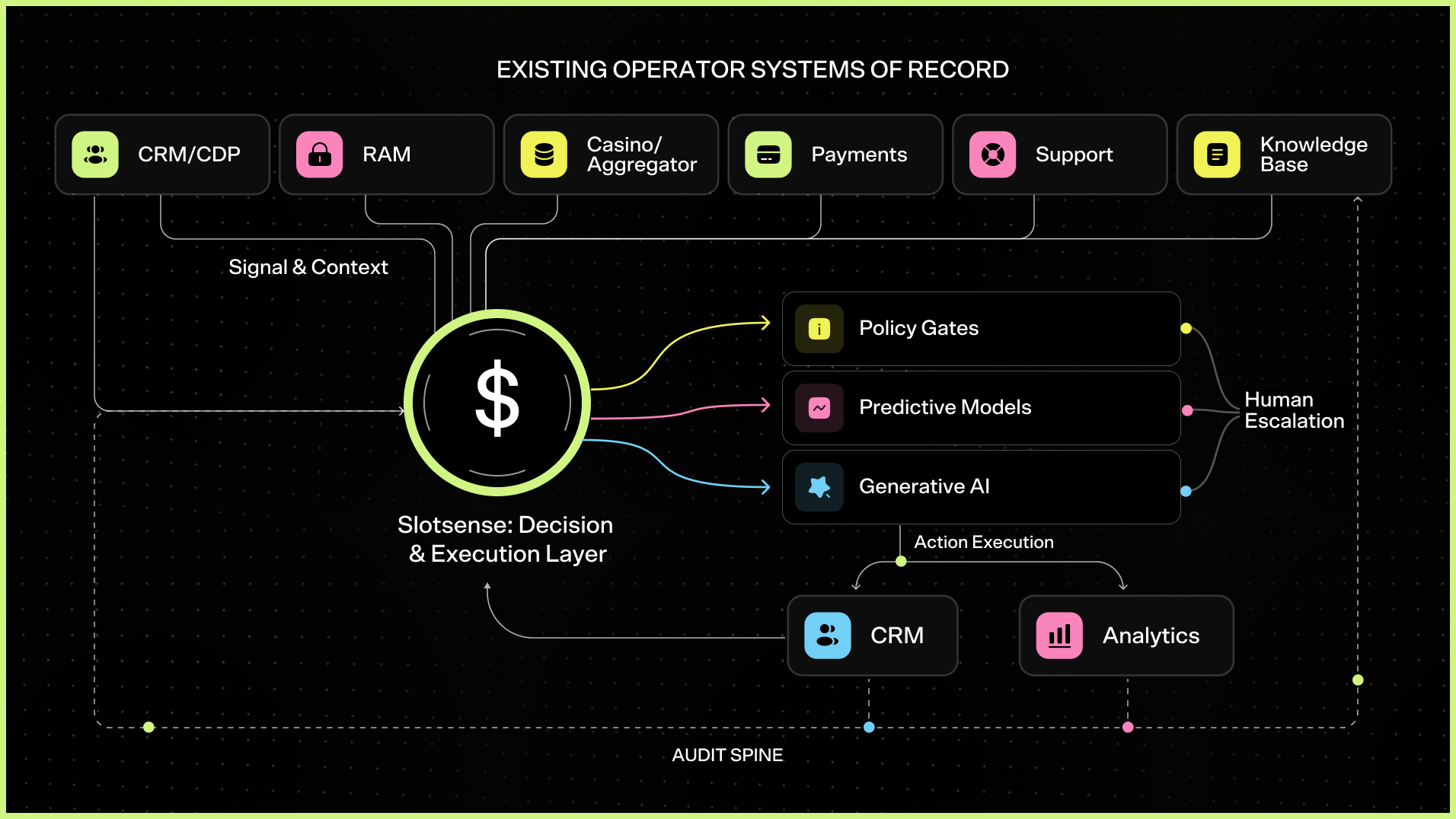
Slotsense is not positioned as a replacement for CRM, PAM, support, payments or operator governance. Those systems and teams retain their existing responsibilities. CRM can continue to own lifecycle logic. PAM remains authoritative for account state. Payments remain authoritative for transaction status. Support owns tickets, approved knowledge and agent workflows. Compliance and player-protection teams define the operating controls relevant to their jurisdictions.
Slotsense operates in the player-facing decision and execution layer. It can consume approved signals from those systems, apply operator-defined eligibility, use predictive logic where relevant, generate or retrieve approved player-facing responses, select a permitted action and record the result for analytics and review.
This boundary is important because the current Real-Time Decisioning article already explains how events become contextual player-facing actions. The governance layer answers a different question: which component has authority at each step of that event-to-outcome chain?
The existing Next Best Action pillar provides another complementary boundary. NBA selects among eligible actions; governance defines which actions may enter that decision environment, what evidence the model can use and when the system must defer to policy or human authority.
Human oversight is often described as if the mere existence of an agent queue makes an AI system human-controlled.
That is too weak.
A meaningful human reviewer needs enough information to understand what the system did, enough authority to change the outcome and enough time or process support to intervene before the review becomes a formality.
GDPR guidance is particularly relevant where decisions are based solely on automated processing and have legal or similarly significant effects. The European Commission explains that applicable safeguards include informing individuals, enabling human intervention, allowing them to express their point of view and allowing the decision to be contested.
The UKGC provides a sector-specific example. Its remote customer interaction requirements call for automated action on strong indicators of harm, while also requiring manual review of the automated process in each relevant customer case and an opportunity for affected customers to contest automated decisions.
The practical design lesson is not that every AI response needs a human approval click. It is that human authority should be proportional to the consequence of the decision.
A routine game recommendation and a disputed account restriction should not share the same oversight model.
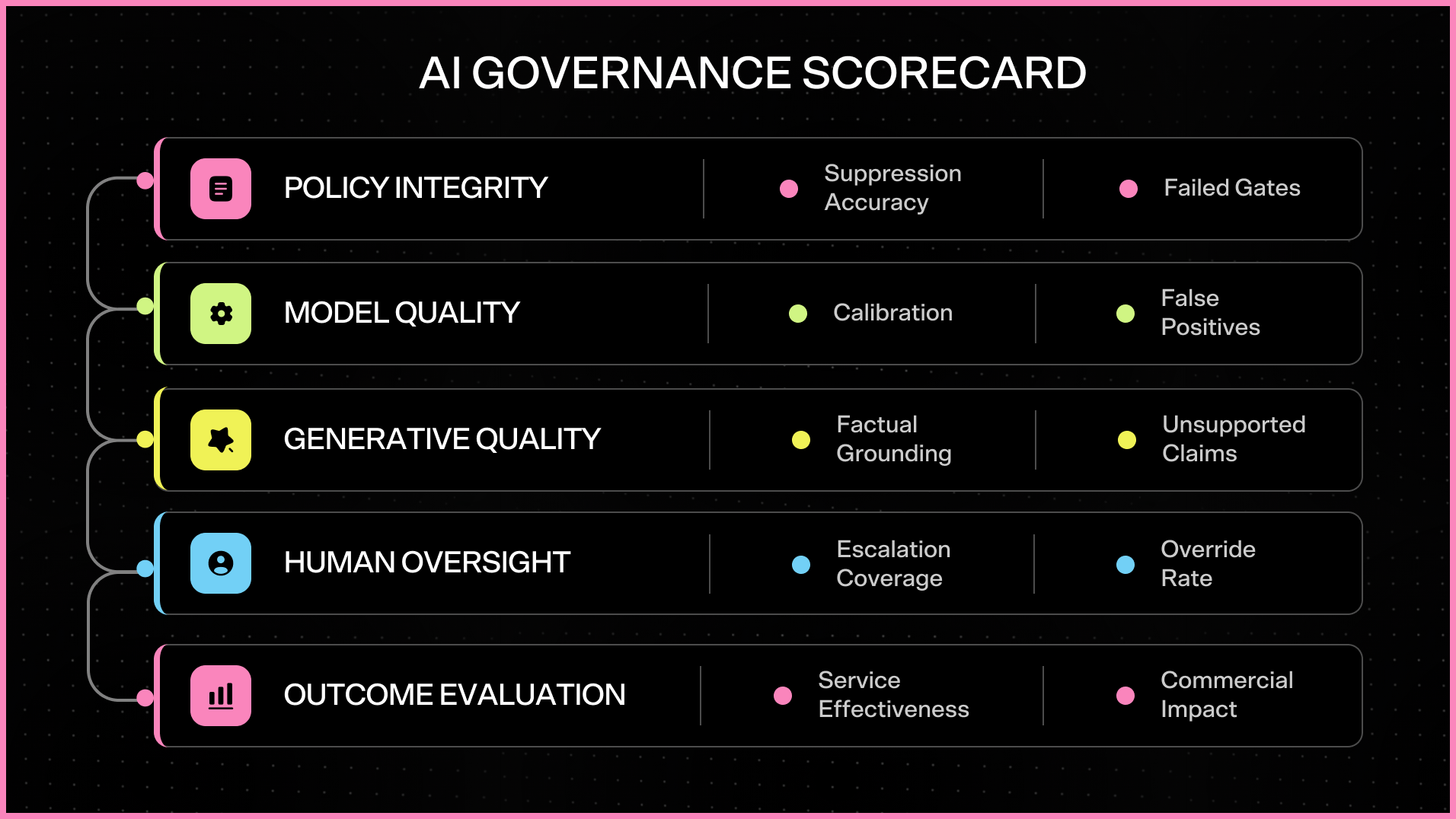
The number of governance documents is not a useful success metric. A system can have extensive documentation and still make poorly controlled decisions in production.
A practical governance scorecard should evaluate five areas.
Policy integrity asks whether ineligible or prohibited actions are reliably removed before model selection. Teams can monitor suppression accuracy, policy conflicts, stale rules, failed gates and incidents where model output bypassed a hard constraint.
Model quality evaluates the predictive component inside its actual operating role. Relevant measures may include calibration, ranking quality, confidence distribution, false positives and false negatives. The metric should match the authority the model has been given.
Generative quality measures factual grounding, approved-source coverage, unsupported claims, unsafe answers, incorrect account explanations and fallback behaviour. A support assistant should not be judged only by fluency or containment.
Human oversight examines escalation coverage, time to review, override rate, contested decisions, repeated routing and whether reviewers have the information necessary to make a meaningful decision.
Outcome evaluation closes the loop. Teams need to know whether the governed process produced the intended service, commercial or protection outcome and whether the decision needs to change next time.
The UKGC’s identify → act → evaluate model provides a useful regulatory example of this broader principle: action should be followed by evaluation of impact, not assumed to be effective because the system executed successfully.
The field report reaches the same conclusion from an AI architecture perspective. Its governance section prioritises eligibility, protection, approved knowledge, confidence fallback, human authority and audit/evaluation, with a fail-safe default where a bad AI action can be more costly than a missed opportunity.
AI governance in iGaming should not start with the question, “How do we control the model?”
It should start with:
Which decisions exist, which layer is allowed to make each one, and what happens when that layer is uncertain or wrong?
That produces a more useful operating model.
Deterministic policy decides what is allowed. Predictive AI estimates what is likely. Generative AI formulates the permitted interaction. Human authority handles the cases where consequence, uncertainty or policy requires a person. The audit spine connects those decisions so teams can reconstruct what happened and evaluate the outcome.
This architecture does not remove AI autonomy entirely. It defines bounded autonomy.
That distinction becomes more important as AI systems move from answering questions toward choosing actions, adapting journeys and influencing regulated player outcomes.
CRM, PAM, payments, support and compliance remain essential systems and functions. Player-facing AI adds another decision layer between those systems and the player. Governance determines how much authority that layer receives and how that authority is controlled.
Map one player-facing AI workflow from policy to outcome with us →
AI governance in iGaming is the set of operating rules, technical controls, ownership structures, review processes and evidence used to determine how AI may influence player and operational decisions. It covers more than model performance because real systems combine policy, predictions, generation, integrations and human escalation.
Model governance focuses on the model itself: purpose, data, validation, performance, monitoring and versioning. AI governance is broader and includes how that model is used inside a business decision, which actions it may influence, what rules constrain it and who remains accountable.
Some decisions already have explicit rules and should not depend on probabilistic inference. Eligibility, consent, product availability, account controls and mandatory suppression conditions are examples where deterministic policy can define the boundary before AI ranking or generation begins.
Predictive AI is useful for estimating relevance, intent, propensity, risk or routing priority. Governance should define whether a prediction may rank eligible options, trigger review or select an action, and what happens when confidence is insufficient.
Generative AI is well suited to conversation, explanation, summarisation, clarification and retrieval-based responses. It should not silently become the source of truth for eligibility, account state, legal requirements or other decisions that belong to deterministic systems or authorised humans.
No. Human oversight should be proportional to the impact and uncertainty of the decision. Routine low-impact recommendations can operate automatically inside defined policy, while disputes, significant account outcomes, sensitive KYC or player-protection cases may require review or human authority.
Yes. Abstention, clarification and escalation should be explicit governance outcomes. A system should not be forced to generate an action when confidence is low, authoritative data is missing or policy requires another route.
The AI Act uses a risk-based framework and includes transparency obligations for certain AI interactions. The European Commission states that people should be made aware when they are interacting with AI systems such as chatbots where the relevant transparency requirements apply. Exact obligations depend on the role, system and use case, so operators need appropriate legal assessment.
Slotsense operates as a player-facing decision and execution layer alongside the operator’s existing product, CRM, PAM, support and data systems. Operator-defined policy and controls constrain which actions are eligible; predictive and generative components can then support bounded decisions and interactions, with outcomes returned for measurement and review.
Content: