Withdrawal Experience in iGaming: How to Reduce Uncertainty Without Inventing ETAs
A practical guide to turning verified withdrawal status, payment state and escalation rules into clearer player-facing guidance without inventing ETAs.
16mins
·
November 16, 2026
Withdrawal automation is not faster payout
Withdrawal experience is often reduced to one metric: how quickly money reaches the player. Speed clearly matters, but it is only one part of the experience. A withdrawal can be processing within an operator’s normal workflow and still create frustration if the player cannot tell what stage it has reached, whether something is blocking it, whether further action is required or when the situation should be escalated.
That uncertainty quickly becomes a support problem. The player sees “pending,” waits, opens live chat, repeats the question, uploads documents again or receives a generic instruction to continue waiting. Support may have access to more detail, but the player-facing surface exposes almost none of it. The transaction may be moving normally while the experience around it feels broken.
The issue is material enough to appear repeatedly in current UK Gambling Commission data. Its July 2026 consumer-trust research explicitly identifies ease of withdrawing winnings and the quality of operator communication as important components of customer experience and trust. Forty-nine percent of respondents who had gambled in the previous 12 months agreed that it was quick and easy to withdraw and collect winnings, while 18 percent disagreed.
Withdrawal and financial-transaction issues also remain one of the largest categories in complaints made to the Commission. The Commission recorded 1,791 withdrawal or financial-transaction complaints during 2025, followed by 454 in the first quarter of 2026 and 421 in the second quarter.
The product problem is therefore not simply “make payouts faster.”
It is:
Expose the verified state clearly, explain only what is known, identify any legitimate blocker, tell the player whether action is required and escalate when self-service is no longer appropriate.
What is withdrawal experience in iGaming?
Withdrawal experience is the complete player journey between requesting funds and reaching a final transaction outcome. It includes the withdrawal interface, verification and account state, payment processing, status communication, support, escalation and the clarity of any action the player needs to take.
A good withdrawal experience does not imply that every transaction can be instant. Payment method, provider processing, verification, fraud controls, AML obligations and other legitimate checks can affect what happens after the request. The product responsibility is to make those states understandable without presenting speculation as fact.
For player-facing AI, that creates a narrow but useful role. AI can translate verified backend information into plain language, connect the player to the correct approved next step and preserve context if the case reaches a human. It should not approve the withdrawal, override KYC or AML decisions, manufacture a payment-provider update or promise a completion time that the authoritative system does not know.
This distinction separates a withdrawal companion from a generic support chatbot. The chatbot begins with the player’s question. A withdrawal companion begins with the authoritative transaction state.
Withdrawal operations, withdrawal support and withdrawal experience are different jobs
Operators already have several systems involved in withdrawals, and a player-facing layer should not collapse their responsibilities.
Payments and the PAM control the transaction state. They know that a withdrawal was requested, which method is involved, whether processing has started, whether the transaction has been approved or passed to another provider and whether a known restriction is present.
KYC, AML, fraud and risk systems determine whether further checks are required under the operator’s policies and legal obligations. Those controls should remain authoritative rather than being inferred from a conversational model.
Support handles questions, disputes, unusual cases and situations where player-facing self-service cannot resolve the issue.
The withdrawal experience determines what the player can understand without having to reconstruct those systems manually through repeated support conversations.
The player-facing AI layer sits between these jobs. It does not move funds. It converts verified operational state into an understandable experience and knows when to stop doing so.
This boundary is important because Slotsense already has dedicated content covering support automation. The support pillar focuses on understanding player intent, collecting missing context and preparing better escalation. The multimodal support article focuses on screenshots, voice notes and messy player inputs. A withdrawal-experience pillar should solve a different problem: how much verified transaction state can be exposed proactively before a ticket is necessary?
Why generic “pending” states create unnecessary friction
A status label such as “pending” may be technically correct while being almost useless to the player.
It does not explain whether the operator has received the request, whether internal review is complete, whether another payment provider is processing it, whether documents are missing, whether the player needs to do anything or whether the request has exceeded an expected processing range.
This produces several predictable behaviours. Players contact support to ask for information already available elsewhere in the stack. Agents repeatedly explain the same transaction states. Players may submit the same documents again because they cannot tell whether the originals were accepted. Repeated payment or account actions can also create additional confusion when the correct instruction was simply to wait.
The opposite failure is equally dangerous: trying to remove uncertainty by generating a confident answer from incomplete data. An AI system that says “your payment will arrive by 5 PM” because historical withdrawals normally completed in that period has created an ETA that the payment system never supplied.
The useful design principle is narrower:
The player-facing layer may simplify verified information. It should not increase the certainty of the underlying information.
If the backend knows only that the transaction has been handed to a provider, the response should explain that state. If the provider supplies an approved expected range, that range can be communicated. If there is no trustworthy timing signal, the system should not manufacture one.
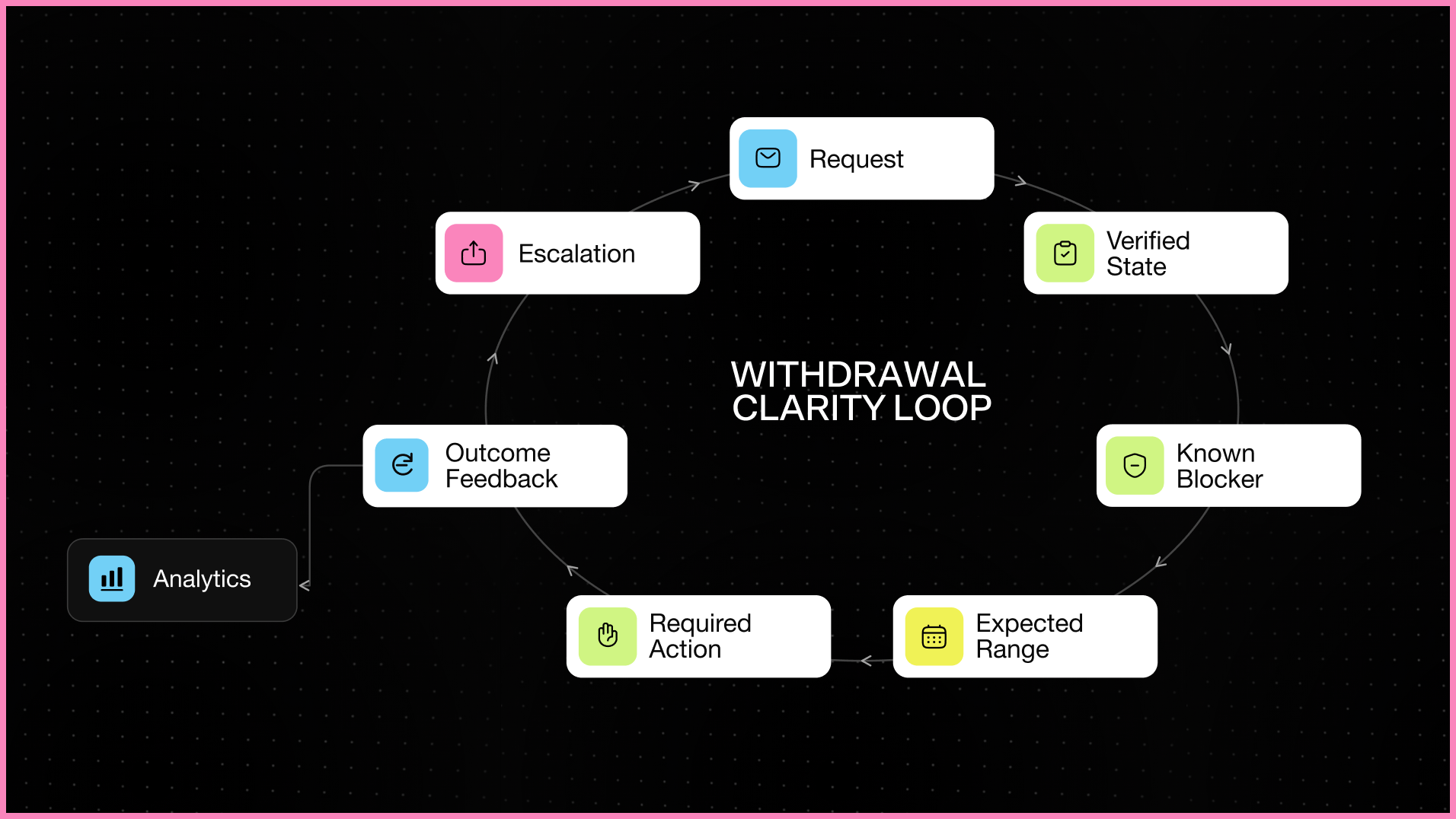
The Withdrawal Clarity Loop
A practical withdrawal experience can be structured around six stages:
Request → Verified State → Known Blocker → Expected Range → Required Action → Escalation
1. Request: establish the authoritative transaction
The first task is to know exactly which transaction the player is asking about. The system should resolve the withdrawal identifier, submission time, payment method, amount and current account context from an authoritative source rather than requiring the player to retype information that already exists in the operator stack.
This sounds basic, but it changes the support experience materially. “Why is my withdrawal pending?” is an incomplete support question when viewed as text. When joined to PAM and payment data, it can become a structured transaction request with a known timestamp, method and processing state.
The system should also distinguish one withdrawal from another. A player may have several transactions, a reversed withdrawal, a previously completed request or another financial event visible in the same account. Player-facing guidance should be grounded in the specific transaction under discussion.
The AI layer can help interpret the player’s language. It should not decide which transaction exists.
2. Verified state: explain what has actually happened
Once the transaction is identified, the player-facing layer should retrieve the most specific trustworthy state available.
The exact status taxonomy will vary by operator and provider. One stack may distinguish requested, under review, approved, submitted to provider, processing and completed. Another may use a different internal workflow. The AI layer should not invent a universal taxonomy. It should translate the operator’s real transaction states into language that players can understand.
For example, “submitted to provider” may be more useful than “pending” if that is genuinely what happened. “Internal review completed; payment provider processing has started” gives the player a clearer mental model without promising when the provider will finish.
This stage also reduces unnecessary support escalation because it answers a common player question directly: has anything actually happened since the request was submitted?
The current Slotsense field report makes this the core of its withdrawal-companion scenario. The recommended data includes withdrawal state and time, known blockers, expected ranges, received documents and escalation policy, while the AI action is limited to explaining the current stage and what is known. The final approval remains outside the AI layer.
3. Known blocker: separate waiting from a problem that requires action
Not every delay has the same cause.
A transaction may be progressing normally. It may be waiting on a required verification step. A provider may have returned a specific status. The transaction may have reached an exception queue. Or the operator may not yet have enough verified information to explain the delay.
These situations should not all produce the same message.
A useful player-facing system should expose a blocker only when that blocker is known. If the authoritative source says that an additional legally required check is necessary, the system can explain the requirement and route the player appropriately. If the source does not contain a reason, the AI should not infer one from historical patterns.
This becomes particularly important around identity verification.
For Great Britain, UKGC Licence Condition 17.1.1 states that a withdrawal request must not result in a requirement for additional information if the licensee could reasonably have requested that information earlier. The condition still allows operators to seek information that they are legally required to obtain at that time.
The Commission repeated this point in August 2026, noting that poor verification practice can disrupt the customer journey and damage trust when checks are delayed until withdrawal.
The player-facing AI should therefore explain a legitimate verified requirement. It should never create a new requirement simply because “additional verification” is a plausible explanation for a delayed withdrawal.
Great Britain is one concrete regulatory example, not a universal standard. Other markets have their own requirements and require local operator-side validation.
4. Expected range: communicate timing without inventing an ETA
Players naturally want to know when the money will arrive.
That does not mean the AI should always answer with a timestamp.
The system should distinguish between three types of timing information.
A verified committed time can be shown when an authoritative provider or operator system supplies one and the operator permits it to be communicated.
An approved expected range can be shown when the payment method has a documented processing range that is relevant to the current transaction state.
Unknown timing should remain unknown when the source systems cannot support a reliable statement.
The third state is important. “There is no confirmed completion time yet” is better than a precise answer derived from historical averages and presented as fact.
Expected ranges should also be anchored to the correct stage. A method-level range starting at the moment of provider submission is different from an overall range beginning when the player first requested the withdrawal. If the system mixes those clocks, an accurate piece of reference data can still become a misleading player message.
The field report captures this design rule directly: the withdrawal companion may communicate a typical range where one exists, but it should not invent an ETA.
5. Required action: ask only for what is actually needed
If the player needs to do something, the interface should say exactly what that action is.
“Contact support” is often too vague. “Upload documents” may also be too vague if the operator already has some of them. The useful experience explains what has been received, what is missing, where the requirement comes from and what will happen after the action is completed.
This is another area where player-facing AI can improve clarity without owning the underlying decision. It can translate a structured requirement into plain language, preserve the status of documents already supplied and direct the player to the correct approved flow.
It should not decide that additional documentation would be “safer” and ask for it independently.
The UKGC’s public guidance says operators should not wait until a withdrawal to ask for identity information that could reasonably have been requested earlier, although new information may legitimately be required at withdrawal where another legal obligation requires it.
That distinction should exist in the system architecture, not be left to the LLM to interpret from scratch in every conversation.
6. Escalation: know when self-service should stop
Some withdrawal questions should not remain in an automated conversation.
A transaction may exceed the operator’s expected range. The status returned by two systems may conflict. The player may dispute a decision. A KYC or AML case may require specialist review. The player may raise a complaint. There may be a repeated unresolved contact, or the system may simply lack enough verified state to give a useful answer.
In these cases, the AI layer should escalate with context rather than continue generating increasingly generic explanations.
The handoff should contain the transaction identifier, timeline, verified status, known blocker, documents or account states already checked, the conversation summary and the reason for escalation. The player should not need to repeat the same story to the next team.
This is where the withdrawal-experience pillar connects to the existing support-automation content. Support automation is valuable after the issue becomes a case. The withdrawal companion should reduce unnecessary cases and improve the quality of the ones that still require human authority.
Four withdrawal experience examples
Example 1: Withdrawal is processing normally
Trigger: A player asks why a withdrawal requested several hours earlier still shows as pending.
Player context: Account verification is complete. No additional information is required. The payment method has a documented processing range and the transaction remains inside it.
Verified state: The operator has completed its current step and the payment is progressing through the normal workflow.
Possible actions: Explain the current stage and approved expected range, link to the transaction status, escalate immediately, request unnecessary documents or provide no additional guidance.
AI decision: Explain the verified stage and expected range. Make clear that no action is currently required from the player. Do not promise an exact completion time if the provider has not supplied one.
Outcome: Transaction completes normally, player waits without recontact, player contacts support again or the transaction later exceeds the expected range and becomes eligible for escalation.
The goal is not ticket deflection at any cost. The goal is to answer the actual question accurately enough that support is unnecessary when nothing is wrong.
Example 2: A legitimate verification requirement is blocking progress
Trigger: The player asks why the withdrawal has not moved and the authoritative account state shows that a legally required check is incomplete.
Player context: The request exists, but a specific verification step remains outstanding under the operator’s current process.
Verified state: The blocker is known and the relevant workflow identifies exactly which information is required.
Possible actions: Explain the required step, direct the player to the approved verification flow, ask for unrelated documents, promise completion after upload or escalate if the requirement is disputed.
AI decision: Explain the verified requirement and the next approved action. Confirm which information has already been received so the player does not repeat completed steps. Do not promise that the withdrawal will complete immediately after submission because the subsequent decision still belongs to the verification process.
Outcome: Required information is supplied, the blocker clears, specialist review begins, the player disputes the requirement or the issue is escalated.
The AI explains the requirement. It does not approve the documents or decide the final withdrawal outcome.
Example 3: Provider processing exceeds the expected range
Trigger: The withdrawal has already passed the operator’s normal internal workflow and has remained in the provider stage longer than the approved expected range.
Player context: No additional player action is outstanding.
Verified state: The transaction has exceeded the threshold at which the operator’s policy calls for investigation or escalation.
Possible actions: Continue saying “please wait,” invent a new ETA, create a payment investigation, route to the relevant team or ask the player to submit the withdrawal again.
AI decision: Explain that the transaction has moved outside the normal expected range and escalate with the complete transaction context. Do not reset the clock by asking the player to make another request unless the authoritative payment workflow specifically requires it.
Outcome: Provider status is clarified, the transaction completes, a payment exception is identified or the case progresses through the operator’s dispute process.
This is where AI should reduce the time between “something is no longer normal” and the correct human or operational action.
Example 4: Withdrawal concern overlaps with player-protection context
Trigger: A player repeatedly contacts the operator about a withdrawal while other live signals indicate a player-protection process is active.
Player context: The commercial journey is already constrained by the operator’s protection policy.
Verified state: The withdrawal information can still be explained, but promotional or retention actions are not eligible.
Possible actions: Give the verified withdrawal status, offer a retention bonus, encourage further play while waiting, route the relevant protected interaction or escalate to a trained team where required.
AI decision: Keep the withdrawal explanation factual and separate from commercial recovery. Suppress promotional actions and follow the operator’s player-protection policy.
Outcome: The player receives accurate transaction information while the protected journey proceeds under the correct rules.
A withdrawal question should never become a reason to insert an unrelated commercial intervention into a sensitive interaction.
“Wait” is a valid withdrawal action
A player-facing system can create unnecessary friction by trying to turn every withdrawal status into an intervention.
Sometimes the verified state is simply that processing is continuing normally and the player does not need to do anything.
In that situation, wait is a legitimate action if it contains enough information to be useful. The system can state what stage has been reached, confirm that no player action is currently required and show the approved expected range if one is available.
This is different from a generic “please wait.”
A useful wait state is evidence-backed.
The distinction also matters for analytics. A decision such as wait_normal_processing is different from status_unknown, player_action_required, provider_range_exceeded or human_escalation_required. Those reason codes help teams understand why withdrawals generate support contacts and where the experience needs redesign.
The existing Real-Time Decisioning framework uses the same principle: a trigger opens a decision opportunity but does not require an intervention, and no action can be the correct output when another response would add unnecessary friction.
What withdrawal experience capabilities should operators compare?
Operators do not need another chatbot simply because withdrawal tickets are common. The useful comparison is whether the product can access and explain the operational state required to answer the player accurately.
Transaction-state access: Can the player-facing layer retrieve the current withdrawal state from the authoritative payment or PAM system?
Timestamp integrity: Can it distinguish request time, internal approval, provider submission and later transaction events instead of treating “pending” as one clock?
Blocker resolution: Can it identify a verified blocker without inferring one from incomplete data?
Verification context: Can it see which approved documents or checks are already complete so the player is not asked to repeat them?
Expected-range control: Are timing ranges sourced from approved provider or operator data rather than generated dynamically by the LLM?
Source grounding: Can every factual status statement be traced to an authoritative system or approved knowledge source?
Escalation policy: Can the system recognise when the case has exceeded its self-service boundary and route it with context?
Human authority: Are disputes, sensitive verification decisions and other high-impact cases kept under the appropriate human process?
Auditability: Can teams reconstruct which transaction state, policy and knowledge version produced the player-facing response?
Outcome measurement: Can the operator see whether proactive status guidance reduced repeat contacts, complaints and time to resolve actual blockers?
The important buying question is not “Can the AI answer withdrawal questions?”
It is:
“Can it answer only what the operator actually knows?”
Withdrawal transparency is becoming a regulatory and trust issue
The commercial case for better withdrawal experience is often framed around support costs or retention, but current regulatory evidence shows that transparency itself is becoming more visible.
In July 2026, UKGC consumer-trust research described ease of withdrawing winnings and quality of communication as components of customer experience and trust. The same research notes that previous qualitative work found difficulties and delays around withdrawal and concerns about information requested at that stage.
The Commission’s current strategic work also includes improving transparency around identity checks and restrictions later in the customer journey, particularly at withdrawal, because withdrawal delays continue to generate consumer complaints.
More recently, on October 21, 2026, the UKGC announced a £900,000 regulatory settlement with L & L Europe covering several failures, including unnecessary withdrawal delays. Among the identified issues were manual review practices that resulted in additional information being requested before withdrawals even where some of that information could have been requested earlier.
That enforcement action does not create a universal product specification for every market. It does reinforce a useful design principle: operators should not treat the withdrawal moment as a convenient place to introduce avoidable uncertainty or late friction.
Great Britain is one concrete example, not a universal regulatory standard. Other jurisdictions have their own rules and require local compliance validation.
Where Slotsense fits: explanation and routing above the transaction systems
Slotsense is not a payment processor, withdrawal engine, PAM replacement or KYC approval system. Those systems remain authoritative for the transaction and account decisions they already control.
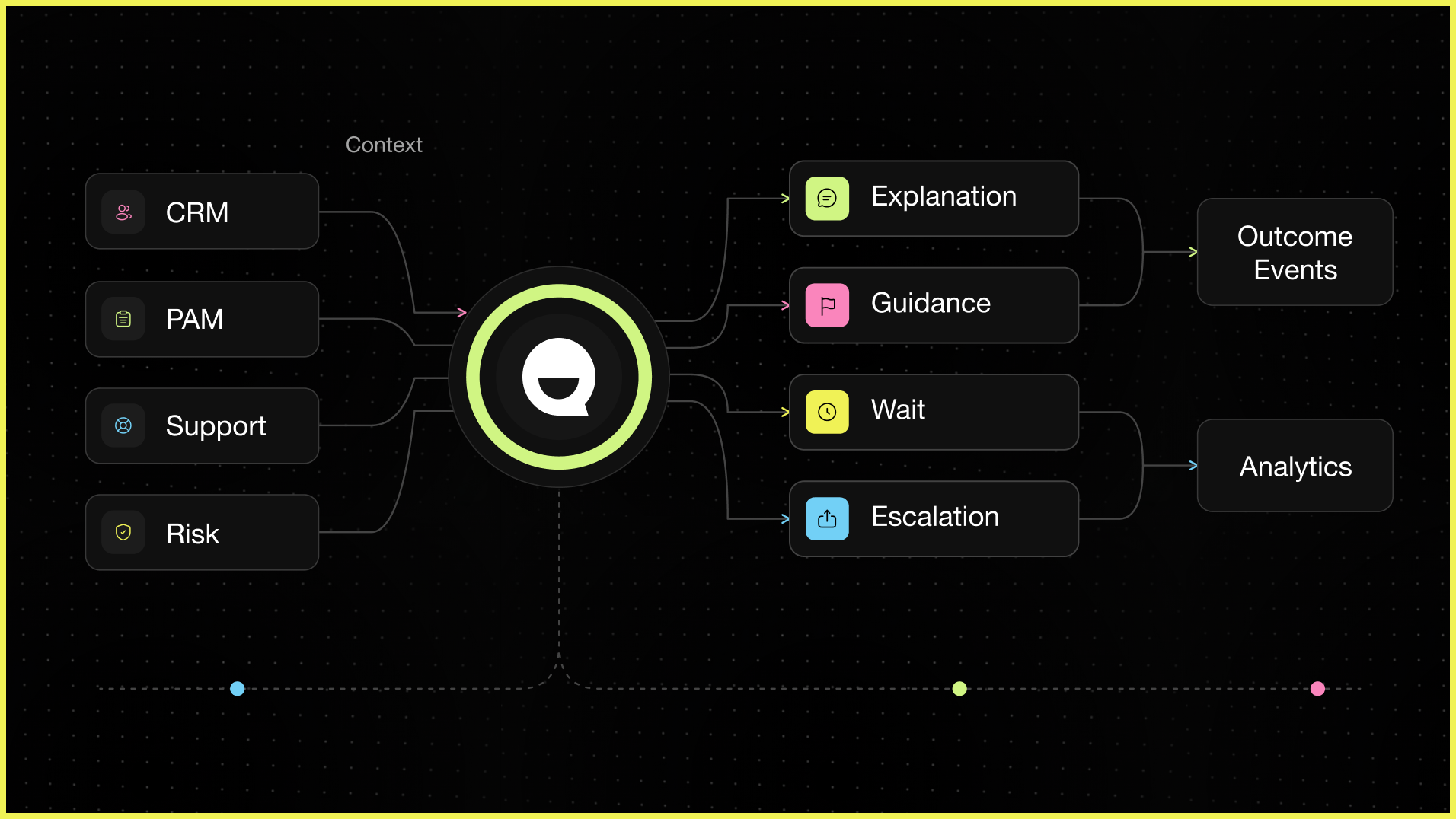
The player-facing layer has a narrower role. It can retrieve verified state, translate technical statuses into plain language, explain an approved next step, suppress irrelevant commercial actions, preserve context across the interaction and escalate when the case leaves the self-service boundary.
This architecture follows the same principle used in the current Slotsense Real-Time Decisioning article. The event opens a decision window, current state provides context, eligibility defines the permitted actions and the selected player-facing experience is then executed and measured. A withdrawal status event simply creates a specific decision environment where factual accuracy and restraint matter more than engagement.
The support stack remains equally important. Once a case requires investigation, dispute handling or human authority, the withdrawal companion should hand over structured context rather than trying to keep the conversation automated. The current Slotsense support framework already treats high-context escalation as a valid successful outcome rather than assuming every case should be contained.
What player-facing withdrawal guidance changes
Status becomes specific instead of generic. “Processing” can be translated into the actual verified stage the operator is permitted to expose.
Waiting becomes explainable. The player can understand whether the transaction is inside its normal range and whether any action is required.
Verification becomes less repetitive. The interface can acknowledge information already received instead of repeatedly requesting generic documents.
Support receives cleaner cases. Escalations can arrive with transaction ID, timeline, verified state and blocker already attached.
Commercial journeys can be suppressed. A transaction problem can take precedence over recommendation or retention logic.
Timing claims become controlled. Approved ranges can be communicated without letting generative AI invent completion promises.
The outcome becomes measurable. Teams can distinguish normal wait states from unresolved blockers, repeated contacts, complaints and actual processing exceptions.
Responsible withdrawal AI must be constrained
A withdrawal assistant should operate under a stricter factual boundary than many general conversational experiences because the player is asking about money, account status and potentially regulated checks.
The safest architecture begins with authoritative state. The AI can explain it, but should not change it. If the source systems conflict, the answer should reflect uncertainty and route the case rather than selecting whichever status appears most plausible.
The system should also distinguish explanation from approval. It may explain that documents are under review, but it should not declare them approved unless the authoritative verification service has done so. It may explain that a transaction has been passed to a provider, but it should not state that the funds have reached the player’s bank unless the system actually knows that.
Human authority becomes especially important for disputes, account restrictions, KYC decisions, suspected fraud, AML-related cases and any withdrawal where operational state cannot be resolved reliably.
The default should be:
Explain what is verified. Ask only for what is required. Abstain when the state is uncertain. Escalate when authority is needed.
How to build the first withdrawal-status companion
Map the real status model. Document every withdrawal state that exists across PAM, payment provider and internal operations. Remove duplicate labels and identify which system is authoritative for each transition.
Define what the player may see. Not every internal code belongs in the interface. Translate each approved status into a clear player-facing meaning without changing its factual certainty.
Map known blockers. Identify which statuses represent normal processing, which represent a required player action and which require internal or human review.
Version the expected ranges. Store approved timing ranges by relevant payment method and stage. Do not ask a generative model to infer timelines from historical transactions.
Connect verification state. Make sure the player-facing layer knows which checks or documents are already complete before it requests anything further.
Write escalation thresholds. Define what happens when a transaction exceeds an expected range, statuses conflict, the player disputes the process or the system lacks sufficient data.
Create deterministic hard stops. Prevent AI from approving withdrawals, overriding restrictions, inventing ETAs, requesting unsupported documents or making promises beyond the verified state.
Instrument the decision reasons. Record normal processing, player action required, blocker identified, range exceeded, status unknown and human escalation as distinct outcomes.
Run against the existing experience. Compare the status companion with the current withdrawal page and support workflow rather than assuming lower ticket volume proves improvement.
Review complaints and recontacts. A useful withdrawal experience should reduce unnecessary uncertainty without hiding legitimate problems or making escalation harder.
Measurement: prove clarity, not containment
Support containment is an incomplete success metric for withdrawal automation. A player who never reaches an agent because the automated answer was confusing has technically been “contained” while the experience has become worse.
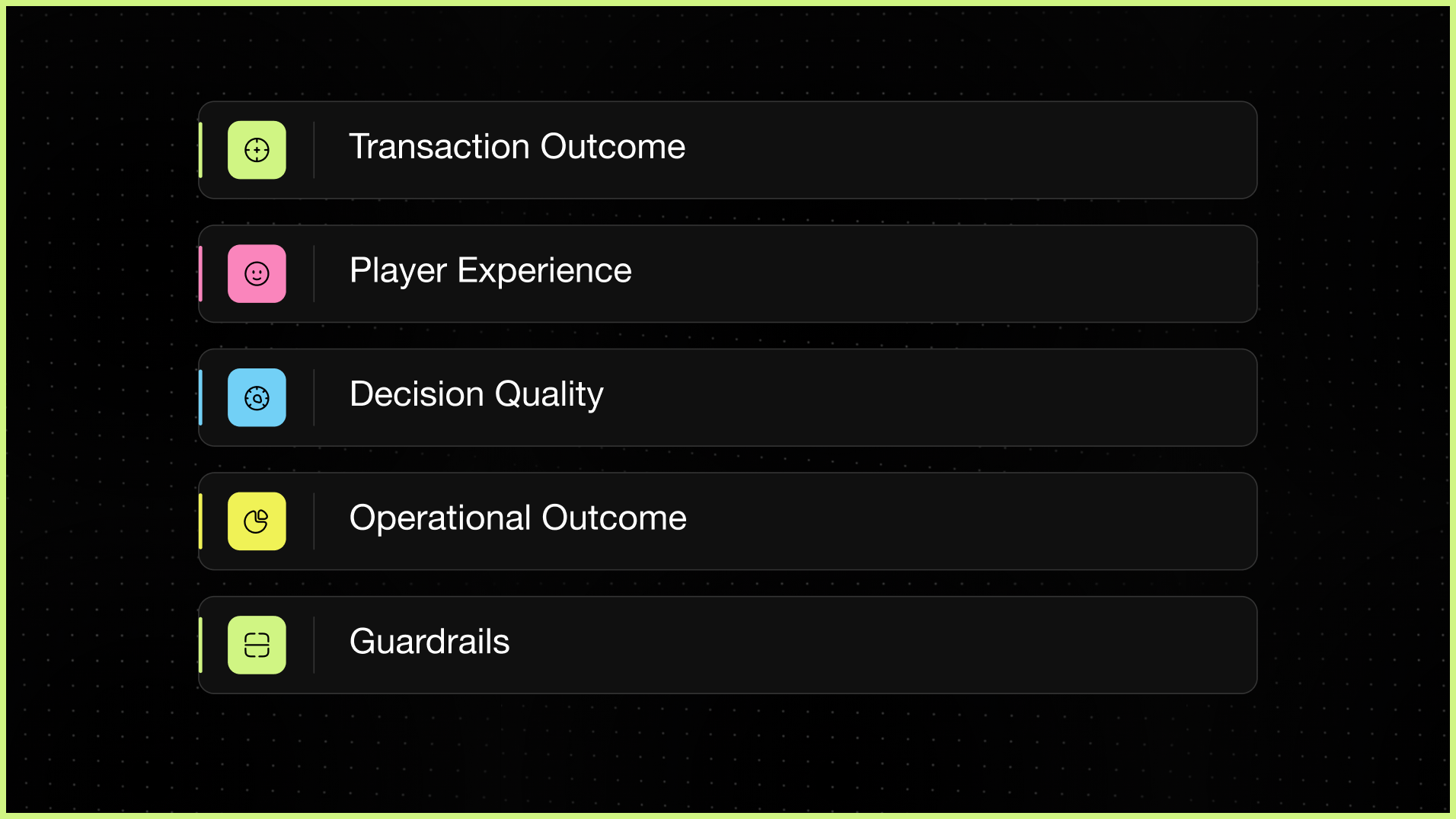
A balanced withdrawal scorecard should start with the underlying transaction and player problem.
Transaction outcome measures whether known blockers are cleared, required steps are completed and payment processing progresses through the expected workflow. The AI should not be credited for moving the money if another system actually performed that task.
Player experience looks at repeat contacts, time to relevant information, status-page revisits, abandonment and complaints. The goal is to reduce uncertainty, not merely reduce agent conversations.
Decision quality measures whether the system correctly classified normal processing, required action, provider-range exceptions, uncertain state and escalation. Incorrect confidence is particularly important because a wrong “everything is normal” answer can delay a legitimate investigation.
Operational outcome measures support contacts per withdrawal, handoff completeness, time to clear real blockers and the amount of repeated information agents need to collect after escalation.
Guardrails measure unsupported ETA claims, incorrect document requests, missed escalation, policy conflicts and any case where the player-facing response contradicted an authoritative transaction state.
The Slotsense field report proposes similar withdrawal-specific measures: status contacts per withdrawal, time to clear a blocker, complaint rate and promised-versus-actual accuracy. Its wider measurement model also emphasizes counter-metrics and stop rules rather than treating automation volume as proof of improvement.
The strategic takeaway
Withdrawal experience should not be designed around the assumption that AI can make payments faster.
In many cases, it cannot.
What player-facing AI can change is the amount of uncertainty between the withdrawal request and the next verified transaction event.
Operators therefore need to separate three questions:
What does the authoritative transaction system know now?
What part of that state can be explained clearly and safely to the player?
When should self-service stop and the case move to the correct human or operational process?
A useful withdrawal companion answers those questions without taking authority away from payments, PAM, KYC, AML or support.
That creates a narrower but more defensible role for AI: make verified state understandable, make legitimate player actions explicit, reduce unnecessary repeat contact and preserve context when escalation is required.
The strongest experience is not the one that always has an answer.
It is the one that knows the difference between known, expected, required and uncertain.
Map one withdrawal journey from transaction state to player-facing clarity with us →
Frequently asked questions
What is withdrawal experience in iGaming?
Withdrawal experience is the complete player journey from requesting funds through transaction processing, verification, communication, support and final resolution. It includes both the payment operation itself and how clearly the operator communicates what is happening.
Can AI make withdrawals faster?
AI cannot make every underlying payment provider, bank, KYC process or regulatory check run faster. It can reduce information delays by explaining verified status, identifying known blockers, guiding legitimate next steps and escalating exceptions sooner.
Should AI give players a withdrawal ETA?
Only when the underlying authoritative data supports that statement. An approved processing range can be communicated where appropriate, but AI should not invent a precise completion time from historical averages or incomplete state.
Can AI decide whether withdrawal documents are approved?
No. Verification and approval should remain with the operator’s authoritative verification systems and authorised staff. AI can explain the verified document state and the approved next step.
How is a withdrawal companion different from AI support?
AI support starts from the player’s question and determines how to answer or route it. A withdrawal companion starts from verified transaction state and proactively translates that state into the player experience. Cases that require investigation or authority can still escalate into the support workflow.
What should happen when a withdrawal is processing normally?
Waiting can be the correct action. The system should explain the current verified stage, confirm whether the player needs to do anything and show an approved expected range where one is available.
What should happen when a withdrawal exceeds the expected range?
The system should stop repeating generic wait messages and follow the operator’s exception or escalation policy. The case should be transferred with the transaction timeline and verified context already attached.
Does withdrawal AI replace the payment provider or PAM?
No. Payments and PAM remain authoritative for transaction and account state. A player-facing AI layer can use those states to provide clearer guidance and route exceptions.
Why does withdrawal transparency matter?
Withdrawals are a visible trust moment because players are waiting for access to their funds. Current UKGC consumer research explicitly links withdrawal ease and communication quality to customer experience and trust, while complaints and recent enforcement continue to show the consequences of avoidable withdrawal friction.