How to Measure Retention AI ROI in iGaming: From Engagement to Incremental GGR and NGR
A practical guide to measuring Retention AI ROI using control groups, incremental business outcomes, GGR/NGR, costs and guardrails.
17mins
·
November 2, 2026
A practical guide to measuring Retention AI ROI using control groups, incremental business outcomes, GGR/NGR, costs and guardrails.

Retention AI is easy to measure badly. A recommendation receives a high click-through rate. A quiz has a strong completion rate. Players who interact with an AI widget place more wagers than the average player. The dashboard looks positive, so the team estimates the value of those interactions and calls the result ROI.
The problem is that none of those observations establishes incremental value. Players with stronger intent are naturally more likely to open recommendations, complete quizzes, explore games and place wagers. If an operator measures only the people who engaged with AI, it selects a high-intent subset after treatment and loses the comparison that would show what those players would have done without the AI experience.
Retention AI ROI therefore begins before revenue modelling. The first question is not how much GGR or NGR came from players who used the feature. It is whether access to the Retention AI policy changed a predefined business outcome relative to a credible control. Only after that causal effect is established should the result be translated into incremental commercial value.
Slotsense’s Retention AI experimentation framework makes this distinction explicit: product analytics explains what users did after seeing the experience, while a controlled experiment estimates what changed because the experience existed. Stable assignment and intention-to-treat preserve that causal comparison.
Retention AI ROI is the incremental economic value attributable to a Retention AI policy compared with the standard player experience, after accounting for the incremental costs required to produce that value.
The word incremental is the important part. Revenue generated by treatment players is not automatically AI-generated revenue. Those players would have produced some deposits, wagers, GGR and NGR without the treatment. The commercial case should therefore measure the difference between what happened under the AI policy and what a credible control suggests would otherwise have happened.
For an operator, that usually requires several connected measurements. The experiment needs a stable eligible population and control. The team needs one predefined business outcome that answers the ship decision. Finance needs an agreed revenue definition and outcome window. Product needs diagnostic interaction data. CRM and retention teams need action and reason-code data. Compliance and player-protection teams need guardrail outcomes.
The result is not one dashboard metric. It is a measurement chain from assignment to incremental behaviour to incremental economic value.
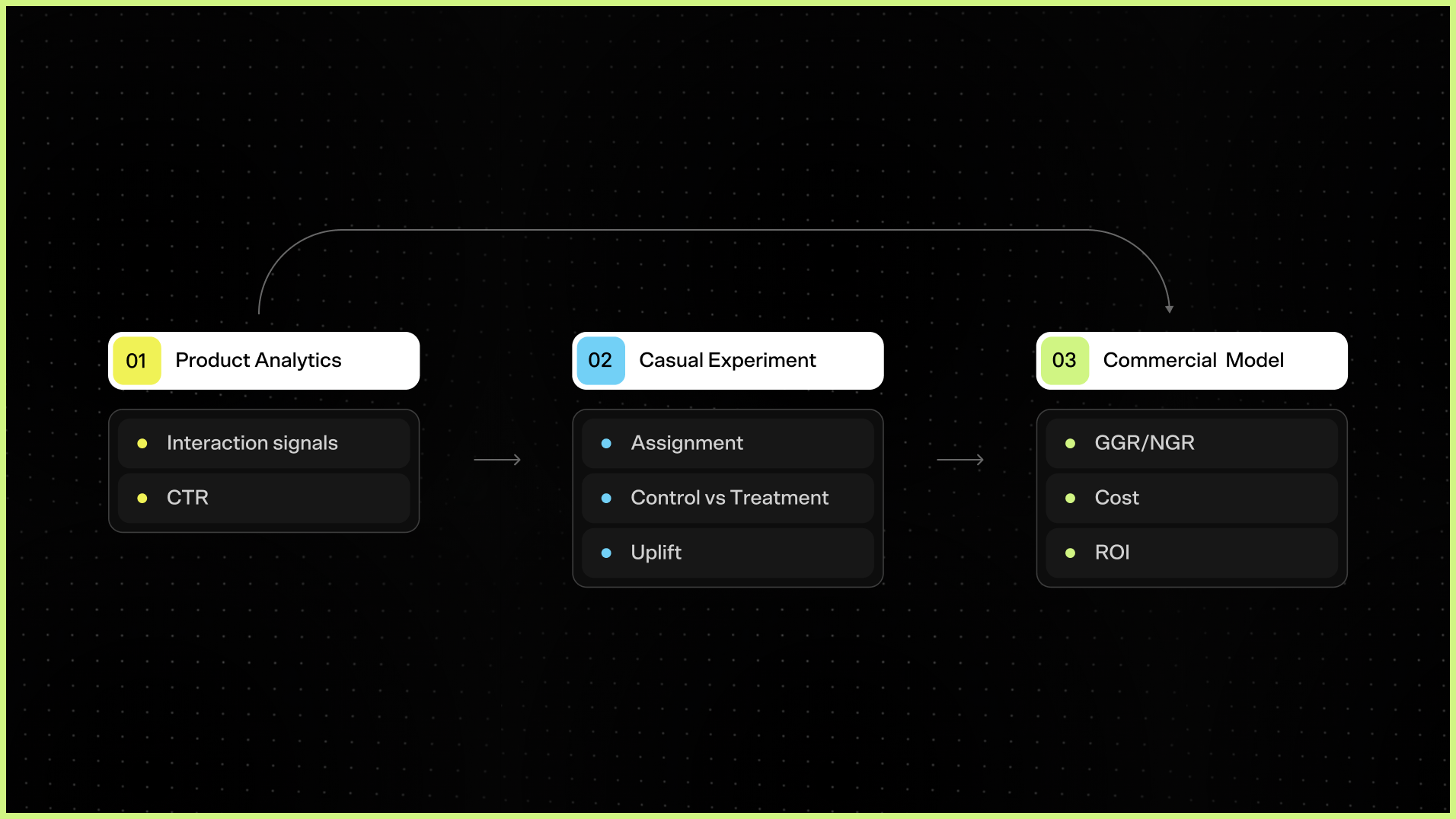
AI measurement becomes confusing when three different analytical questions are collapsed into one.
Product analytics asks how players used the experience. It measures recommendation impressions, click-through rate, quiz completion, prompt dismissals, game launches, support interactions and other behavioural diagnostics. These metrics are valuable because they explain where the experience works or fails, but they do not establish causality.
Experimentation asks whether access to the Retention AI policy changed behaviour compared with what would have happened without it. That requires a credible control, stable assignment, a predefined analysis population and a fixed outcome window. The primary analysis should normally preserve the original randomized groups rather than filtering treatment players according to whether they later interacted.
Commercial modelling takes the incremental behavioural or financial effect and translates it into operator value. Depending on the use case, that may involve incremental conversions, wagers, GGR or an operator-defined NGR metric. Costs then need to be applied consistently to determine whether the incremental value justifies the treatment.
These layers should connect, but they should not substitute for one another. A product dashboard cannot prove causal ROI. A statistically significant conversion lift does not automatically prove positive NGR. A positive NGR estimate can also be misleading if bonus cost, support cost or important guardrails were omitted from the model.
Engagement metrics should not be removed from Retention AI reporting. They explain how the treatment produced its result and help teams diagnose why one policy performs differently from another. A low recommendation-open rate may indicate poor placement. Strong quiz completion combined with weak downstream conversion may suggest the experience is engaging but not helping players progress. High dismissals may reveal intervention fatigue or poor timing.
The mistake is promoting these diagnostic metrics into the primary business outcome. A treatment can produce more AI interactions without producing more valuable player behaviour. Conversely, a policy that uses AI selectively may generate fewer impressions while producing a stronger business result because the system intervenes only when it has enough evidence to help.
Experimentation platforms commonly distinguish between primary metrics, secondary metrics and monitoring or guardrail metrics. The primary metric determines whether the hypothesis succeeds, while secondary measures help explain what happened and monitoring metrics help detect unwanted effects.
For Retention AI, this hierarchy prevents teams from declaring success because an interface attracted attention. The ship decision should be tied to a business outcome that exists downstream from the interaction.
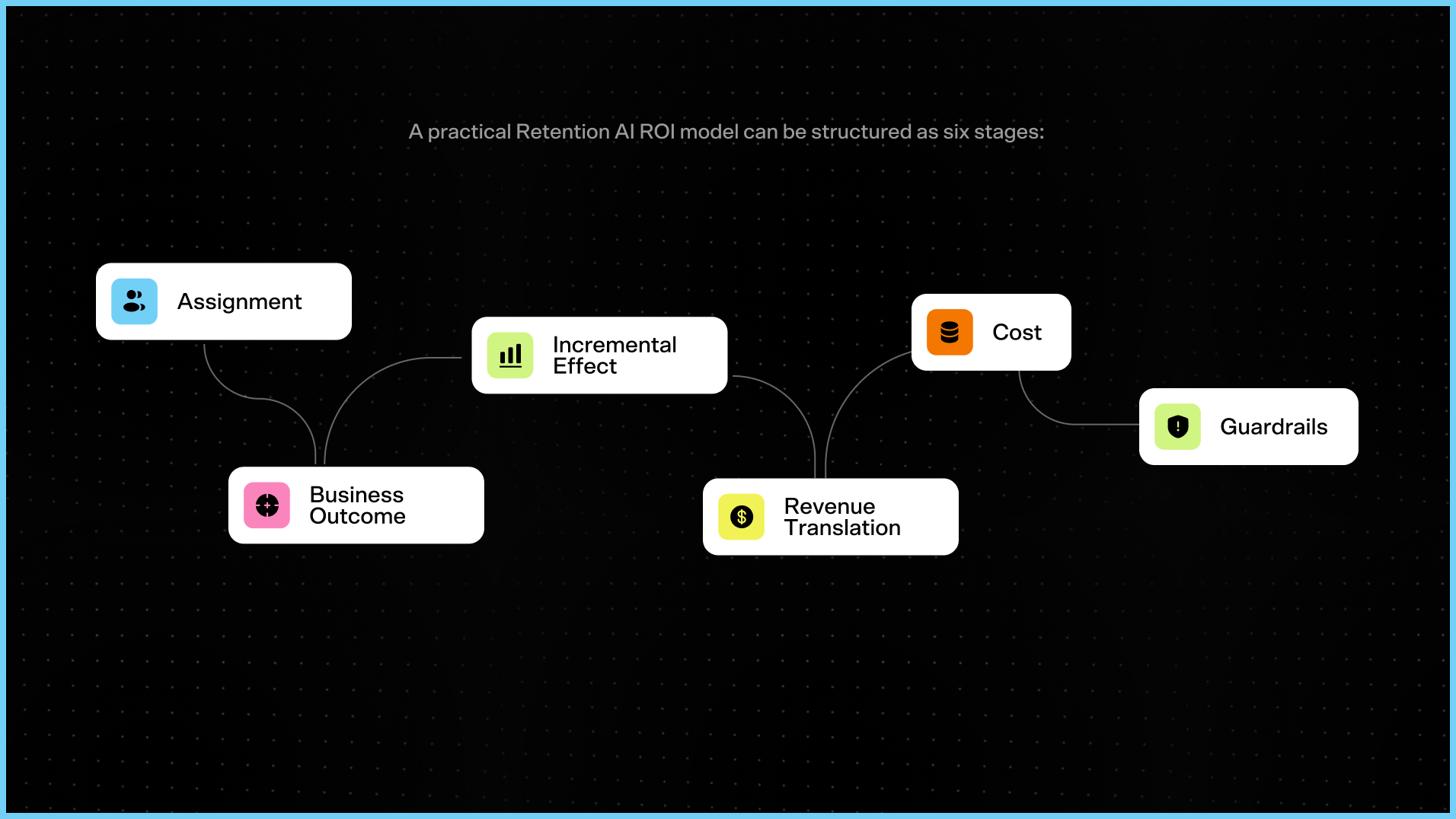
A practical Retention AI ROI model can be structured as six stages:
Assignment → Business Outcome → Incremental Effect → Revenue Translation → Cost → Guardrails
The first stage determines which players are included in the experiment and which experience they are assigned to receive. Assignment should happen at the player-account level and remain stable across the relevant test period so the same person does not move between control and treatment whenever a new session starts.
The analysis population also needs to be frozen before treatment. If the use case is post-deposit game discovery, the denominator might be all eligible assigned players who complete the qualifying deposit trigger. It should not later change to “players who opened the recommendation” because interaction itself is affected by treatment.
This is the foundation for intention-to-treat analysis. Every eligible assigned player remains in the group to which they were assigned, whether the AI shows a recommendation, chooses another action, deliberately selects no action or fails to generate an interaction because the player leaves quickly.
Slotsense’s A/B-testing framework recommends this approach specifically to avoid post-treatment selection bias.
The primary outcome should answer the operator’s actual ship question. It should be defined before the first eligible player enters the experiment and remain fixed for the primary analysis.
For a post-deposit discovery journey, the business outcome might be the percentage of eligible assigned players who place at least one real bet within 24 hours. For failed-deposit recovery, successful payment completion may be closer to the decision being tested. For an onboarding journey, completion of the blocked progression step may be more appropriate. For support-led recovery, actual issue resolution may be stronger than message interaction.
The outcome should stay close enough to the treatment that the experiment remains interpretable. Revenue metrics such as total stakes, GGR and NGR can then be evaluated as downstream business measures rather than forcing every pilot to use a noisy long-horizon revenue metric as its only success criterion.
The existing Slotsense experimentation guide uses the same hierarchy. It recommends one primary business metric while treating faster conversion, game starts, first-bet amount and total stake as secondary measures depending on the use case.
Once the outcome window closes, the operator compares the treatment population with control.
Suppose the control conversion rate is 8% and the treatment conversion rate is 10%. The absolute lift is 2 percentage points. The relative lift is 25%. These are different statements and should not be compressed into an ambiguous phrase such as “2% uplift.”
The estimated number of incremental conversions is:
Absolute conversion lift × eligible treatment players
That is the first commercially useful bridge from experiment statistics to value. It estimates how many additional outcomes occurred at the observed treatment scale relative to the control benchmark.
The same principle can be applied directly to financial metrics. If average GGR, GGY or operator-defined NGR per assigned treatment player exceeds the corresponding control metric, the difference can be scaled by the assigned population. The analysis should preserve the experimental denominator rather than reporting revenue only among players who interacted with AI.
A conversion is not automatically worth the same amount in every journey. Finance therefore needs to define how the incremental behavioural outcome maps into financial value.
For some mature experiments, the operator may measure revenue directly at the assigned-player level. Treatment GGR per eligible assigned player can be compared with control GGR per eligible assigned player over the predefined window. The same can be done with an agreed NGR field if that metric is consistently calculated across both groups.
For smaller or earlier pilots, direct revenue may be too variable to serve as the cleanest primary read. The commercial model can instead begin with incremental conversions and apply an agreed financial value per incremental outcome. That extrapolation should be clearly separated from the experiment estimate because it introduces additional assumptions.
Terminology also needs discipline. The UK Gambling Commission uses Gross Gambling Yield (GGY) rather than GGR for regulatory returns and defines GGY around stakes and other relevant accruals less prizes or winnings. The Commission explicitly instructs licensees not to substitute GGR for GGY in those regulatory returns.
An internal Retention AI ROI model should therefore use the operator’s own approved finance terminology rather than casually mixing regulatory GGY, internal GGR and NGR. There is no single universal NGR definition across operators, so the exact calculation should be frozen with Finance before the experiment starts and applied identically to control and treatment.
Incremental revenue is not yet ROI.
The treatment may carry bonus cost, promotional cost, third-party model or platform cost, implementation cost, additional support contacts, payment fees or other incremental operating costs. Which of these belong in the experiment-level ROI calculation depends on the operator’s accounting objective, but the boundary needs to be defined before the final number is presented.
The main risk is double-counting. If the operator’s internal NGR field already deducts certain bonus, tax or provider costs, those amounts should not be deducted again when calculating Retention AI ROI. If the business instead models from GGR, the commercial bridge needs to show which costs are applied before reaching the selected contribution or net value measure.
A simple ROI expression is:
(Incremental economic value − incremental treatment cost) ÷ incremental treatment cost
But the formula is less important than consistent definitions. Teams should be able to show what is inside “economic value,” which costs are incremental to the AI treatment and which costs already exist in the operator’s normal journey.
A positive commercial estimate should not automatically trigger rollout.
Retention AI operates inside a regulated player journey. A treatment can improve conversion while also increasing support contacts, repeated interruptions, suppression errors or player-protection concerns. Those outcomes need to be visible alongside the primary business result rather than reviewed after scaling.
Depending on the use case, guardrails may include support contact rate, repeated prompt rate, wrong-route escalations, technical delivery failures, marketing suppression compliance, frequency-cap compliance, complaints and relevant player-protection indicators.
The final business question is therefore not simply whether treatment generated more revenue. It is whether the incremental value remained positive inside the operating constraints the operator set before launch.
Experiment: A post-deposit AI recommendation layer is compared with the standard lobby experience.
Product result: Treatment players open the recommendation experience far more often than expected, and players who interact with it show a high conversion rate to gameplay.
Primary experiment result: The intention-to-treat conversion to the predefined real-bet outcome is effectively unchanged versus control.
Commercial interpretation: Incremental GGR or NGR has not been demonstrated simply because engaged treatment users look valuable. Those users selected themselves into the interaction after assignment and are likely to contain a disproportionate share of high-intent players.
Decision: Do not model ROI from recommendation CTR or engaged-user revenue. Diagnose why the treatment attracted interaction without creating overall business lift, then decide whether placement, targeting, action selection or the experience itself should change.
This is the core engagement trap. Product usage can be strong while incremental business value remains close to zero.
Experiment: Eligible failed-deposit sessions are assigned either to the standard cashier experience or to an AI-assisted recovery policy that can explain the state, surface an eligible next step or route the player to support.
Primary outcome: Successful deposit recovery inside a predefined window.
Secondary outcomes: Time to recovery, repeat payment attempts, support contact and downstream game activity.
Commercial interpretation: The first causal estimate should measure the incremental deposit recoveries created by treatment. Finance can then evaluate downstream GGR or NGR from the assigned groups over an agreed horizon rather than attributing all later revenue from recovered players to AI.
Decision: Scale only if the recovery improvement survives the control comparison and the downstream commercial value remains positive after relevant costs and guardrails.
The measurement follows the actual friction. It does not force a game-recommendation metric onto a payment problem.
Experiment: A retention decision policy is allowed to choose between contextual guidance, recommendation, an eligible promotional action and wait.
Primary outcome: Conversion to the next predefined valuable action improves relative to control.
Diagnostic result: The treatment selects the promotional candidate much more frequently than expected.
Commercial result: Incremental GGR is positive, but the additional promotional cost materially narrows the contribution after the operator applies its approved NGR or contribution definition.
Guardrail result: Support contacts also rise because some players need clarification about the treatment.
Decision: The policy should not be judged from conversion lift alone. Teams should inspect whether the action-selection logic is overusing the expensive candidate and test whether recommendation, guidance or wait can preserve more of the behavioural uplift at lower cost.
This is why the AI policy itself needs measurement. Retention ROI depends not only on whether treatment works, but also on which actions create the effect.
Experiment: One treatment policy aggressively fills most eligible player moments. A second policy uses a higher confidence threshold and selects no action more often.
Product result: The aggressive policy generates more impressions, clicks and measurable interactions.
Business result: The selective policy produces a similar primary business outcome.
Cost and experience result: The selective policy creates fewer interventions, lower delivery volume and fewer dismissals.
Commercial interpretation: A policy does not need more visible AI activity to create more value. If the business outcome is maintained while incremental treatment cost and experience friction fall, the more selective decision policy may have the stronger economic profile.
Decision: Treat no action as part of the optimisation problem rather than assuming that unfilled player moments represent lost revenue.
The economics of Retention AI are usually discussed as if value can only come from interventions. That creates a structural bias toward showing more recommendations, sending more messages and using more promotional actions because visible interventions produce easy-to-count events.
A mature decision system should compare intervention with restraint. If a player is already progressing naturally, the incremental value of another prompt may be near zero while the treatment still carries delivery cost, interruption cost and potential fatigue. If confidence is low, waiting can preserve the existing experience while the system collects more evidence. If another support or player-protection objective has priority, suppression can be economically and operationally preferable to a commercial action.
Next Best Action frameworks already treat wait as a legitimate decision when the player is progressing naturally, model confidence is weak, recent prompts were ignored, frequency limits apply or no eligible action justifies interruption.
For ROI measurement, no action should therefore be logged with a reason code and remain inside the treatment policy. It should not be excluded from the analysis as if the AI “did nothing.” The policy made a decision, and intention-to-treat measures the value of having access to that complete policy—including restraint.
The market offers experimentation platforms, CRM analytics, product analytics, decisioning systems, CDPs and internal data warehouses. Operators should separate the category labels and examine which parts of the ROI chain each system can actually support.
The most important capability is not a dashboard labelled “AI ROI.” It is a traceable path from eligible assignment to outcome, financial value and guardrails.
Experimentation systems increasingly separate primary outcomes from supporting and monitoring metrics because product engagement alone is rarely enough to make a rollout decision. The primary metric is used to judge the hypothesis, while secondary measures and monitoring goals explain broader behaviour and potential negative effects.
The same shift is necessary for player-facing AI. AI creates many intermediate events because the system can recommend, ask, guide, suppress, explain and wait. A conventional feature dashboard can measure all of them. But the more adaptive the system becomes, the more important it is to keep the experiment anchored to a stable population and predefined business objective.
This changes the operator’s measurement question from “Did players use the AI?” to “Did access to the AI decision policy create additional valuable outcomes relative to the standard journey?”
Once that causal layer is credible, Finance can ask the next question: “What were those incremental outcomes worth after revenue, cost and guardrails were considered?”
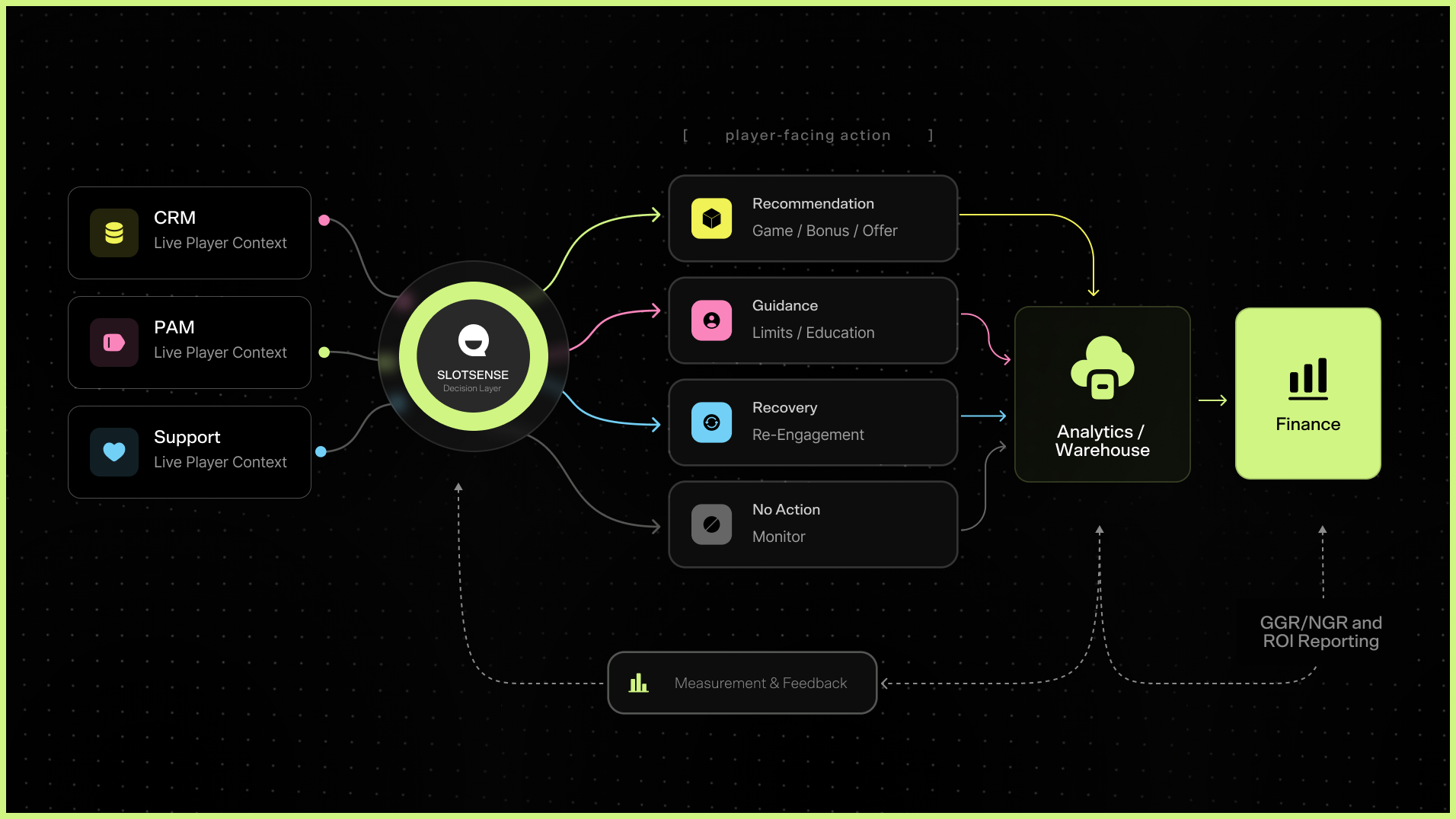
Slotsense is not intended to replace the operator’s CRM, PAM, analytics warehouse or finance reporting. Those systems can continue to own lifecycle data, player state, campaign records and authoritative financial metrics.
The player-facing layer has a different role. It can consume live player and product signals, make a bounded decision among eligible actions, execute that decision inside the active session and record the events needed to explain what happened. The useful measurement output is not only an impression or click. It includes assignment, eligibility, selected action, reason code, intentional no action, interaction and downstream outcome.
Slotsense describes Retention AI as acting on real-time player signals across onboarding, engagement, recovery and retention while working with the existing product, CRM, support and data stack.
The finance system should remain authoritative for GGR, GGY, NGR or contribution metrics. Slotsense should provide the experiment and decision context required to connect those financial outcomes back to the treatment policy.
A Retention AI system should not optimise NGR as if every additional unit of short-term player value were equally desirable. Commercial objectives operate inside player-protection, consent, account and jurisdiction constraints. Those controls need to determine which actions are eligible before the model optimises expected value.
The UK Gambling Commission provides one concrete regulatory example. Its remote customer-interaction requirements require operators to embed an ongoing identify, act and evaluate process, take timely action when risk is identified, prevent marketing and new bonus take-up where strong indicators of harm are present, understand the impact of interactions on player behaviour and evaluate the effectiveness of the overall approach.
For Retention AI ROI, this implies that guardrails cannot be converted into optional costs and traded away against short-term revenue uplift. A policy that creates higher NGR while violating suppression rules or worsening protected outcomes is not a commercially successful treatment inside the operator’s permitted decision environment.
The measurement system should therefore preserve a precedence model. Player-protection and mandatory account controls define what the policy is allowed to do. The experiment then estimates value inside those constraints.
Great Britain is one concrete regulatory example, not a universal standard. Other markets have their own requirements and require local operator-side validation.
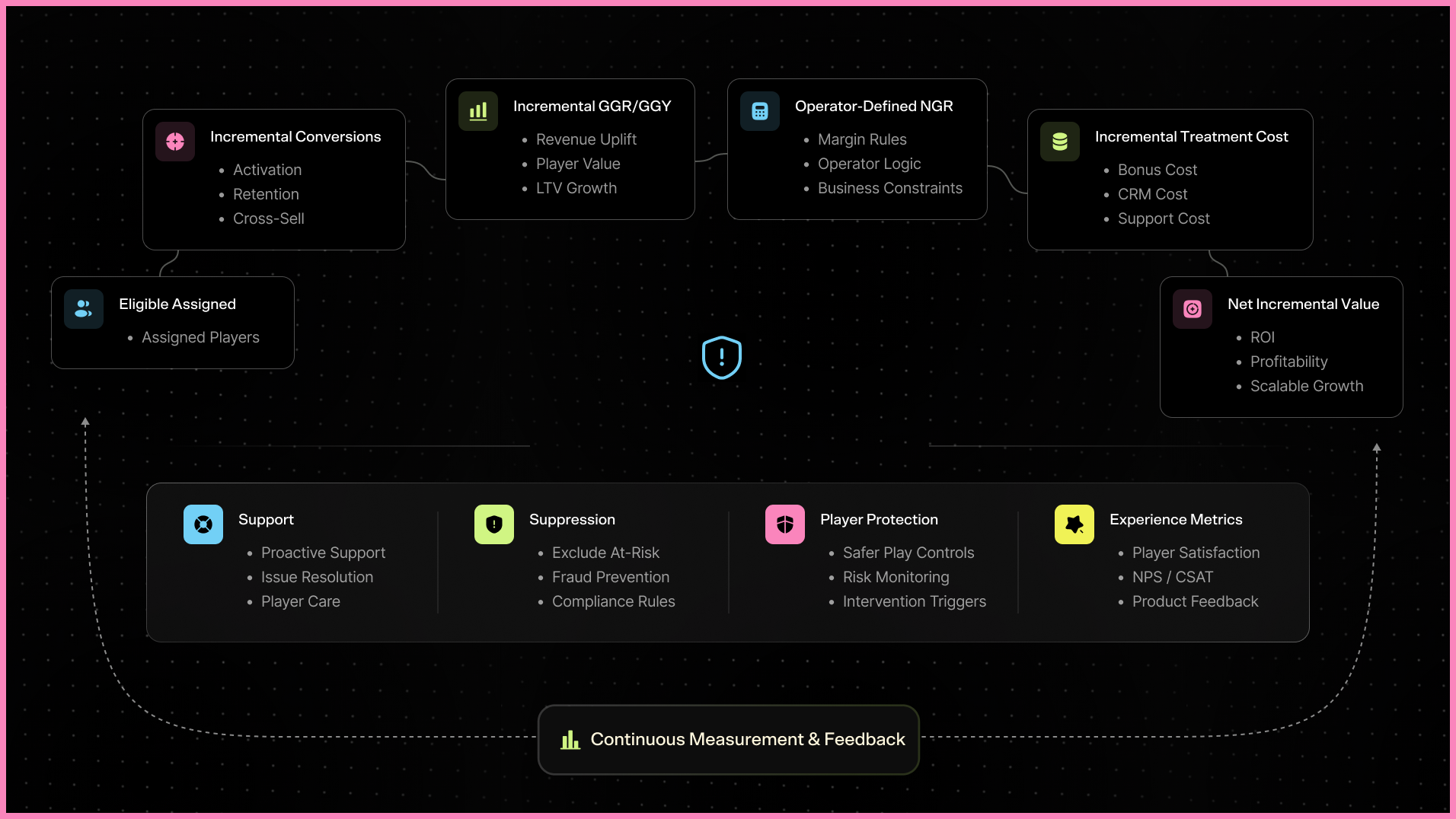
The cleanest commercial model starts with the randomized population.
First calculate the primary treatment and control rates. The difference gives absolute lift. Multiply that absolute lift by the number of eligible assigned treatment players to estimate the incremental business outcomes created at the observed scale.
Incremental outcomes = absolute lift × eligible treatment population
If the experiment is sufficiently powered for direct financial measurement, the operator can compare financial value per assigned player between treatment and control.
Incremental financial value per assigned player = treatment value per assigned player − control value per assigned player
That difference can then be scaled by the relevant treatment population.
For GGR or GGY measurement, the outcome window needs to be fixed before analysis. The team should not keep extending the revenue window until treatment happens to look favourable. A short window may miss later value, while a very long window introduces more behaviour that is increasingly distant from the original intervention. The appropriate horizon depends on the journey and should be agreed in advance.
NGR requires even more definitional discipline because the exact deductions used by operators can differ. The experiment should therefore rely on one internal finance field or explicitly documented formula that is applied identically to treatment and control. If bonus cost or another treatment expense is already deducted inside that NGR field, it should not be deducted again when the final ROI calculation is produced.
A final ROI model can then express:
ROI = (incremental economic value − incremental treatment cost) ÷ incremental treatment cost
The number should always be accompanied by the assumptions that produced it. Teams should distinguish observed experimental effects from modeled lifetime extrapolation, distinguish GGR/GGY from NGR, and show whether promotion or operating costs have already been deducted.
The strongest ROI report is not the one with the largest percentage. It is the one where another Product, Data or Finance team can reproduce the number from assignment through to the final financial field.
Retention AI ROI should be measured as a causal commercial problem, not as a feature-engagement problem. Engagement tells teams whether players interacted with the experience. Experimentation determines whether access to the decision policy changed behaviour. Finance then translates that incremental effect into an agreed GGR, GGY, NGR or contribution measure and applies the relevant incremental cost.
Operators therefore need to separate four questions:
The second question is the bridge between product analytics and ROI. Without it, revenue generated by treatment players can easily be mistaken for revenue generated by AI.
CRM, PAM, product analytics and Finance remain essential systems of record. The player-facing AI layer provides the live decisions, action reason codes and outcome events that allow those systems to evaluate whether a different player experience created incremental value.
Measure one Retention AI workflow from assignment to incremental value with us →
Retention AI ROI is the incremental economic value created by a Retention AI policy compared with the standard player experience, after accounting for the relevant incremental treatment costs. It should be based on a credible control rather than revenue generated only by players who interacted with AI.
Engagement measures how players interact with a feature. Players with stronger existing intent are often more likely both to engage with the AI experience and to complete valuable actions, so engaged-user performance cannot show what would have happened without AI. A controlled experiment is needed to estimate incrementality.
The primary metric should match the player moment being changed. For a post-deposit discovery journey, conversion to a real bet within a predefined window can be appropriate. For failed-deposit recovery, successful payment recovery may be more direct. The metric, denominator and window should be fixed before launch.
Not necessarily. Revenue metrics are important commercial outcomes, but a more proximal business conversion can provide a clearer experimental read for many pilots. GGR, GGY or operator-defined NGR can then be evaluated as downstream financial metrics and used to construct the commercial case.
Terminology should follow the operator’s approved finance definitions. The UK Gambling Commission specifically requires GGY rather than GGR for its regulatory returns. NGR does not have one universal definition across operators, so operators should freeze their internal NGR calculation before the experiment and apply it consistently to control and treatment.
The experiment should compare the agreed financial metric across the original assigned treatment and control populations over a predefined outcome window. The difference represents the incremental financial effect attributable to treatment under the experiment, subject to statistical uncertainty and the chosen financial definition.
That depends on the operator’s accounting objective. Relevant incremental costs may include bonus or promotion cost, treatment delivery cost, platform usage or additional service cost. Teams should document the boundary and avoid deducting costs twice when they are already included in an NGR or contribution metric.
Yes. A selective policy may preserve the same business outcome while reducing interventions, expensive treatments or experience friction. No action should remain a logged policy decision and stay inside the intention-to-treat analysis rather than being treated as a delivery failure.
Slotsense can provide the player-facing assignment, decision, reason, action and outcome context needed to evaluate a Retention AI policy. CRM, PAM, analytics and Finance can remain the authoritative systems for lifecycle, player and financial data, with those outcomes joined back to the experiment.
Content: