AI Support for iGaming: What Operators Need Beyond a Generic Chatbot
Generic chatbots are not enough for iGaming support. Learn how AI support for iGaming can reduce repetitive tickets, understand screenshots and voice, impr
15 min
·
June 17, 2026
Generic chatbots are not enough for iGaming support. Learn how AI support for iGaming can reduce repetitive tickets, understand screenshots and voice, impr

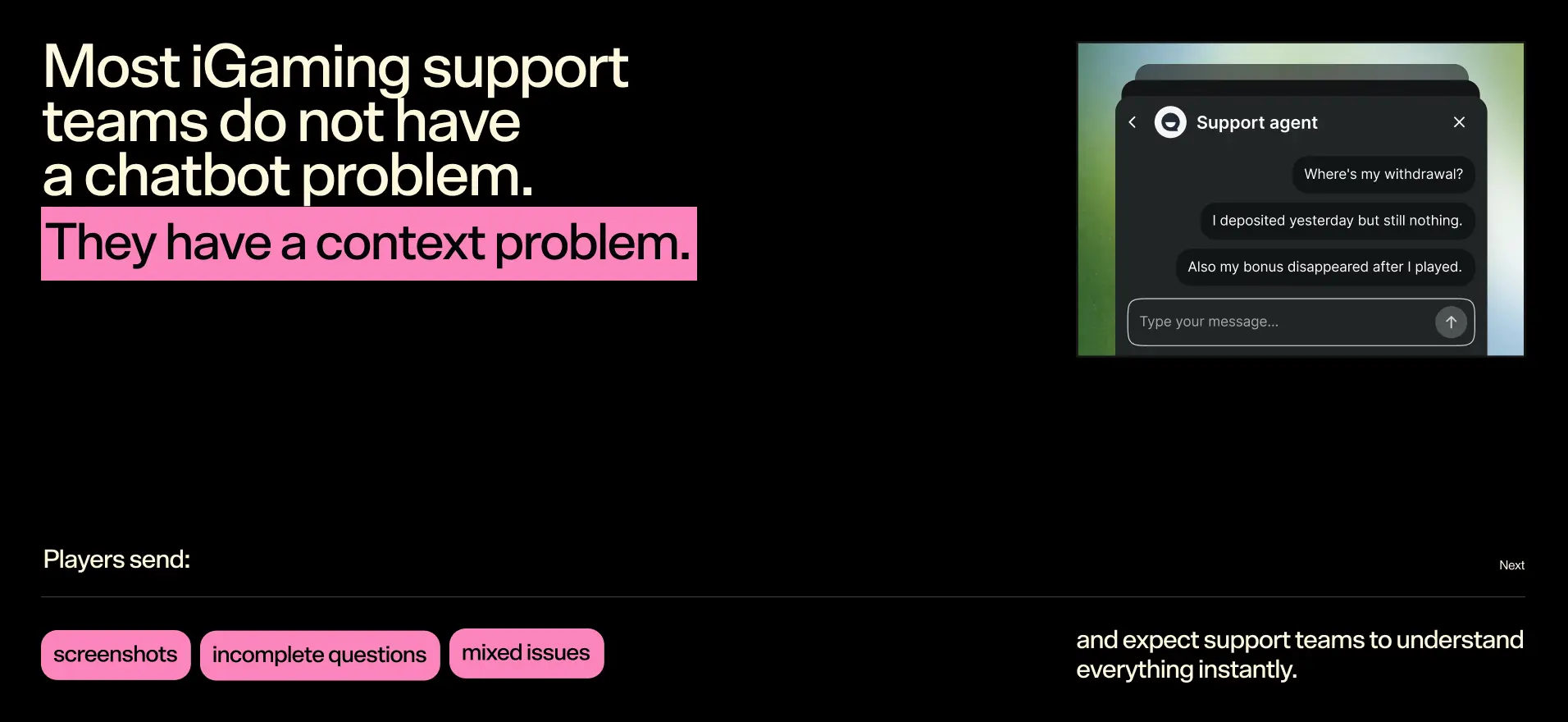
Most iGaming support teams do not have a chatbot problem.
They have a context problem.
Players ask about withdrawals without giving enough detail. They send screenshots instead of explaining what happened. They mix bonus, payment, KYC, and account questions in one message. They use voice notes when typing feels too slow. And when the bot fails, the human agent still has to start from zero.
That is the gap AI support for iGaming needs to solve.
The best AI support layer should not just answer common questions. It should understand player intent, collect missing context, route complex cases correctly, and help support teams reduce repetitive work without damaging the player experience.
Because in iGaming, support is rarely clean.
A player might ask, “Where is my money?” — but behind that question could be a pending withdrawal, a failed deposit, a bonus restriction, a payment provider delay, an incomplete KYC check, or an account-level issue. A generic chatbot will usually treat that as a FAQ query. A strong AI support agent should treat it as the beginning of a support journey.
And that is the difference operators need to understand.
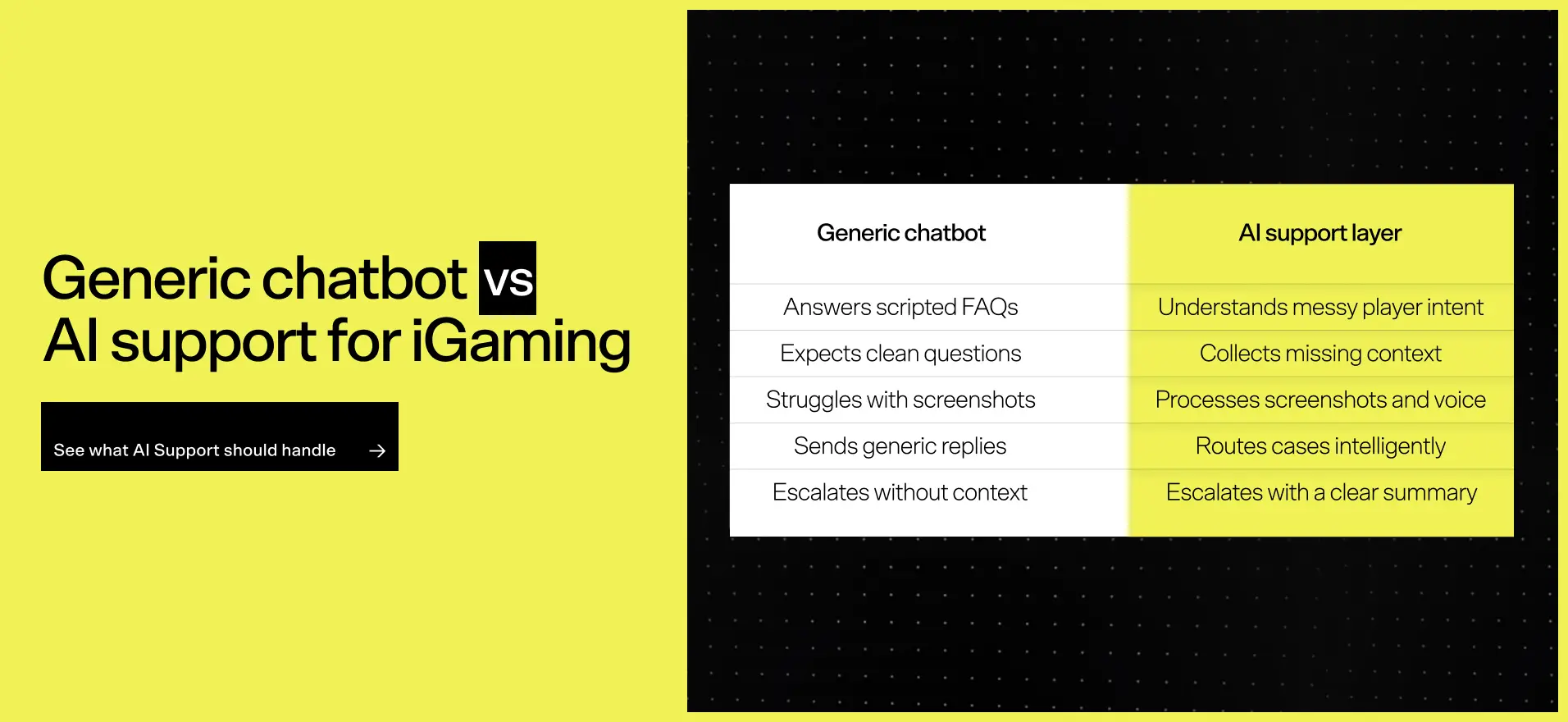
A generic chatbot can answer simple questions.
“How do I reset my password?”
“Where can I find the bonus terms?”
“How do I contact support?”
That has value, but it is not enough for iGaming support operations.
The reality is that players do not always ask neat, searchable questions. They often arrive frustrated, unclear, emotional, or in a rush. They may not know whether their issue belongs to payments, bonuses, verification, technical support, or account management.
And sometimes, they do not explain the issue at all. They send a screenshot and expect the support team to understand what went wrong.
That is where generic chatbot logic breaks down.
Most scripted bots are built around predictable paths. They expect the player to choose a category, follow a flow, and ask something close to a help-centre article. But iGaming support rarely stays that clean.
A player might ask why a withdrawal is delayed, attach a screenshot of their transaction page, mention that they used a bonus, and expect the operator to understand the full context immediately.
A generic bot may respond with a generic withdrawal FAQ.
The player gets frustrated.
The issue escalates.
The agent receives a messy conversation with no useful summary.
And the support team has not saved time. They have simply delayed the real work.
That is the uncomfortable truth about bad automation: it does not reduce workload. It moves the workload further down the queue, often with more frustration attached.
For iGaming operators, especially multi-brand and multi-market teams, that is a serious problem. Support volume is already high. Payment questions are repetitive. Bonus terms create confusion. KYC steps generate friction. Localised behaviours vary by market. And agents are expected to move quickly while staying accurate, compliant, and sensitive to player risk.
A chatbot that only answers basic FAQs will not be enough.
Operators need AI support that can deal with messy player reality.
The phrase “AI chatbot for iGaming” is often too narrow.
What operators really need is not just another bot widget on the site. They need an intelligent support layer that sits before the human team, understands what is happening, and helps move each case in the right direction.
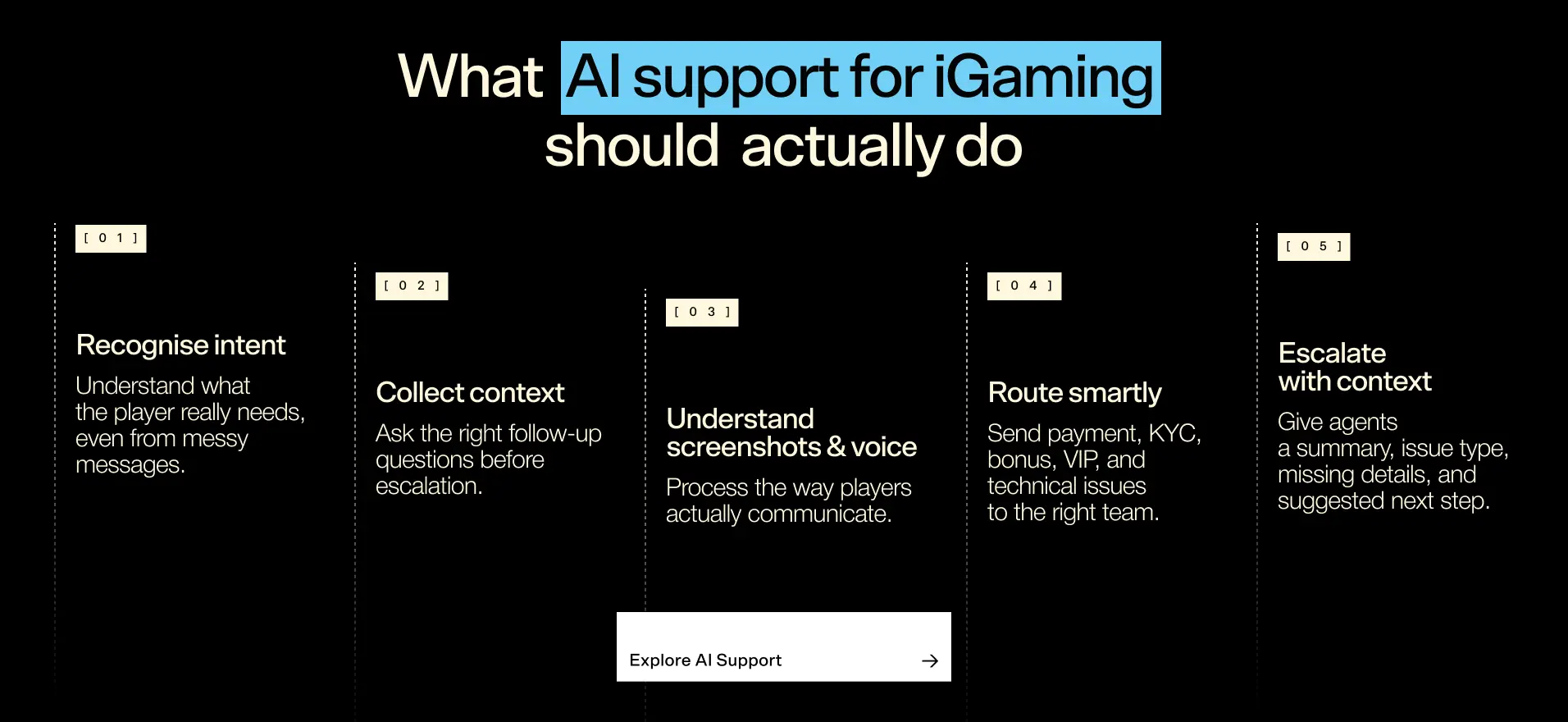
That layer should do five things well.
The first job of AI support is to understand what the player is actually asking.
That sounds obvious, but in iGaming it is more complex than it looks.
A message like “my bonus disappeared” could mean:
The player did not meet the terms.
The bonus expired.
The player placed a restricted bet.
The bonus was cancelled after withdrawal.
The promotion was not available in their GEO.
The player misunderstood wagering requirements.
Or the account has a specific status that affects eligibility.
A generic chatbot may look for the keyword “bonus” and send a help article. A stronger AI support agent should recognise the likely intent, identify what information is missing, and decide whether this can be answered automatically or needs escalation.
Intent recognition is not just about classifying tickets. It is about understanding what the player is trying to resolve.
Support agents lose a lot of time asking basic follow-up questions.
Which payment method did you use?
When did you request the withdrawal?
Did you receive an error message?
Can you share a screenshot?
Have you completed verification?
Which promotion are you referring to?
These questions are necessary, but they are repetitive. They also slow down resolution when the agent only receives the case after several unclear messages.
AI support can improve this by collecting missing context before escalation.
Instead of forwarding a vague message like “withdrawal not working,” the AI layer can ask targeted follow-up questions and package the case properly for the agent.
That alone can make a meaningful difference.
Because the goal is not always to fully resolve the issue automatically. Sometimes the best outcome is making sure that, when the case reaches a human, it is already clear, structured, and ready to act on.
Many players do not describe the problem clearly.
They send screenshots.
They send short voice messages.
They upload an error screen, a payment confirmation, a promotion page, or a game-loading issue and expect support to interpret it.
This is one of the biggest reasons generic chatbots feel weak in iGaming. They are built for typed questions, but real player support is increasingly multimodal.
AI support for iGaming should be able to understand image inputs and voice recognition, not just text.
If a player sends a screenshot of a failed deposit, the AI support layer should be able to recognise that the issue is payment-related, extract useful context where possible, suggest the right help content, or route the issue to the correct team.
If a player sends a voice note explaining that their account verification failed, the AI should be able to process that input, understand the intent, and continue the support journey.
This matters because the player experience should not depend on the player explaining everything perfectly.
Support should adapt to how players actually communicate.
Not every case should go to the same team.
Payments, KYC, bonuses, VIP, technical issues, responsible gaming, account security, and product questions all require different handling.
A weak bot either tries to answer everything itself or dumps too many cases into one general support queue.
That creates delays and messy handoffs.
Smart routing means the AI support layer can recognise the type of issue, apply escalation logic, and send the case to the right place.
For example:
A payment method question may go to payment support.
A verification issue may go to KYC.
A bonus eligibility question may go to the promotions or support team.
A VIP issue may require priority handling.
A responsible gaming concern should be escalated carefully and not treated like a normal FAQ.
The important point is this: AI should not blindly automate every issue.
It should know when to answer, when to collect context, and when to escalate.
That judgement is especially important in iGaming, where some cases are sensitive by nature.
Escalation is not failure.
In iGaming support, escalation is part of a healthy support system.
The problem is when escalation happens badly.
If the human agent receives only a long, messy chat transcript, they still have to read everything, understand what the player wants, ask for missing details, and decide what to do next.
That is not efficient. It also creates a poor player experience, because the player feels like they are repeating themselves.
A strong AI support layer should pass useful context to the human agent.
That can include:
Player intent.
Issue category.
Conversation summary.
Collected details.
Missing information.
Suggested next step.
Relevant help article or macro.
Escalation reason.
This is the direction Slotsense takes with AI Support: not just answering questions, but making the whole support path cleaner before the case reaches a human.
The goal is not to replace agents.
The goal is to make agents faster, better informed, and less buried in repetitive work.
AI support should not be used as a blanket replacement for every support interaction.
That is the wrong way to think about automation in iGaming.
The better goal is to automate what is repetitive, collect better context for what is unclear, and escalate what is sensitive or complex.
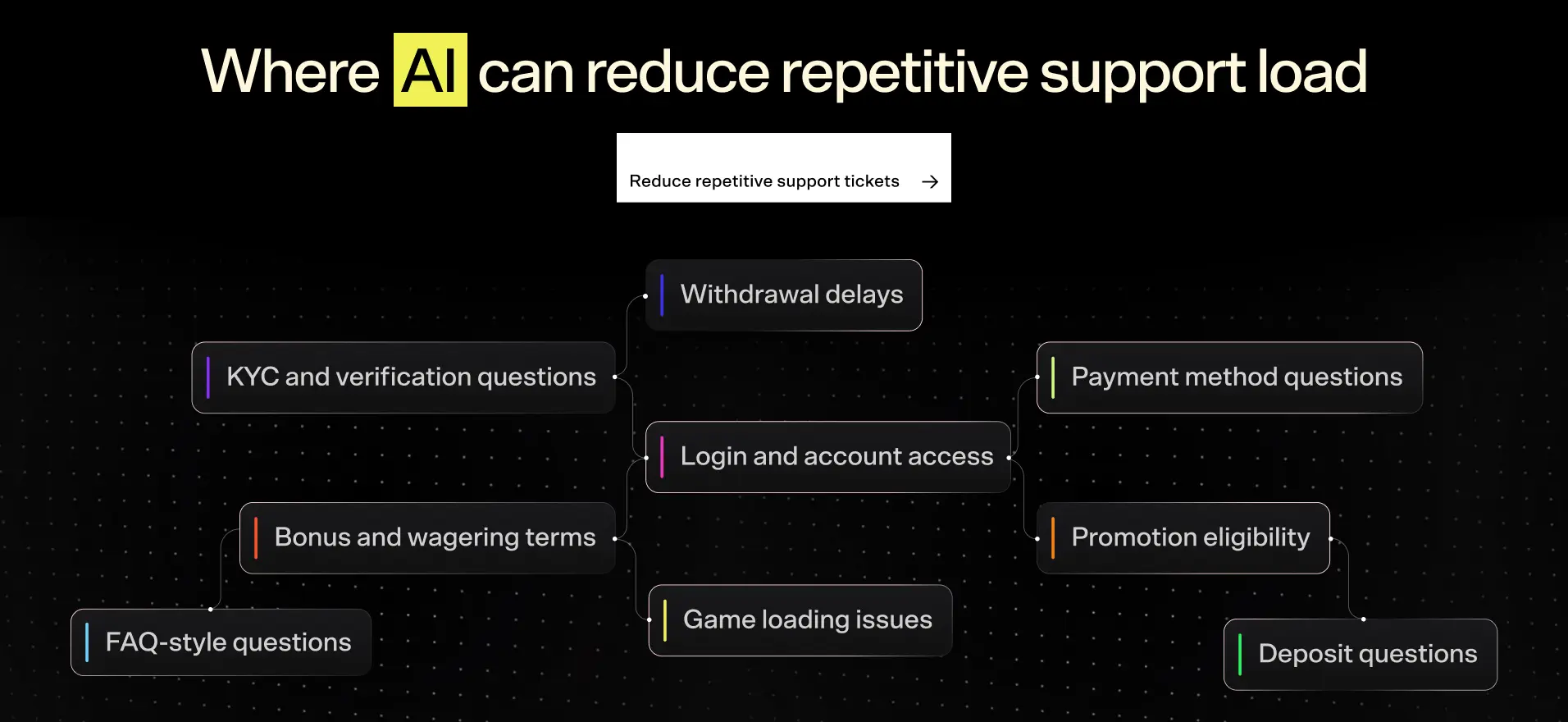
There are many support areas where AI can help reduce manual load.
Deposit questions are one of the most obvious examples. Players often ask whether a deposit went through, why a payment failed, which payment methods are available, or how long a transaction should take.
Withdrawal questions are another major area. “Where is my money?” may be one of the most common support themes in online casino and sportsbook operations. Sometimes the answer is simple. Sometimes it depends on verification, payment method, processing time, internal checks, or account status.
Bonus terms and wagering clarification also create heavy support volume. Players may not understand wagering requirements, restricted games, expiry dates, maximum bet limits, or why a bonus was not applied.
Account verification and KYC questions are another repetitive but sensitive category. AI can help explain the process, collect missing context, and guide players to the right next step. But if the case involves risk, rejection, document issues, or compliance-sensitive decisions, it should be escalated properly.
Login and account access issues can often be supported with guided flows, especially when the issue is password reset, email verification, or basic account recovery.
Payment method questions are also well suited to AI support, especially when players need general information about available methods, timing, or requirements.
Promotion eligibility questions are another strong use case. Players often ask why they did not receive an offer or whether they qualify for a campaign. Depending on the operator’s rules and integrations, AI can either answer based on help content or route the case for review.
Game access or loading issues can often be triaged by AI. The assistant can ask about device, browser, connection, game title, error message, and screenshot before escalating to technical support.
Basic responsible gaming guidance can also be supported carefully, but this area should never be treated as simple automation. AI may guide players to the right resources or collect context, but sensitive cases need clear escalation rules and human oversight.
FAQ-style support questions are the easiest category: account setup, where to find terms, how to contact support, how to upload documents, how to claim a promotion, or where to find transaction history.
The common pattern is clear.
AI support is strongest when it handles repetitive questions, improves context collection, and supports cleaner escalation.
It should not pretend that every case can or should be solved automatically.
Operators often use the words “chatbot,” “AI assistant,” “AI support agent,” and “copilot” interchangeably.
But they are not the same thing.
And the difference matters when you are deciding what to implement.
A chatbot is usually best for simple, scripted FAQ flows.
It can answer common questions, guide users through basic menus, and reduce some repetitive enquiries.
But it is weak when player context is messy.
If the player asks one clear question, the chatbot may work well. If the player sends an unclear message, a screenshot, or a combined issue involving bonus, payment, and verification, the chatbot often struggles.
That is why many operators end up with bots that look good in demos but disappoint in real support environments.
An AI copilot usually helps the human agent.
It might draft replies, summarise conversations, search the knowledge base, or suggest macros.
This is useful, especially for busy support teams. It can make agents faster and reduce manual writing.
But it is still agent-dependent.
The player usually reaches the human support workflow first, and the AI helps behind the scenes.
That means the copilot improves agent productivity, but it may not reduce the number of repetitive conversations entering the support queue.
An AI support agent is more active.
It can interact with players directly, understand intent, collect missing context, suggest help content, route issues, and escalate when needed.
This is where player support automation becomes more valuable.
Instead of only helping agents after the case arrives, the AI support agent improves the support path before escalation.
It can answer simple questions, triage unclear ones, and prepare complex cases for humans.
Human agents are still essential.
They are needed for complex, sensitive, VIP, compliance-related, emotional, or high-risk cases.
They are also needed where judgement, empathy, discretion, or operator-specific decision-making matters.
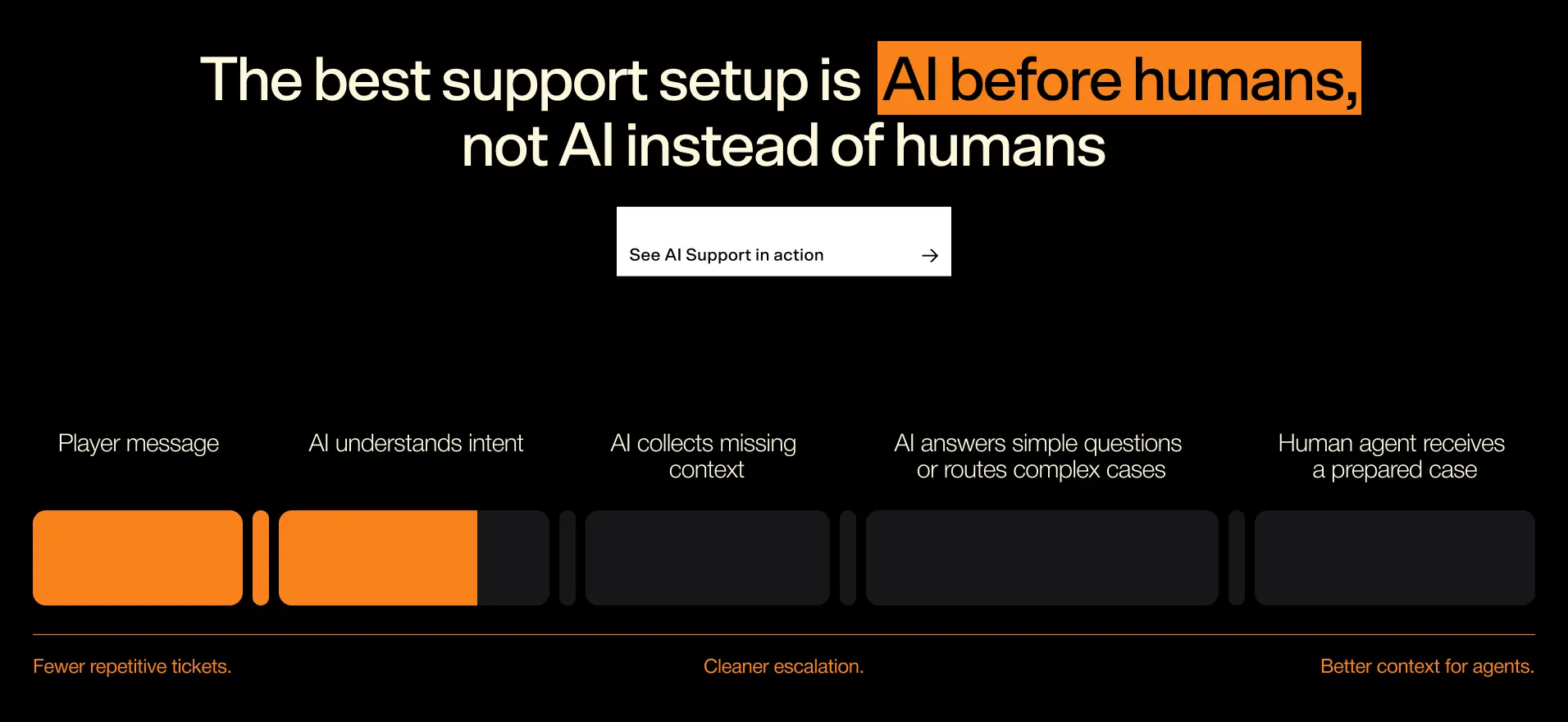
The best support setup is not AI instead of humans.
It is AI before humans.
AI helps agents receive fewer repetitive cases and better context when escalation is needed.
That is the model operators should aim for.
AI support should be judged by operational value, not by how impressive the demo sounds.
For iGaming operators, there are four practical areas where AI support can create value.
Every support team has a set of questions that appear again and again.
Payment timing.
Bonus terms.
Verification steps.
Login issues.
Promotion eligibility.
Basic account questions.
Agents can answer these questions, of course. But when they answer the same thing hundreds or thousands of times, their time is not being used well.
AI support helps reduce that load.
It can handle common questions, suggest relevant help content, and guide players through basic steps before a human is involved.
That does not remove the need for agents. It protects their time.
And in support operations, protected agent time is valuable.
Players do not always need a full agent conversation.
Sometimes they need fast direction.
They want to know where to upload documents, why their withdrawal may still be pending, what a wagering requirement means, or what information they need to provide.
AI support can give immediate guidance instead of making the player wait in a queue.
This is especially useful during high-volume periods: campaign launches, match days, payment delays, new market activity, or seasonal spikes.
The faster the player receives useful direction, the less pressure there is on the support team.
Some cases will always need a human.
The question is whether they reach the human cleanly or chaotically.
AI support can improve escalation by collecting the right details first and summarising the issue before handoff.
That means the agent does not have to start from zero.
They can see what the player wants, what has already been asked, what information is available, and what the likely next step should be.
This reduces repeated questions and makes the player feel understood.
That is important because poor escalation is one of the fastest ways to damage player trust.
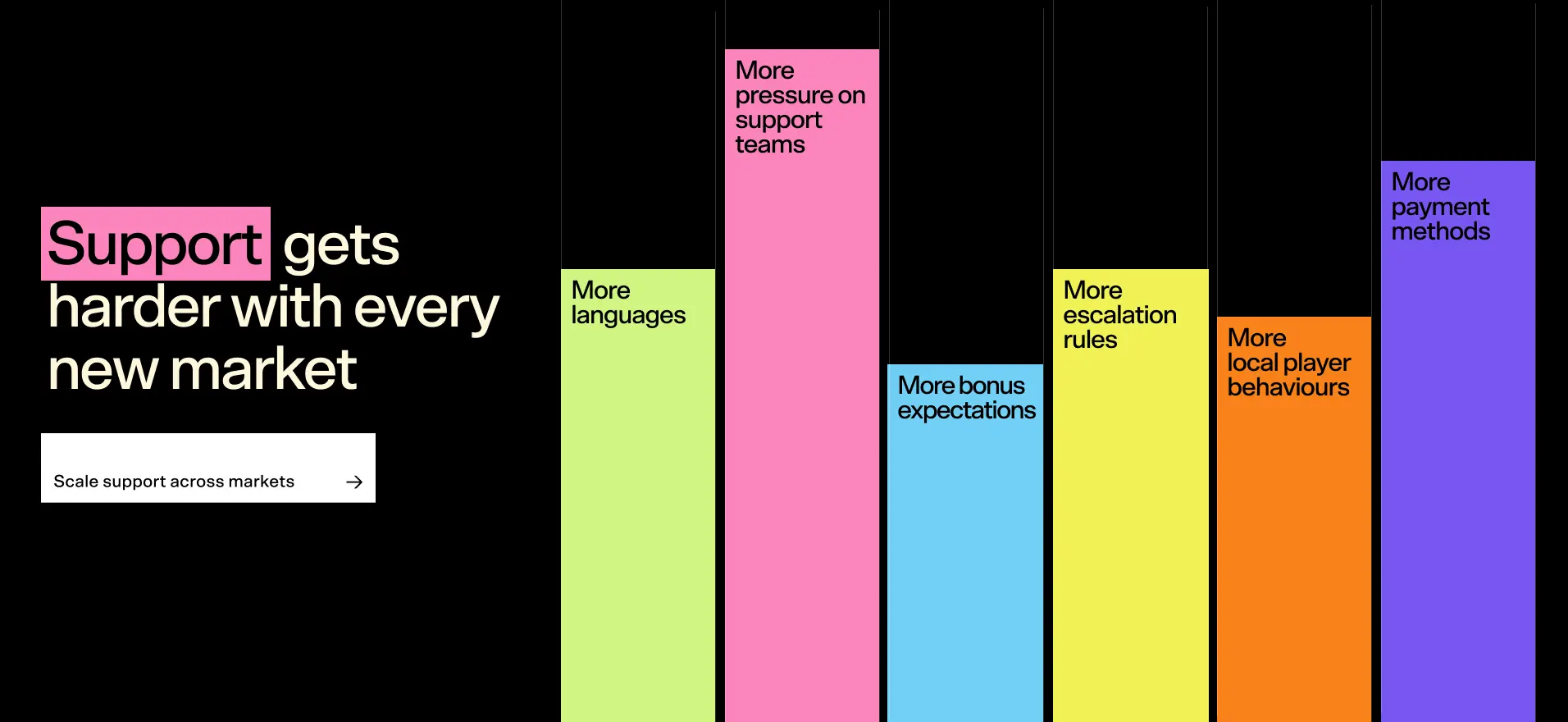
For operators working across multiple markets, support complexity does not grow in a straight line.
Every new GEO brings different payment methods, bonus expectations, languages, player behaviours, localised questions, and escalation rules.
A multi-market support team may be dealing with different levels of player maturity, different terminology, different promotion mechanics, and different support expectations.
AI support helps standardise the first layer without removing the human team.
It can support multiple languages, recognise repeated patterns, suggest localised content, and route issues based on market-specific logic.
For multi-brand iGaming groups, this becomes especially useful. Each brand may have different campaigns, tone of voice, bonus structures, and player segments, but the support team still needs consistency and speed.
AI support gives operators a way to scale the first layer of player support without scaling headcount at the same pace.
Before implementing AI support, operators should not start with the technology.
They should start with the support reality.
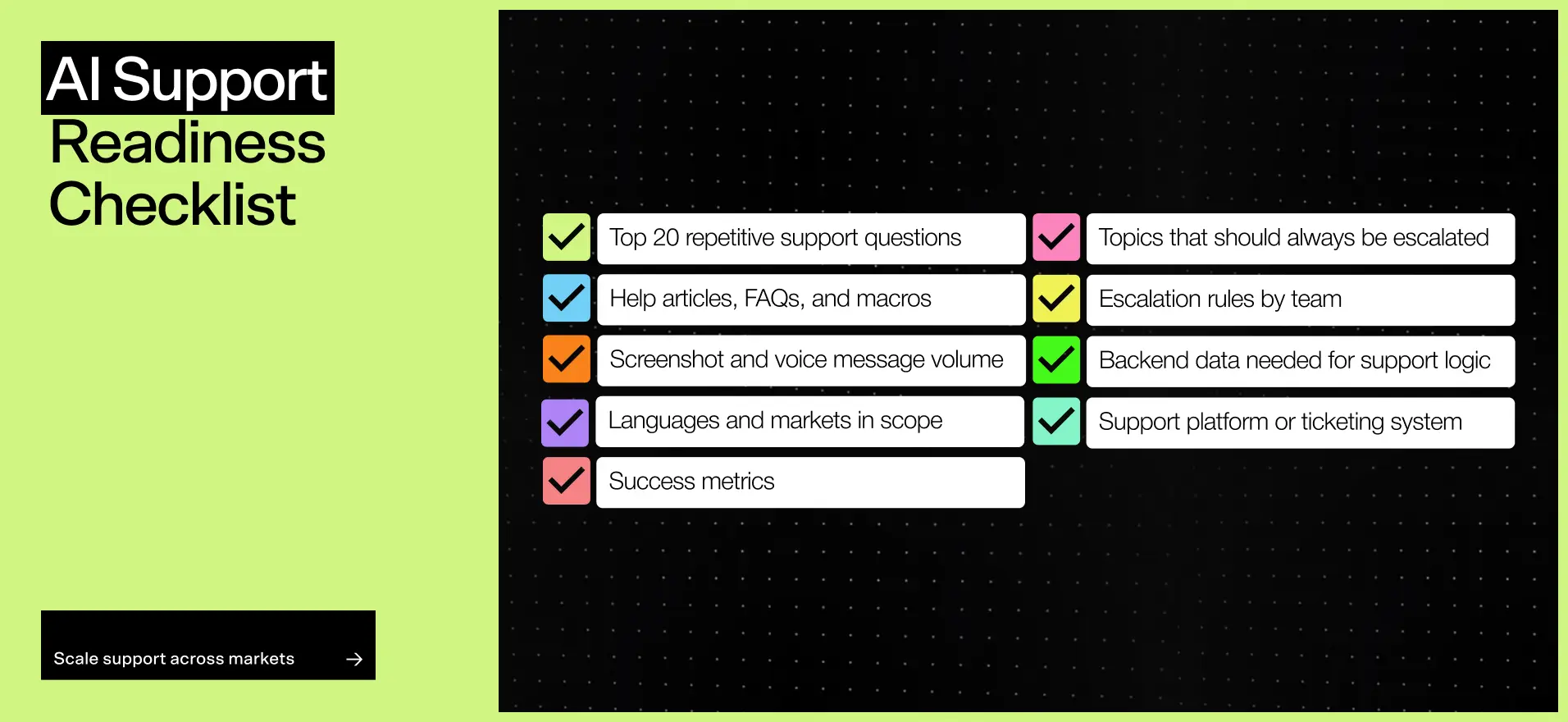
A good first question is: what are your top 20 repetitive support questions?
This tells you where automation can create value quickly.
If the same issues appear every day across payments, bonuses, verification, account access, and promotions, those are strong candidates for AI support.
The next question is: which topics should never be fully automated?
This is just as important.
Responsible gaming, fraud-sensitive cases, compliance-related decisions, VIP complaints, payment disputes, and account restrictions may need careful escalation. AI can support these journeys, but it should not handle them blindly.
Operators should also review their help content.
Do you already have FAQs, help articles, internal macros, or support scripts?
AI support works better when it has structured, accurate information to use. If your knowledge base is outdated, unclear, or inconsistent, that needs to be fixed before you expect AI to perform well.
You should also map your escalation rules.
Which teams need to receive which types of cases?
Payments.
KYC.
Bonuses.
Technical support.
VIP.
Responsible gaming.
Account security.
General support.
If routing is unclear internally, AI will not magically solve it. The implementation should reflect how your team actually works.
Another important question is whether players often send screenshots or voice messages.
If they do, text-only automation will be limited. You need AI support that can understand image inputs and voice recognition, because that is how your players already communicate.
You should also decide whether you need backend-aware logic.
Some support answers can be based on help content. Others require account-level or transaction-level awareness.
For example, a general question like “How long does a withdrawal take?” can be answered from policy content.
But “Why is my withdrawal pending?” may require backend-aware logic, depending on what you want AI to access and what should remain with the human team.
Operators should also define which languages and markets are in scope.
A single-market English setup is very different from a multi-market support layer across several GEOs, player behaviours, and localisation requirements.
Then there is the support stack.
What platform or ticketing system should AI connect to?
Do you need live chat integration?
Ticket creation?
Agent handoff?
CRM or segmentation data?
Help centre access?
Analytics?
These questions matter because AI support should fit into the existing workflow, not create a parallel system that agents ignore.
Finally, you need to define success.
Useful metrics may include:
Reduction in repetitive tickets.
Deflection rate for simple questions.
Escalation quality.
Average handling time.
First response time.
Player satisfaction.
Agent workload.
Number of cases routed correctly.
Resolution rate for AI-supported journeys.
The point is not to “launch AI.”
The point is to improve the support operation in measurable ways.
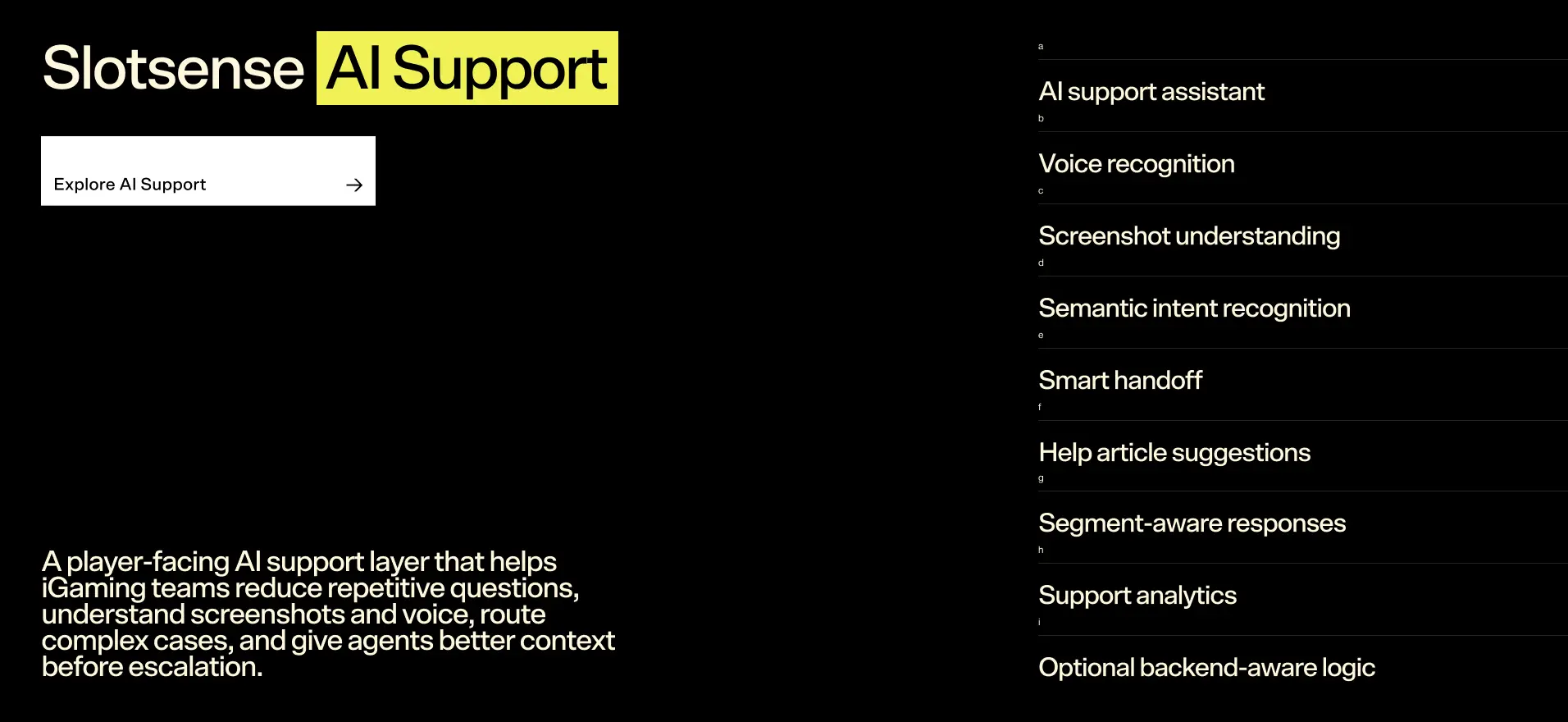
Slotsense is built as a player-facing AI support layer for iGaming teams.
It can work with your existing support tools and help teams reduce repetitive player questions, understand screenshots and voice messages, suggest the right help content, and route complex cases with better context.
It is not designed to replace agents.
It is designed to protect agent time.
That distinction matters.
Most operators already have support platforms, macros, help centres, and human teams. The issue is not that support teams have no tools. The issue is that players often arrive with messy context, and agents still have to untangle it manually.
Slotsense AI Support helps create a cleaner first layer.
Depending on the setup, it can support:
AI support assistant functionality for player-facing support conversations.
Voice recognition for players who prefer to explain issues verbally.
Image and screenshot understanding for messy or visual support cases.
Semantic recognition to understand player intent beyond exact keywords.
Smart redirects and handoff when a case needs a human.
Help article suggestions based on the player’s issue.
Segment-aware responses where different player groups need different handling.
Support performance analytics to understand what players ask and where support load comes from.
Optional ticketing logic to fit into existing support workflows.
Optional backend-aware support logic depending on the operator’s integration needs.
The goal is to make support smoother at the point where most friction begins: the first player message.
If the issue is simple, AI can guide the player.
If the issue is unclear, AI can collect context.
If the issue is complex, AI can route it properly.
And if the issue needs a human, the agent receives a better-prepared case.
That is what makes AI support useful as an operational layer rather than just another chatbot experiment.
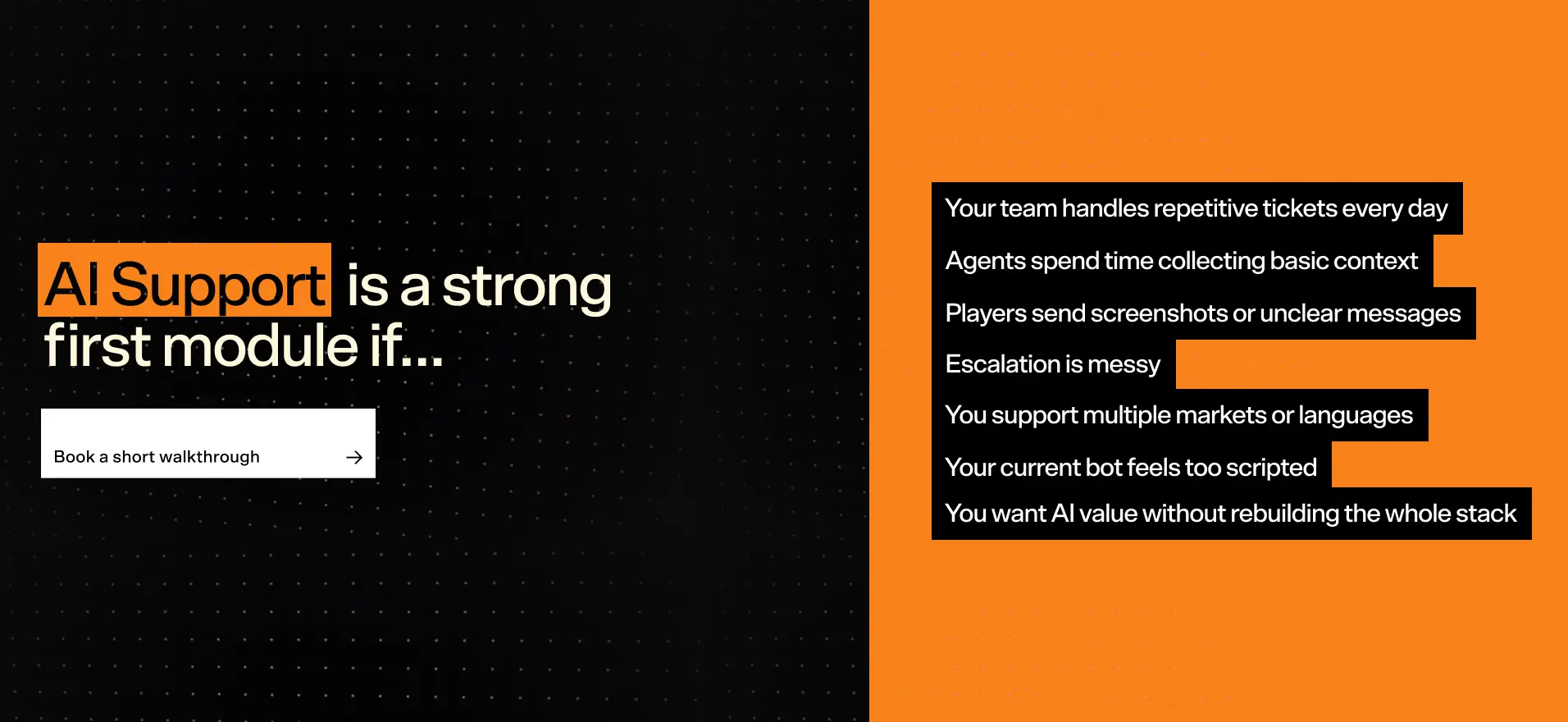
For many operators, AI Support is one of the most practical first AI modules to launch.
The reason is simple: the pain is visible.
Support teams know when they are overloaded. They know which questions repeat. They know where players get stuck. They know when escalation is messy. They know when agents are wasting time collecting basic information.
That makes the workflow easier to measure.
AI Support is often a good fit if your support team handles many repetitive tickets.
It is also a strong fit if agents spend too much time asking for basic context before they can help.
If players often send screenshots, unclear messages, or voice notes, AI Support can also create value because it adapts to how players actually communicate.
It is a good starting point if escalation is messy and agents receive cases without enough context.
It is also useful if support is scaling across multiple markets and the team needs to handle more languages, behaviours, and localised questions without growing headcount at the same pace.
Another common trigger is an existing bot that feels too scripted.
Many operators already have a chatbot or help centre flow, but the team knows it only handles the cleanest questions. AI Support can add a more intelligent layer on top of that support journey.
It is also a good fit for operators who want AI value without rebuilding the whole stack.
You do not always need to start with a massive AI transformation project.
Sometimes the best first step is a focused module that solves a clear operational problem.
AI Support is often the most practical first AI module because the pain is visible, the workflow is measurable, and the value can be tied directly to resolved conversations and reduced manual load.
No. A chatbot usually answers simple scripted questions. AI support for iGaming should understand player intent, collect context, process screenshots or voice, route issues, and escalate complex cases to agents.
No. The goal is not to replace agents. The goal is to reduce repetitive support load and give agents better context for complex, sensitive, or high-value cases.
AI can help with repetitive questions around deposits, withdrawals, bonuses, account access, verification, help content, payment methods, promotion eligibility, and common player issues. Sensitive or complex cases should be escalated with context.
Slotsense AI Support helps iGaming teams answer repetitive player questions, understand screenshots and voice, suggest help content, route cases, and escalate with better context.
AI support for iGaming should not be judged by whether it can answer a few FAQ questions.
That is the old chatbot standard.
The real question is whether it can reduce repetitive work, understand messy player inputs, route cases intelligently, and give human agents better context when they are needed.
Because that is where support teams feel the pressure.
Not in the perfect demo conversation.
In the real conversations where players ask incomplete questions, send screenshots, mix issues together, and expect fast answers.
Generic chatbots were not built for that level of complexity.
AI support for iGaming needs to be more practical, more contextual, and more operator-aware.
It should help players get direction faster. It should help agents avoid repetitive work. It should make escalation cleaner. And it should fit into the existing support stack without forcing the team to rebuild everything around it.
That is what moves AI support from a chatbot experiment to an operational layer operators can actually use.
Slotsense helps iGaming teams reduce repetitive support load, understand screenshots and voice, route complex cases, and give agents better context before escalation.
Explore AI Support
Content:
.png)
.png)