Build vs Buy: Should iGaming Operators Build Their Own AI Support and Retention Layer?
Compare build vs buy AI in iGaming across support, retention, integrations, QA, localisation, compliance, cost, and rollout speed.
16 min
·
July 7, 2026
Compare build vs buy AI in iGaming across support, retention, integrations, QA, localisation, compliance, cost, and rollout speed.
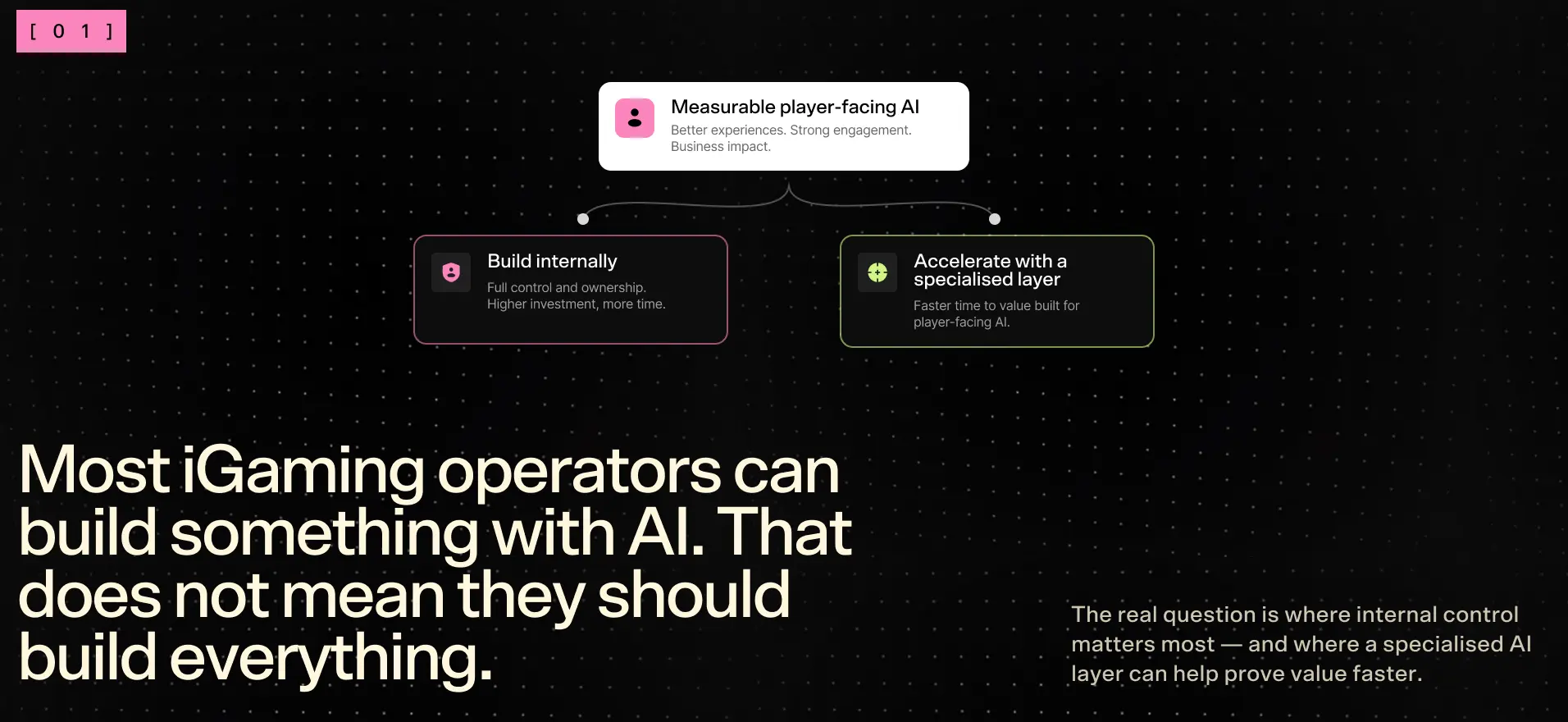
Most iGaming operators can build something with AI.
That does not mean they should build everything.
An internal team can connect an LLM to a help centre, create a support bot, generate CRM copy, build a few trigger-based flows, or test a recommendation concept.
But a production-ready player-facing AI layer is more than a model and a prompt.
It needs support logic, routing, escalation, screenshots and voice handling, player context, data boundaries, QA, localisation, monitoring, performance analytics, and ongoing optimisation.
So the build vs buy AI in iGaming question is not simple.
It is not “can we build it?”
Many teams can.
The better question is:
Where does internal control matter most, and where does buying a specialised AI layer help you prove value faster?
Because in iGaming, speed matters. But so do compliance, player trust, escalation quality, localisation, and control over sensitive decisions.
The smartest answer is often not purely build or purely buy.
It is knowing what to own internally, what to accelerate with a partner, and what to test before committing months of product and engineering capacity.
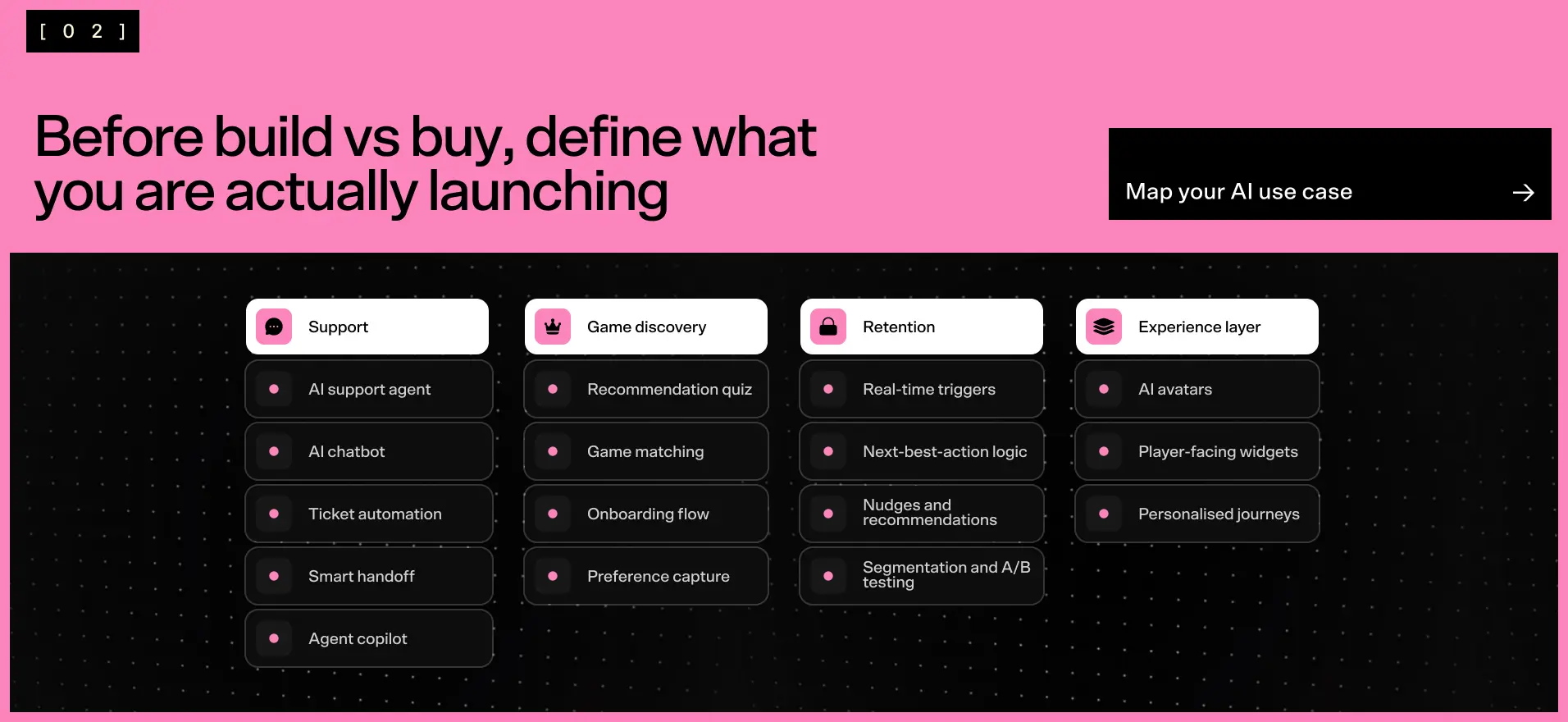
Before choosing build or buy, operators need to define what they are actually trying to launch.
“AI layer” can mean many different things.
For one team, it means an AI support agent that answers repetitive player questions.
For another, it means a chatbot connected to the help centre.
For another, it means support ticket automation and smart handoff.
For another, it means an AI copilot for human agents.
For a casino team, it may mean a game recommendation engine or quiz-based onboarding flow.
For CRM, it may mean retention trigger workflows, next-best-action logic, or real-time personalisation.
For brand and engagement teams, it may mean AI avatars, gamified journeys, or more interactive player communication.
For marketing, it may mean CRM content generation.
These are very different products.
They have different data needs, risks, integrations, and success metrics.
That is why the build vs buy conversation often becomes messy. Teams say “AI” but mean completely different things.
This article focuses on player-facing AI, especially three areas:
AI Support.
Game Discovery and Quiz.
Retention AI.
AI Support helps operators handle repetitive player questions, understand screenshots and voice, route issues, and escalate with better context.
Game Discovery and Quiz helps players find relevant games faster, especially during onboarding or cold-start personalisation.
Retention AI reacts to player behaviour in real time with nudges, recommendations, triggers, gamified journeys, segmentation, and A/B testing.
These are not just internal productivity tools.
They directly affect what the player experiences.
That makes the decision more important.
Before choosing build or buy, operators need to define whether they are building an internal productivity tool, a support assistant, a recommendation flow, or a real-time player-facing decision layer.
Those choices require very different levels of control, complexity, and maintenance.
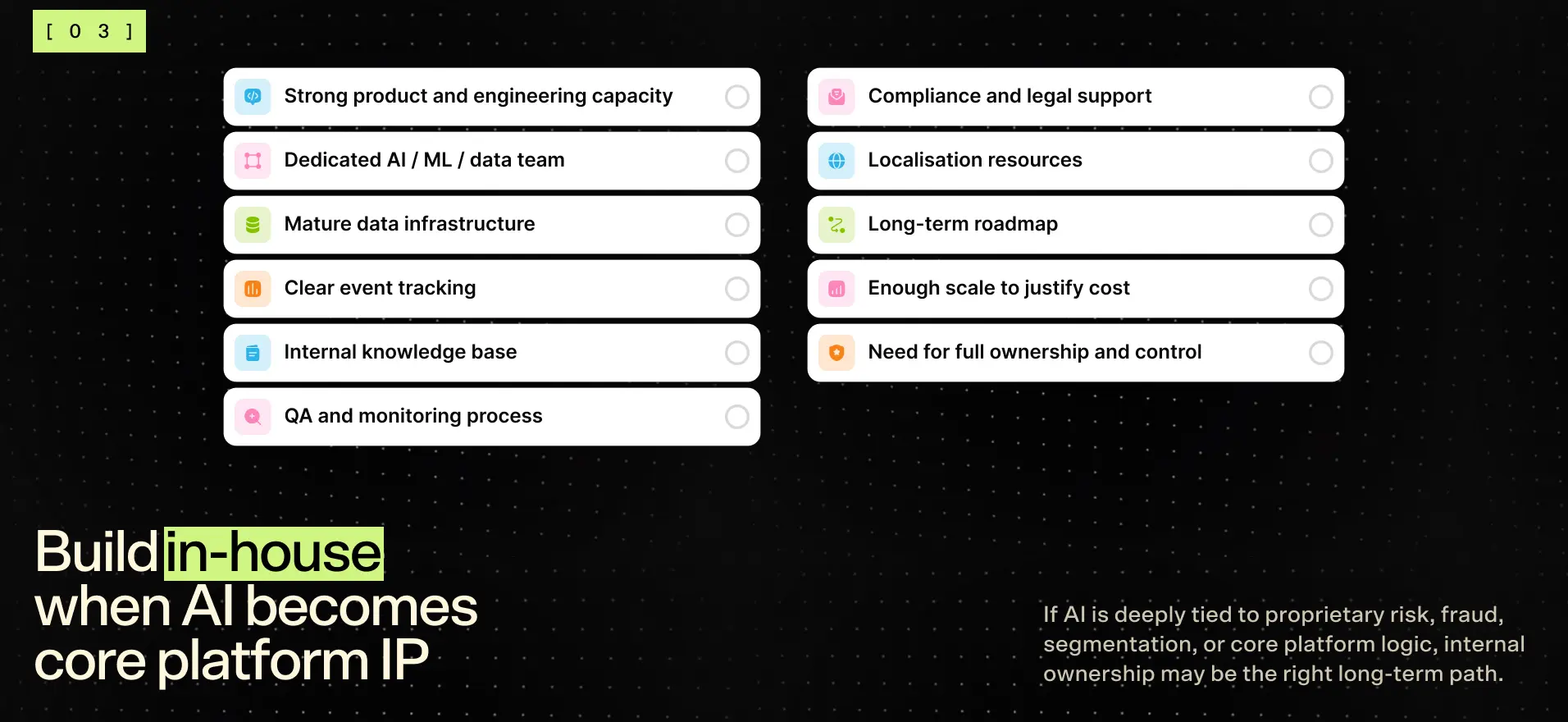
Building internally can be the right decision.
This article is not here to argue that every operator should buy everything.
In-house development can make sense when the AI capability is part of your core platform IP, when the use case is strategically sensitive, or when the operator has the resources to build and maintain it properly.
Building in-house may be a strong option if you have strong product and engineering capacity, a dedicated AI or data team, mature data infrastructure, clear event tracking, an internal knowledge base, QA and monitoring processes, compliance and legal support, localisation resources, and a long-term roadmap.
It may also make sense if the scale of the operation justifies the cost.
Large multi-brand groups with mature platform teams may want full ownership over certain AI workflows, especially if those workflows are deeply tied to proprietary data, risk logic, CRM strategy, or core product differentiation.
Good use cases for internal build can include internal analytics, custom data models, proprietary risk or fraud logic, segmentation models, deep platform integrations, internal agent copilots, and sensitive backend systems.
For example, if your team is building proprietary risk scoring, fraud detection, or player segmentation that directly affects the core platform, internal ownership may be the right long-term decision.
If AI becomes part of your core platform IP, building internally can be the right long-term decision.
But that is not the same as saying every support flow, recommendation quiz, retention trigger, escalation rule, AI interface, and analytics dashboard should be built from scratch.
That is where the hidden cost appears.
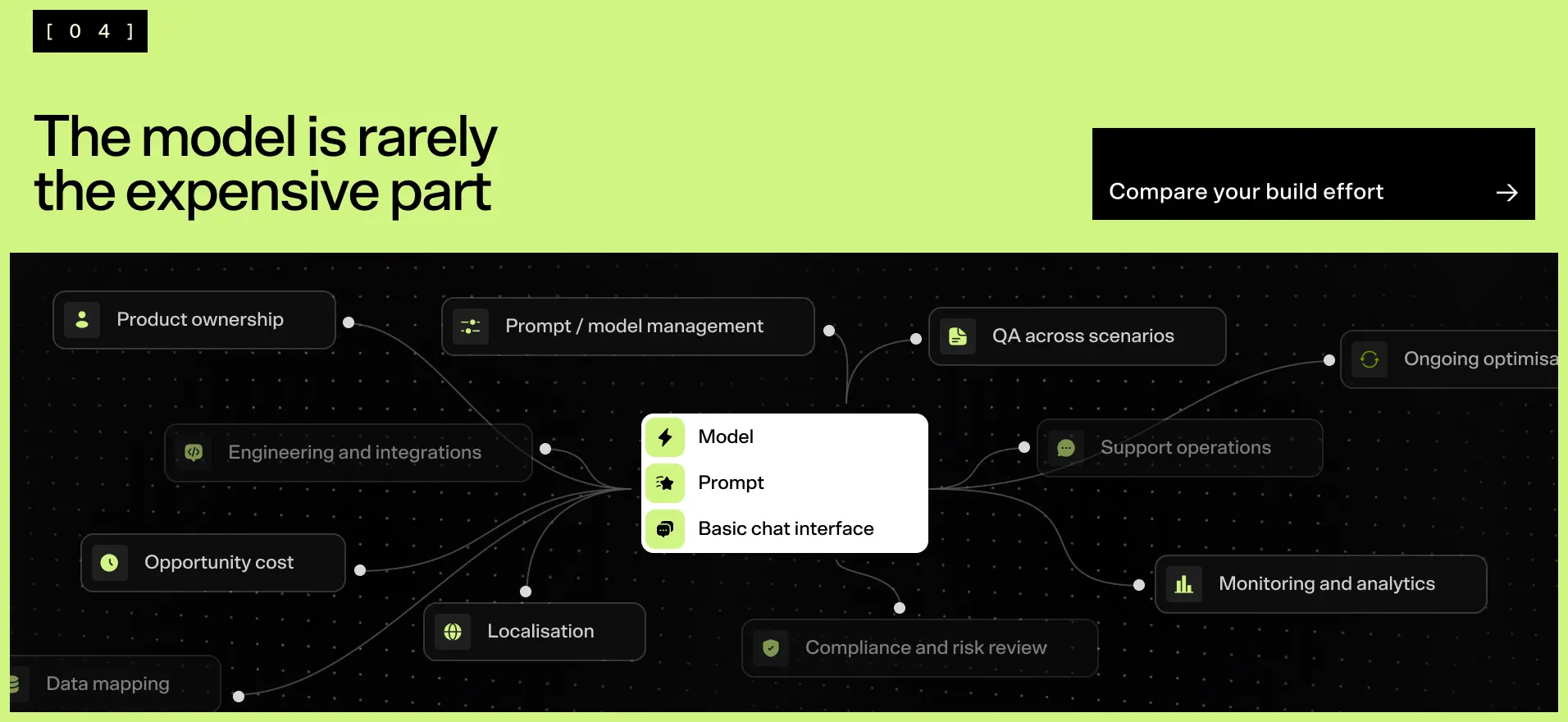
The model is rarely the expensive part.
The expensive part is making AI safe, useful, measurable, and maintainable inside a real iGaming operation.
An internal build may look simple at first.
Connect a model.
Add a prompt.
Use help centre content.
Create a chat interface.
Launch a pilot.
But production reality is different.
There are at least ten cost areas operators need to consider.
Someone needs to define the actual use case.
What should the AI do?
Which player problems should it solve?
What should it never answer?
When should it route?
When should it escalate?
What should the player experience look like?
Which metrics define success?
How will the rollout work across markets, brands, and languages?
These are product questions, not just technical questions.
Without clear product ownership, AI projects become experiments that never turn into reliable operational systems.
Engineering work goes far beyond the model connection.
You may need a player-facing widget, backend services, APIs, support platform integrations, CRM integrations, event streams, logging, permissions, environments, admin tools, fallback flows, and monitoring infrastructure.
If the AI needs to create tickets, read help articles, understand player state, or trigger retention actions, the integration scope grows quickly.
This does not mean it cannot be done.
It means it needs to be scoped honestly.
AI needs reliable data to be useful.
That may include player events, segments, account states, support history, bonus information, payment context, language, market, device, and behaviour signals.
But raw data is rarely ready for AI use.
Teams need to map data, clean events, define player states, set permissions, handle data boundaries, and decide what should be masked or anonymised.
For sensitive player data, operators also need to define what can be processed by AI, what should stay inside internal systems, and what requires stricter handling.
Data work often becomes one of the biggest hidden costs.
The model is only one part of the system.
Teams also need prompt design, model routing, hallucination control, fallback logic, multilingual quality, output testing, and failure handling.
What happens when the AI is not confident?
What happens when the player asks a sensitive question?
What happens when the answer depends on account status?
What happens when the help article is outdated?
What happens when the player sends a screenshot or voice note?
These questions need clear handling.
Otherwise, AI may sound confident but produce support outcomes that are not operationally safe.
QA in iGaming AI is not only checking whether the chatbot replies.
It means testing across markets, languages, player scenarios, edge cases, screenshots, voice inputs, support categories, escalation rules, responsible gaming concerns, payment cases, bonus confusion, and VIP complaints.
It also means checking tone.
A response that sounds fine in one market may feel wrong in another.
A support answer that works for a basic FAQ may be risky in a payment dispute.
A retention nudge that works for one segment may be inappropriate for another.
QA needs ongoing ownership, not just launch testing.
AI does not run itself.
Support teams need to understand how it works, what it can answer, when it escalates, and how to review its performance.
Help content needs to be updated.
Routing logic needs to be improved.
Failed conversations need to be reviewed.
Agents need to trust the handoff summaries.
Support managers need reporting.
If AI becomes part of the support operation, operations teams need a process to maintain it.
Multi-market operators cannot treat localisation as translation only.
Support questions vary by market.
Payment methods vary by market.
Bonus expectations vary by market.
Tone of voice varies by language and culture.
Player behaviour varies by GEO.
A phrase that feels direct and helpful in one language may feel cold or confusing in another.
If the AI is player-facing, localisation needs to include language quality, local support context, payment terminology, bonus rules, escalation behaviour, and tone.
That is a real operational cost.
iGaming AI needs clear boundaries around responsible gaming, AML, KYC, risk signals, payment disputes, legal complaints, account restrictions, and sensitive player behaviour.
The AI should know when not to answer.
It should know when to route.
It should know when to escalate.
It should not over-handle sensitive cases just to reduce ticket volume.
Operators need compliance and legal input on data processing, escalation rules, auditability, and player-facing claims.
This is not optional.
It is part of making AI safe enough for production.
After launch, the system needs monitoring.
Are conversations being resolved correctly?
Are players re-contacting support?
Are sensitive cases escalating?
Are wrong-team routes increasing or decreasing?
Are AI summaries useful to agents?
Are certain languages underperforming?
Are players abandoning the flow?
Are help content gaps appearing?
Are hallucinations or incorrect answers happening?
A serious AI support or retention layer needs ongoing quality checks and performance tracking.
Without monitoring, teams may not see problems until players or agents complain.
Every sprint spent building the AI layer is a sprint not spent somewhere else.
Core product.
Payments.
Market expansion.
Sportsbook or casino improvements.
Retention strategy.
CRM infrastructure.
Player onboarding.
Compliance work.
Acquisition flows.
Platform stability.
This is often the most underestimated cost.
An internal AI build may look cheaper because there is no vendor invoice. But if it consumes months of product and engineering capacity, the real cost can be much higher.
The most expensive AI project is not always the one with the highest vendor fee.
Sometimes it is the internal build that never reaches production or never gets maintained properly.
Buying can be faster.
But only if the product actually fits the operator’s use case.
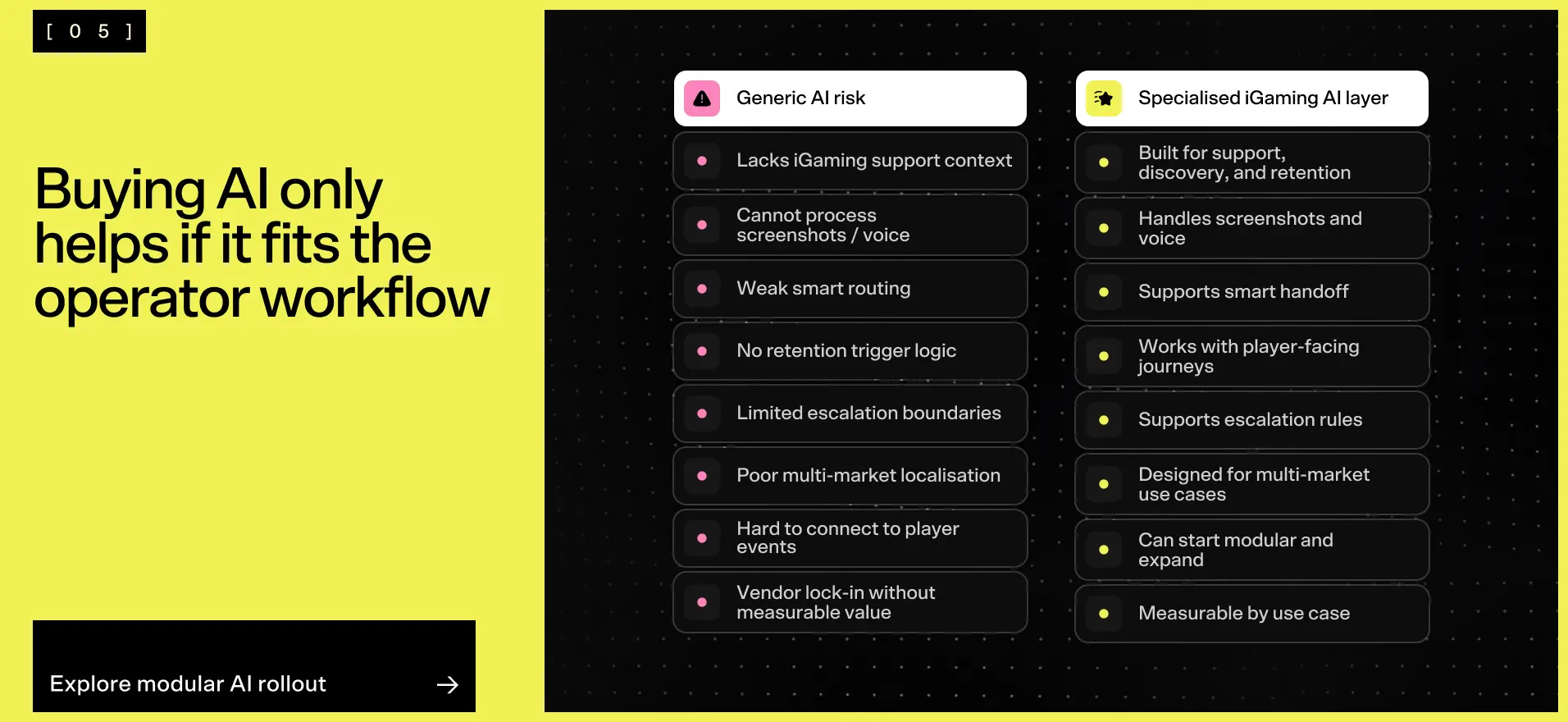
Buying generic AI is not the same as buying an iGaming AI platform.
A generic AI tool may help with content generation, summarisation, or simple chatbot flows. But it may not understand iGaming support context, screenshots, voice notes, smart routing, responsible escalation, game discovery, real-time retention, multi-market localisation, or player event logic.
Buying works best when the vendor is not selling “AI in general,” but a specific operational layer that fits the operator’s support, product, and retention workflows.
Buying may make sense when the operator wants faster proof of value, product or development capacity is limited, support or retention pain is urgent, the team wants a focused pilot, the use case is not core IP, or the vendor already has support, routing, workflow, and player-facing components.
It is especially useful when the operator wants to test before committing to a full internal build.
For example, support teams may want to reduce repetitive tickets now, not wait six months for an internal roadmap slot.
CRM teams may want to test real-time retention triggers without building a full decisioning system.
Casino teams may want a game discovery quiz to capture preferences before investing in a full recommendation engine.
But buying can also create risks.
A vendor may lack iGaming support context.
It may not process screenshots or voice.
It may not support smart routing.
It may not support retention triggers.
It may not understand escalation boundaries.
It may not support localisation across several markets.
It may not integrate with player events or the support stack.
It may create vendor lock-in without measurable value.
This is why specialised logic matters.
Slotsense is packaged as modular player-facing AI: AI Support, Quiz, and Retention AI.
Operators can start with one use case instead of committing to a full AI transformation project.
That modular approach reduces risk.
It lets teams prove value before deciding how deep the integration should go.
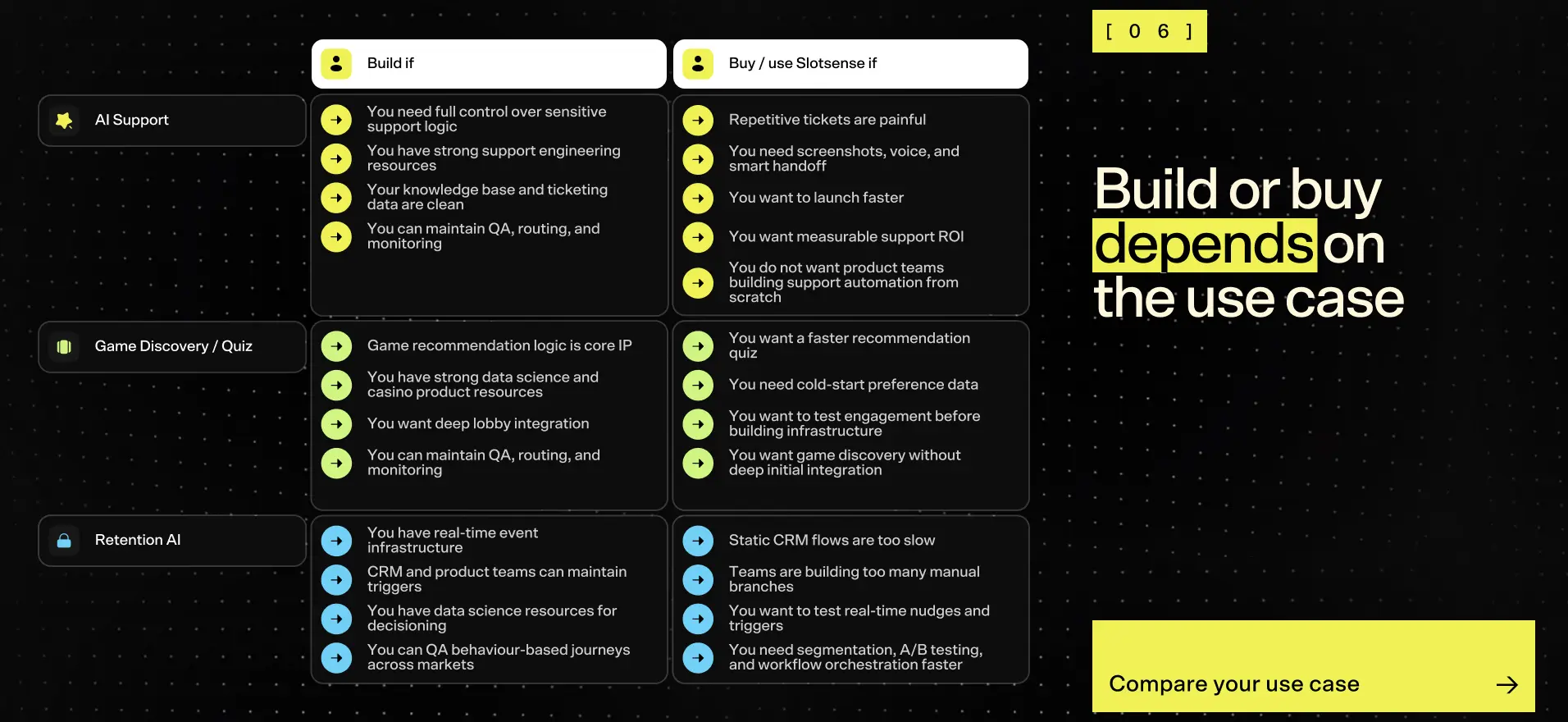
A practical build vs buy decision should be made by use case, not at the abstract “AI strategy” level.
AI Support, Game Discovery, and Retention AI each have different requirements.
AI Support covers repetitive player questions, screenshots, voice, help content, routing, escalation, and smart handoff.
Building internally may make sense if you need full control over sensitive support logic, already have strong support engineering resources, your knowledge base and ticketing data are clean, and your team can maintain QA, routing, monitoring, and escalation rules.
It may also make sense if support AI is tightly connected to your proprietary platform logic or if your compliance requirements demand deep internal ownership.
Buying or using Slotsense may make sense if repetitive tickets are already painful, you need screenshots, voice, and smart handoff, you want to launch faster, you want support analytics and measurable ROI, or you do not want your product team building support automation from scratch.
Support AI is often the easiest first buy because ROI is clearer.
You can measure resolved conversations, repetitive ticket reduction, saved agent hours, deflection by topic, re-contact rate, escalation quality, and CSAT.
That makes the business case easier to prove.
Game discovery is about helping players find relevant games faster.
This can include recommendation quizzes, preference capture, game matching, onboarding flows, and cold-start personalisation.
Building internally may make sense if recommendation logic is core IP, you have strong data science and casino product resources, and you want to deeply embed recommendations into the lobby or game catalogue.
This may be the right path for operators with mature product teams and long-term recommendation infrastructure plans.
Buying or using Slotsense may make sense if you want a faster recommendation quiz, need cold-start player preference data, want game discovery without deep initial integration, or want to test engagement before building internal recommendation infrastructure.
This is often a good lightweight entry point.
The operator can learn what players prefer, improve onboarding, and test recommendation value without committing to a large data science project on day one.
Retention AI covers real-time triggers, nudges, recommendations, segmentation, A/B testing, gamified journeys, and next-best-action logic.
Building internally may make sense if you already have real-time event infrastructure, your CRM and product teams can maintain triggers, you have data science resources for decisioning, and you can QA behaviour-based journeys across markets.
This path gives more control, but it also requires more integration and measurement discipline.
Buying or using Slotsense may make sense if static CRM flows are too slow, teams are building too many manual branches, you want to test real-time nudges and triggers, or you need A/B testing, segmentation, recommendations, and workflow orchestration without building a full system first.
Retention AI may become more strategic over time, but it usually requires deeper trigger integration and stronger measurement.
That is why a modular rollout is useful.
Start with one specific retention moment.
Prove the value.
Then decide whether to deepen integration, expand with the vendor, or build certain parts internally later.
Buying an AI layer does not mean outsourcing your player strategy.
The operator should still own the rules, data boundaries, and business logic that matter most.
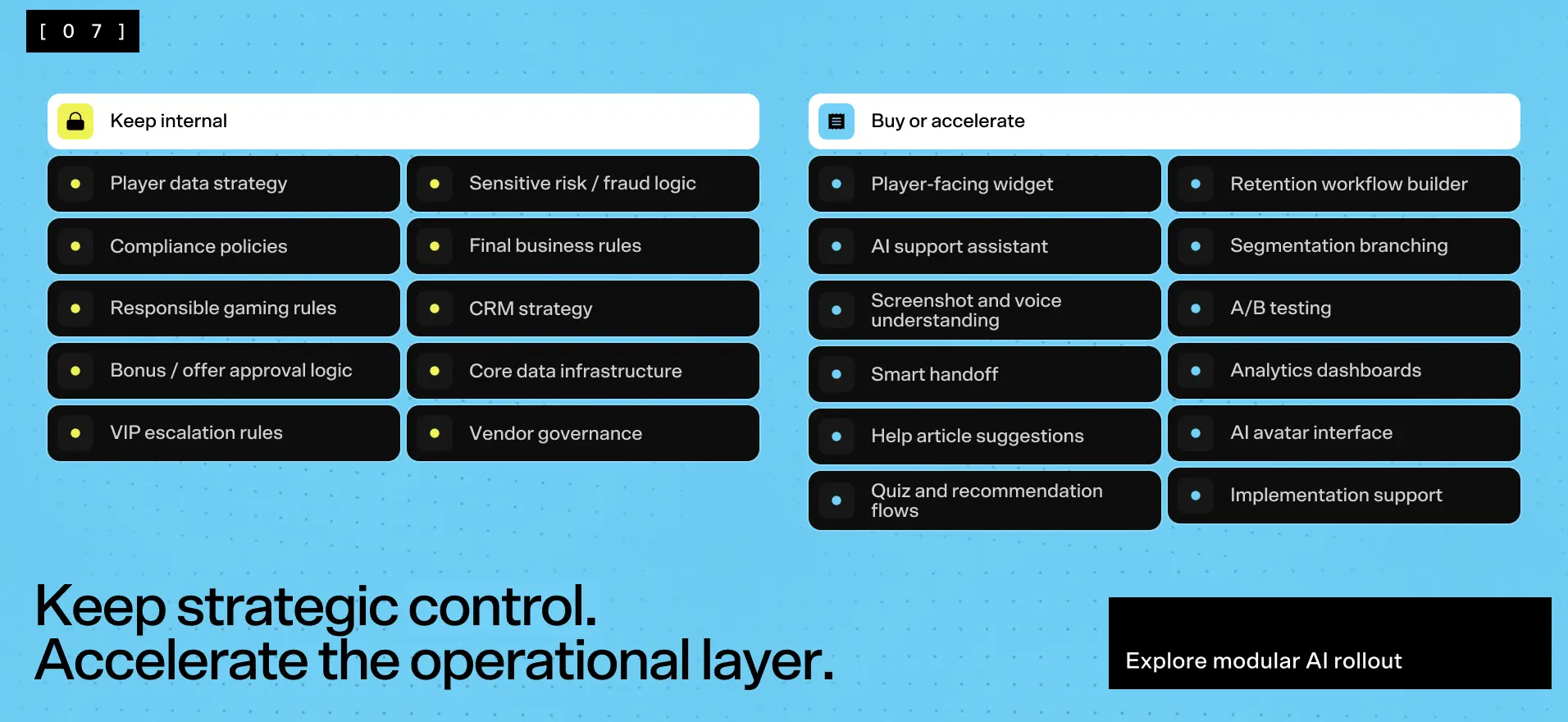
Some things should usually stay under internal control.
Player data strategy should stay internal.
Compliance policies should stay internal.
Responsible gaming rules should stay internal.
Bonus and offer approval logic should stay internal.
VIP escalation rules should stay internal.
Sensitive risk, fraud, and AML logic should stay internal.
Final business rules should stay internal.
CRM strategy should stay internal.
Core data infrastructure should stay internal.
Vendor governance should stay internal.
This is important because AI should not become a black box that makes strategic decisions without operator control.
Even when using a specialised vendor, the operator should define what AI can do, what it cannot do, what data it can access, how escalation works, what content it can use, and how performance will be measured.
A vendor can accelerate the layer.
It should not own the operator’s strategy.
The practical middle ground is to buy the layer that accelerates rollout while keeping strategic data, policies, and decision rights inside the operator.
Operators can often buy or accelerate:
Player-facing widget or interface.
AI support assistant.
Screenshot and voice understanding.
Smart handoff.
Help article suggestions.
Quiz and game recommendation flows.
Retention workflow builder.
Segmentation branching.
A/B testing.
Analytics dashboards.
AI avatar interface.
Reusable support and retention logic.
Implementation support.
This does not mean the operator gives up control.
It means the operator avoids building every component from zero before proving value.
For many teams, this is the sensible path.
Build the core strategy internally.
Accelerate the player-facing AI layer externally.
Then decide what to deepen, integrate, or internalise later.
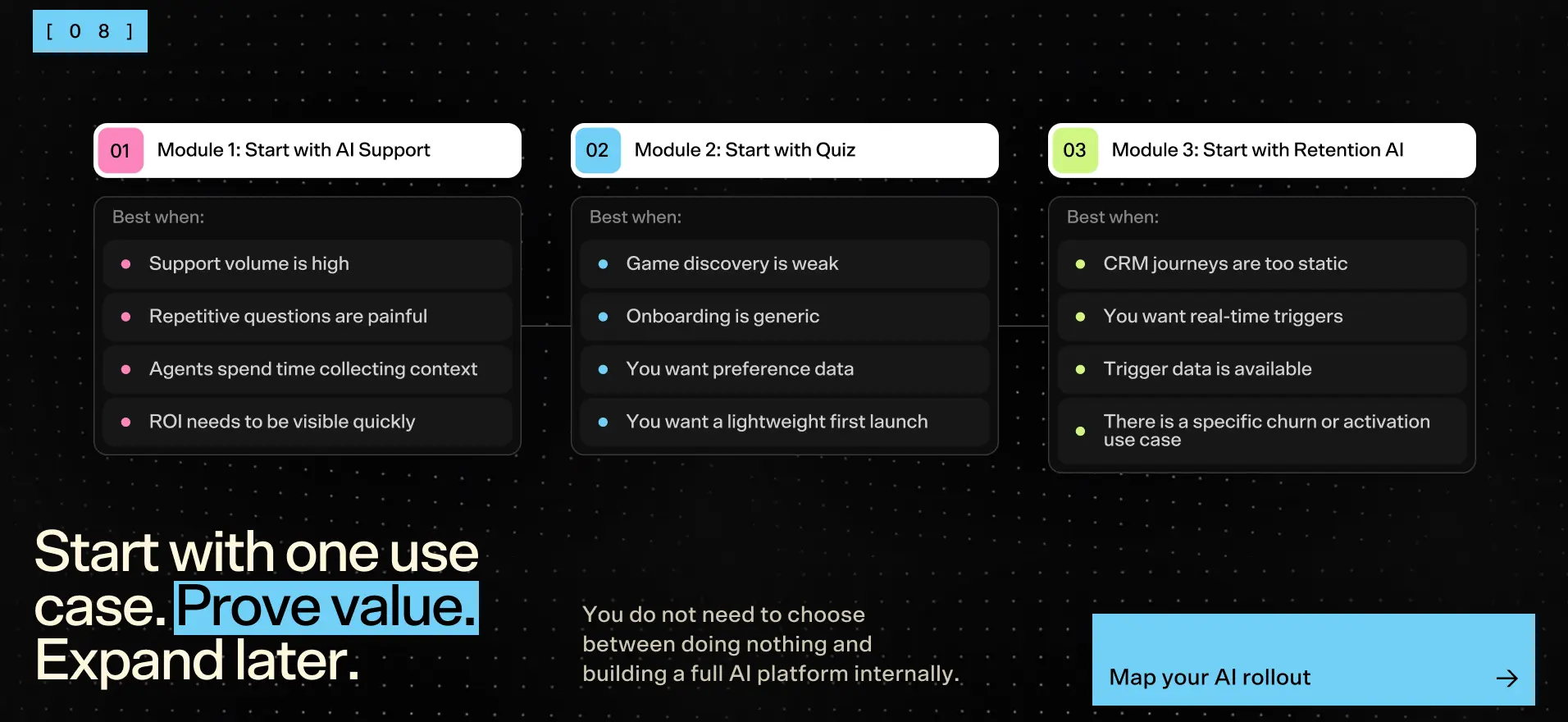
You do not need to choose between doing nothing and building a full AI platform internally.
A modular rollout lets you start with one painful use case, prove value, and then decide what to deepen, integrate, or build later.
There are three practical entry points.
AI Support is often the best starting point when support volume is high, repetitive questions are painful, agents spend too much time on context collection, and ROI needs to be visible quickly.
The value is usually easier to measure.
You can track:
Resolved AI conversations.
Repetitive ticket reduction.
Saved support hours.
Deflection by topic.
Escalation quality.
Re-contact rate.
CSAT.
Agent feedback.
This makes AI Support a strong first module for operators that need operational relief.
Quiz or Game Discovery is a strong starting point when game discovery is weak, onboarding is generic, the operator wants player preference data, or the team wants a lightweight first launch.
It can help answer questions like:
What types of games do players say they want?
Which recommendations drive game launches?
Where do new players get stuck?
Can a quiz improve onboarding engagement?
Does preference capture improve future segmentation?
This module can often start lighter than deep retention AI because it does not always require full event infrastructure on day one.
Retention AI is a strong starting point when CRM journeys are too static, the team wants to react while the player is active, trigger data is available, and there is a specific churn, activation, or reactivation use case.
For example:
Failed deposit recovery.
Low-balance nudge.
Game switching recommendation.
First-session onboarding.
Repeat deposit trigger.
Inactivity after registration.
Bonus confusion support route.
Retention AI can be highly valuable, but it needs clearer trigger data and measurement.
That is why starting with one defined use case is better than trying to automate every retention journey at once.
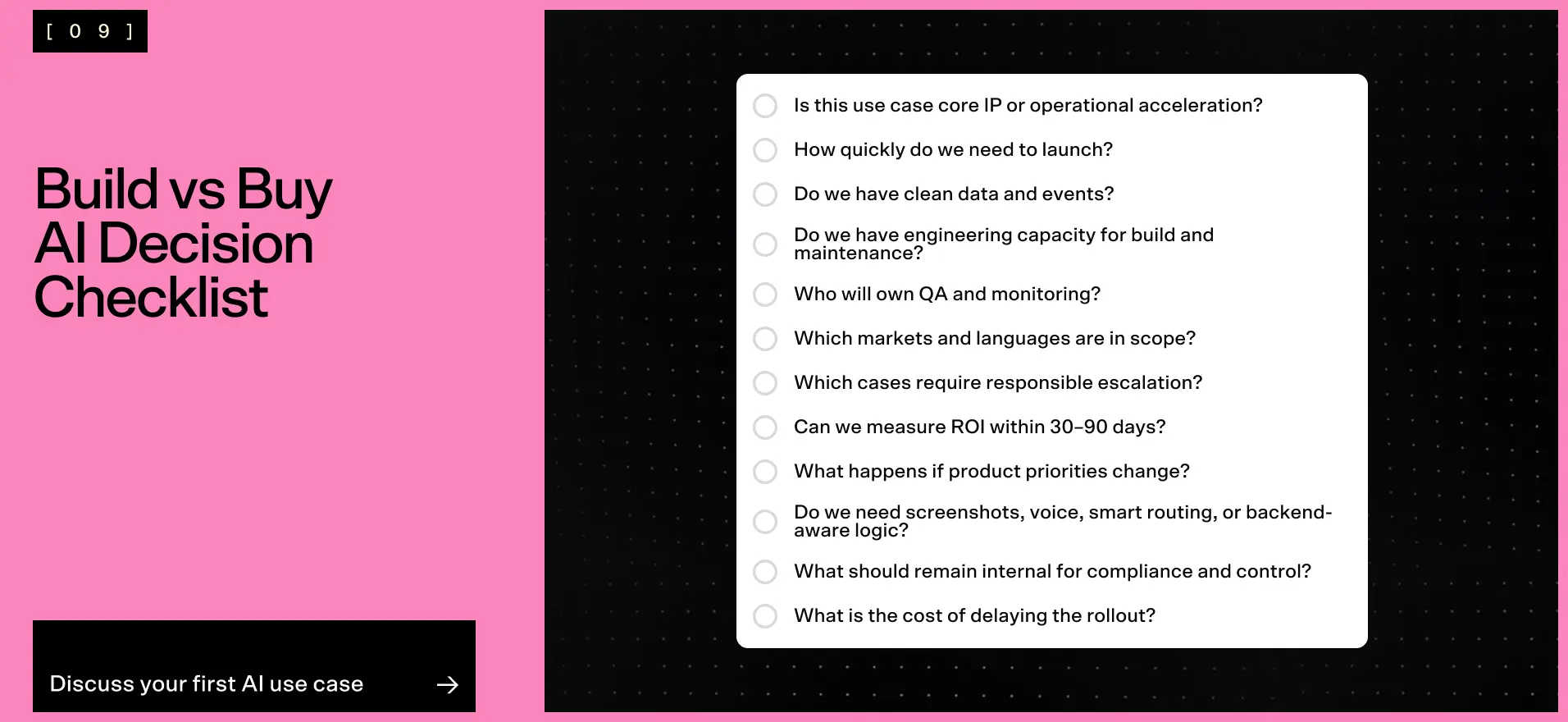
Before making the decision, operators should ask practical questions.
Is this AI use case core IP or operational acceleration?
How quickly do we need to launch?
Do we have clean data and events?
Do we have engineering capacity for both build and maintenance?
Who will own QA and monitoring?
Which markets and languages are in scope?
Which cases require responsible escalation?
Can we measure ROI within 30 to 90 days?
What happens if product priorities change?
How much support or retention logic already exists?
Do we need screenshots, voice, smart routing, or backend-aware logic?
What should remain internal for compliance and control?
What is the cost of delaying the rollout?
These questions are more useful than asking whether build or buy is “better.”
There is no universal answer.
There is only the right answer for your use case, your team capacity, your timeline, your data maturity, and your risk tolerance.
The most expensive AI project is not always the one with the highest vendor fee.
Sometimes it is the internal build that never reaches production or never gets maintained properly.
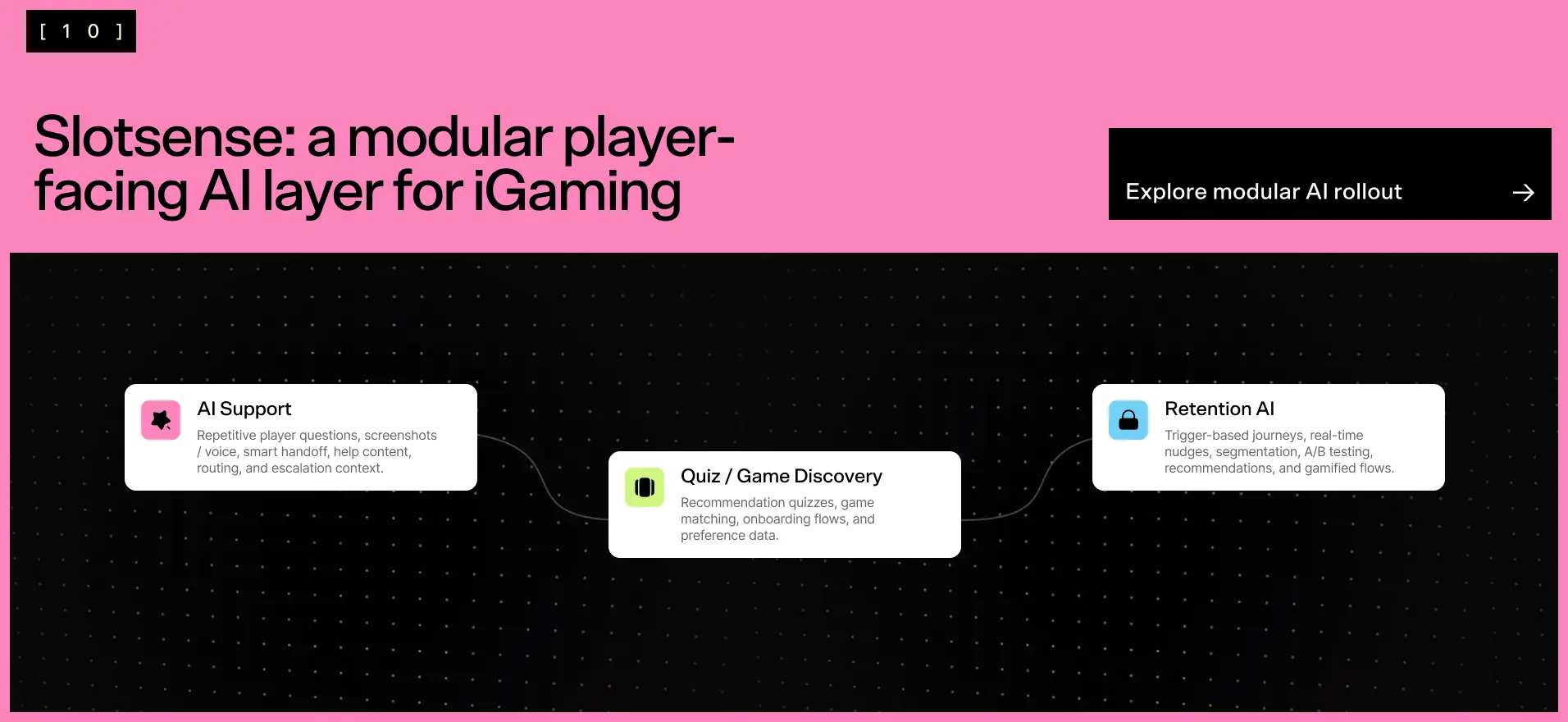
Slotsense is built for operators that want to move faster without giving up control of their stack.
It works as a modular player-facing AI layer across AI Support, Quiz / Game Discovery, and Retention AI.
Slotsense AI Support helps with repetitive player questions, screenshots and voice, smart handoff, help content, routing, and escalation context.
It is designed to reduce repetitive support load while giving agents better context when human involvement is needed.
Slotsense Quiz helps operators launch recommendation quizzes, game matching, onboarding flows, and preference capture.
It gives teams a practical way to improve game discovery and collect cold-start player preference data before building deeper recommendation infrastructure.
Slotsense Retention AI supports trigger-based journeys, real-time nudges, segmentation, A/B testing, recommendations, randomizers, and gamified flows.
It helps teams react to player behaviour while the player is still active, rather than relying only on static CRM journeys.
Slotsense can start light and expand with deeper integration when needed.
The goal is not to replace your CRM, support platform, or product team.
The goal is to reduce the amount of AI infrastructure your team has to build before proving value.
This gives operators a practical middle ground:
Keep strategic control internally.
Use a specialised player-facing AI layer to launch faster.
Measure the result.
Then decide what should be integrated deeper, expanded, or eventually built internally.
Building AI internally can make sense if the use case is core IP, the operator has strong engineering and data resources, and the team can maintain QA, monitoring, localisation, compliance, and integration over time.
Buying makes sense when the goal is to launch faster, reduce product and engineering workload, test a specific use case, or access specialised iGaming support, recommendation, and retention logic without building everything from scratch.
The hidden cost is not only engineering. Operators also need product ownership, data mapping, QA, monitoring, prompt and model management, localisation, compliance review, support training, escalation design, and ongoing optimisation.
Yes. A modular vendor rollout can help operators prove value first. After that, teams can decide which parts should be integrated deeper, kept with the vendor, or eventually built internally.
The build vs buy decision in iGaming AI is not binary.
Some parts should stay internal: player strategy, sensitive business rules, compliance, data governance, and core platform logic.
But operators do not need to build every support assistant, recommendation flow, retention trigger, escalation path, AI interface, QA process, and analytics layer from scratch before testing value.
The better approach is to decide what gives you strategic control and what gives you speed.
For many teams, the smartest first step is modular.
Start with AI Support, Quiz, or Retention AI.
Measure the result.
Then decide where to integrate deeper, where to expand, and where it may make sense to build more internally later.
Because the goal is not to win an abstract build vs buy debate.
The goal is to create a player-facing AI layer that works in the real operator environment — with the right balance of control, speed, quality, and measurable value.
Tell us whether you are looking at AI support, game discovery, or real-time retention. We’ll help map what can be launched with Slotsense, what requires integration, and what may make sense to keep internal.
Compare your use case
Content:
.png)
.png)