Why iGaming Support Teams Still Drown in Repetitive Tickets — and How AI Can Help
Learn how iGaming teams can reduce repetitive support tickets around deposits, withdrawals, bonuses, KYC, account issues, and messy player context.
18 min
·
June 27, 2026
Most iGaming support teams are not overloaded by rare, complex cases.
They are overloaded by the same questions arriving again and again, usually with missing context.
Where is my withdrawal?
Why did my deposit not arrive?
Why is my bonus not working?
How do I verify my account?
Why can’t I log in?
What does this screenshot mean?
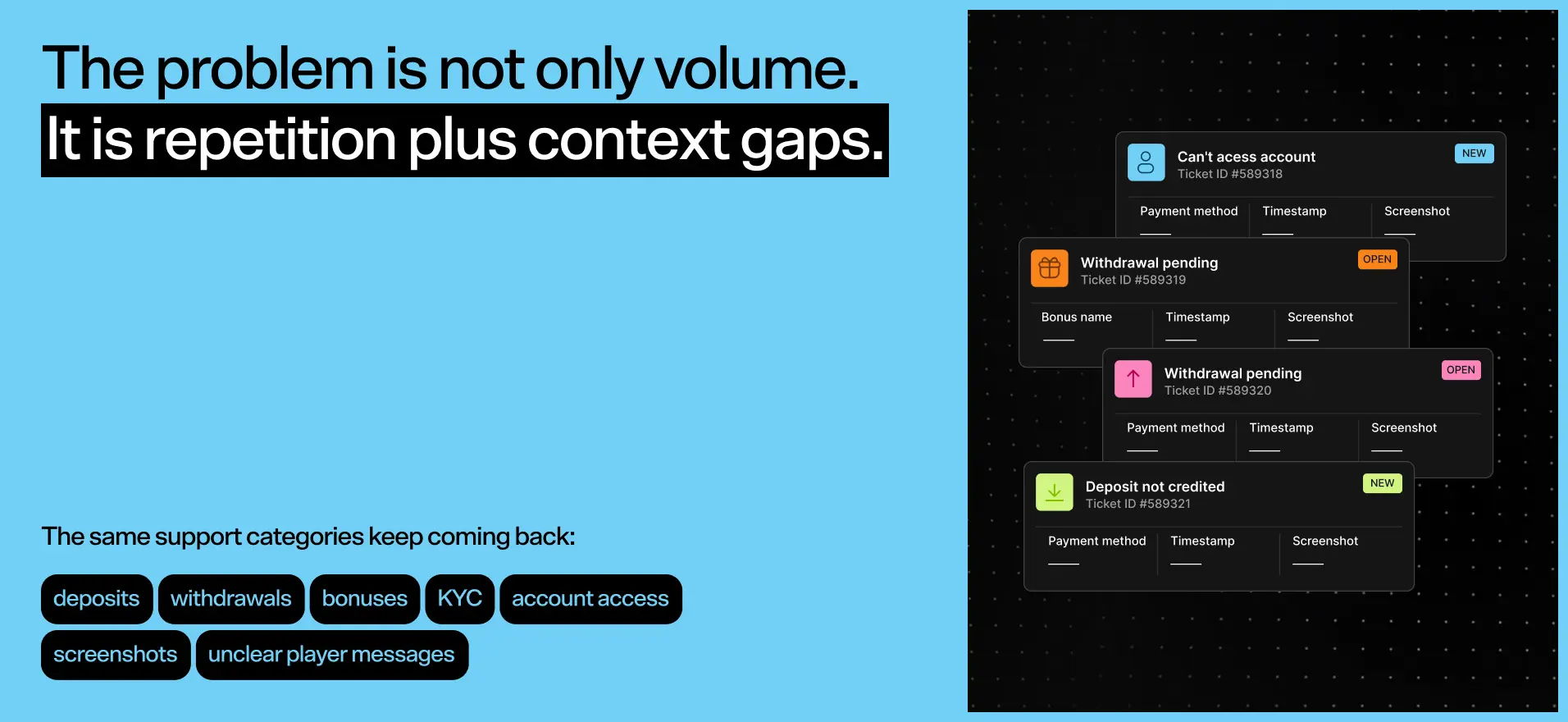
The problem is not only volume.
It is repetition plus context gaps.
That is why trying to reduce support tickets in iGaming is not just about adding a chatbot or pushing more players to an FAQ page.
It requires a support layer that can understand intent, collect missing details, handle screenshots or voice messages, and know when to answer, route, or escalate.
Because support teams are not drowning because players ask questions.
They are drowning because the same few categories keep arriving with messy, incomplete context — and agents have to untangle them manually every day.
Why repetitive tickets are such a big problem in iGaming
Repetitive tickets are easy to underestimate.
On paper, they look simple.
A deposit question.
A withdrawal delay.
A bonus clarification.
A verification step.
A login issue.
A game error.
But at scale, these tickets become one of the biggest drains on support capacity.
Support volume can spike after promotions, bonus launches, sports events, payment provider issues, product incidents, market campaigns, or technical problems. A small issue in one payment flow can create hundreds of similar conversations. A confusing bonus mechanic can flood the team with the same question in different forms.
And when money is involved, players expect fast answers.
A delayed withdrawal does not feel like a small support query to the player. A failed deposit can create immediate frustration. A missing bonus can quickly become a complaint. A KYC issue can block access to funds, withdrawals, or account activity.
So even when the ticket category is repetitive, the emotional temperature can be high.
That is what makes iGaming support difficult.
The topic repeats, but the context changes slightly every time.
One withdrawal ticket may be a normal processing-time question.
Another may involve incomplete KYC.
Another may involve bonus wagering.
Another may involve missing payment details.
Another may involve a payment provider delay.
Another may involve an angry VIP player who has already contacted support twice.
The category is the same.
The handling is not.
This is why generic automation often disappoints support teams. It sees the category but misses the context.
Meanwhile, agents spend too much time on basic explanation and context gathering. They ask the same questions repeatedly:
Which payment method did you use?
When did you request the withdrawal?
Have you completed verification?
Which bonus are you referring to?
Can you send a screenshot?
What device are you using?
Did you receive an error message?
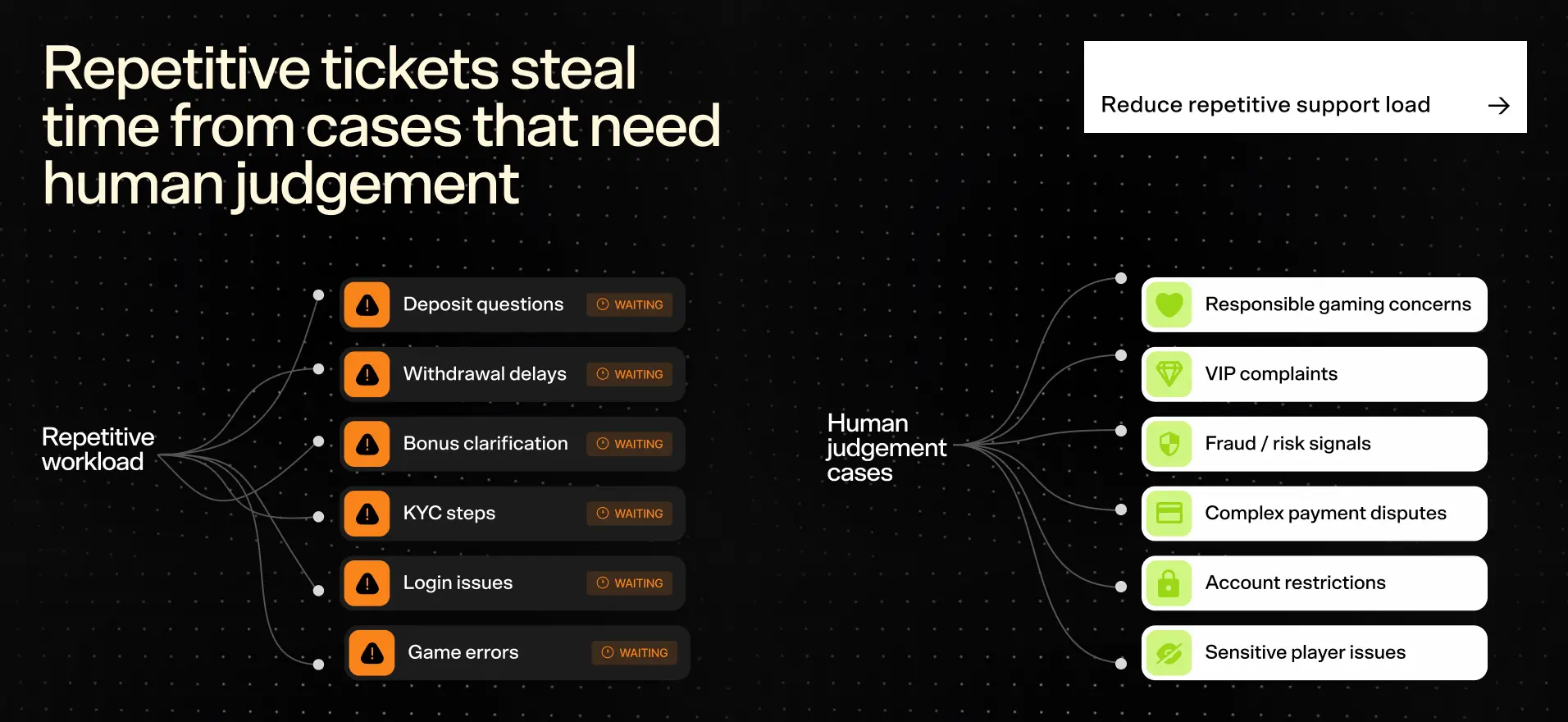
This takes time away from the cases where human judgement actually matters: VIP complaints, responsible gaming concerns, fraud or risk signals, complex payment disputes, account restrictions, and sensitive player issues.
Repetitive tickets are not harmless.
They steal time from the cases where human support creates the most value.
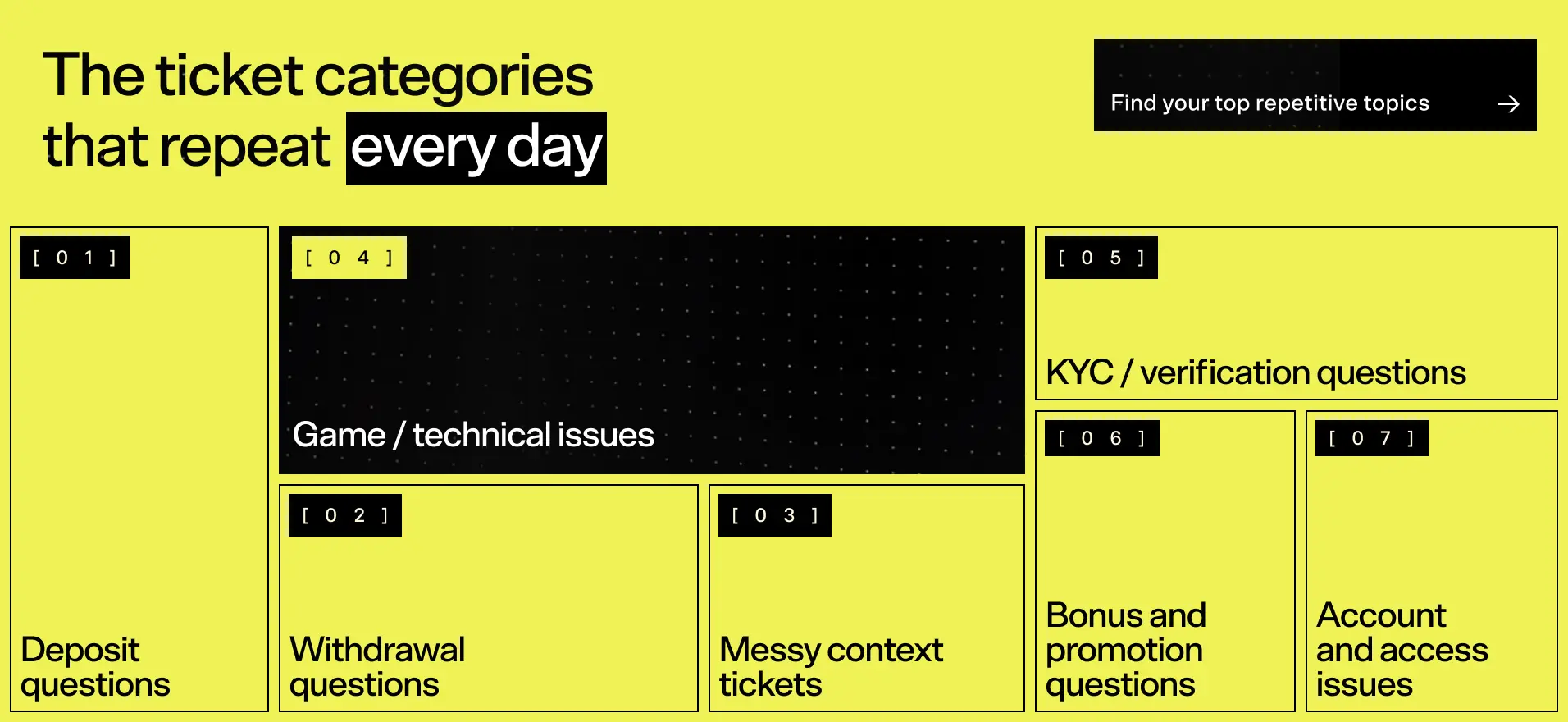
The most common repetitive support tickets in iGaming
Every operator has its own support patterns, but most high-volume iGaming teams see the same categories again and again.
The exact wording changes. The underlying topics are familiar.
1. Deposit questions
Deposit tickets are one of the most common sources of support load.
Players ask why a deposit did not arrive, why it is pending, why a payment method is not working, why the wrong amount appears, or whether there is a local payment provider issue.
These questions are repetitive, but they often need context.
A failed deposit may depend on payment method, provider status, bank behaviour, region, transaction time, account status, or technical error.
A player may simply write:
“I deposited but nothing came.”
That is not enough for an agent to solve the case.
The team still needs details.
AI support can help by identifying the issue, asking for the payment method or transaction time, suggesting general guidance, or routing the case to payments when account-level review is needed.
2. Withdrawal questions
Withdrawal tickets often create even more pressure because players are waiting for money.
Common questions include:
Why is my withdrawal pending?
Why was my withdrawal rejected?
Why is it taking so long?
What payment details are missing?
Is this a payment provider delay?
Do I need to verify my account?
Can I withdraw while using a bonus?
This is where repetitive support becomes sensitive.
A withdrawal question may be simple guidance, or it may need careful review.
AI can help with common withdrawal guidance, standard processing information, and context collection. But backend-dependent or sensitive cases should be routed or escalated properly.
The goal is not for AI to decide every withdrawal case alone.
The goal is to reduce repetitive questions and prepare unclear cases better before they reach a human.
3. Bonus and promotion questions
Bonus tickets are repetitive because bonus rules are often misunderstood.
Players may ask why a bonus was not credited, why free spins are not appearing, why a promo code is not working, why wagering terms apply, or why they are not eligible for a campaign.
These issues can generate a lot of frustration because players often believe they should have received something.
Common bonus-related tickets include:
Bonus not credited.
Wagering terms unclear.
Player not eligible.
Free spins not appearing.
Promo code not working.
Restricted games confusion.
Bonus expired.
Maximum bet rule misunderstood.
Promotion not available in the player’s market.
A FAQ can explain bonus terms, but it does not always help if the player does not understand which term applies to their case.
AI support can suggest relevant help content, ask for the promotion name, identify whether the issue is about eligibility or wagering, and route cases that need account-specific review.
4. KYC and verification questions
KYC and verification tickets are another major source of repetitive support volume.
Players often ask:
Why was my document rejected?
Why is verification still pending?
How do I upload documents?
Why is my withdrawal blocked by KYC?
Which document do I need?
Why does the system still say I am not verified?
KYC tickets can be repetitive, but they are not always safe to fully automate.
AI can explain standard verification steps, guide players to upload documents, and collect context. But document decisions, account restrictions, fraud signals, or sensitive verification cases should be escalated to the right team.
This is where AI should be used carefully.
It can reduce repetitive explanation and improve routing, but it should not over-handle cases that require specialist review.
5. Account and access issues
Account and access tickets include login problems, password resets, account locked messages, self-exclusion or limits, account status confusion, and basic navigation issues.
Some of these can be automated safely.
Password reset guidance, email verification steps, and basic account navigation are often good candidates for AI support.
But other account-related issues need more care.
Self-exclusion, limits, account restrictions, suspicious access, and sensitive status questions should have clear escalation logic.
This is where the automate / route / escalate model matters.
Not every account issue belongs in the same flow.
6. Game and technical issues
Game or technical tickets often arrive with screenshots.
Players may say:
“The game froze.”
“My balance did not update.”
“This provider is not working.”
“The game is unavailable.”
“I got an error.”
“What does this screen mean?”
The challenge is that players often do not provide the details agents need: game name, provider, device, browser, timestamp, error message, balance impact, or screenshot.
AI can help by collecting those details before routing the case.
If a player sends a screenshot of an error screen, AI can use that image context to classify the issue and ask better follow-up questions.
This does not mean AI should automatically decide balance-impact cases. But it can make the handoff cleaner for the technical or support team.
7. “Messy context” tickets
Some of the hardest repetitive tickets are not hard because of the topic.
They are hard because the player gives almost no usable context.
Examples include:
Screenshot without explanation.
Voice note complaint.
“My money is gone.”
“This is not working.”
“Why pending?”
“You scammed me.”
“I already did it.”
Several issues in one message.
These cases force agents to reconstruct the situation manually.
Is it about a deposit, withdrawal, bonus, game error, verification, or account access?
Is the player angry, confused, high-value, or at risk?
Does the case need general guidance, routing, or escalation?
The same categories repeat every day.
What changes is the context the agent has to reconstruct manually.
That is why context capture is so important.
Why FAQs and generic chatbots do not reduce enough tickets
FAQs help.
But only when the player knows what to search for.
They work best when the issue is simple, the player understands the terms, and the answer does not depend on account context.
For example, a FAQ can explain how to reset a password or where to find bonus terms.
But many repetitive iGaming tickets do not start with a clean question.
They start with confusion.
A player may not know whether the issue is payment-related, bonus-related, verification-related, or technical.
They may not know what information is missing.
They may not know the right support term.
They may not want to search the help centre while frustrated.
Generic chatbots have a similar limitation.
They can be useful for scripted flows, but they often fail when the message is unclear, the issue touches payments or account state, the player sends a screenshot, the case needs specialist routing, or the player is angry or high-value.
A generic chatbot might see the word “withdrawal” and send a withdrawal FAQ.
But if the real issue is KYC, bonus wagering, missing payment details, or risk review, the player still needs more help.
A generic chatbot might see the word “bonus” and send bonus terms.
But if the player is asking about a specific promotion, eligibility, free spins, or wagering progress, the answer may not be useful.
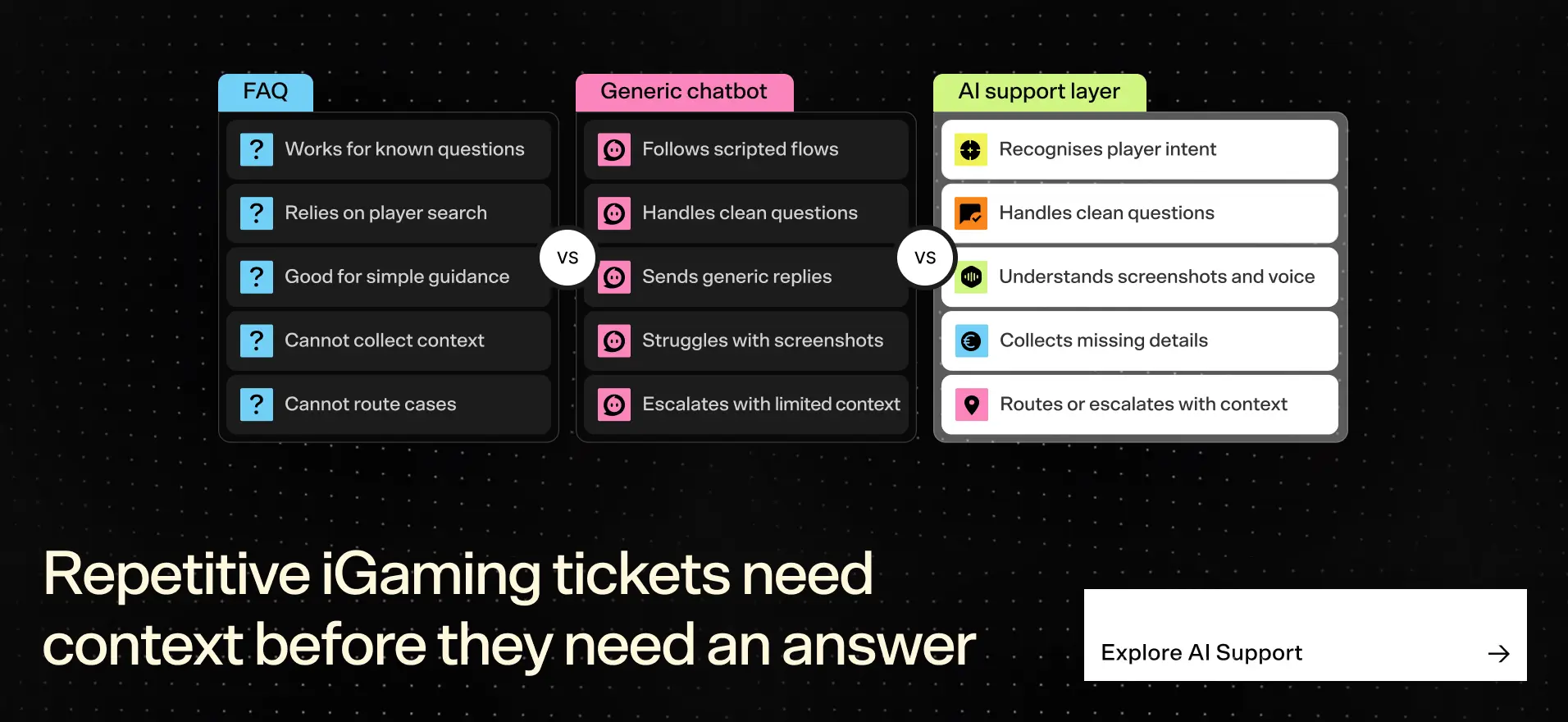
A FAQ answers known questions.
A generic chatbot follows scripts.
But repetitive iGaming tickets often need context before they need an answer.
That is the gap AI support needs to fill.
Not by pretending every issue is simple.
But by understanding the player’s intent, collecting missing details, and deciding whether to answer, route, or escalate.
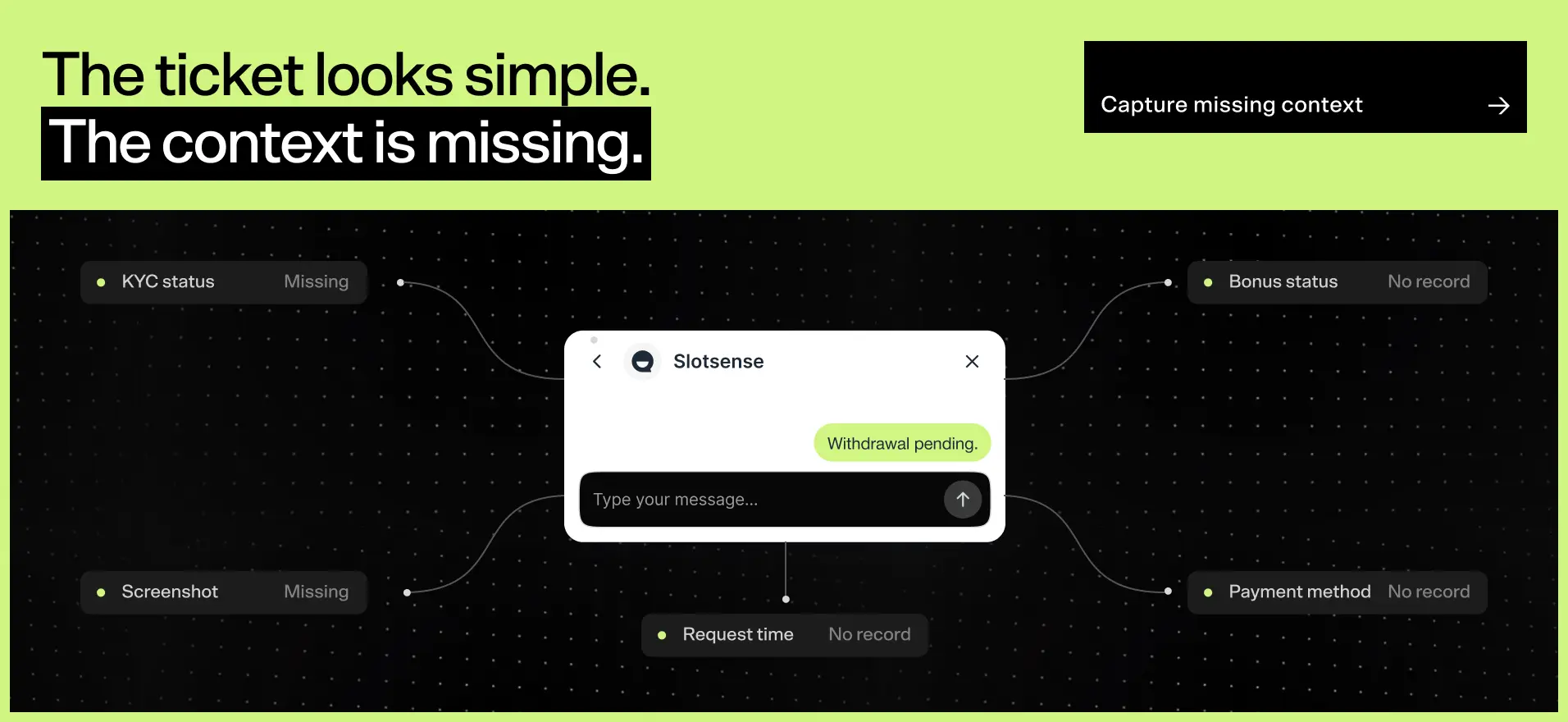
The real reason support teams stay overloaded: missing context
Many repetitive tickets are not hard because the issue is complex.
They are hard because the first message is incomplete.
A player says:
“Withdrawal pending.”
But does not include the request time, payment method, verification status, bonus status, or screenshot.
A player says:
“Bonus not working.”
But does not include the promotion name, eligibility context, wagering status, or market.
A player sends a screenshot of an account page.
But gives no explanation.
A player says:
“Deposit failed.”
But does not include payment method, transaction detail, timestamp, or error message.
A player says:
“Game froze.”
But does not include game name, provider, device, browser, timestamp, or balance impact.
This creates a predictable support pattern.
The agent has to ask for missing information.
The player waits.
The queue grows.
The case may be routed late.
If escalation happens, the specialist team may still need more context.
This is the work AI can reduce.
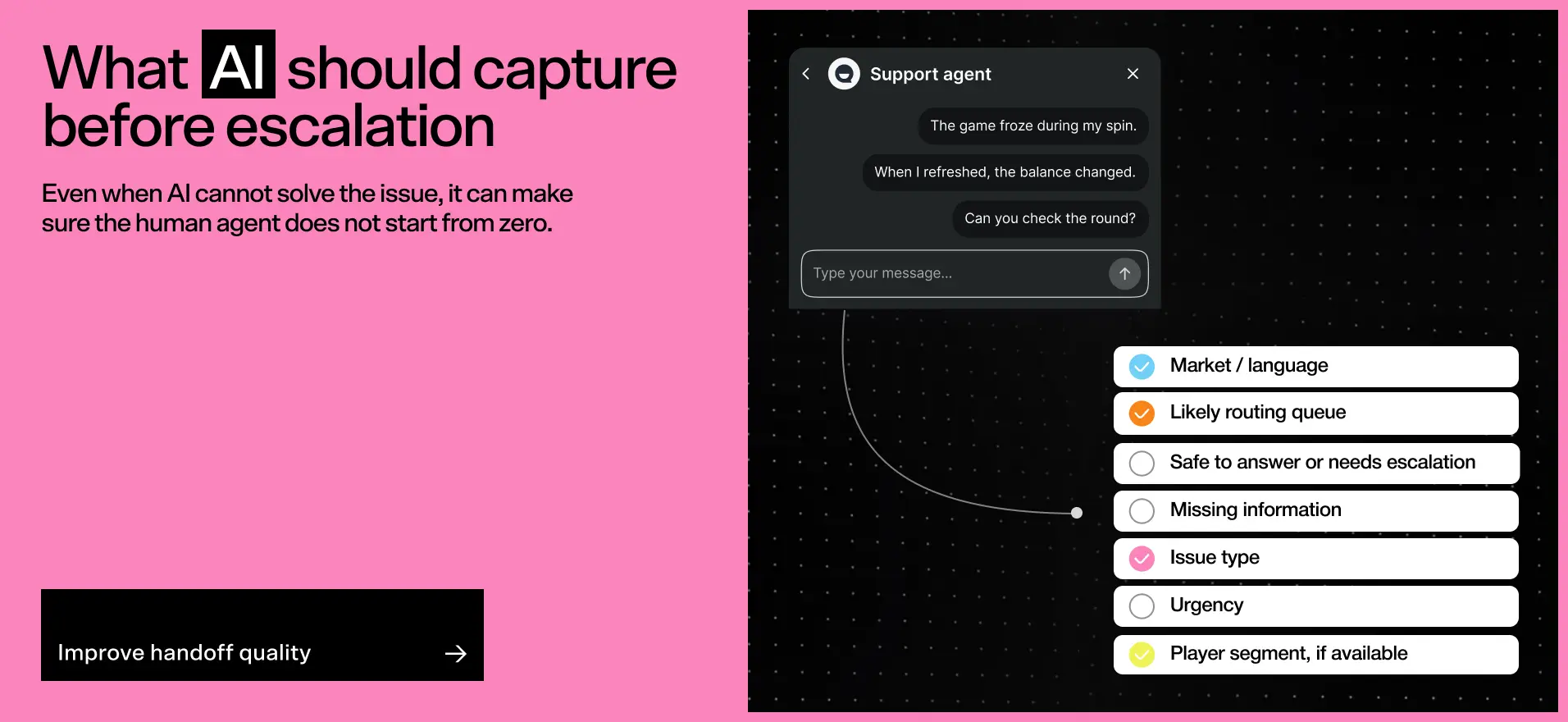
A good AI support layer should identify the issue type, missing information, urgency, player segment if available, market and language, likely routing queue, and whether the case is safe to answer or should escalate.
That does not mean AI must resolve everything.
Even if the AI cannot solve the issue, it can still reduce support workload by making sure the human agent does not start from zero.
For support teams, that is a meaningful improvement.
If every repetitive case arrives with better context, agents can work faster.
If unclear cases are routed correctly, L2 receives fewer messy handoffs.
If sensitive cases escalate quickly, the player experience is safer.
And if low-risk questions are answered automatically, the team has more capacity for cases that need human judgement.
How AI can reduce repetitive support tickets without hurting CX
Good automation does not try to block players from support.
It removes repetitive friction and makes human support more focused.
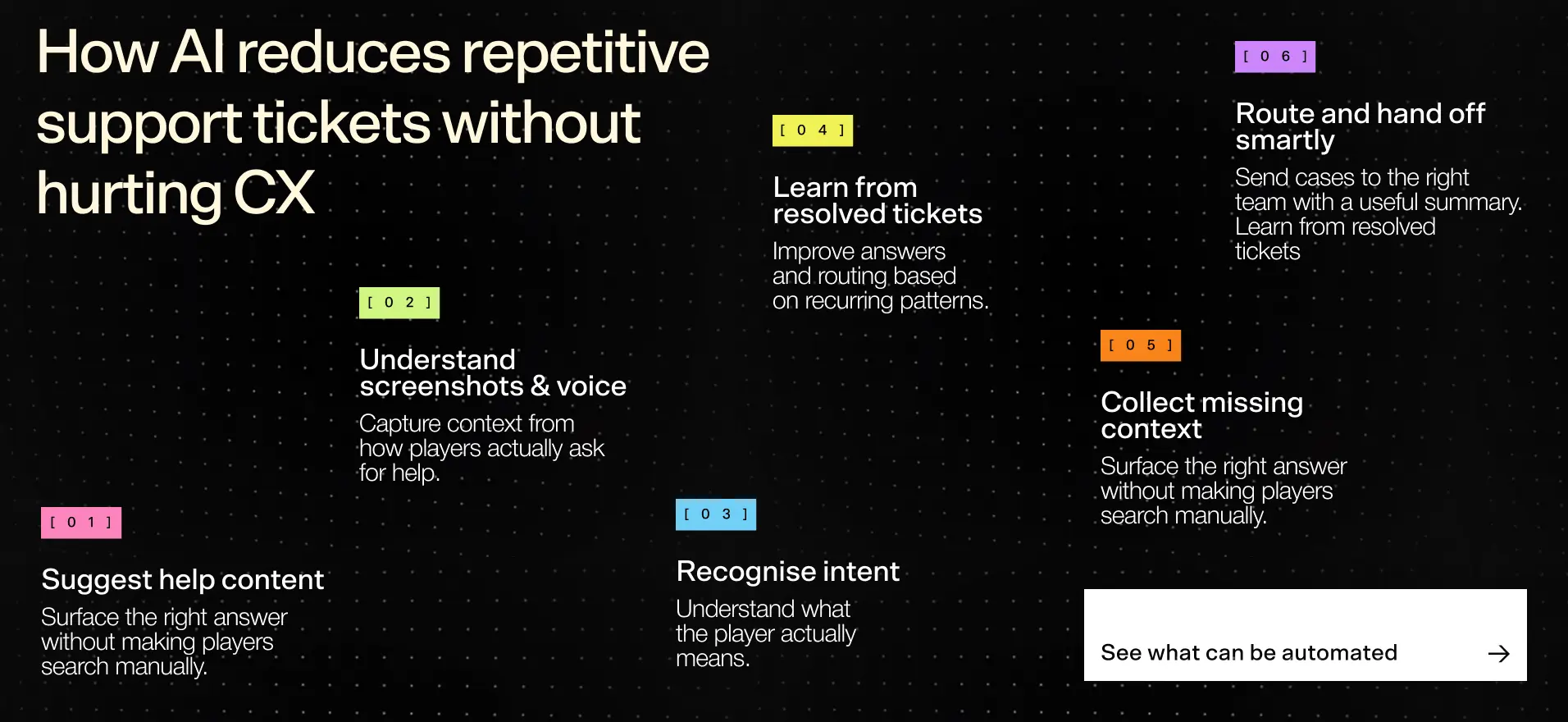
There are six practical ways AI can help reduce repetitive support tickets in iGaming.
1. Intent recognition
AI can identify what the player is actually asking, even when the message is messy.
For example:
“Where is my money?” may mean a withdrawal issue.
“I didn’t get it” may relate to a bonus, deposit, free spins, cashback, or game result.
“Why pending?” may refer to payment, KYC, withdrawal, or account review.
Intent recognition helps the system choose the right next step instead of pushing the player into a generic flow.
This is especially important in iGaming because many support categories overlap.
Payments, bonuses, KYC, and account status often connect to each other.
2. Help content suggestions
AI can surface the right article or guided answer without making the player search manually.
This works well for repetitive, low-risk questions such as bonus terms, verification steps, account navigation, password reset, common payment method guidance, or basic deposit and withdrawal instructions.
The key is relevance.
Players do not need a random FAQ link.
They need the right answer for the issue they actually asked about.
3. Screenshot and voice understanding
Players do not always type clean explanations.
They send screenshots.
They send voice notes.
They upload error screens, payment status pages, bonus progress images, account messages, or game issues.
AI that can understand screenshots and voice can capture context that text-only automation misses.
For example, a screenshot may show a pending transaction, a bonus progress bar, a KYC prompt, or a game error.
A voice note may explain the sequence of events more clearly than a short text message.
This helps the support layer classify the issue, ask better follow-up questions, and route the case more accurately.
4. Context collection
AI can ask the right follow-up questions before routing.
This is one of the most useful applications for support teams.
For a withdrawal issue, AI can ask about request time, payment method, verification status, and screenshot.
For a game error, AI can ask about game name, device, browser, timestamp, and balance impact.
For a bonus issue, AI can ask for promotion name, free spins status, wagering progress, or error message.
This reduces the number of cases that reach agents with missing details.
It also helps players feel guided rather than ignored.
5. Smart routing and handoff
AI can route payments, bonuses, KYC, technical, VIP, or sensitive issues to the right place.
But routing is only part of the value.
The handoff matters too.
When a case reaches a human agent, the AI should pass the issue summary, player intent, collected details, screenshot or voice summary if available, suggested queue, urgency, and reason for escalation.
That helps the agent continue the conversation instead of restarting it.
Smart handoff reduces repeated questions and improves support quality.
6. Learning from resolved tickets
Support teams already have valuable knowledge in resolved conversations.
AI can learn from recurring patterns and operator-approved resolutions.
This can help improve answers, identify missing help content, refine routing logic, and spot topics that should be automated next.
For example, if many players ask the same bonus question after every campaign launch, the AI support layer can help identify that pattern.
If many cases are escalated with missing transaction details, AI can start collecting those details earlier.
If players repeatedly re-contact support after a certain automated answer, the answer may need improvement.
This is how AI support becomes an operational layer, not just a chatbot.
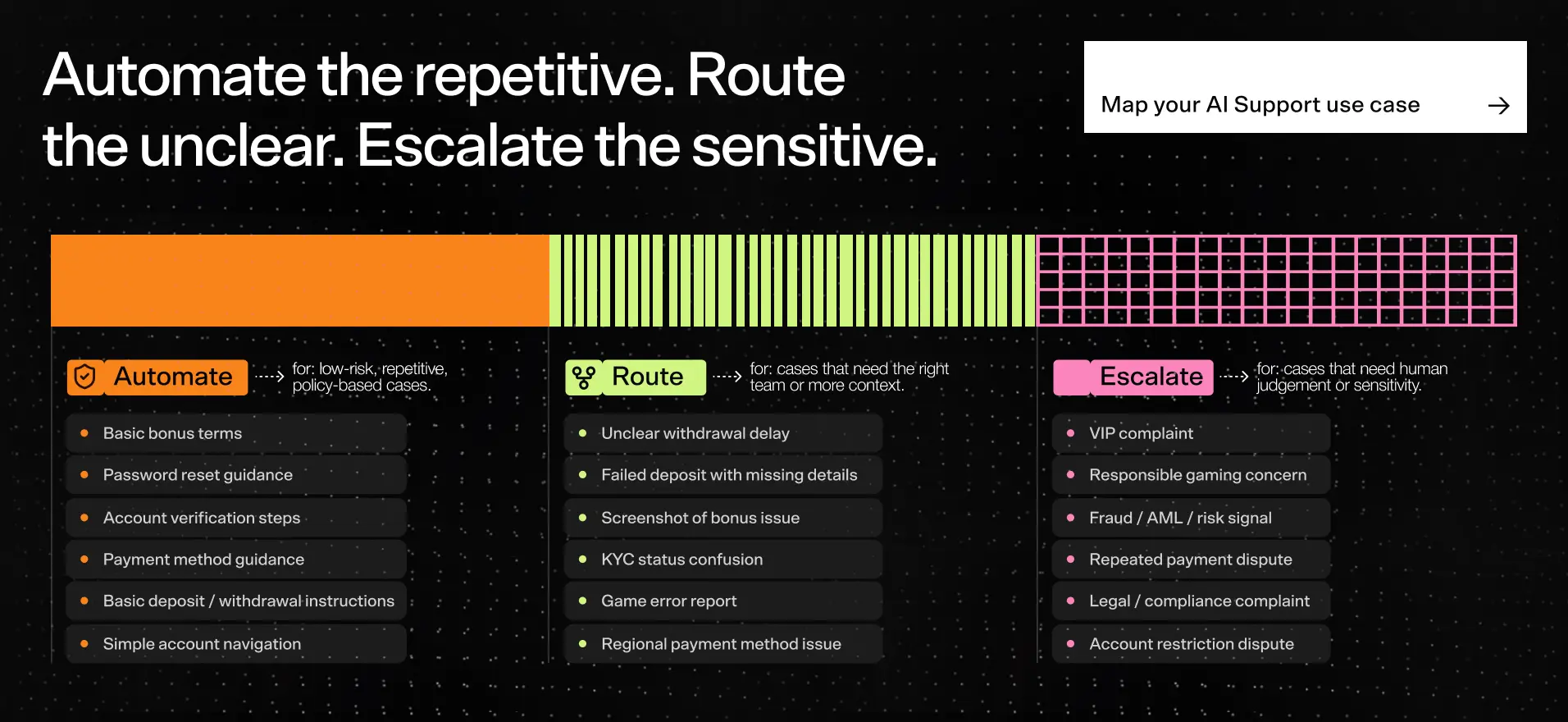
What should be automated, routed, and escalated?
The target is not to automate everything.
The target is to automate the repetitive, route the unclear, and escalate the sensitive.
This framework helps support teams apply AI without damaging player experience.
These cases are usually safe to answer when the information is clear and approved.
Route
Route cases that need the right team or more context.
Examples include:
Unclear withdrawal delay.
Failed deposit with missing details.
Screenshot of bonus issue.
KYC status confusion.
Game error report.
Regional payment method issue.
Account access issue with incomplete information.
Payment provider issue.
These cases may not need immediate senior intervention, but they do need correct classification and clean handoff.
AI can collect context and route them properly.
Escalate
Escalate cases that require human judgement, sensitivity, or specialist ownership.
Examples include:
VIP complaint.
Responsible gaming concern.
Fraud, AML, or risk signal.
Repeated payment dispute.
Legal or compliance complaint.
Angry high-value player.
Account restriction dispute.
Sensitive KYC issue.
Anything involving player safety.
These cases should not be trapped inside automation.
AI can identify them, collect limited context where appropriate, and escalate quickly.
This is how support automation protects player experience.
It does not hide the human team.
It brings the human team in at the right moment.
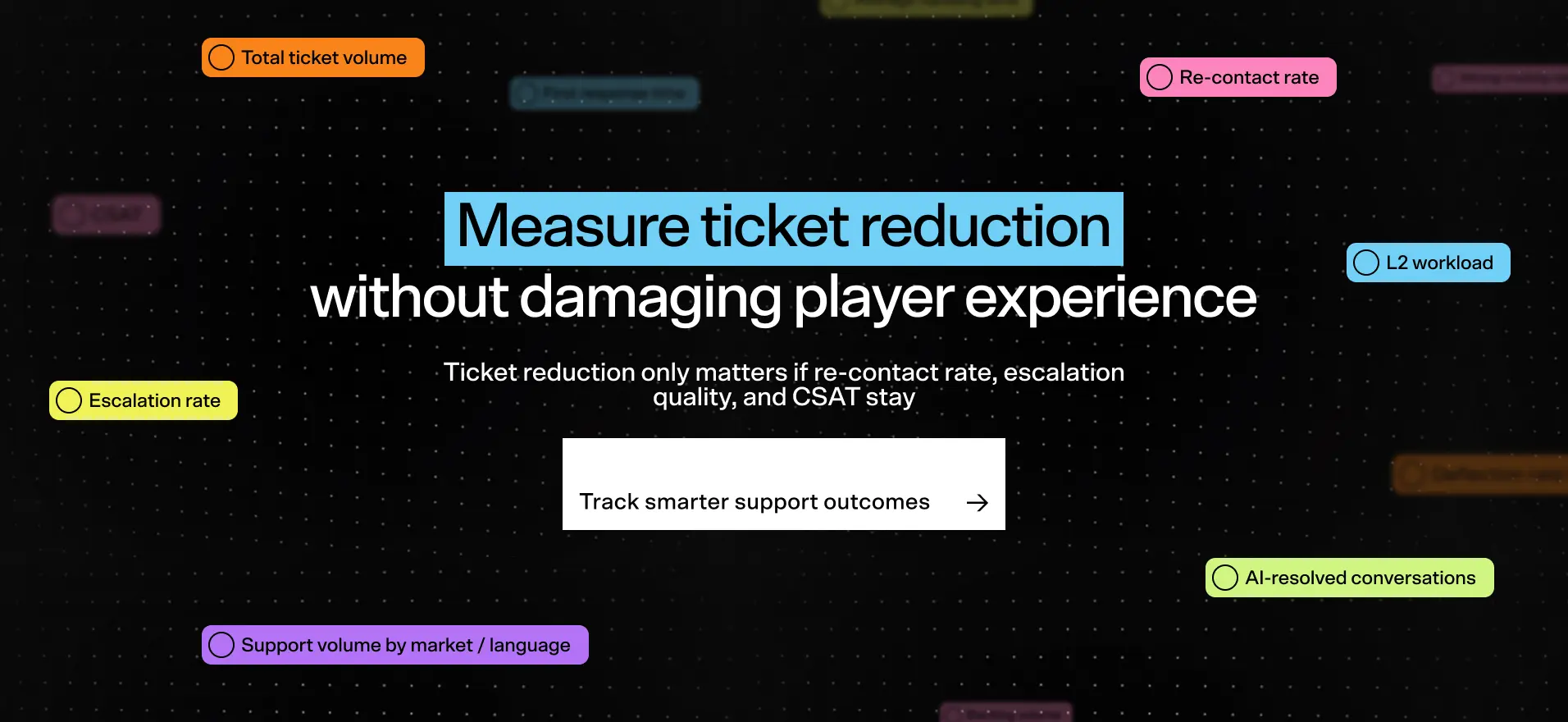
Metrics to track when trying to reduce support tickets
Ticket reduction only matters if player experience does not suffer.
Always measure deflection together with re-contact rate, escalation quality, and CSAT.
Useful metrics include:
Total ticket volume.
Repetitive ticket volume by topic.
AI-resolved conversations.
Deflection rate by topic.
Escalation rate.
Wrong-routing rate.
Average handling time.
First response time.
Re-contact rate.
Backlog volume.
CSAT.
L2 workload.
Agent time spent on repetitive cases.
Cost per resolved case.
Support volume by market and language.
Cases escalated with complete context.
Screenshot or voice-supported cases.
These metrics help operators avoid the common trap of measuring only volume.
A lower ticket count can look good, but if players are contacting again, CSAT is dropping, or sensitive cases are not escalating properly, the automation is not working.
For iGaming teams, the strongest support automation results usually combine three outcomes:
Fewer repetitive cases reaching agents.
Cleaner context for cases that do escalate.
Stable or improved player experience.
That is the balance to aim for.
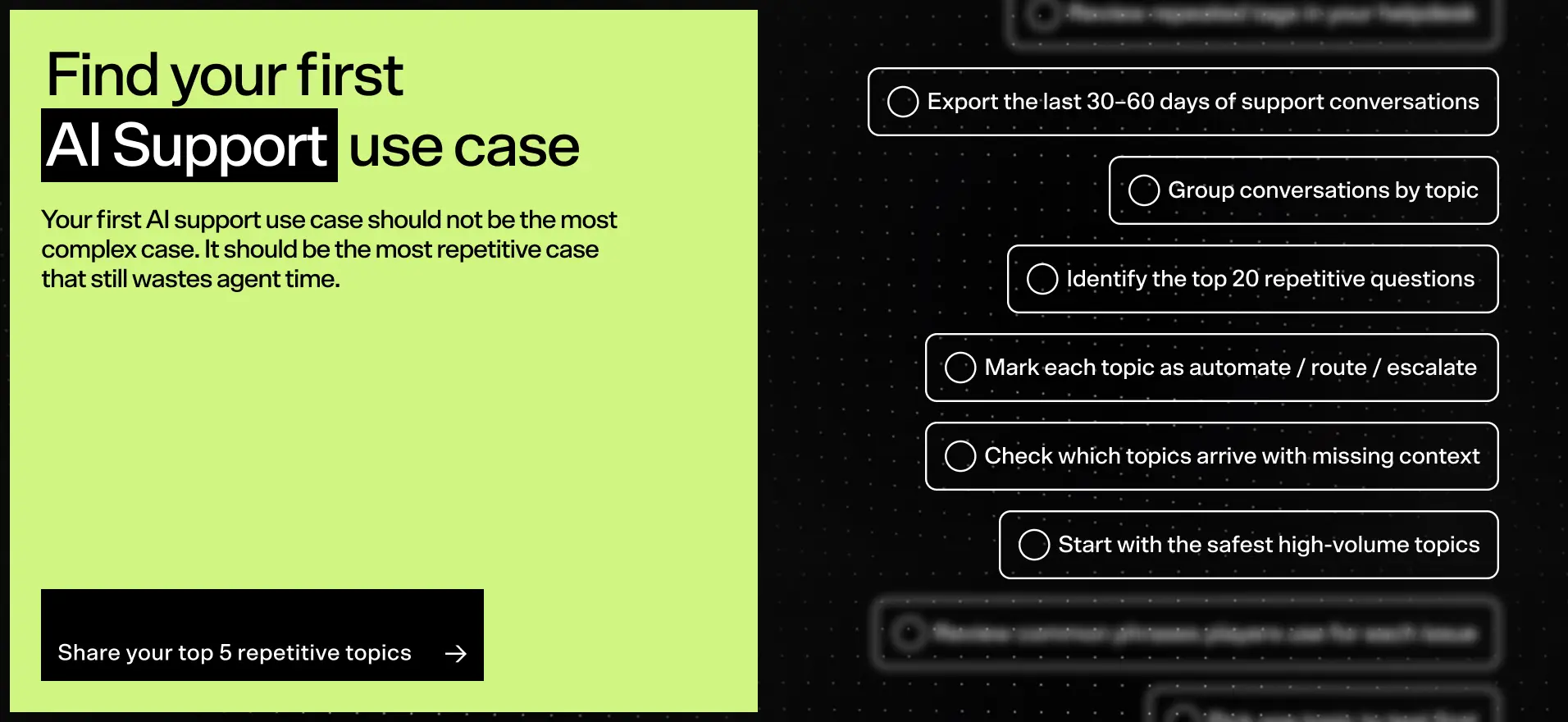
How to identify your top repetitive support topics
Before adding AI support, you need to understand where repetitive workload actually comes from.
Start with a simple process.
Step 1: Export the last 30–60 days of support conversations
Pull conversations from your support platform, live chat, email, or ticketing system.
You do not need a perfect data science project to start.
You need a practical view of what your team handles every day.
Step 2: Group conversations by topic
Look for recurring categories such as:
Deposits.
Withdrawals.
Bonuses.
KYC.
Account access.
Game errors.
Payment methods.
Promotion eligibility.
Screenshots without explanation.
Voice note complaints.
Account restrictions.
This will show which support topics repeat most often.
Step 3: Identify the top 20 repetitive questions
Focus especially on payments, withdrawals, bonuses, KYC, account access, and game issues.
These are often the categories that create the biggest combination of volume, frustration, and agent workload.
You may find that a small number of topics represent a large share of support conversations.
Those are your AI support opportunities.
Step 4: Mark each topic as automate, route, or escalate
This becomes your first AI support map.
For example:
Password reset guidance: automate.
Bonus terms: automate.
Withdrawal delay with missing details: route.
Failed deposit with screenshot: route.
Responsible gaming concern: escalate.
VIP complaint: escalate.
This helps avoid over-automation.
Step 5: Check which topics arrive with missing context
These are high-value for AI context collection.
If agents repeatedly ask the same follow-up questions, AI can ask them earlier.
For example:
Payment method.
Transaction time.
Promotion name.
Verification status.
Game name.
Device or browser.
Screenshot.
Market or language.
This reduces manual back-and-forth and improves handoff quality.
Step 6: Start with the safest high-volume topics
Your first AI support use case should not be the most complex case.
It should be the most repetitive case that still wastes agent time.
Start where the answer is clear, the risk is low, and the support load is visible.
Then expand gradually.
Add more topics, routing logic, languages, integrations, and backend-aware support only when the first use case proves value.
That is how AI support becomes practical instead of overbuilt.
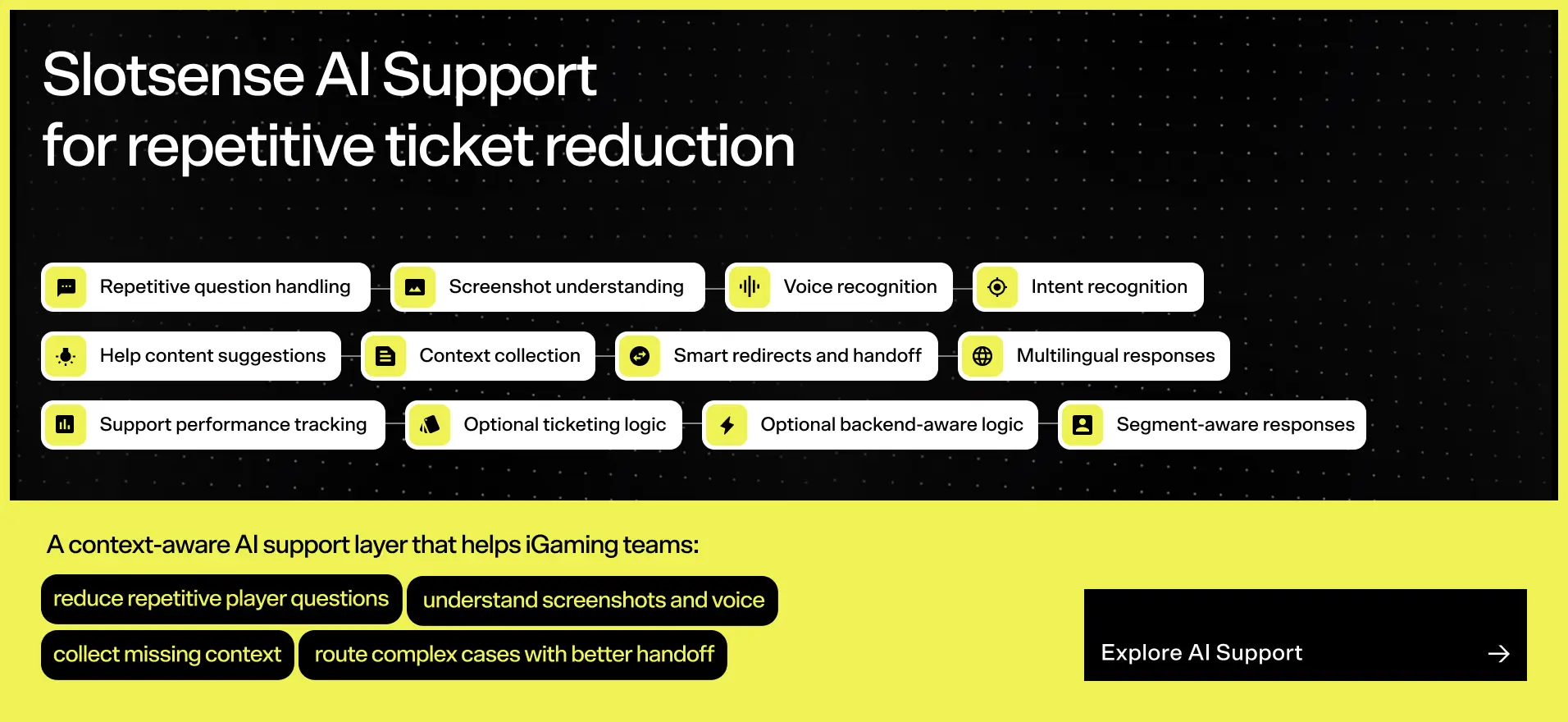
Where Slotsense AI Support fits
Slotsense AI Support is built for the repetitive, messy reality of iGaming support.
It helps operators reduce repetitive player questions, understand screenshots and voice, recognise player intent, suggest relevant help content, collect missing context, route complex cases with better context, support multiple markets and languages, train on resolved tickets, and track support performance.
The goal is not to replace your support team.
The goal is to keep repetitive, low-value work from consuming the team’s time.
Slotsense can help operators create a smarter first-line support layer that handles common questions, prepares unclear cases, and escalates sensitive issues properly.
Advanced capabilities can include ticketing logic, backend-aware support logic, deposit or withdrawal status checks, bonus eligibility checks, and deeper support platform integration.
This means operators can start with repetitive support reduction and expand over time as the use case proves value.
For example, a team may start by automating common bonus, deposit, and account access questions.
Then add screenshot and voice understanding.
Then improve smart handoff for payment, KYC, and technical cases.
Then connect deeper support or backend logic where needed.
This modular approach matters because most operators do not need a huge AI transformation project on day one.
They need relief from the support categories that repeat every day.
That is where AI support should start.
FAQ: reducing support tickets in iGaming
How can iGaming operators reduce support tickets?
Operators can reduce support tickets by identifying repetitive support topics, automating low-risk questions, collecting missing context before escalation, improving routing, and using AI support for common player issues.
What are the most common repetitive support tickets in iGaming?
Common repetitive tickets include deposit issues, withdrawal questions, bonus and wagering clarification, KYC or verification problems, login issues, account access, game errors, screenshots, and incomplete player questions.
Can AI support automate payment and withdrawal questions?
AI can help with common payment and withdrawal guidance, collect missing context, and route complex cases. Sensitive or backend-dependent cases should be escalated or handled with deeper integration.
Will AI support replace human agents?
No. AI support should reduce repetitive workload and improve context before escalation. Human agents remain essential for complex, sensitive, VIP, compliance, and high-risk cases.
Final thoughts
Repetitive support tickets will not disappear because an operator adds another FAQ page.
Players will still ask about deposits, withdrawals, bonuses, KYC, account access, screenshots, and unclear issues.
The question is whether every one of those cases needs to consume human support time from the first message.
Modern AI support can reduce repetitive workload by answering what is safe, collecting context for what is unclear, and escalating what needs a human.
That is how iGaming teams reduce support tickets without weakening the player experience.
The best support automation does not push players away from support.
It helps them get the right support faster.
And it gives human agents more time for the cases where they are actually needed.
Send us your top 5 repetitive support topics
We’ll help you identify which player questions can be automated, which should be routed, and which should always stay with human agents.


.png)
.png)