AI in iGaming 2026: The Guide to Player-Facing AI
Explore AI in iGaming 2026: player-facing AI for support, game discovery, retention, real-time triggers, AI avatars, and responsible escalation.
18 min
·
July 2, 2026
Explore AI in iGaming 2026: player-facing AI for support, game discovery, retention, real-time triggers, AI avatars, and responsible escalation.
In 2026, the most useful AI in iGaming will not be the loudest chatbot.
It will be the layer that understands what a player needs in the moment.
Most operators already have CRM systems, support tools, campaigns, help centres, segmentation, product teams, and dashboards. The problem is not a lack of tools. The problem is that player behaviour moves faster than most workflows.
A player gets stuck during a withdrawal.
A new user cannot find a game.
A VIP sends a frustrated message.
A churn-risk player shows warning signs inside the session.
A support case arrives with a screenshot instead of a clear explanation.
A player opens five games, leaves each one quickly, and disappears.
That is where player-facing AI becomes valuable.
It helps operators act inside the player journey — not hours later, not through another static flow, and not by forcing support, CRM, or product teams to untangle every case manually.
The next phase of AI in iGaming 2026 is not about adding “a bot” somewhere on the site.
It is about giving operators a real-time AI layer that can understand the player moment and decide what should happen next.

Player-facing AI is AI that interacts with or directly supports the player experience.
It is different from internal AI.
Internal AI helps teams work faster. It might summarise reports, assist agents, generate campaign ideas, analyse data, or help product teams make decisions.
That has value.
But player-facing AI changes what the player experiences.
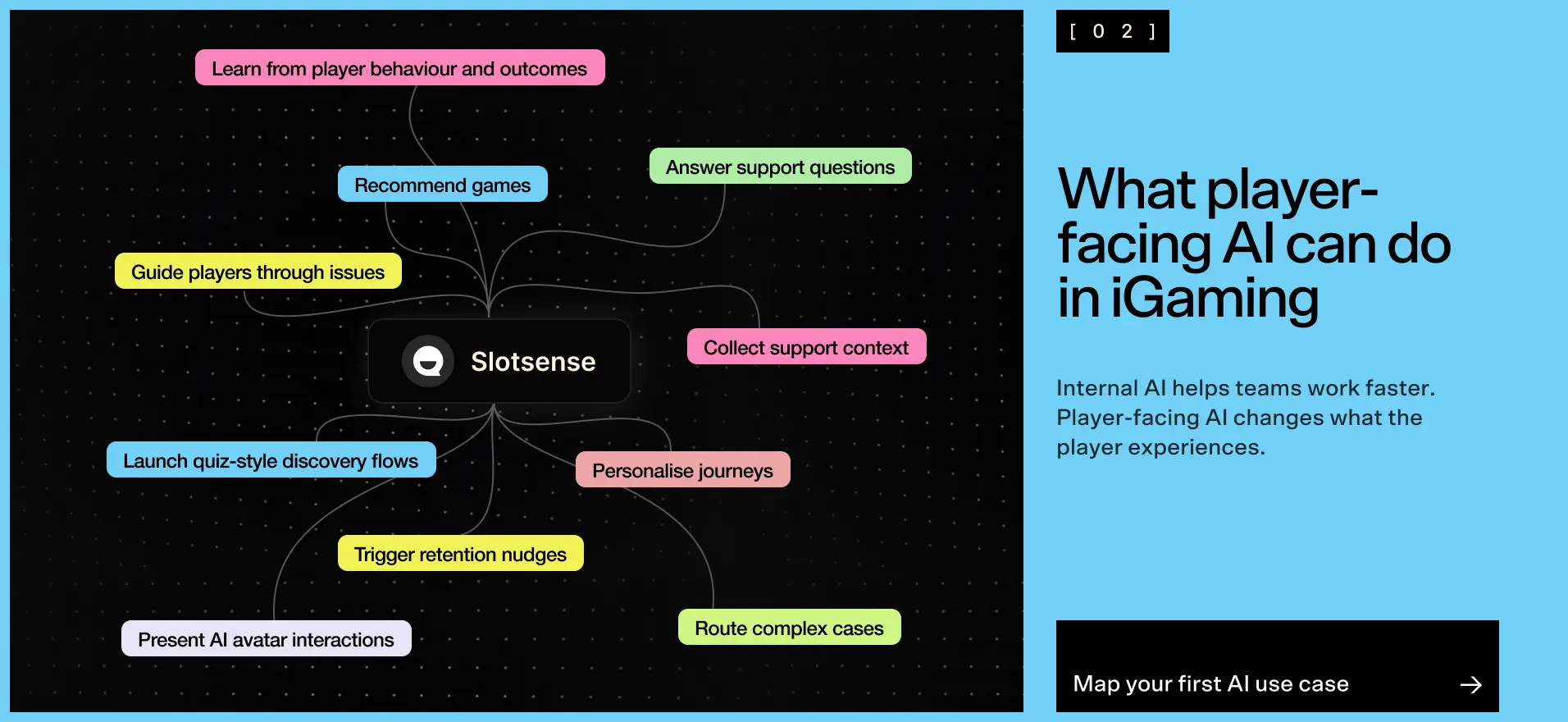
It can answer support questions, guide players through issues, recommend games, launch quiz-style discovery flows, trigger retention nudges, personalise journeys, collect missing support context, route complex cases, present AI avatar interactions, and learn from player behaviour and outcomes.
In other words, player-facing AI sits closer to the player moment.
It is not only looking at what happened afterwards. It can help while the player is still active, uncertain, frustrated, curious, or at risk of leaving.
For operators, the real value is not simply “using AI.”
The value is using AI at the point where player behaviour, support friction, and retention risk actually happen.
That distinction matters.
A dashboard can show that players are dropping off after registration.
A CRM campaign can send a message later.
A support ticket can be reviewed after the issue becomes visible.
But player-facing AI can act inside the journey.
It can help a new player find a relevant game.
It can recognise a repetitive support question and answer it instantly.
It can collect missing context before an issue reaches an agent.
It can trigger a nudge when a player is stuck.
It can escalate sensitive cases instead of forcing them through generic automation.
That is why player-facing AI is becoming its own category.
Not a chatbot.
Not a CRM replacement.
Not a helpdesk replacement.
Not a generic personalisation engine.
A layer that helps operators respond to real player behaviour in real time.
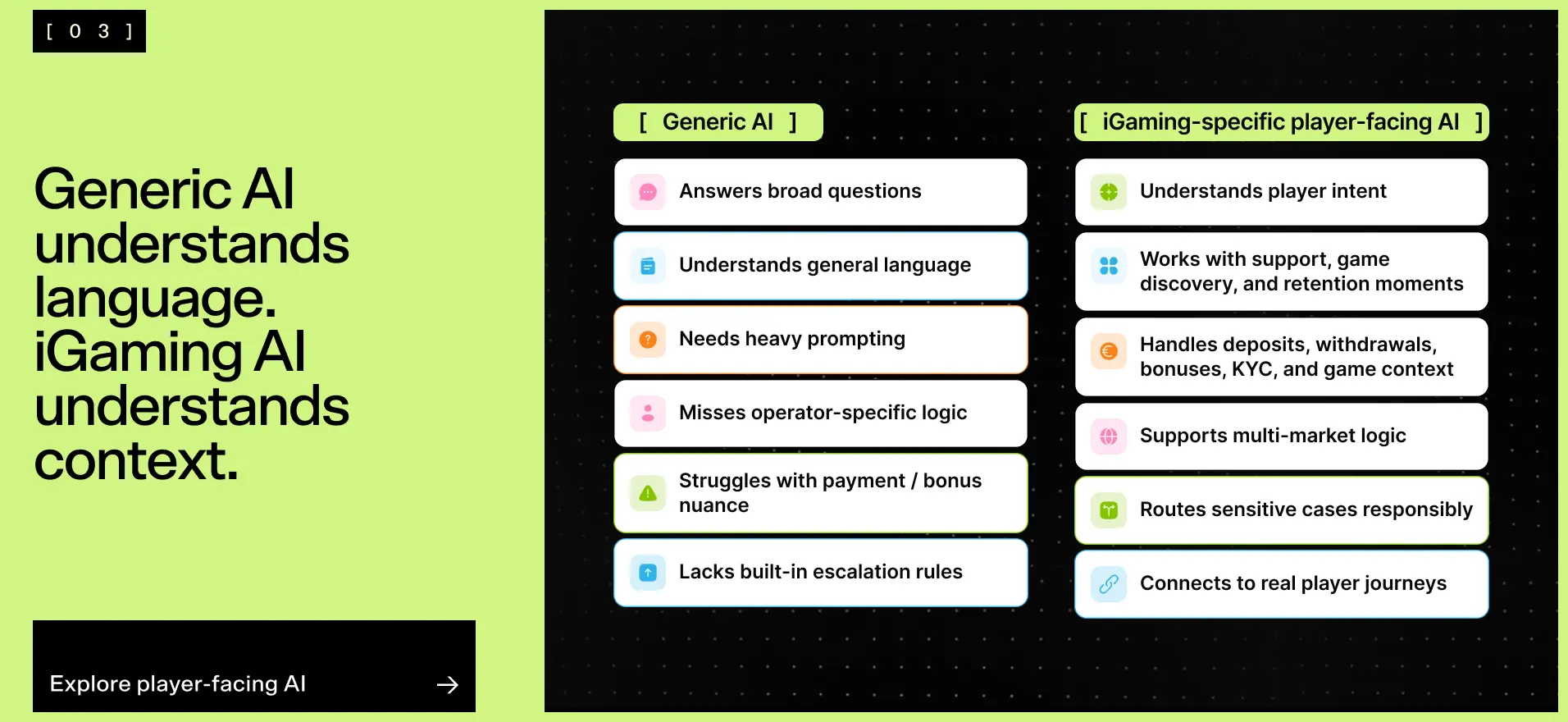
A generic AI assistant may understand language.
That does not mean it understands iGaming.
This is one of the biggest mistakes operators can make when evaluating AI tools.
iGaming has its own operational context. Player conversations are tied to money, trust, urgency, bonuses, KYC, withdrawals, account access, payment methods, game behaviour, VIP relationships, compliance, and responsible escalation.
That makes the environment very different from a normal ecommerce chatbot or generic SaaS assistant.
A player asking “Where is my money?” is not asking a simple FAQ question.
The issue could involve a pending withdrawal, payment provider delay, unfinished KYC, bonus wagering restrictions, account review, regional payment rules, or a technical issue in the cashier.
A player saying “bonus not working” could mean they are not eligible, the bonus expired, the terms were misunderstood, the game is restricted, the bet size exceeded a limit, or the promotion is not available in that market.
A player sending a screenshot of a frozen game is not only asking for technical support. There may also be a balance concern, a session issue, or a potential complaint.
This is why generic AI often fails in real operator environments.
It can produce a fluent answer, but the answer may not be operationally useful.
iGaming also has unique recommendation logic.
Game discovery is not the same as recommending a shirt, a movie, or a playlist. Players have preferences around volatility, theme, mechanics, provider, session style, risk appetite, bonus compatibility, and familiarity.
A recommendation layer needs to understand what the operator is trying to achieve as well: activation, engagement, session depth, responsible limits, campaign performance, and retention.
CRM and retention also have their own complexity.
Timing matters. Context matters. Player state matters.
A player who failed a deposit needs a different intervention from a player who is bored with the lobby. A player on a losing streak needs different handling from a player exploring new games. A VIP complaint needs a different route from a casual FAQ.
Multi-market operators have another layer of complexity: language, GEO, payment methods, bonus expectations, local player behaviours, support norms, and escalation rules.
Generic AI tools do not understand this out of the box.
They may understand words.
They do not automatically understand the operator environment those words belong to.
That is why the next phase of AI in iGaming needs to be more specialised, more contextual, and more connected to the player journey.
In 2026, operators will expect AI support to do more than answer basic questions.
The old standard was simple:
Can the bot answer FAQs?
Can it reduce some repetitive tickets?
Can it send players to the help centre?
That is no longer enough.
Real iGaming support is messy.
Players send incomplete questions.
They attach screenshots.
They record voice notes.
They mix payment, bonus, KYC, and account questions in one message.
They get emotional around withdrawals or failed deposits.
They expect the support team to understand the full situation quickly.
Modern AI support needs to deal with that reality.
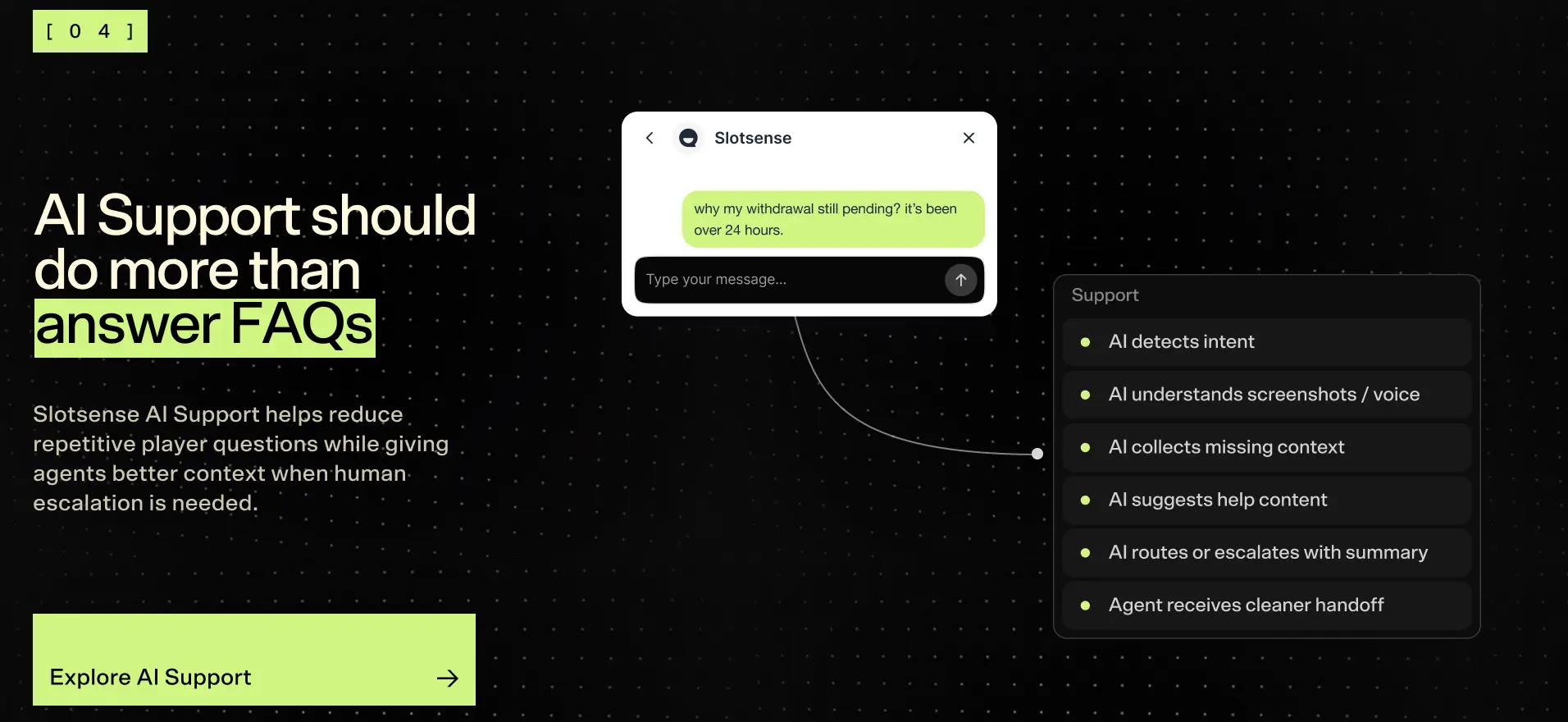
It should understand messy player questions, process screenshots, support voice inputs, suggest help content, collect missing context, route to the right team, escalate sensitive cases, learn from resolved tickets, and work across markets and languages.
For example, if a player sends a screenshot of a pending withdrawal, AI should not simply reply with a generic withdrawal FAQ.
It should identify that the issue is payment-related, understand what context may be missing, ask relevant follow-up questions, and route the case if account-level review is needed.
If a player sends a voice note about a failed deposit, AI should be able to transcribe it, summarise the issue, classify the intent, and prepare the case for the right team.
If a player asks about bonus eligibility, AI should suggest the right help content or collect the promotion details before escalation.
If a player mixes KYC and payment confusion in one message, AI should not force them through a rigid scripted path. It should understand that the issue may overlap across support teams.
This is where AI support becomes more than a chatbot.
It becomes a first-line support layer.
A good AI support layer does not replace human agents. It protects their time.
It reduces repetitive support load while helping agents receive cleaner context when human escalation is needed.
Slotsense AI Support is built around this shift: not a generic bot, but a support layer that understands player intent, captures context from screenshots and voice, routes cases intelligently, and escalates with better information.
The goal is not to keep every player away from an agent.
The goal is to make sure every player reaches the right answer, route, or human handoff faster.
Online casinos are not short on games.
They are short on relevance.
Many operators have huge lobbies, multiple providers, branded categories, campaign banners, featured games, new releases, jackpot sections, and search tools.
But for the player, the experience can still feel overwhelming.
Too many games.
No clear starting point.
Generic lobby recommendations.
Poor onboarding after registration.
Low engagement after sign-up.
Difficulty finding preferred game styles.
Promoted games that do not match player intent.
This is where player-facing AI can create value.
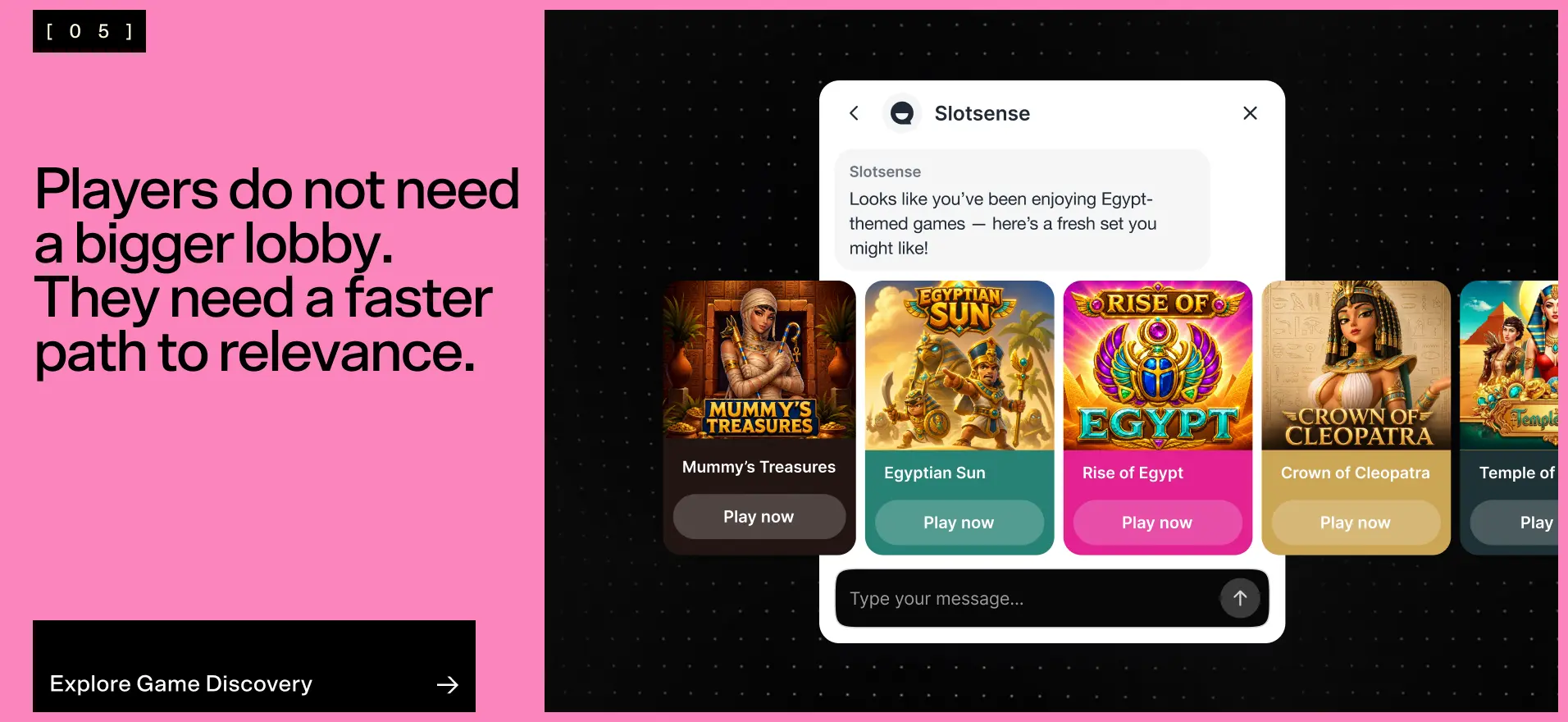
Players do not need a bigger lobby.
They need a faster path to a game that feels relevant.
Game discovery is one of the clearest player-facing AI use cases because it solves a visible problem: the player arrives, but does not know what to play.
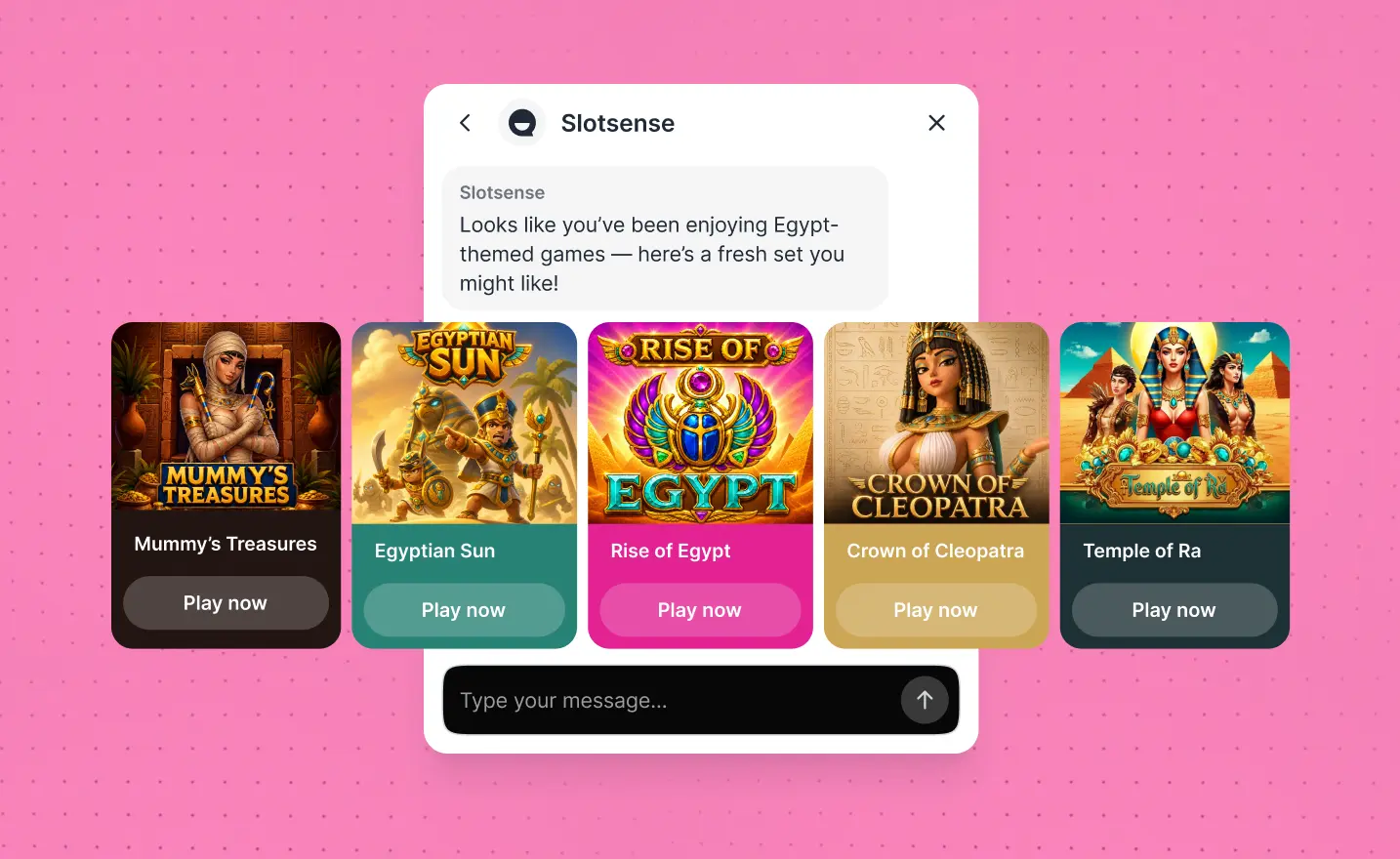
AI can help through recommendation quizzes, game assistants, preference capture, cold-start personalisation, personalised recommendations, onboarding flows, and game matching logic.
For example, a new player may not know whether they prefer high-volatility slots, bonus-heavy games, classic mechanics, branded themes, low-stakes casual play, or fast sessions.
A quiz-style discovery flow can capture preferences quickly and recommend games that feel more relevant than a generic lobby.
This is especially useful for cold-start personalisation.
Before an operator has enough behavioural data, AI can ask better questions.
What type of experience are you looking for?
Do you prefer simple mechanics or feature-rich games?
Are you in the mood for quick play or longer sessions?
Do you like familiar themes or something new?
Do you want bonus features, jackpots, or classic slots?
That preference data can then support recommendations, onboarding, segmentation, and future journeys.
This is where Slotsense Quiz and game recommendation flows create an easy entry point.
Operators can start with game discovery before building deeper real-time trigger logic.
It is a lighter, more measurable way to introduce player-facing AI into the journey.
And it solves a real product problem: helping players find something relevant faster.
CRM campaigns and lifecycle journeys are still important.
They are not going away.
But many retention moments happen inside the session, not hours later.
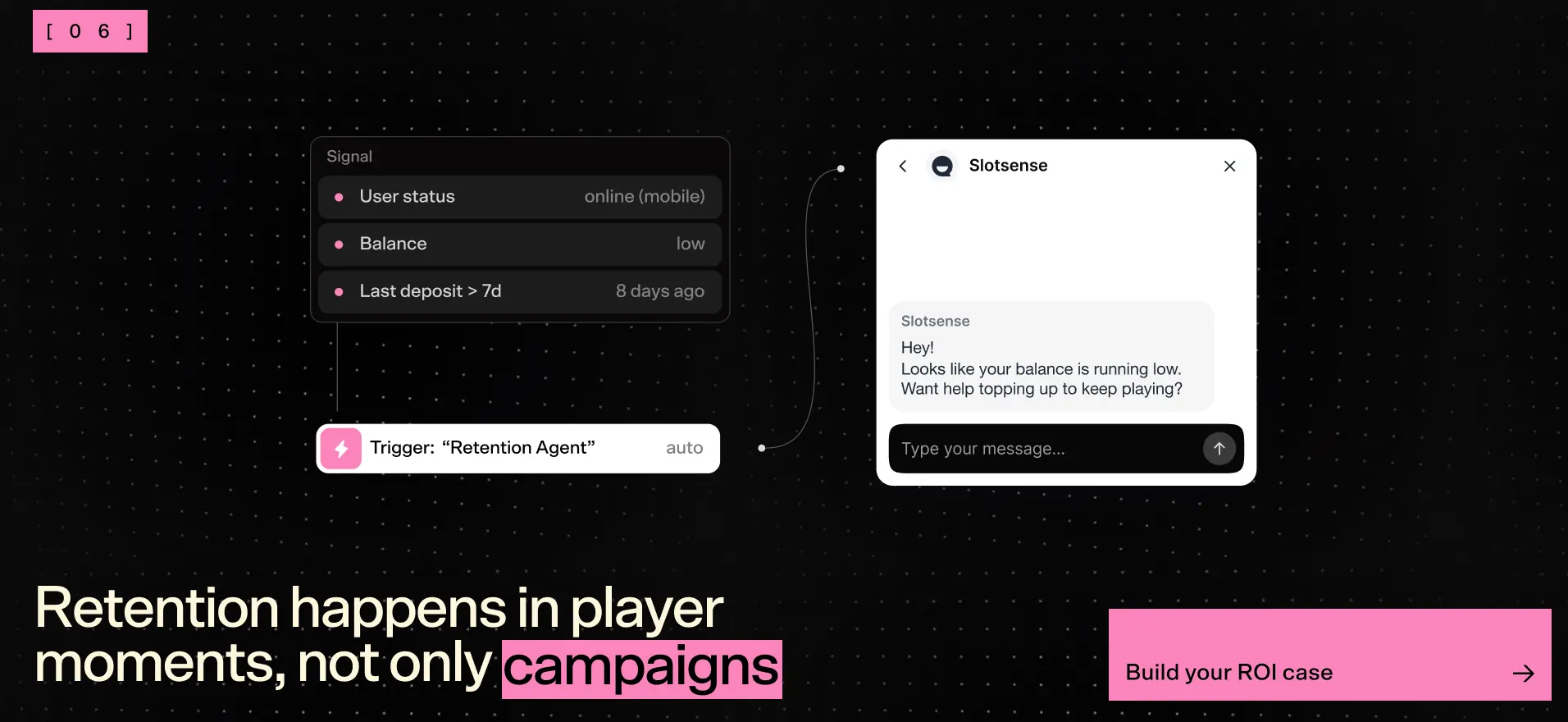
A player has a low balance.
A deposit fails.
A new user browses but does not engage.
A player switches games repeatedly.
A player shows signs of game fatigue.
A player seems stuck before the first deposit.
A bonus creates confusion.
A churn-risk player is active right now, but may not be active tomorrow.
Traditional CRM is often built around scheduled journeys, segments, and campaigns. That works for many use cases, but it does not always react fast enough to the live player moment.
Your CRM can send a message later.
Player-facing AI can react while the player is still deciding.
This is where real-time AI personalisation in casino environments becomes valuable.
The system can detect a player moment, choose the next best action, launch a nudge, recommend a game, trigger a gamified flow, offer support, avoid over-bonusing, or test which action performs best.
The point is not to bombard players with automated messages.
The point is to respond with more relevance.
A failed deposit may need support guidance, not a bonus.
A player switching games repeatedly may need better game recommendations.
A new player who is stuck after registration may need onboarding help.
A player showing signs of frustration may need careful escalation, not another promotion.
A churn-risk player may need a personalised journey before they disappear.
This is the shift from campaign-only retention to moment-based retention.
Slotsense Retention AI is designed for this gap: real-time triggers, segmentation, A/B testing, recommendations, nudges, randomizers, and gamified journeys inside the player experience.
The goal is not to replace CRM.
It is to add a player-facing layer that can react to behaviour while it is happening.
That is where the retention opportunity becomes more immediate.
AI avatars in iGaming are easy to misunderstand.
Used badly, they are just decoration.
A talking video. A novelty. A campaign gimmick.
Used well, they can become an interface.
That distinction matters.
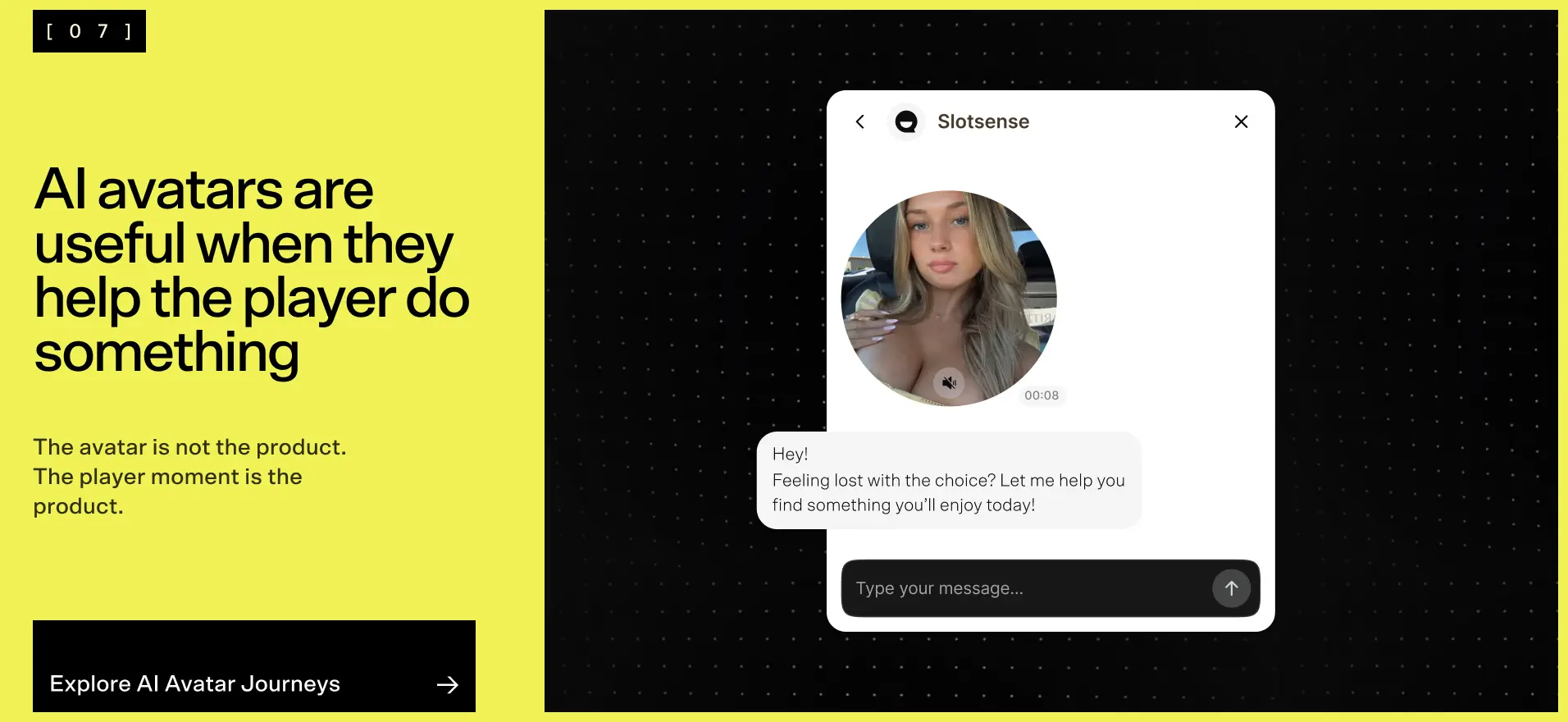
An AI avatar is only useful if it helps the player do something: understand, choose, resolve, continue, or come back.
Better use cases include support entry points, onboarding guidance, branded player assistance, VIP-style experiences, gamified campaigns, retention prompts, localised communication, and richer player-facing journeys.
For example, an avatar could guide a new player through game discovery.
It could introduce a quiz flow.
It could explain a promotion in a clearer, more engaging format.
It could appear as part of a retention journey.
It could support VIP-style communication for selected segments.
It could provide a more human-feeling entry point into support before handing off to chat or a human agent.
But avatars should not be treated as a replacement for support quality.
If the underlying support logic is weak, an avatar will not fix it.
If the recommendation is irrelevant, a video face will not make it useful.
If the message is poorly timed, a more visual interface may make it even more annoying.
AI avatars need clear use cases, tone, localisation, responsible boundaries, and integration with the actual player journey.
They should not be overused.
They should not pretend to be human in a misleading way.
They should not become a random layer of “AI theatre.”
Slotsense treats AI avatars as an optional interface layer for support, retention, onboarding, VIP, or gamified journeys — not as a standalone video toy.
The avatar is not the product.
The player moment is the product.
The avatar is one possible way to deliver that moment more effectively.
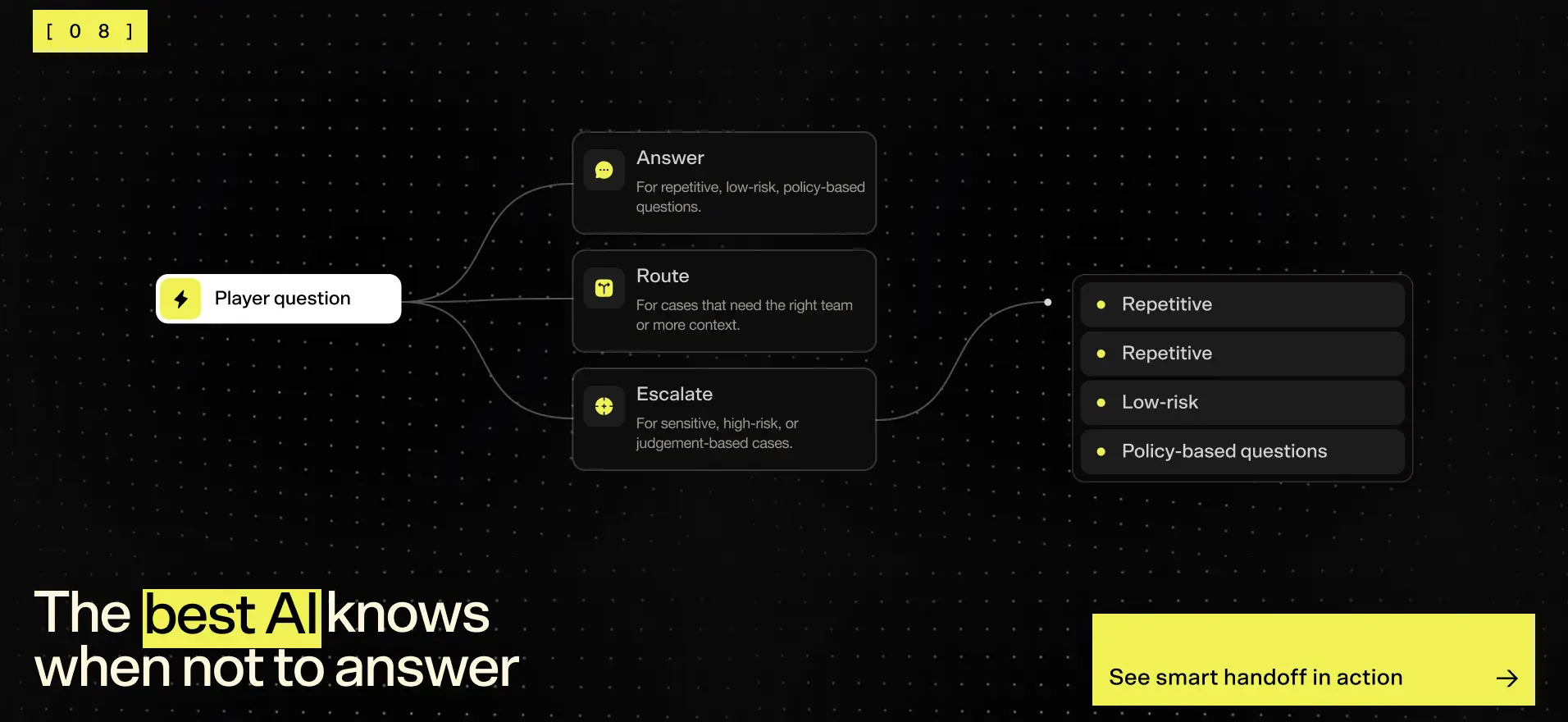
The more AI interacts with players, the more important escalation becomes.
In iGaming, AI should not try to answer everything.
That is not maturity.
That is risk.
The best AI support systems are not the ones that answer every question. They are the ones that know what to answer, what to route, and what to escalate.
Responsible escalation should be built into player-facing AI from the start.
AI should know when not to continue automation.
Cases that may need fast human or specialist escalation include responsible gaming concerns, VIP complaints, fraud or AML signals, risk indicators, payment disputes, legal or compliance issues, angry high-value players, account restrictions, complex KYC, and sensitive player behaviour.
This is not only a support issue.
It applies across the player journey.
A retention system should not blindly trigger incentives in every situation.
A support assistant should not over-handle sensitive messages.
A game recommendation flow should not ignore responsible boundaries.
An AI avatar should not deliver messages that should be handled by a human or specialist process.
This is especially important for operators working across complex markets, semi-regulated environments, and multi-brand structures where rules, expectations, and risk levels may vary.
Player-facing AI needs clear boundaries.
It should be able to escalate based on topic, urgency, player segment, language, market, risk level, or operator-defined rules.
It should also support smart handoff.
That means when a case reaches a human, the agent receives useful context: player intent, issue summary, collected information, screenshot or voice summary where available, suggested route, urgency, and reason for escalation.
Slotsense is designed to support smart handoff and escalation logic so human teams stay in control of sensitive cases.
That is the right model for iGaming.
AI should handle the repetitive and contextual work.
Humans should remain in control where judgement, empathy, compliance, or risk handling matters.
Player-facing AI gets more valuable when it can use real-time player events.
The richer the event layer, the better the system can understand the player moment.
Useful event types include:
Registration.
First deposit.
Deposit failed.
Withdrawal request.
Low balance.
Game launch.
Game exit.
Losing streak.
Session duration.
Bonus activation.
Support contact.
Inactivity.
Repeat deposit.
VIP or segment status.
Game switching.
Campaign interaction.
Player-facing AI can use these signals to decide what should happen next.
Should the player receive support guidance?
A game recommendation?
A quiz?
A nudge?
A retention journey?
A responsible escalation?
A VIP route?
No action at all?
But this does not mean every operator needs deep integration on day one.
In fact, trying to integrate everything first can slow down the project before value is proven.
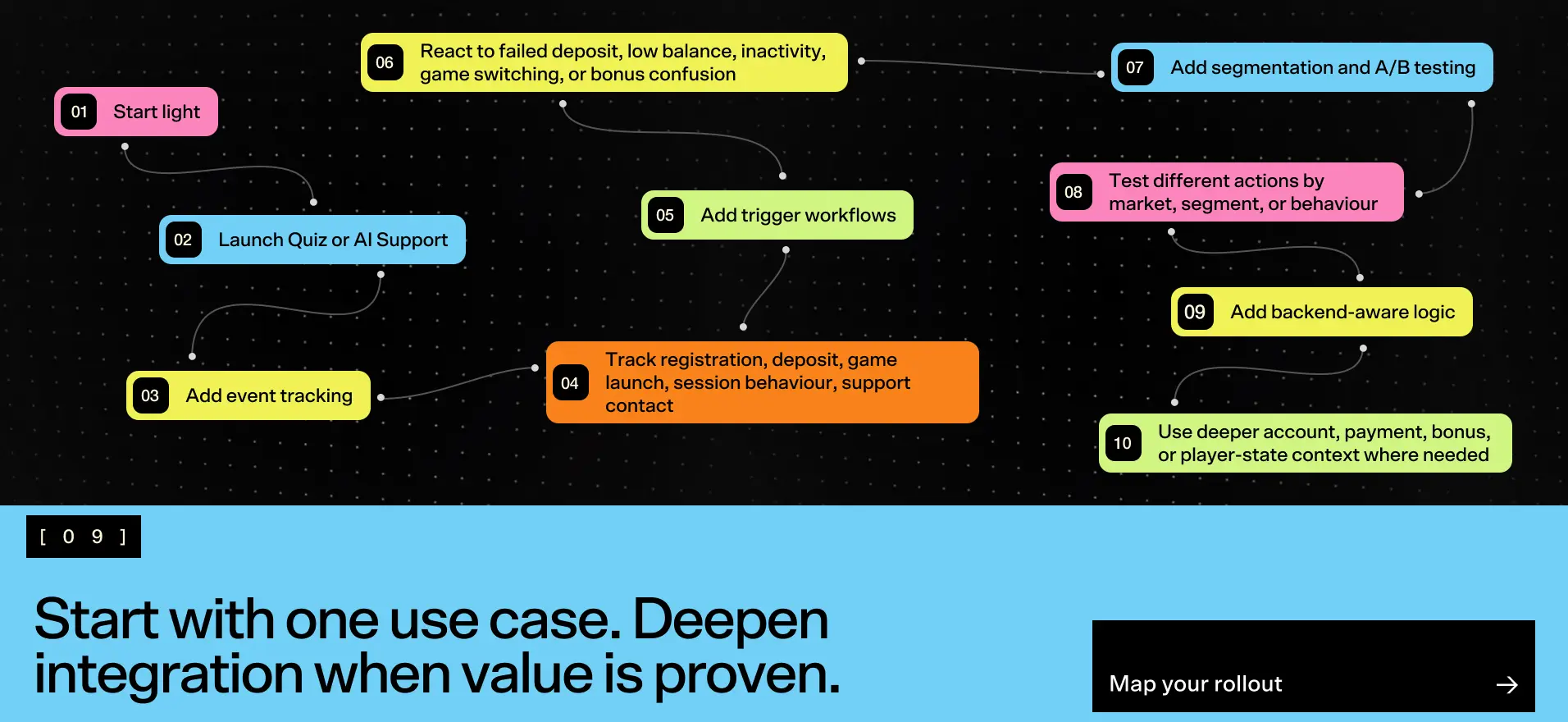
The smartest rollout is not “integrate everything first.”
It is to start with one measurable use case and deepen the integration when the value is proven.
For example, an operator might start with AI Support to reduce repetitive questions and improve handoff quality.
Or they might start with a game discovery quiz to improve onboarding and preference capture.
Or they might start with one Retention AI use case, such as a failed deposit trigger or a game discovery nudge for new players.
Then, once the first module shows value, the operator can add event tracking, trigger workflows, segmentation, A/B testing, backend-aware logic, and more advanced personalisation.
This modular approach is usually more practical.
It gives teams a way to learn before committing to a large technical build.
It also helps align product, CRM, support, and operations teams around real outcomes rather than abstract AI ambition.
Because AI value does not come from integration depth alone.
It comes from using the right data to improve the right player moment.
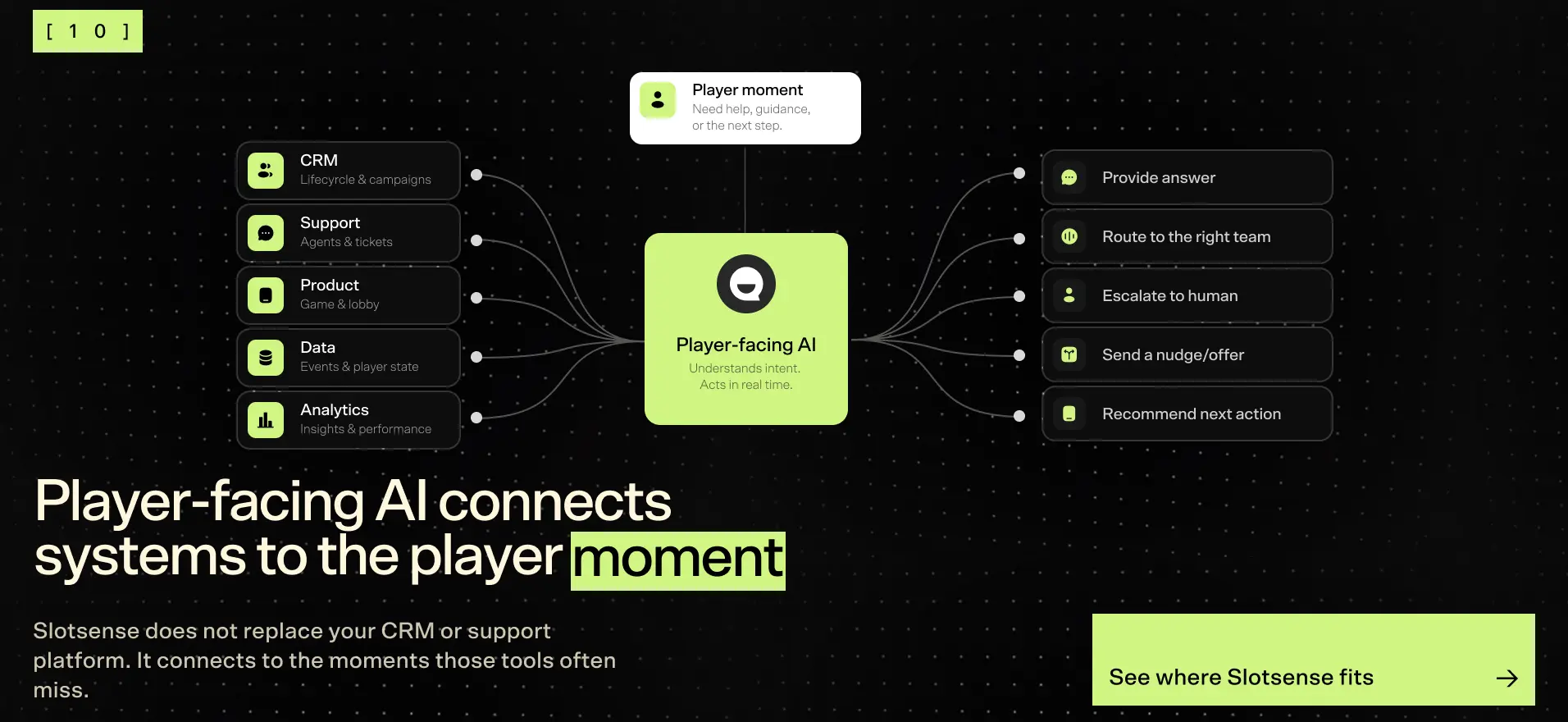
Player-facing AI should not be seen as a replacement for the operator’s existing stack.
It should be seen as a layer that connects player moments to the systems that already exist.
CRM manages campaigns and lifecycle communication.
The support stack manages agents, tickets, and queues.
Product controls the player experience.
The data layer holds events, segments, and player state.
Analytics shows what is happening.
Player-facing AI acts between those systems and the player moment.
It can use support content to answer a question.
It can use event data to trigger a retention action.
It can use game metadata to recommend relevant games.
It can use segmentation to adjust tone or routing.
It can use ticketing logic to create a support case.
It can use escalation rules to involve a human team.
Slotsense does not need to replace your CRM or support platform.
It connects to the moments those tools often miss: when the player is active, uncertain, frustrated, or ready for the next action.
That is an important distinction.
Most operators already have tools for managing workflows.
But workflows often happen after the moment has passed.
A support ticket is created after the player asks for help.
A CRM campaign goes out after a segment is built.
A product insight appears after behaviour is analysed.
Player-facing AI can sit closer to the moment itself.
That is where it becomes useful.
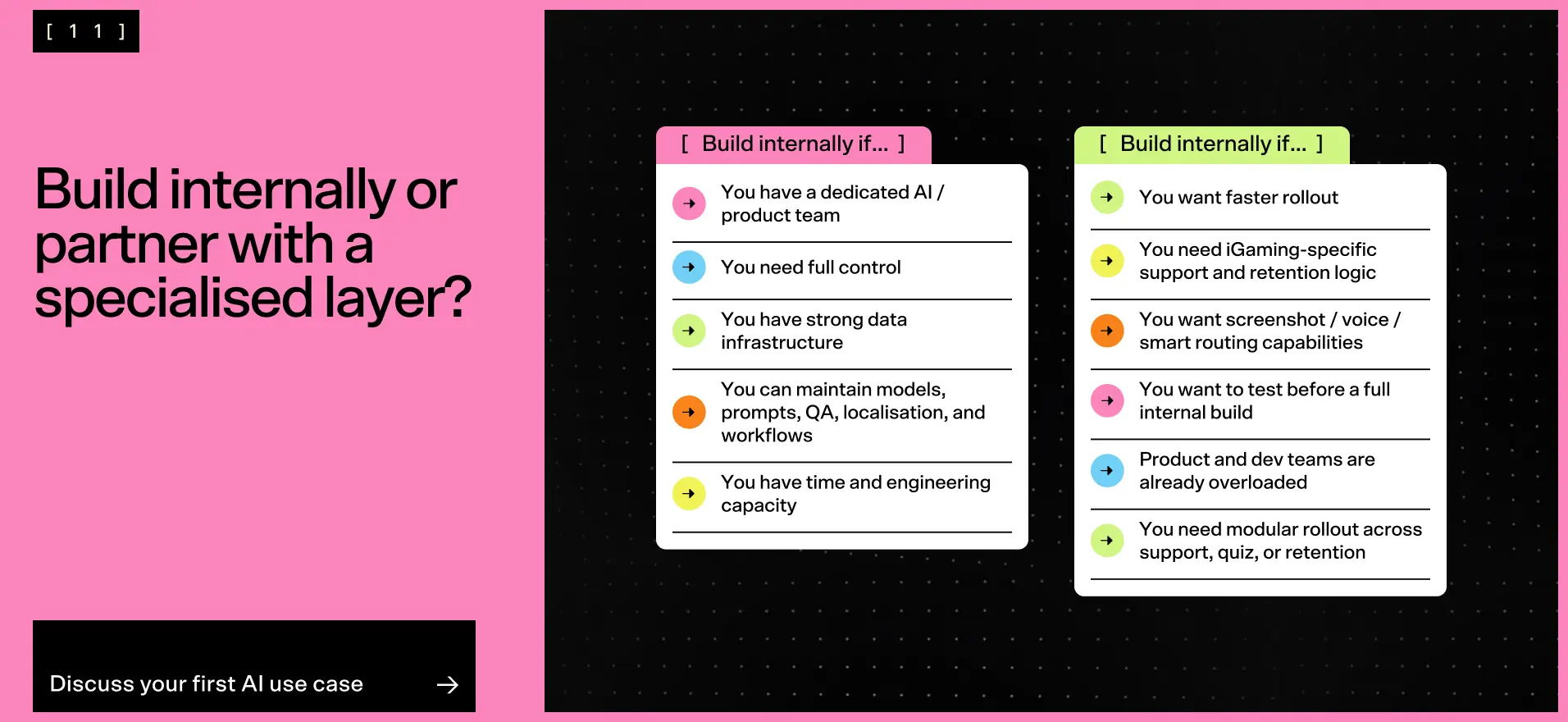
Many operators are asking whether they should build AI internally or partner with a specialised provider.
The honest answer is: it depends.
Building internally can make sense if you have a dedicated AI and product team, strong data infrastructure, available engineering capacity, clear ownership, and the ability to maintain models, prompts, workflows, QA, localisation, analytics, compliance rules, and ongoing optimisation.
It can also make sense if AI is a core strategic differentiator and the operator wants full control over every part of the system.
But internal builds come with a cost.
Not just development cost.
Ongoing maintenance.
Quality assurance.
Prompt management.
Model updates.
Localisation.
Support flow design.
Testing.
Monitoring.
Data boundaries.
Escalation rules.
Integrations.
Analytics.
Operational ownership.
Most operators can build something.
The real question is whether they should spend product and engineering capacity building every support, recommendation, and retention flow from scratch.
Buying or partnering may be a better option when you want faster rollout, iGaming-specific support logic, screenshot and voice understanding, smart routing, retention triggers without building everything from scratch, and a way to test before committing to a full internal build.
It can also make sense when your product and development teams are already overloaded with platform, payments, compliance, sportsbook, casino, CRM, or market expansion priorities.
A specialised layer gives operators a way to start with a defined use case and expand if the value is proven.
That is how Slotsense is designed: as a modular player-facing AI layer.
Operators can start with AI Support, Quiz, or Retention AI.
Then they can expand into more markets, triggers, segments, integrations, or AI avatar journeys when the use case is validated.
The build vs buy decision should not be ideological.
It should be practical.
Where do you need control?
Where do you need speed?
Where do you need iGaming-specific logic?
Where is your internal team’s time better spent?
Those are the questions that matter.
The operators that win with AI in 2026 will not be the ones that launch the most tools.
They will be the ones that connect AI to the right player moments and measure what actually changes.
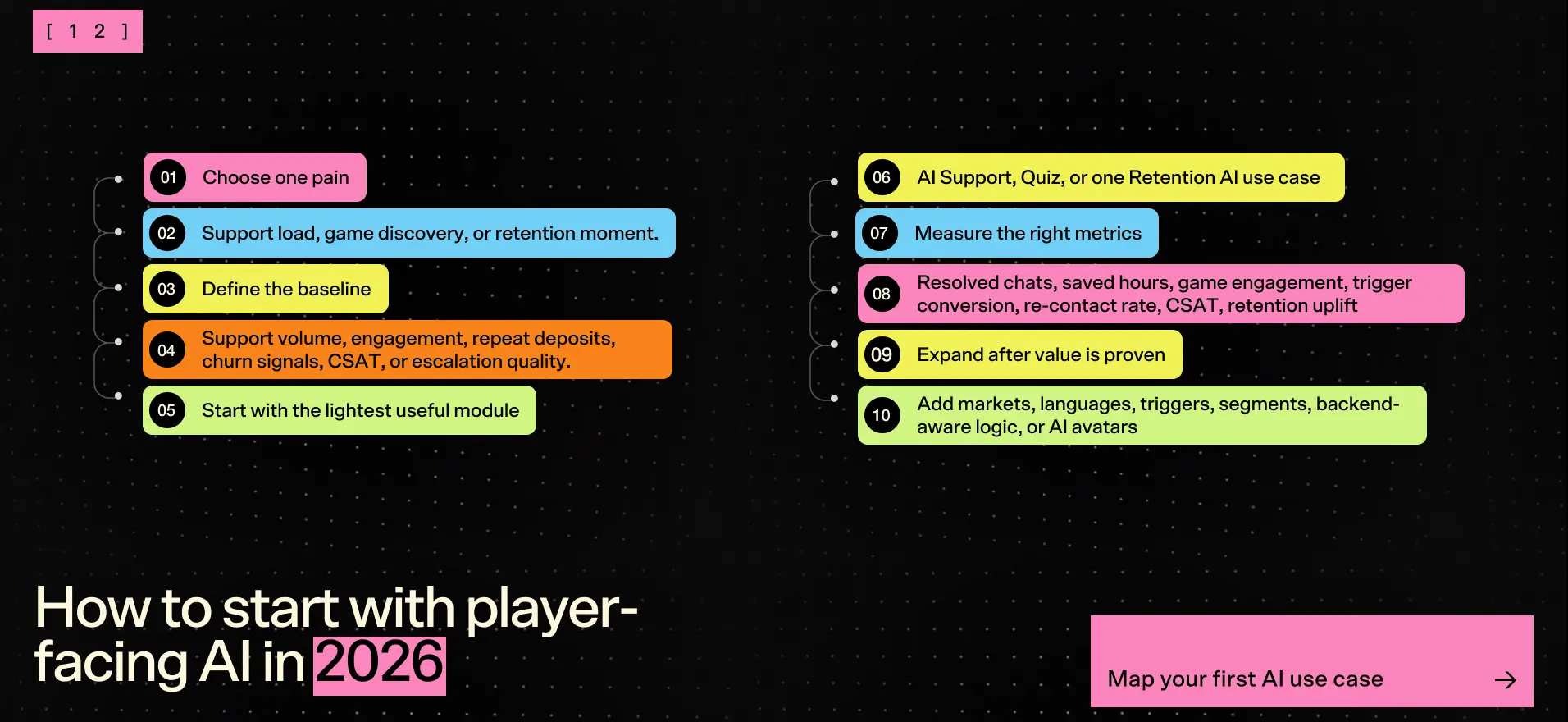
A practical rollout can start with five steps.
Do not start with “we need AI.”
Start with a specific player or operational pain.
For example:
Support load is too high.
Players repeat the same questions.
Escalation quality is poor.
New users cannot find relevant games.
Registration-to-first-deposit flow is weak.
Players churn after a few sessions.
CRM messages are too slow or too generic.
Retention opportunities are missed inside the session.
Choose one pain that matters enough to measure.
Before launching AI, define your current baseline.
For support, this might include support volume, repetitive topics, average handling time, escalation rate, re-contact rate, CSAT, and backlog.
For game discovery, this might include quiz completion, lobby engagement, game launches, first-session activity, click-through rate, or conversion to gameplay.
For retention, this might include repeat sessions, deposit behaviour, churn signals, trigger conversion, campaign engagement, or segment-level performance.
Without a baseline, AI performance becomes guesswork.
With a baseline, the business case becomes clearer.
You do not need to launch the entire future vision at once.
Start with the lightest module that can prove value.
That might be:
An AI Support layer for repetitive support questions.
A Quiz or game discovery flow for onboarding and recommendation.
One Retention AI trigger for a specific player moment.
A smart handoff process for complex support cases.
A small AI avatar experiment connected to a real support or onboarding use case.
The key is to avoid launching AI as a vague innovation project.
Launch it against a measurable workflow.
Different use cases need different metrics.
For AI Support, track resolved chats, saved agent hours, deflection by topic, re-contact rate, escalation quality, CSAT, and average handling time after handoff.
For game discovery, track quiz starts, quiz completion, recommendation clicks, game launches, session depth, return rate, and conversion after onboarding.
For Retention AI, track trigger conversion, repeat sessions, deposit behaviour, churn reduction, A/B test performance, and segment-level uplift.
For AI avatars, track engagement, completion rate, click-through, support follow-through, retention action, and player feedback.
The point is not to prove that AI is impressive.
The point is to prove that something changed in the player journey.
Once a use case works, expand gradually.
Add more markets.
Add more languages.
Add more triggers.
Add more player segments.
Add deeper integrations.
Add backend-aware logic.
Add AI avatar interfaces.
Add A/B testing.
Add more personalised journeys.
This approach helps teams avoid overbuilding before they know what works.
It also makes AI adoption easier internally.
Support sees value.
CRM sees value.
Product sees value.
Operations sees value.
Management sees value.
That is how player-facing AI becomes part of the operating model, not just an experiment.
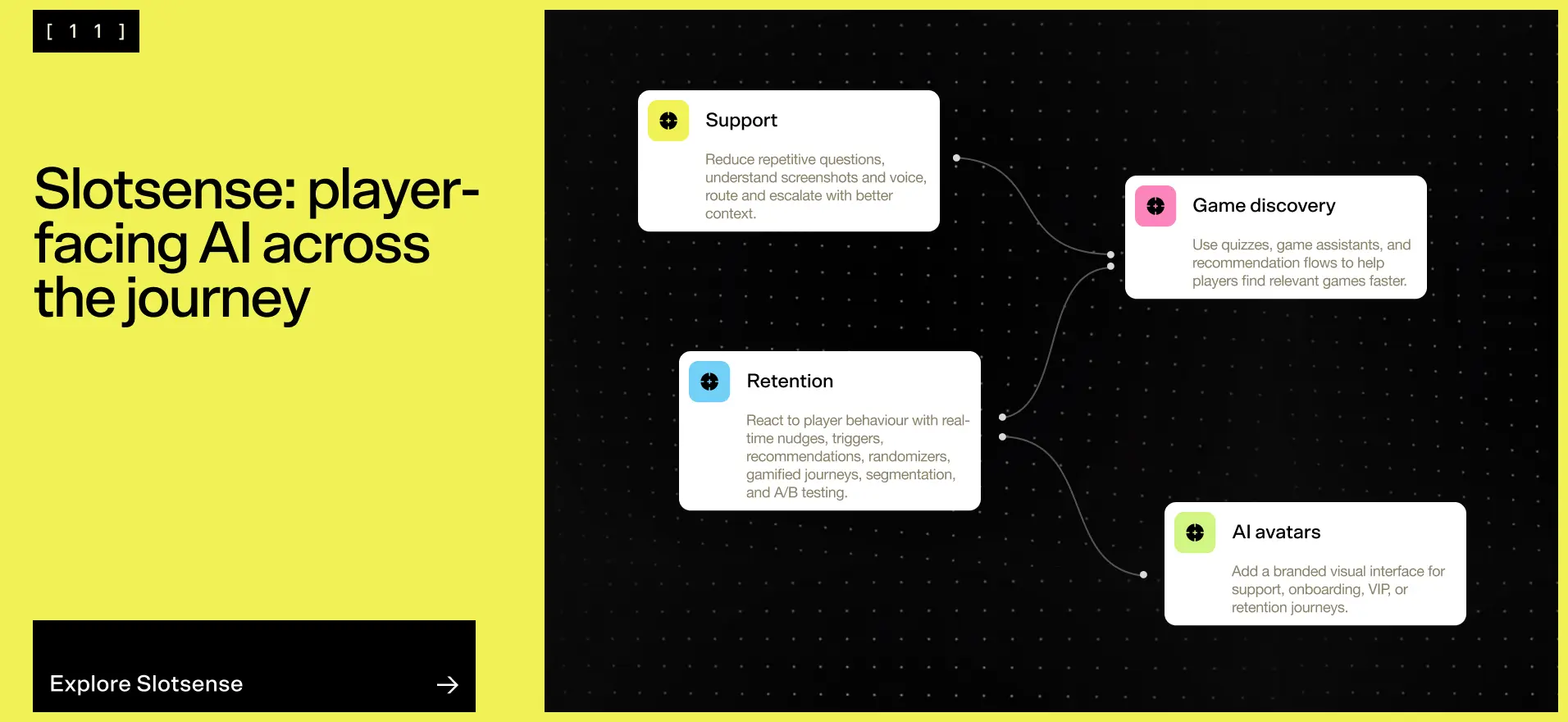
Slotsense is a player-facing AI layer for iGaming operators.
It helps teams improve three key areas of the journey: support, game discovery, and retention.
Slotsense AI Support helps operators reduce repetitive player questions, understand screenshots and voice, suggest help content, route complex cases, and escalate with better context.
It is built for the reality of iGaming support: messy questions, payment confusion, bonus issues, KYC context, account access, screenshots, voice notes, and sensitive escalation.
The goal is not to replace agents.
The goal is to help agents spend less time on repetitive work and receive better-prepared cases when human support is needed.
Slotsense Quiz and game recommendation flows help players find relevant games faster.
This is especially useful for onboarding, cold-start personalisation, game preference capture, and casino lobby engagement.
Instead of sending every player into the same large lobby, operators can guide players through a more interactive discovery flow.
That creates a better starting point for recommendation, segmentation, and future personalisation.
Slotsense Retention AI helps operators react to player behaviour in real time with nudges, triggers, recommendations, randomizers, gamified journeys, segmentation, and A/B testing.
It is designed for the moments that CRM campaigns often miss: low balance, failed deposit, repeated game switching, inactivity, bonus confusion, churn-risk behaviour, or moments where a player needs guidance before leaving.
The goal is not to replace CRM.
The goal is to make retention more responsive inside the player journey.
Slotsense can also support AI avatars as an optional interface layer for support, onboarding, VIP, or retention journeys.
The avatar is not treated as a gimmick or standalone video tool.
It is part of the player-facing experience when a more visual, branded, or guided interaction makes sense.
The goal is not to add AI for the sake of AI.
The goal is to make the player journey more responsive, more helpful, and less dependent on manual workflows.
Player-facing AI is AI that interacts with or supports the player experience directly, such as AI support, game recommendations, onboarding quizzes, retention nudges, smart handoff, and AI avatars.
No. A chatbot is one possible interface. Player-facing AI is broader and can include support automation, game discovery, retention triggers, personalisation, segmentation, A/B testing, and responsible escalation.
No. It works alongside CRM and support tools. CRM manages lifecycle communication, support platforms manage tickets and agents, and player-facing AI helps act inside the player journey when timing and context matter.
The best first use case depends on the team’s pain. Support teams often start with repetitive question automation. Casino and product teams can start with game discovery quizzes. CRM teams can start with one real-time retention trigger.
AI in iGaming 2026 will be judged less by how impressive it sounds and more by where it fits in the player journey.
Generic chatbots, internal copilots, and dashboards will not be enough on their own.
Operators need AI that can support players, guide discovery, trigger retention moments, escalate responsibly, and learn from real behaviour.
The biggest opportunity is not replacing teams.
It is helping teams react faster, route smarter, and personalise the experience while the player is still active.
That is what makes player-facing AI different.
It does not sit in the background waiting for someone to read a report.
It works closer to the moment where the player needs help, direction, relevance, or a reason to continue.
For operators in 2026, that is where AI starts to matter.
Slotsense helps iGaming operators add player-facing AI across support, game discovery, and real-time retention — without replacing your existing CRM or support stack.
Explore Slotsense
Content:
.png)
.png)