How to Measure AI Support ROI in iGaming
Measure AI support ROI in iGaming with resolved chats, deflection rate, escalation quality, response time, agent capacity, CSAT, and cost per case.
17 min
·
June 22, 2026
Measure AI support ROI in iGaming with resolved chats, deflection rate, escalation quality, response time, agent capacity, CSAT, and cost per case.

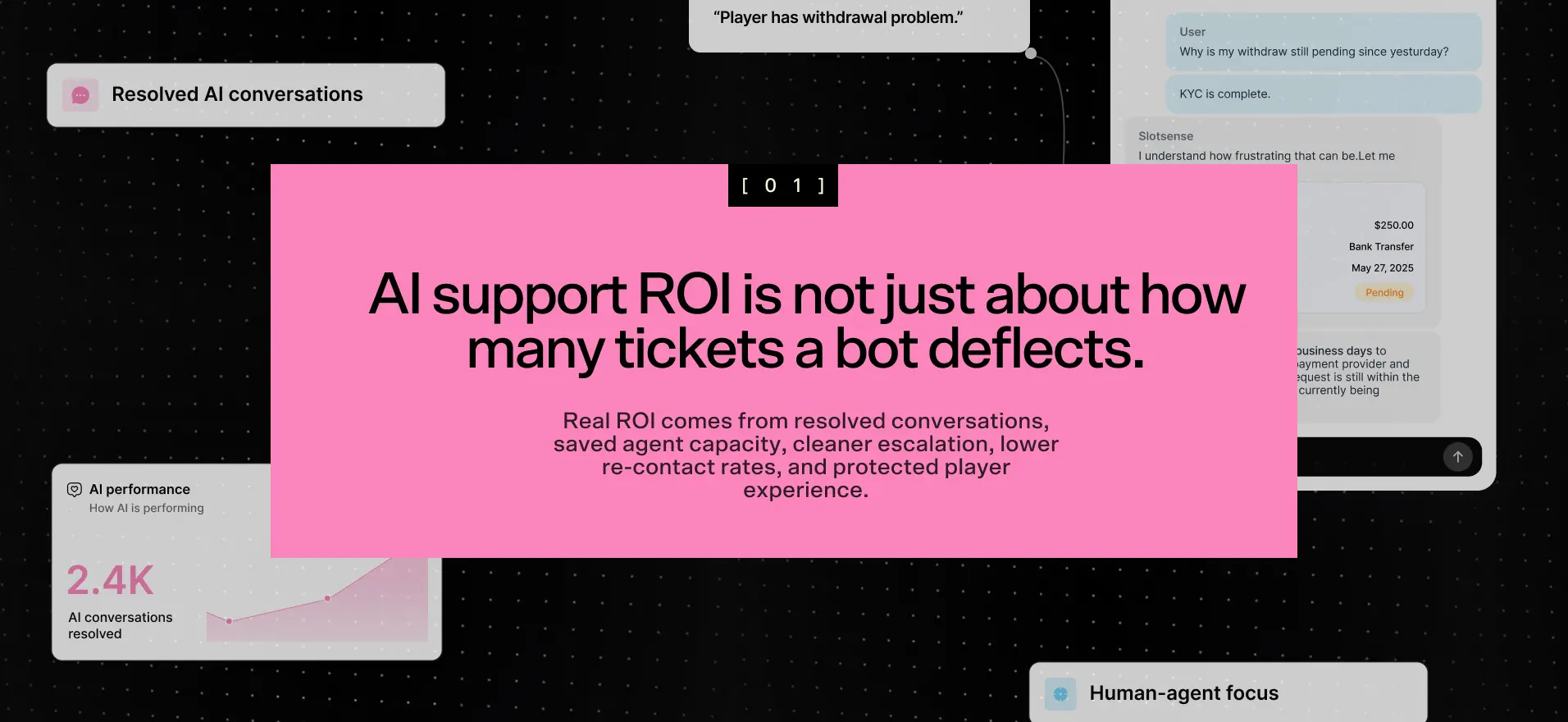
AI support ROI is not just about how many tickets a bot deflects.
In iGaming, support automation touches money questions, withdrawals, bonuses, KYC, account access, VIP complaints, and player trust. If AI reduces ticket volume but frustrates players, routes cases badly, or makes agents clean up messy handoffs, the ROI is not real.
A better way to measure AI support ROI in iGaming is to look at the full support journey:
What does AI resolve?
What does it route?
What does it escalate?
How much agent time does it save?
Does the player experience improve or suffer?
For operators, the strongest AI support business case usually comes from reducing repetitive work without lowering support quality.
Because the goal is not to make support look cheaper on paper.
The goal is to reduce low-value manual work while keeping player experience, escalation quality, and operational control under control.
A generic SaaS company may measure support automation by tickets deflected.
An iGaming operator has to go deeper.
Was the player guided correctly?
Was the issue routed safely?
Was the case escalated when it should have been?
Did the support team actually save time?
That matters because iGaming support is closely tied to money, trust, and urgency.
Players are not only asking how to change a password. They are asking why a withdrawal is pending, why a deposit did not appear, why a bonus was removed, why their account needs verification, or why a game issue affected their balance.
These are not always simple FAQ questions.
Some cases should not be fully automated. Responsible gaming concerns, fraud signals, VIP complaints, payment disputes, account restrictions, and compliance-sensitive issues need clear escalation rules and human judgement.
That makes ROI more complex.
Support volume also changes constantly.
A big sports weekend can increase traffic.
A bonus campaign can create promotion-related questions.
A payment provider issue can flood the team with deposit or withdrawal queries.
A new market can bring language, payment, and policy differences.
A product bug can suddenly increase technical support volume.
So when you measure AI customer support ROI in iGaming, you cannot only ask, “Did the bot reduce tickets?”
You need to ask whether it reduced the right tickets.
Repetitive support load is a strong automation target. Sensitive cases are not.
Another reason ROI is harder to measure is that agent workload is not only about ticket count.
A human-handled case can be short and simple, or it can require context reconstruction: reading previous messages, opening screenshots, checking account status, asking follow-up questions, and figuring out which team should own the issue.
Bad automation can make this worse.
If AI gives generic answers, misunderstands player intent, or escalates with no context, agents may spend more time fixing the conversation than they would have spent handling it directly.
That is why the ROI calculation needs to include quality.
Not just volume.
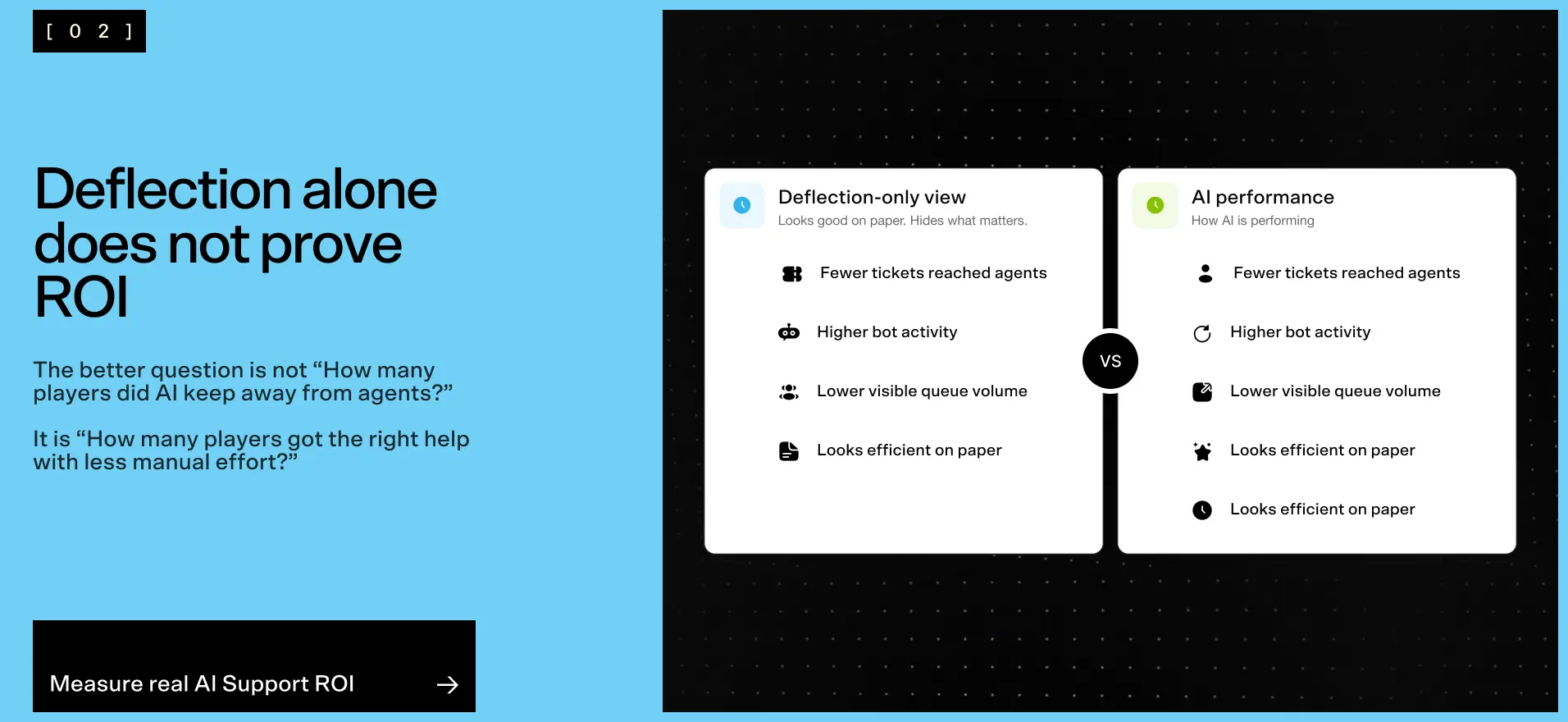
Deflection rate is useful.
But it is incomplete.
A high deflection rate can look impressive in a dashboard and still be bad for the support operation.
For example, deflection may be misleading if players abandon the conversation frustrated.
It may be misleading if the AI gives generic answers that do not solve the issue.
It may be misleading if players contact support again later with the same problem.
It may be misleading if sensitive cases are not escalated quickly enough.
It may be misleading if agents receive worse context after escalation.
And it may be misleading if CSAT drops while ticket volume goes down.
This is why support automation ROI should never rely on deflection alone.
Deflection answers one question:
“How many cases did not reach agents?”
But it does not answer the more important question:
“Did the player get the right help?”
That is the standard operators should use.
The better question is not:
“How many players did AI keep away from agents?”
The better question is:
“How many players got the right help with less manual effort?”
That means deflection should be measured together with:
Resolution quality.
Re-contact rate.
Escalation quality.
Player satisfaction.
Average handling time.
Backlog reduction.
Agent capacity saved.
Cost per resolved case.
If those metrics move in the right direction together, the ROI is much more credible.
If deflection rises but re-contact rate also rises, you may not be solving the problem. You may just be delaying it.
If escalation rate drops but CSAT falls, players may feel trapped.
If AI resolves more cases but L2 receives messier escalations, the support team may not actually be saving time.
This is where many chatbot ROI calculations become too optimistic.
They count avoided tickets.
They do not always count support quality.
For iGaming operators, that is too risky.
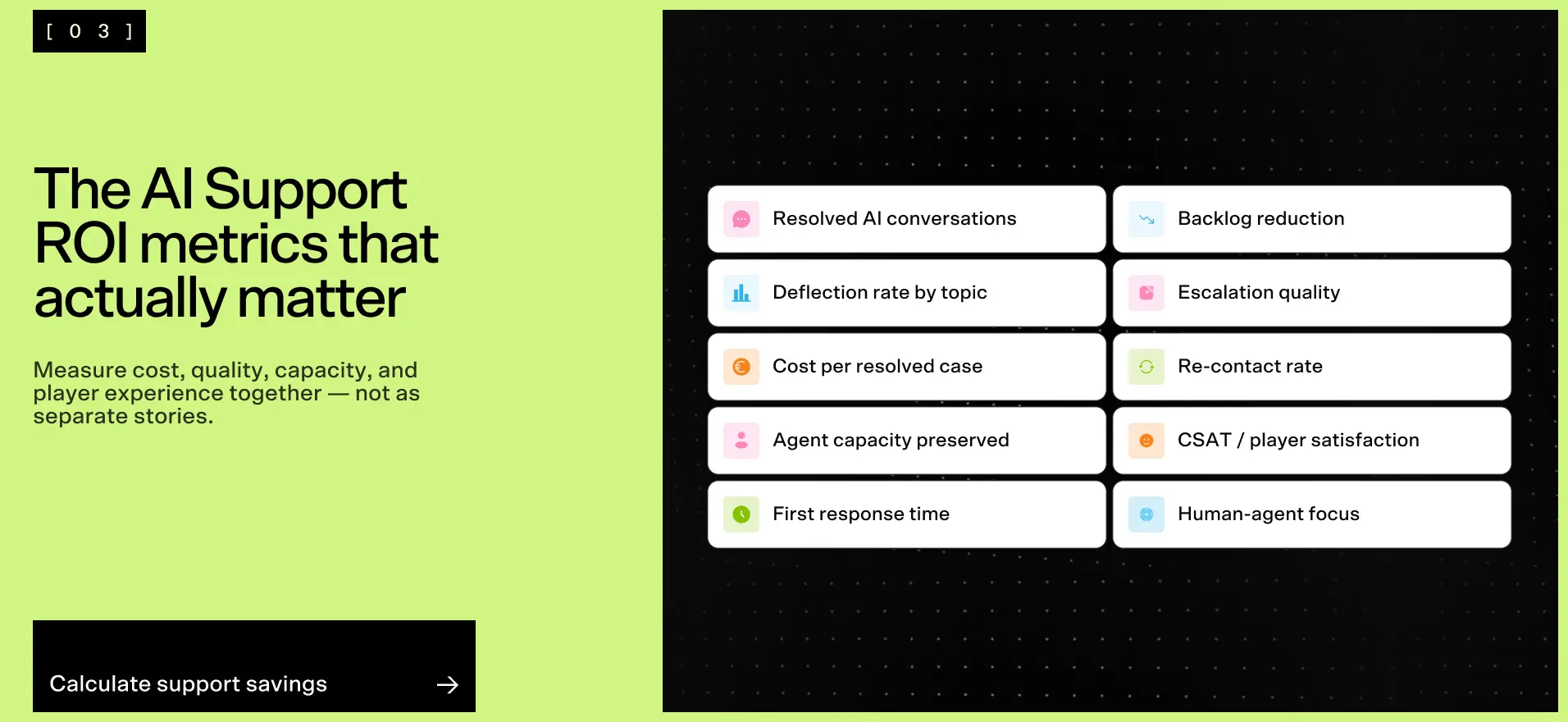
AI support ROI should be measured through a group of metrics, not a single number.
Some metrics show cost reduction.
Some show saved capacity.
Some show player experience.
Some show escalation quality.
Together, they give a more realistic view of whether AI support is working.
Resolved AI conversations are usually the cleanest starting point for AI support ROI.
This metric shows how many conversations were fully resolved by AI without human involvement.
Why does this matter?
Because these are cases where the support team did not need to spend manual time.
If AI resolves a repetitive question about bonus terms, payment methods, account navigation, or verification steps, that is a direct reduction in manual support load.
This metric also maps well to usage-based AI support pricing.
You can compare the cost of an AI-resolved conversation with the estimated cost of a human-handled case.
That gives support, ops, and finance teams a practical starting point.
However, “resolved” should be defined carefully.
A conversation should not be considered resolved just because the player stopped replying.
A better definition may include:
The AI answered the player’s question.
The player did not re-contact within a defined period.
The case did not require escalation.
The interaction received neutral or positive feedback.
The player completed the intended action.
Resolved conversations are most useful when combined with re-contact rate and CSAT.
Otherwise, you may count conversations as resolved when they were simply abandoned.
Deflection rate shows how many support topics AI prevented from reaching agents.
It is a useful metric, but it should be tracked by topic, not only overall.
For example:
Bonus questions.
Payment method questions.
Withdrawal guidance.
Account access.
KYC steps.
Promotion eligibility.
Game access troubleshooting.
FAQ-style support questions.
This matters because not all deflection has the same value.
A 60% deflection rate on simple FAQ questions is useful, but it may not change operational pressure much if agents are still overloaded with payment and withdrawal cases.
A smaller improvement on high-volume payment-related questions may create more value than a large improvement on low-impact FAQ topics.
Operators should also separate safe deflection from risky deflection.
Safe deflection happens when AI answers repetitive, low-risk questions accurately.
Risky deflection happens when AI tries to handle cases that should have been escalated.
That difference is important in iGaming.
A good AI support system should reduce unnecessary escalation, not suppress necessary escalation.
Cost per resolved case helps translate support automation into business language.
The basic comparison is:
Average cost of a human-handled case.
AI cost per resolved conversation.
Blended cost after AI implementation.
One simple way to estimate savings is:
Cost saved = AI-resolved conversations × average human handling cost
Another useful metric is:
Cost per resolved case = monthly support cost / resolved cases
Then compare this before and after AI implementation.
This gives you a practical view of whether AI is reducing the manual cost of support.
The important detail is to use realistic assumptions.
Average human handling cost should include loaded support cost where possible, not just base salary. Depending on how your finance team works, this may include salary, contractor cost, management overhead, tooling, office cost, or shift coverage.
You do not need a perfect number to start.
But you do need a consistent number.
If your baseline is consistent, you can compare improvement over time.
AI support ROI is not always about reducing headcount.
Often, the stronger business case is preserving agent capacity.
That means your team can handle more support volume without increasing headcount at the same pace.
This is especially important for operators growing across markets, brands, languages, or campaign volume.
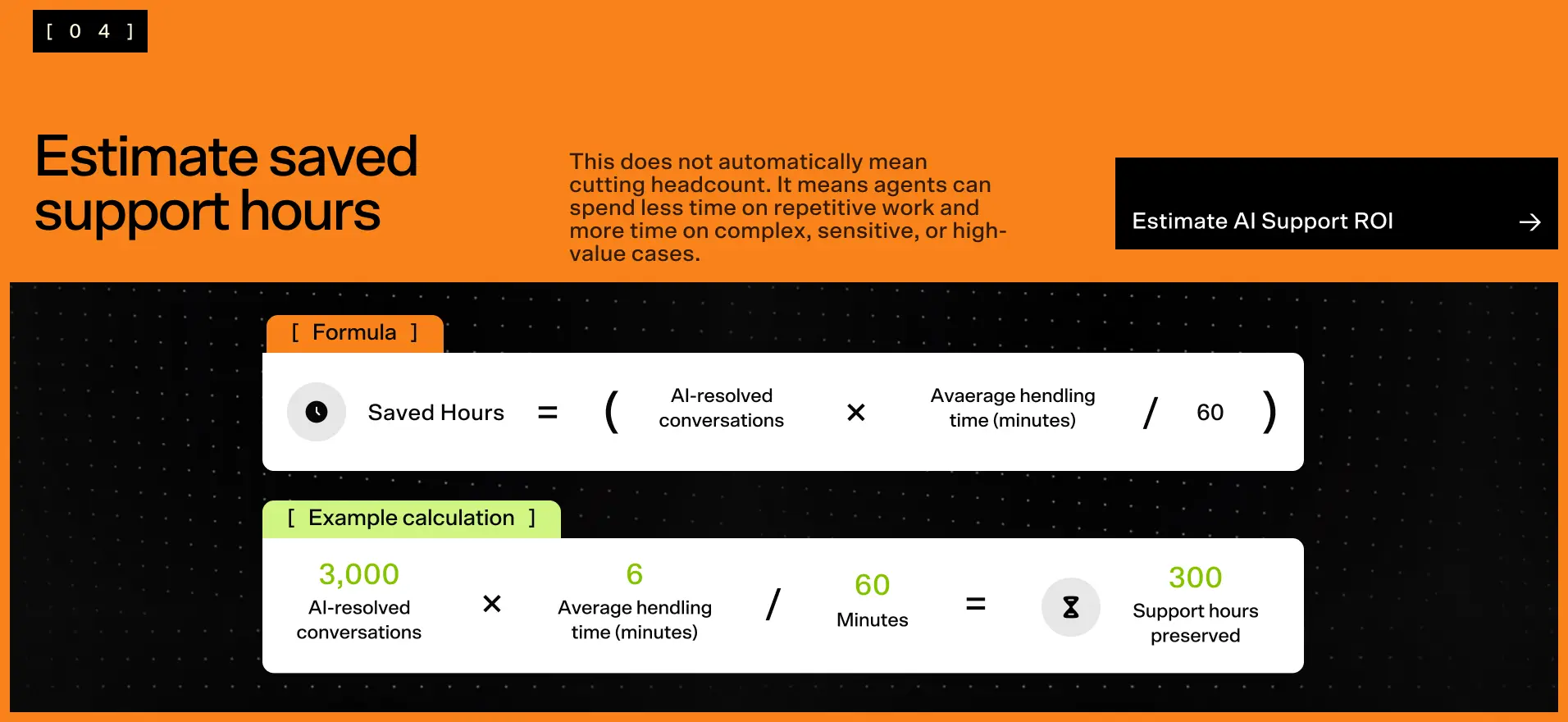
The basic formula is:
Saved hours = resolved AI conversations × average handling time / 60
For example:
If AI resolves 3,000 repetitive conversations per month and the average human handling time is 6 minutes, that equals:
3,000 × 6 / 60 = 300 support hours preserved
That does not automatically mean you cut 300 hours from the team.
It means those hours can be redirected.
Agents can spend more time on complex cases, VIP players, payment edge cases, responsible gaming escalation, quality assurance, training, or backlog reduction.
This is important because many support teams are not trying to become smaller.
They are trying to stop drowning in repetitive work.
Preserved capacity is often more realistic and more valuable than a simple cost-cutting claim.
AI should reduce time to first useful answer.
Not just first response.
First useful answer.
A generic “Thanks, we’re checking this” may technically count as a response, but it does not always help the player.
Operators should track:
Average first response time before AI.
AI first response time.
First useful response time.
First response by topic.
First response by language.
First response by market.
This is particularly important in support areas where players expect immediate guidance: withdrawals, deposits, bonuses, login issues, and verification steps.
AI can often provide immediate direction, even when the final case still needs human review.
For example, if a withdrawal issue needs escalation, AI can still explain what information is needed, collect the payment method and timeframe, and tell the player what will happen next.
That can reduce frustration while the case moves to the right team.
Backlog is where AI support value becomes very visible.
If the team has too many open conversations, players wait longer, agents feel pressure, and support quality can drop.
AI support can help reduce backlog by handling repetitive questions before they enter the human queue.
This is especially relevant during:
Weekends.
Big campaigns.
Bonus launches.
Payment provider issues.
Major sports events.
New market launches.
Seasonal traffic spikes.
Market-specific traffic peaks.
Operators should measure whether AI reduces open queues during these periods.
Useful backlog metrics include:
Open conversations by hour or day.
Queue size by topic.
Queue size by language or market.
Time to first human response.
Cases waiting for L2.
Backlog during campaign periods.
Backlog after payment incidents.
If AI performs well only during quiet periods but fails during traffic spikes, the ROI may be weaker than expected.
Support automation needs to be tested against real operational pressure.
A good AI support layer does not only reduce escalation volume.
It improves the quality of the escalations that still need to happen.
This is especially important in iGaming because many cases should still reach a human: payment edge cases, VIP complaints, responsible gaming concerns, account restrictions, fraud signals, and compliance-sensitive issues.
The goal is not to stop those escalations.
The goal is to make them cleaner.
Operators should track:
Cases escalated with complete context.
Wrong-team routing rate.
Average handling time after escalation.
Number of follow-up questions agents still need to ask.
L2 workload reduction.
Agent feedback on AI summaries.
Escalation by topic.
Escalation by market.
Escalation by language.
A poor AI system may reduce the number of escalations but make the remaining escalations harder to handle.
A strong AI support layer should help agents start with a clearer case.
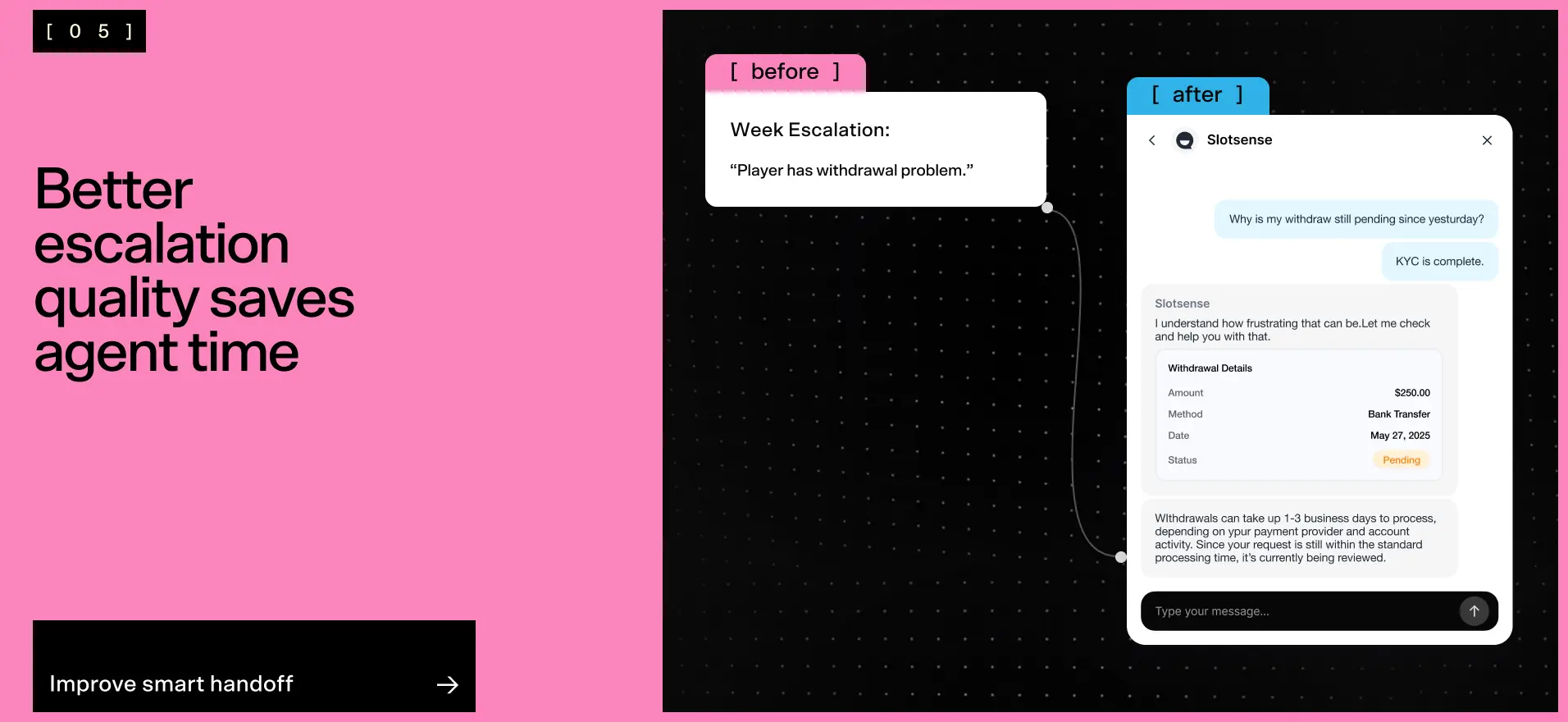
For example, instead of receiving:
“Player has withdrawal problem.”
The agent should receive something closer to:
“Player asks why withdrawal is pending since yesterday. Player says KYC is complete. Screenshot shows pending transaction. AI explained standard processing times. Suggested route: Payments / Withdrawal review. Escalation reason: specific account-level transaction requires review.”
That kind of handoff saves time.
It also improves player experience because the agent does not need to ask the player to repeat everything.
Re-contact rate is one of the most important quality checks for AI support ROI.
If players come back with the same issue, the first answer may not have solved the problem.
Operators should track:
Repeat contact within 24 hours.
Repeat contact within 7 days.
Repeat contact by topic.
Repeat contact after AI resolution.
Repeat contact after handoff.
Repeat contact by market or language.
This is where deflection can become misleading.
If AI “deflects” a player today but the player contacts support again tomorrow, the issue was not truly resolved.
It may even create more total workload.
Re-contact rate helps operators understand whether AI answers are actually useful.
A strong AI support implementation should reduce repetitive contacts, not just move them around.
Support cost reduction should not come at the cost of player experience.
This matters especially in iGaming because support interactions often happen at moments of tension: money delays, failed deposits, bonus confusion, account verification, or game issues.
Operators should track:
CSAT after AI-handled interactions.
CSAT after handoff.
Complaint rate.
Abandonment rate.
“Agent requested” frequency.
Player sentiment.
Negative feedback themes.
Resolution satisfaction by topic.
A drop in CSAT may mean the AI is over-automating, giving generic responses, hiding escalation paths, or failing to handle emotional player messages well.
A stable or improved CSAT suggests the AI is reducing friction without damaging trust.
It is also worth looking at CSAT by topic.
Players may be happy with AI for basic FAQ questions but unhappy when it handles payment or bonus issues.
That does not mean the AI failed overall.
It means the automation boundaries need to be adjusted.
The best AI support business case is not only that AI handles more conversations.
It is that human agents spend more time on valuable cases.
Operators should track:
Share of repetitive tickets handled by AI.
Share of complex cases handled by agents.
Share of VIP or sensitive cases handled by agents.
Average complexity of human-handled cases.
Agent satisfaction.
Time spent on low-value repetitive work.
Agent feedback on support quality.
This metric is especially useful for support leaders.
If AI removes repetitive low-risk conversations, agents can focus on cases where human judgement matters: high-value players, sensitive issues, payment edge cases, training, QA, and complex complaint handling.
That is a better operating model.
It also helps reduce agent fatigue.
Repetitive support work can drain teams. If AI handles the simplest recurring questions, agents can spend more time where they make a real difference.
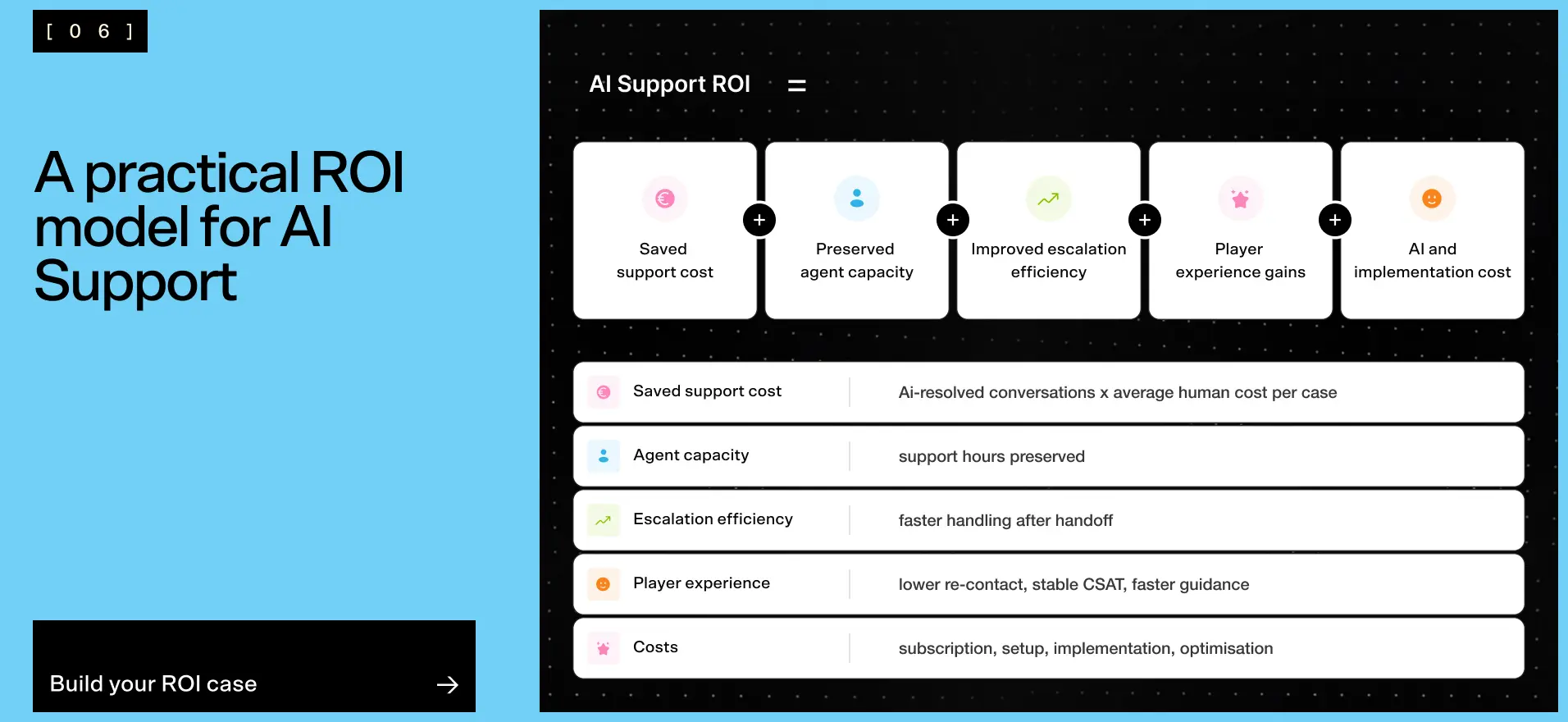
A practical AI support ROI formula should include both cost and quality.
A simple framework is:
AI Support ROI = Saved support cost + preserved agent capacity + improved escalation efficiency + player experience gains - AI and implementation cost
Let’s break that down.
This is the most direct part of the calculation.
You estimate how many conversations AI resolved and multiply that by the average cost of a human-handled case.
For example:
AI-resolved conversations × average human cost per case = estimated direct support cost saved
This is usually the easiest number to explain to finance.
This measures support hours saved.
AI-resolved conversations × average handling time / 60 = estimated support hours preserved
This is especially useful if your goal is not headcount reduction, but scaling support without growing the team at the same pace.
This measures whether AI improves the cases that still go to humans.
If agents receive better summaries, collected context, screenshot notes, voice transcripts, and recommended routing, they can handle escalated cases faster.
That can reduce average handling time after escalation.
It can also reduce internal transfers and follow-up questions.
This part is harder to express as a simple financial number, but it matters.
Faster responses, fewer repeated contacts, cleaner routing, and better guidance all affect player trust.
Operators can track this through CSAT, re-contact rate, complaint rate, abandonment, and sentiment.
Costs may include:
Monthly AI support subscription.
Setup fee.
Internal implementation time.
Training and optimisation.
Knowledge base clean-up.
Integration work.
Maintenance.
Ongoing review.
The cleanest ROI model starts with cost reduction.
But the strongest business case includes capacity and experience.
That is where AI support becomes more than a chatbot experiment.
Here is a simple illustrative scenario.
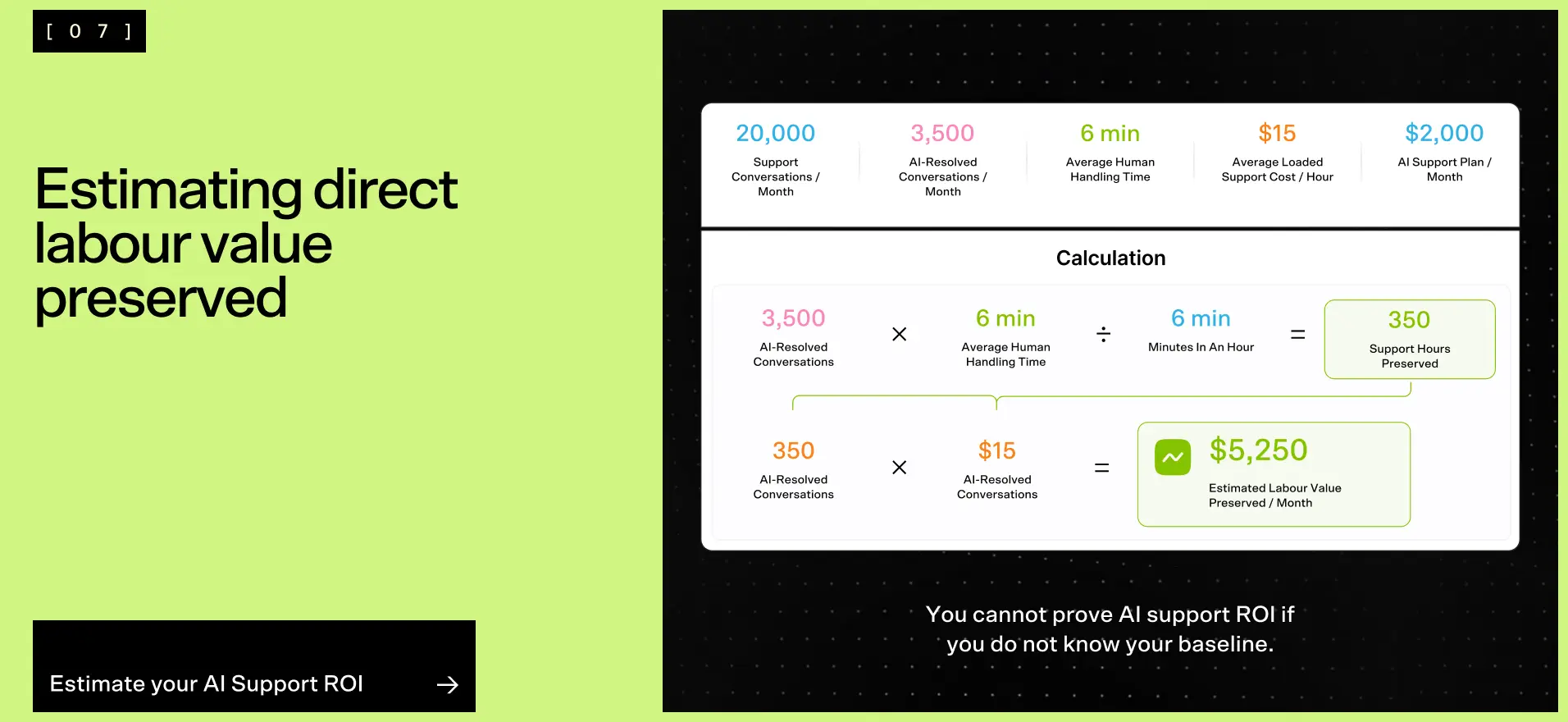
An operator handles 20,000 support conversations per month.
Out of those, 40% are repetitive first-line questions.
AI resolves 3,500 conversations per month.
Average human handling time is 6 minutes.
Average loaded support cost is $15 per hour.
Estimated saved hours:
3,500 × 6 / 60 = 350 hours
Estimated labour value preserved:
350 × $15 = $5,250 per month
If the AI Support plan costs $2,000 per month, the direct labour ROI is already visible before counting faster response time, cleaner routing, backlog reduction, and improved player experience.
But this example should not be treated as a promise.
Actual ROI depends on support volume, topic mix, handling time, labour cost, markets, languages, automation boundaries, help content quality, and integration depth.
The point of the example is to show how operators can start building the business case.
Start with repetitive conversations.
Estimate saved handling time.
Compare against AI support cost.
Then add quality metrics to make sure cost savings are not coming at the expense of player experience.
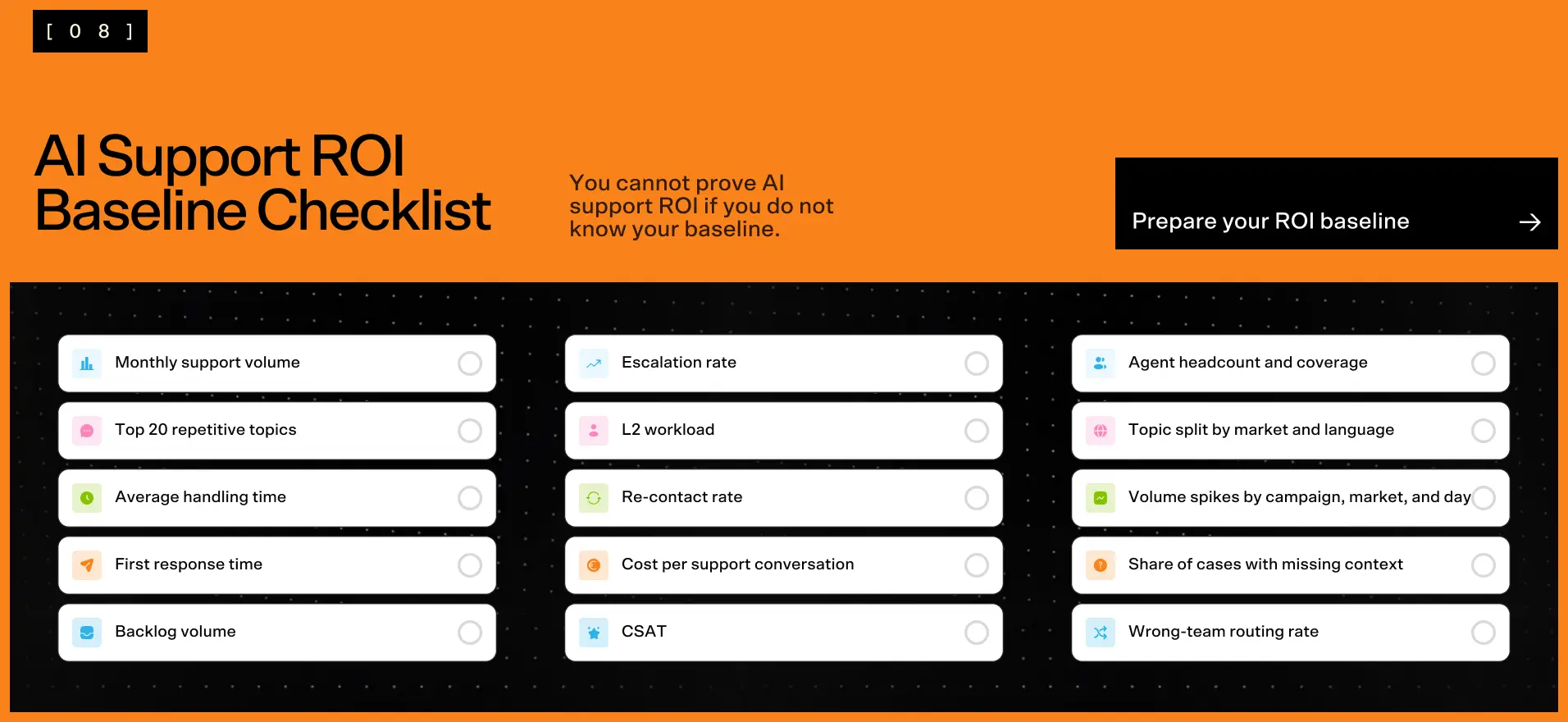
You cannot prove AI support ROI if you do not know your baseline.
The first step is not automation.
It is measurement.
Before launching AI support, operators should collect baseline metrics such as:
Monthly support volume.
Top 20 repetitive topics.
Average handling time.
First response time.
Backlog volume.
Escalation rate.
L2 workload.
Re-contact rate.
Cost per support conversation.
CSAT.
Agent headcount and coverage.
Topic split by market and language.
Volume spikes by campaign, market, and day.
Current chatbot or help centre usage.
Share of cases with missing context.
Wrong-team routing rate.
This baseline helps you understand where AI can create the most value.
For example, if 35% of your support volume is repetitive bonus and payment guidance, that is a clear automation opportunity.
If L2 is overloaded because cases arrive with missing context, then smart handoff may be a bigger ROI driver than simple deflection.
If re-contact rate is high after FAQ responses, then the issue may be content quality, not just automation coverage.
Without a baseline, every ROI conversation becomes guesswork.
With a baseline, you can measure before and after.
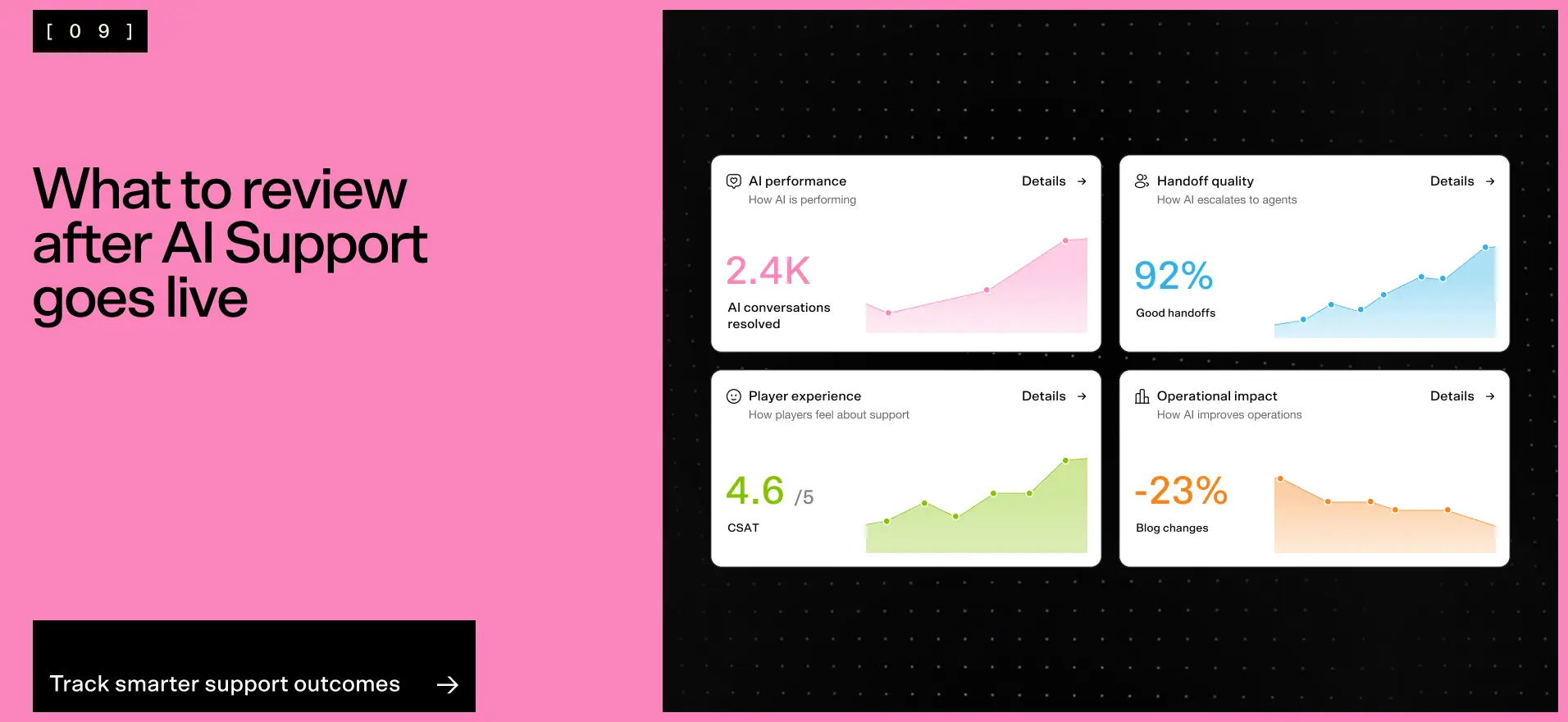
Post-launch measurement should show more than whether the AI is active.
It should show whether AI is improving the support operation.
Operators should track:
AI conversations started.
AI conversations resolved.
Deflection by topic.
Escalation by topic.
AI-to-human handoff quality.
First response time.
Average handling time after escalation.
Re-contact rate.
CSAT.
Backlog changes.
Agent feedback.
Market and language performance.
Content gaps discovered by AI.
New automation opportunities.
Wrong routing rate.
Screenshot and voice-supported cases.
AI performance by support topic.
The first month should not only answer:
“Did AI work?”
It should show which topics are ready for automation, which need better help content, and which should always escalate.
For example, AI may perform well on account navigation, bonus terms, and basic verification steps.
It may need more knowledge base work for payment provider questions.
It may need stricter escalation rules for responsible gaming, VIP complaints, or payment disputes.
This is normal.
AI support improves when operators treat it as an operational layer, not a one-time chatbot launch.
Monthly review should include both performance and quality.
Where did AI resolve cases successfully?
Where did it escalate well?
Where did it misunderstand intent?
Which player questions appeared repeatedly?
Which help articles were missing or unclear?
Which markets or languages need adjustment?
Which topics created low CSAT?
This review process turns AI support into a measurable system.
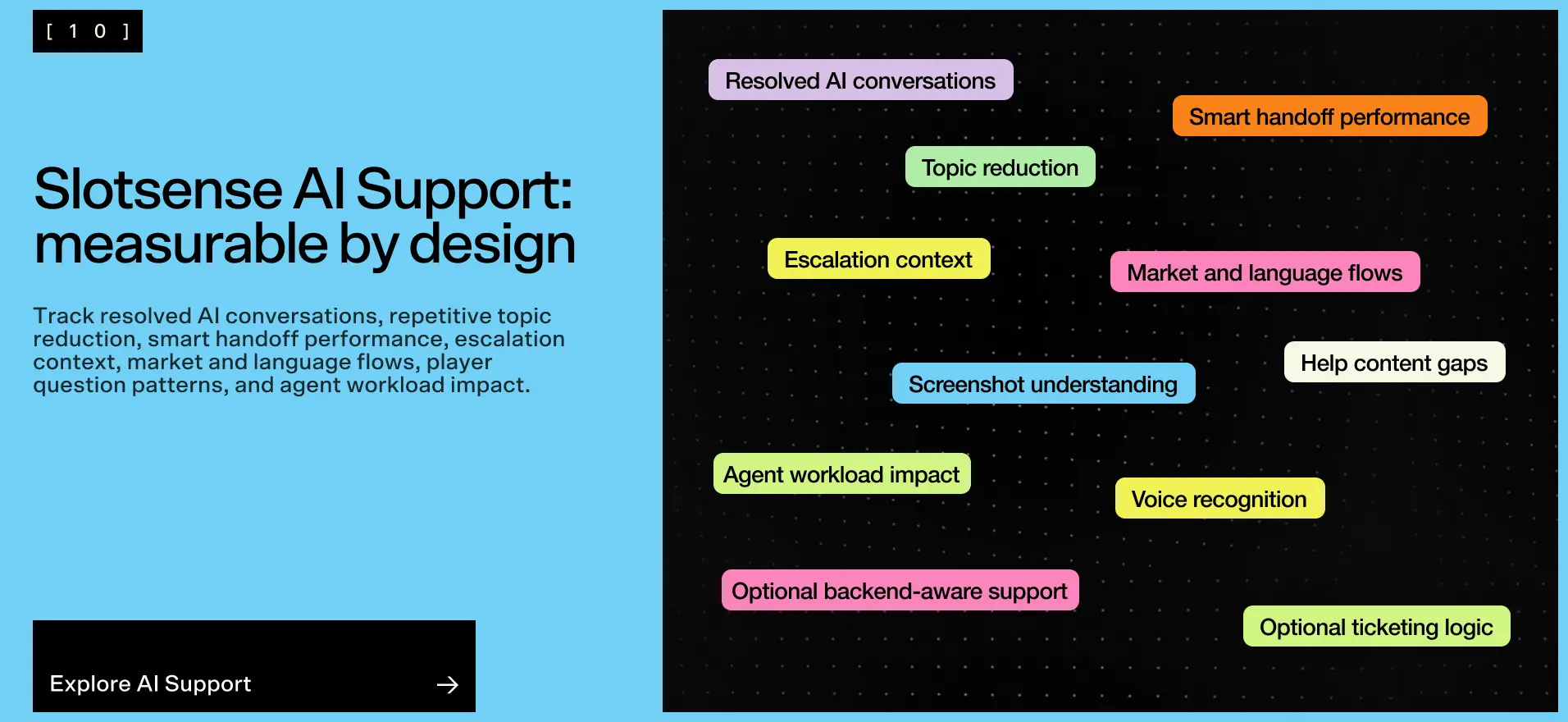
Slotsense AI Support is built around measurable support outcomes, not generic chatbot activity.
It helps operators track and improve:
Resolved AI conversations.
Repetitive topic reduction.
Smart handoff performance.
Escalation context.
Support flows by market and language.
Player question patterns.
Help content gaps.
AI performance by support topic.
Agent workload impact.
This matters because operators need to understand not only whether AI is answering, but whether it is reducing manual load in the right places.
Slotsense also supports voice recognition, image and screenshot understanding, semantic recognition, smart redirects and handoff, help article suggestions, segment-aware responses, training on resolved tickets, optional ticketing logic, and optional backend-aware support logic.
These capabilities support ROI in practical ways.
Voice recognition and screenshot understanding help capture messy player context faster.
Semantic recognition helps classify intent more accurately.
Smart handoff helps agents receive cleaner escalations.
Help article suggestions can reduce repetitive questions.
Support analytics can reveal what players ask, where the AI performs well, and where the knowledge base needs improvement.
Optional ticketing and backend-aware logic can help operators connect AI support more closely to existing workflows and support systems.
The goal is to make AI support measurable enough for support leaders, operations teams, and management to understand whether it is actually saving time and improving the player journey.
Not just whether the bot is busy.
Whether the support operation is better.
Start by measuring resolved AI conversations, average human handling time, support cost per hour, and AI support cost. Then add quality metrics such as escalation rate, re-contact rate, CSAT, backlog reduction, and escalation quality.
No. Deflection rate is useful, but it should be measured alongside resolution quality, re-contact rate, escalation quality, CSAT, and agent capacity saved.
For cost savings, resolved AI conversations and saved agent hours are the most practical starting points. For player experience, escalation quality, re-contact rate, and CSAT are just as important.
Yes, if it automates repetitive low-risk cases, collects context for unclear issues, and escalates complex or sensitive cases quickly with useful information for agents.
AI support ROI in iGaming should never be reduced to one metric.
Deflection matters, but it is not enough.
Operators should look at resolved conversations, saved agent hours, cost per resolved case, escalation quality, response speed, backlog reduction, re-contact rate, and player satisfaction.
The strongest AI support business case is not:
“We installed a bot.”
It is:
“We reduced repetitive work, protected agent capacity, improved routing, and kept player experience under control.”
That is what support and operations leaders can take to management.
That is what finance teams can understand.
And that is what separates a real AI support layer from a chatbot experiment.
Share your monthly support volume, average handling time, and top repetitive topics. We’ll help estimate where AI Support could reduce manual load and improve support efficiency.
Estimate AI Support ROI
Content:
.png)
.png)