Best iGaming CRM Platforms in 2026: What Operators Should Compare — and What CRM Still Doesn't Cover
A practical, vendor-neutral shortlist for CRM, retention, product and data teams — plus a clear model for where a player-facing AI layer fits.
15 min
·
August 21, 2026
The best iGaming CRM platforms at a glance
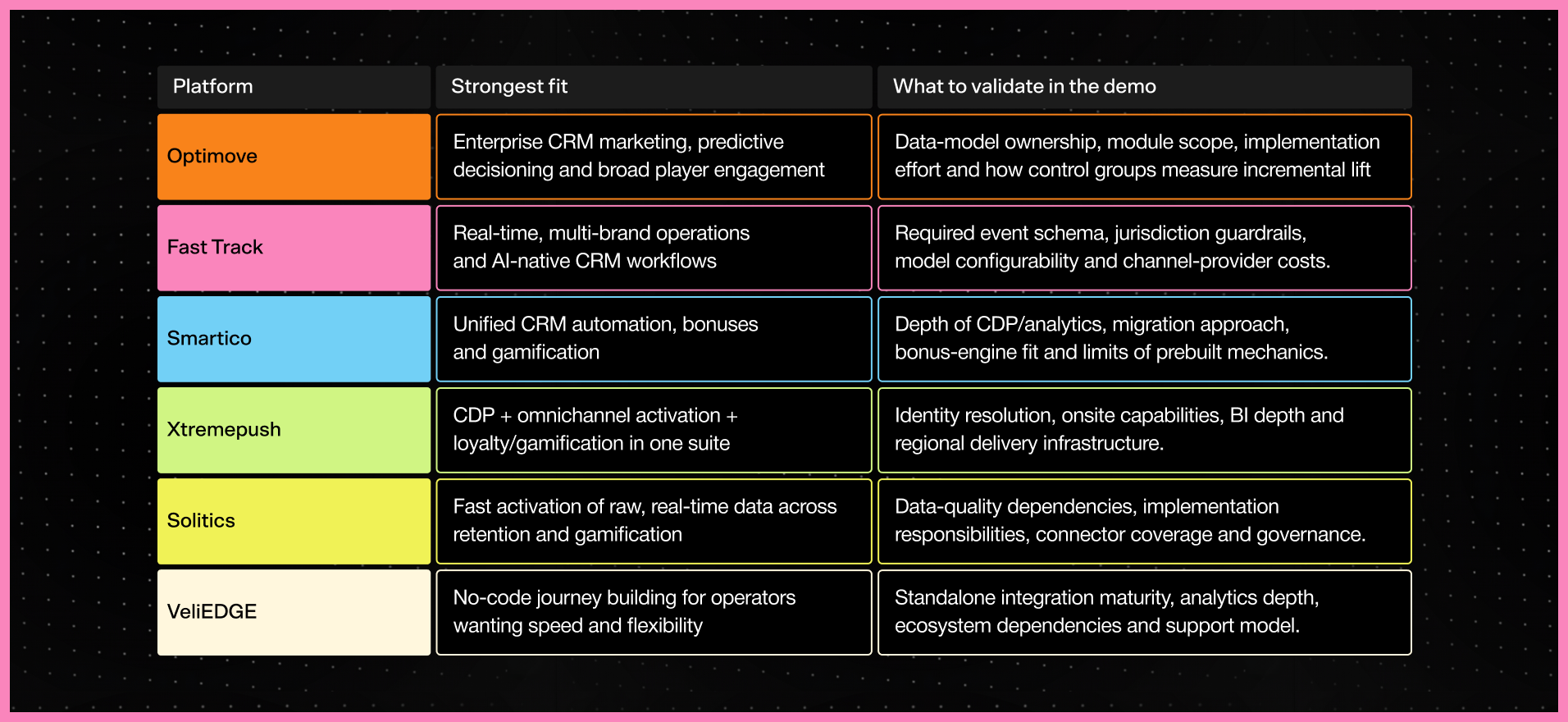
For a high-intent buying decision, start with fit rather than a generic league table. The table below summarizes where each platform appears strongest based on its current official product positioning. Treat it as a shortlist, then validate the details in a live demo and technical discovery.
What “iGaming CRM” should mean in 2026
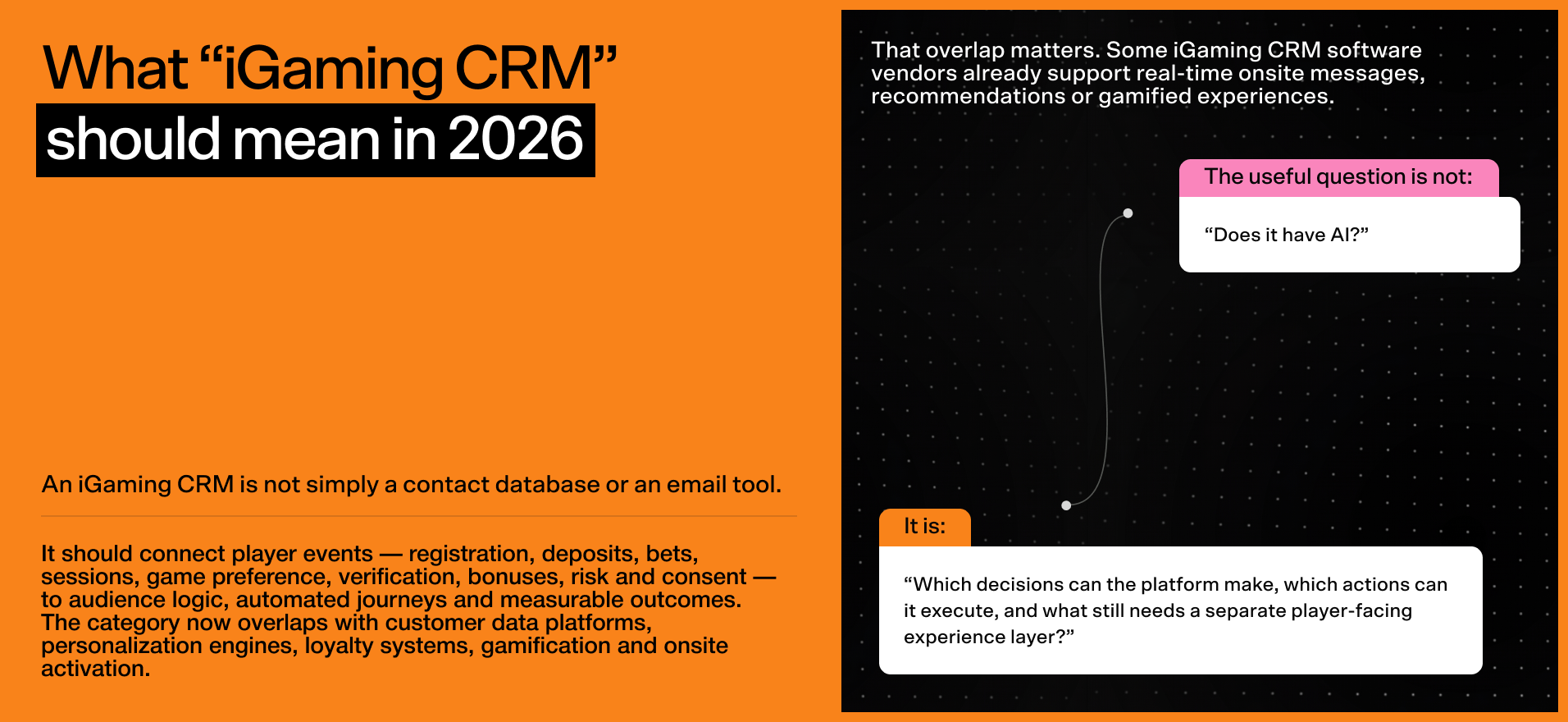
An iGaming CRM is not simply a contact database or an email tool. It should connect player events — registration, deposits, bets, sessions, game preference, verification, bonuses, risk and consent — to audience logic, automated journeys and measurable outcomes. The category now overlaps with customer data platforms, personalization engines, loyalty systems, gamification and onsite activation.
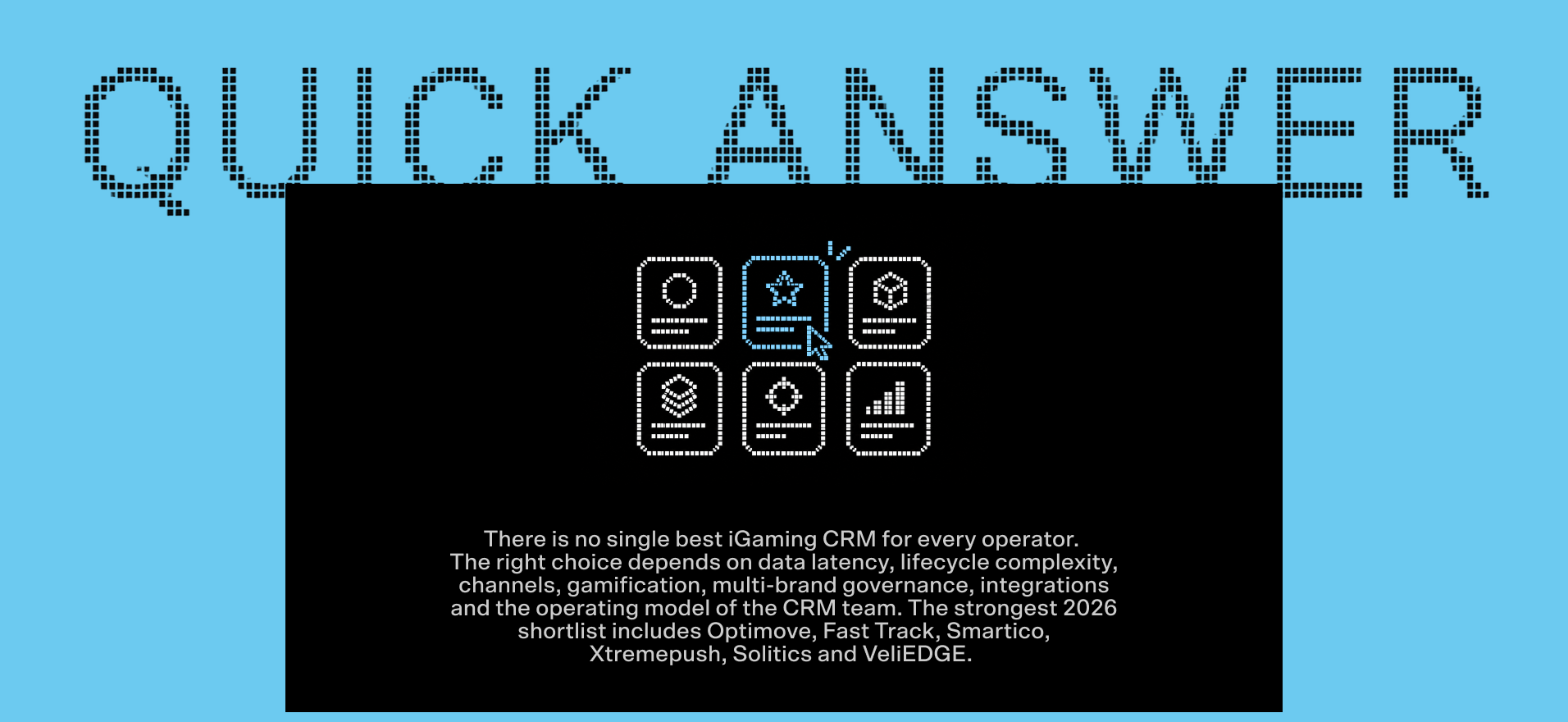
That overlap matters. Some iGaming CRM software vendors already support real-time onsite messages, recommendations or gamified experiences. So the useful question is not “Does it have AI?” It is: “Which decisions can the platform make, which actions can it execute, and what still needs a separate player-facing experience layer?”
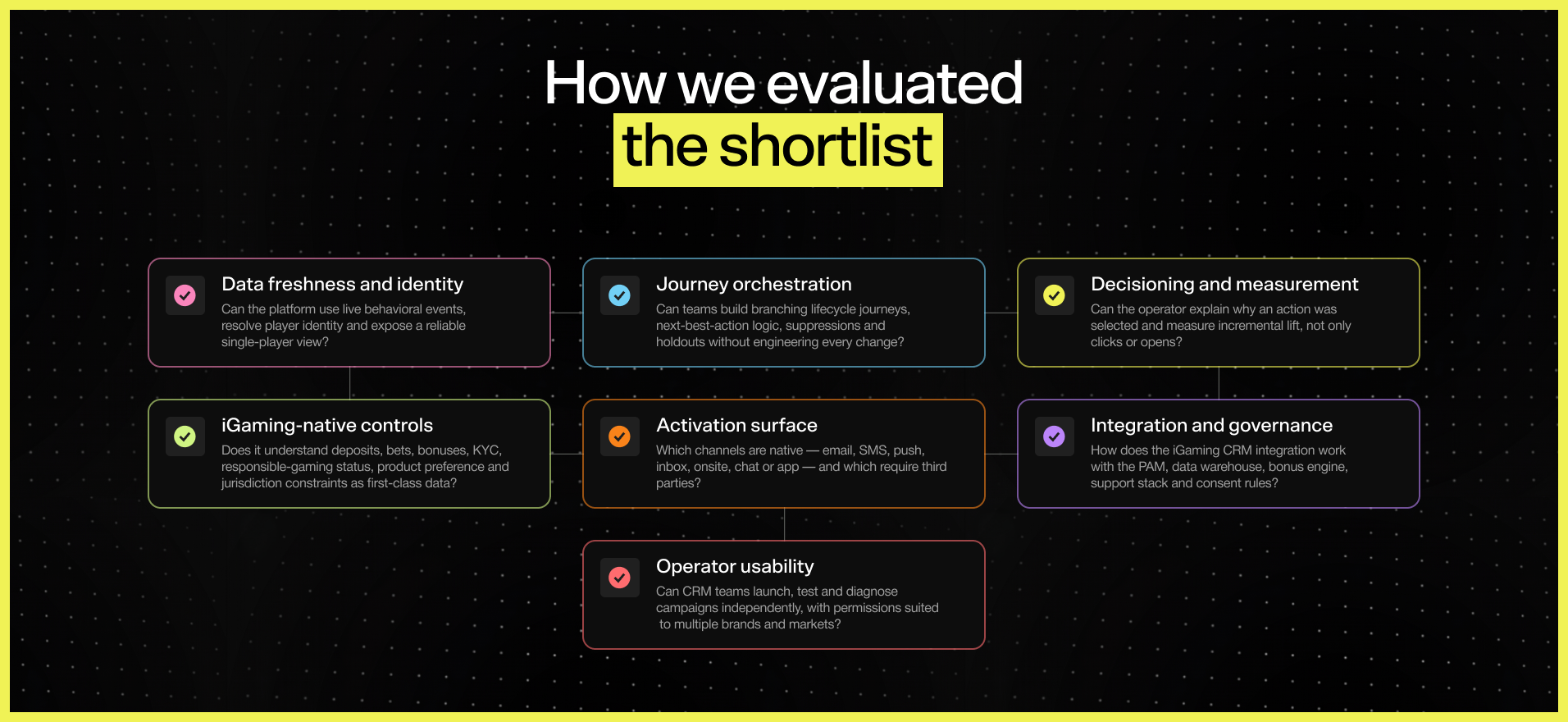
How we evaluated the shortlist
Data freshness and identity: Can the platform use live behavioral events, resolve player identity and expose a reliable single-player view?
Journey orchestration: Can teams build branching lifecycle journeys, next-best-action logic, suppressions and holdouts without engineering every change?
iGaming-native controls: Does it understand deposits, bets, bonuses, KYC, responsible-gaming status, product preference and jurisdiction constraints as first-class data?
Activation surface: Which channels are native — email, SMS, push, inbox, onsite, chat or app — and which require third parties?
Decisioning and measurement: Can the operator explain why an action was selected and measure incremental lift, not only clicks or opens?
Integration and governance: How does the iGaming CRM integration work with the PAM, data warehouse, bonus engine, support stack and consent rules?
Operator usability: Can CRM teams launch, test and diagnose campaigns independently, with permissions suited to multiple brands and markets?
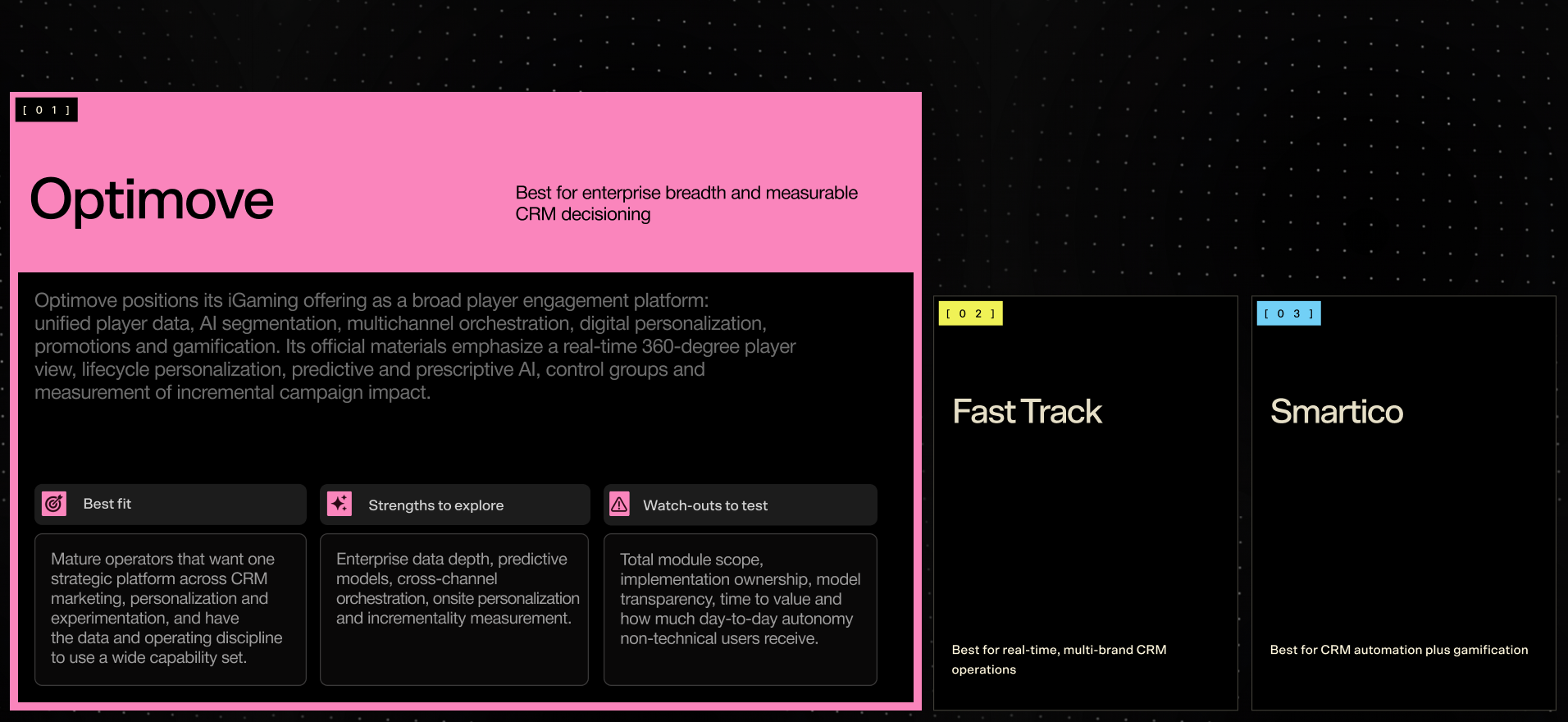
1. Optimove — best for enterprise breadth and measurable CRM decisioning
Optimove positions its iGaming offering as a broad player engagement platform: unified player data, AI segmentation, multichannel orchestration, digital personalization, promotions and gamification. Its official materials emphasize a real-time 360-degree player view, lifecycle personalization, predictive and prescriptive AI, control groups and measurement of incremental campaign impact.
Best fit: mature operators that want one strategic platform across CRM marketing, personalization and experimentation, and have the data and operating discipline to use a wide capability set.
Strengths to explore: enterprise data depth, predictive models, cross-channel orchestration, onsite personalization and incrementality measurement.
Watch-outs to test: total module scope, implementation ownership, model transparency, time to value and how much day-to-day autonomy non-technical users receive.
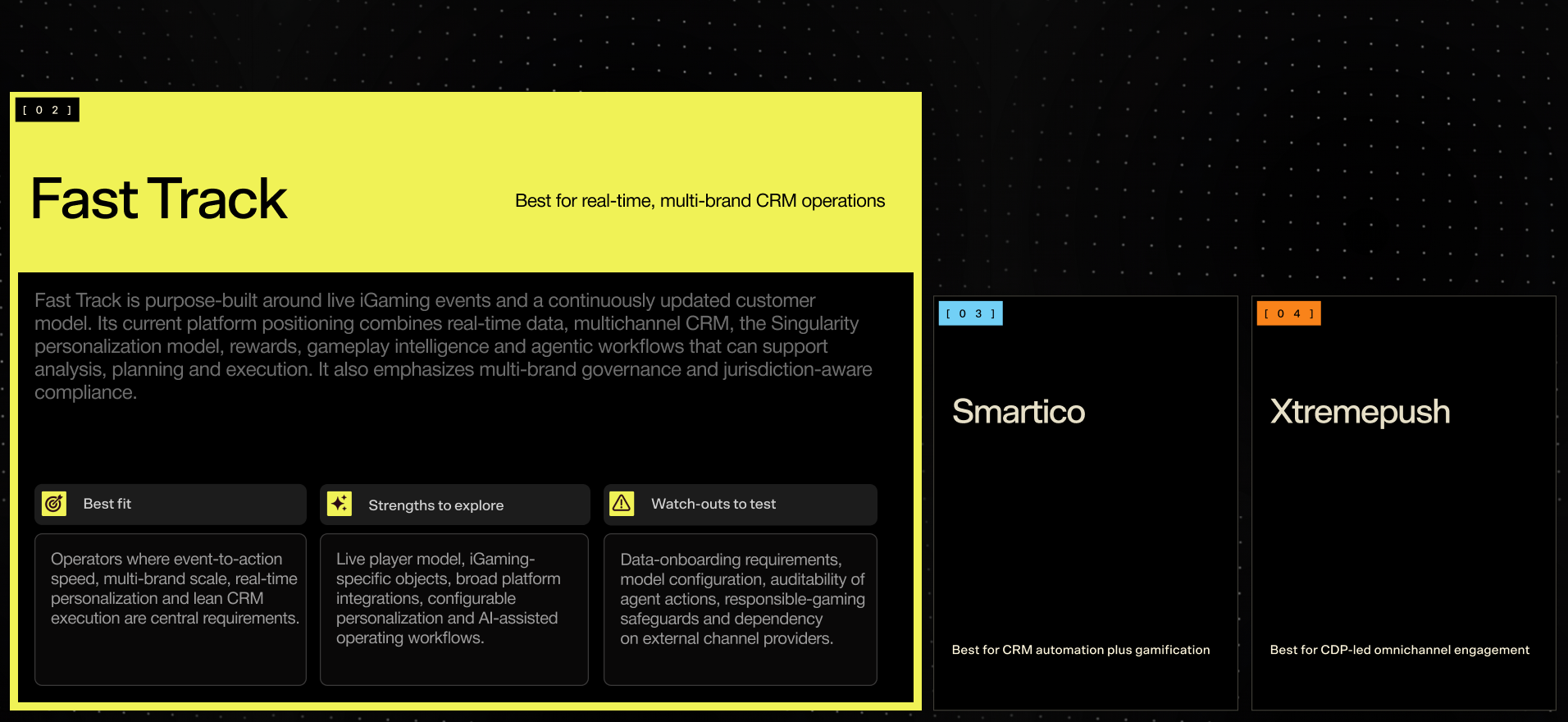
2. Fast Track — best for real-time, multi-brand CRM operations
Fast Track is purpose-built around live iGaming events and a continuously updated customer model. Its current platform positioning combines real-time data, multichannel CRM, the Singularity personalization model, rewards, gameplay intelligence and agentic workflows that can support analysis, planning and execution. It also emphasizes multi-brand governance and jurisdiction-aware compliance.
Best fit: operators where event-to-action speed, multi-brand scale, real-time personalization and lean CRM execution are central requirements.
Strengths to explore: live player model, iGaming-specific objects, broad platform integrations, configurable personalization and AI-assisted operating workflows.
Watch-outs to test: data-onboarding requirements, model configuration, auditability of agent actions, responsible-gaming safeguards and dependency on external channel providers.
3. Smartico — best for CRM automation plus gamification
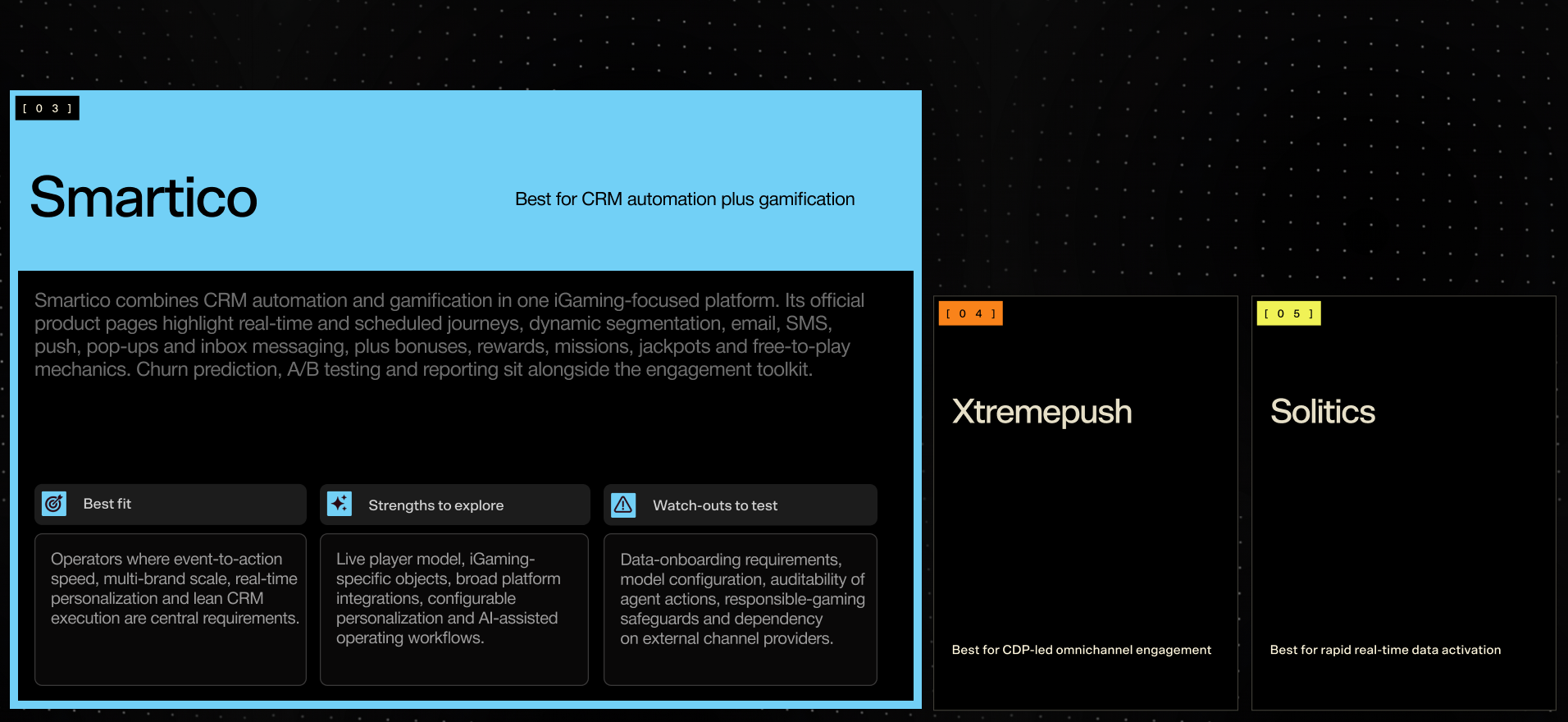
Smartico combines CRM automation and gamification in one iGaming-focused platform. Its official product pages highlight real-time and scheduled journeys, dynamic segmentation, email, SMS, push, pop-ups and inbox messaging, plus bonuses, rewards, missions, jackpots and free-to-play mechanics. Churn prediction, A/B testing and reporting sit alongside the engagement toolkit.
Best fit: operators that want campaign orchestration and gamified retention mechanics under one commercial and operational roof.
Strengths to explore: unified campaign and reward workflows, real-time triggers, lifecycle automation, dynamic bonuses and a wide engagement-mechanics catalogue.
Watch-outs to test: sophistication of analytics and data science, flexibility outside built-in mechanics, migration complexity and the exact boundaries between CRM, bonus engine and PAM.
4. Xtremepush — best for CDP-led omnichannel engagement
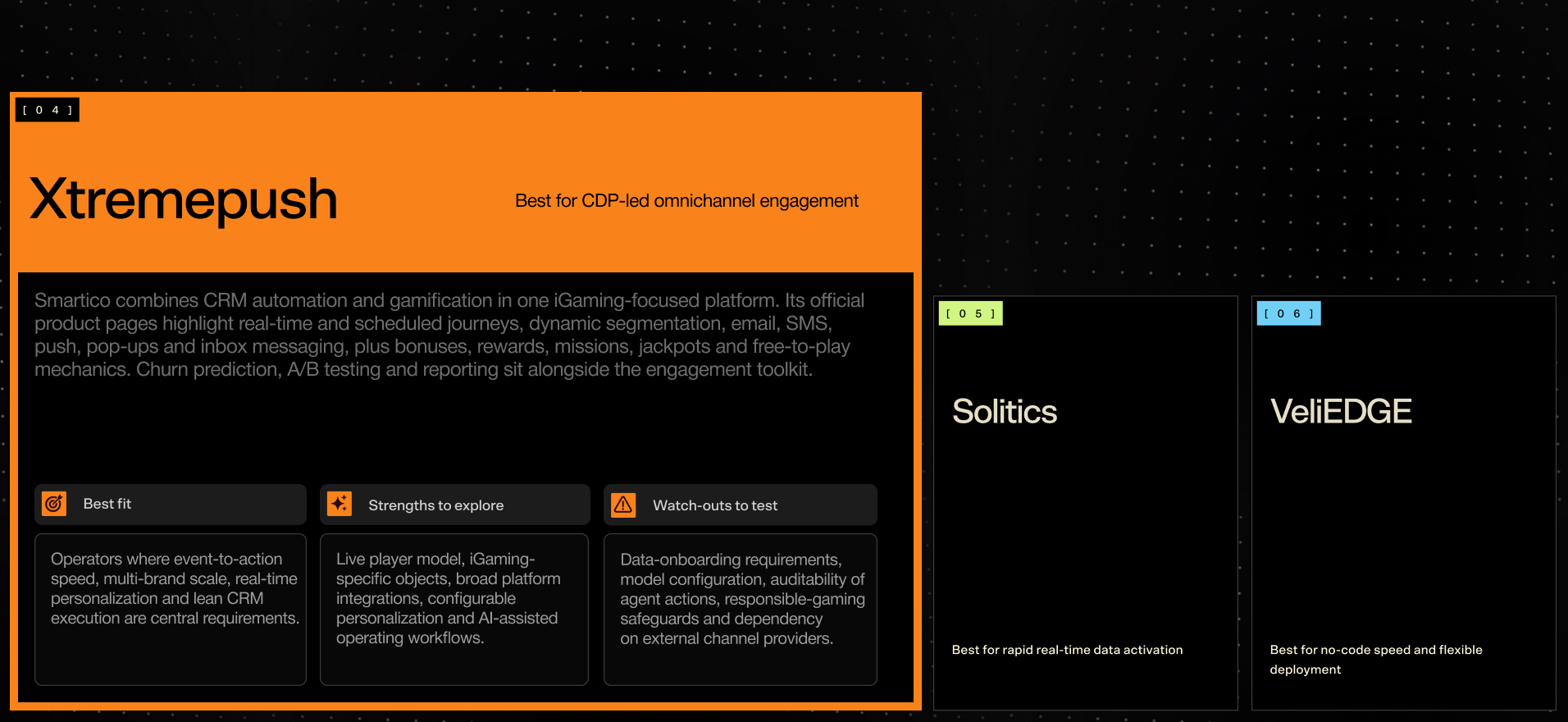
Xtremepush presents its iGaming product as a combined real-time CDP, AI optimization, omnichannel activation, gamification and BI platform. The value proposition is a single-player view that can power lifecycle predictions and coordinated experiences across channels, supported by loyalty and gamified use cases.
Best fit: operators that want to reduce fragmentation between customer data, campaign activation, loyalty and reporting.
Strengths to explore: unified data and activation, lifecycle prediction, omnichannel consistency, gamification and business intelligence.
Watch-outs to test: identity resolution, ingestion latency, reporting customization, onsite interaction depth and the operational split between vendor and operator teams.
5. Solitics — best for rapid real-time data activation
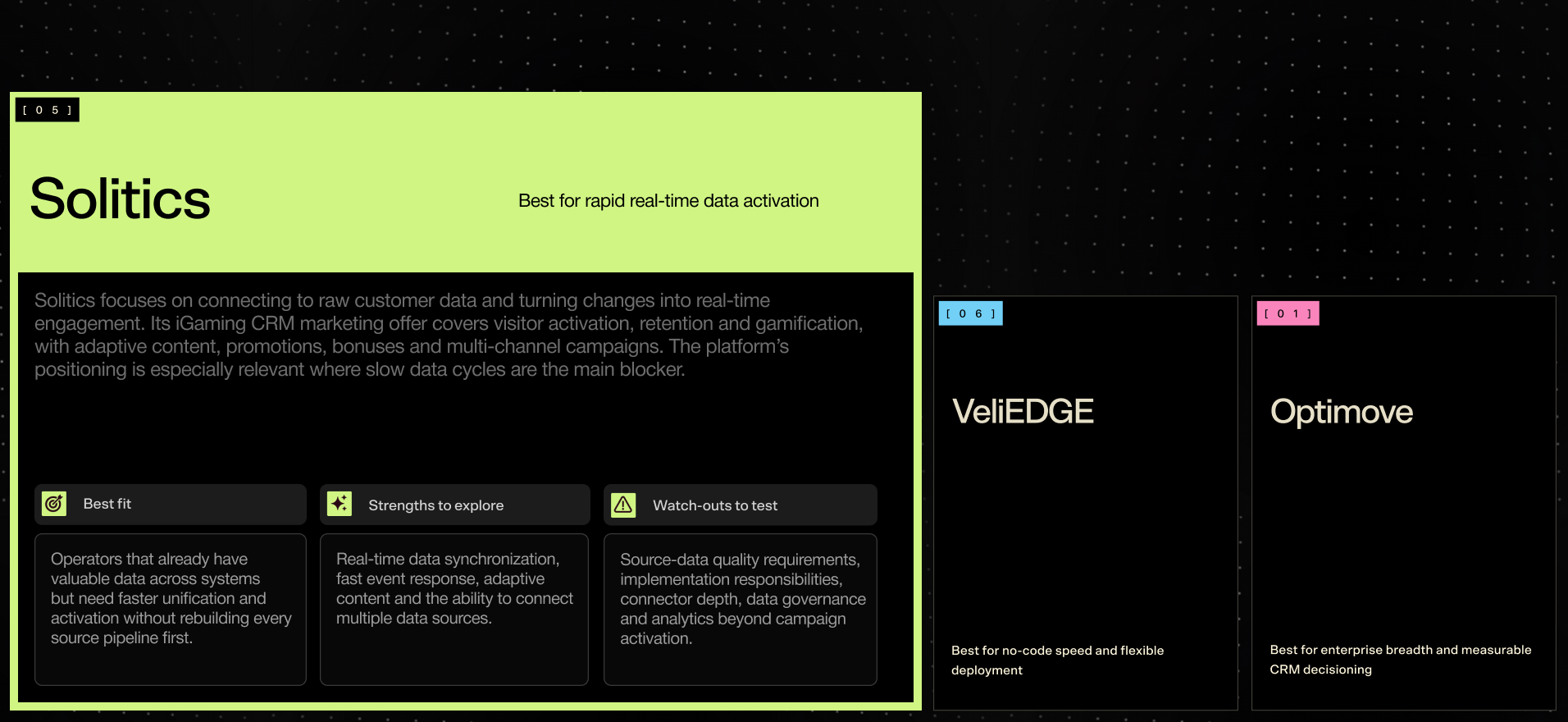
Solitics focuses on connecting to raw customer data and turning changes into real-time engagement. Its iGaming CRM marketing offer covers visitor activation, retention and gamification, with adaptive content, promotions, bonuses and multi-channel campaigns. The platform’s positioning is especially relevant where slow data cycles are the main blocker.
Best fit: operators that already have valuable data across systems but need faster unification and activation without rebuilding every source pipeline first.
Strengths to explore: real-time data synchronization, fast event response, adaptive content and the ability to connect multiple data sources.
Watch-outs to test: source-data quality requirements, implementation responsibilities, connector depth, data governance and analytics beyond campaign activation.
6. VeliEDGE — best for no-code speed and flexible deployment
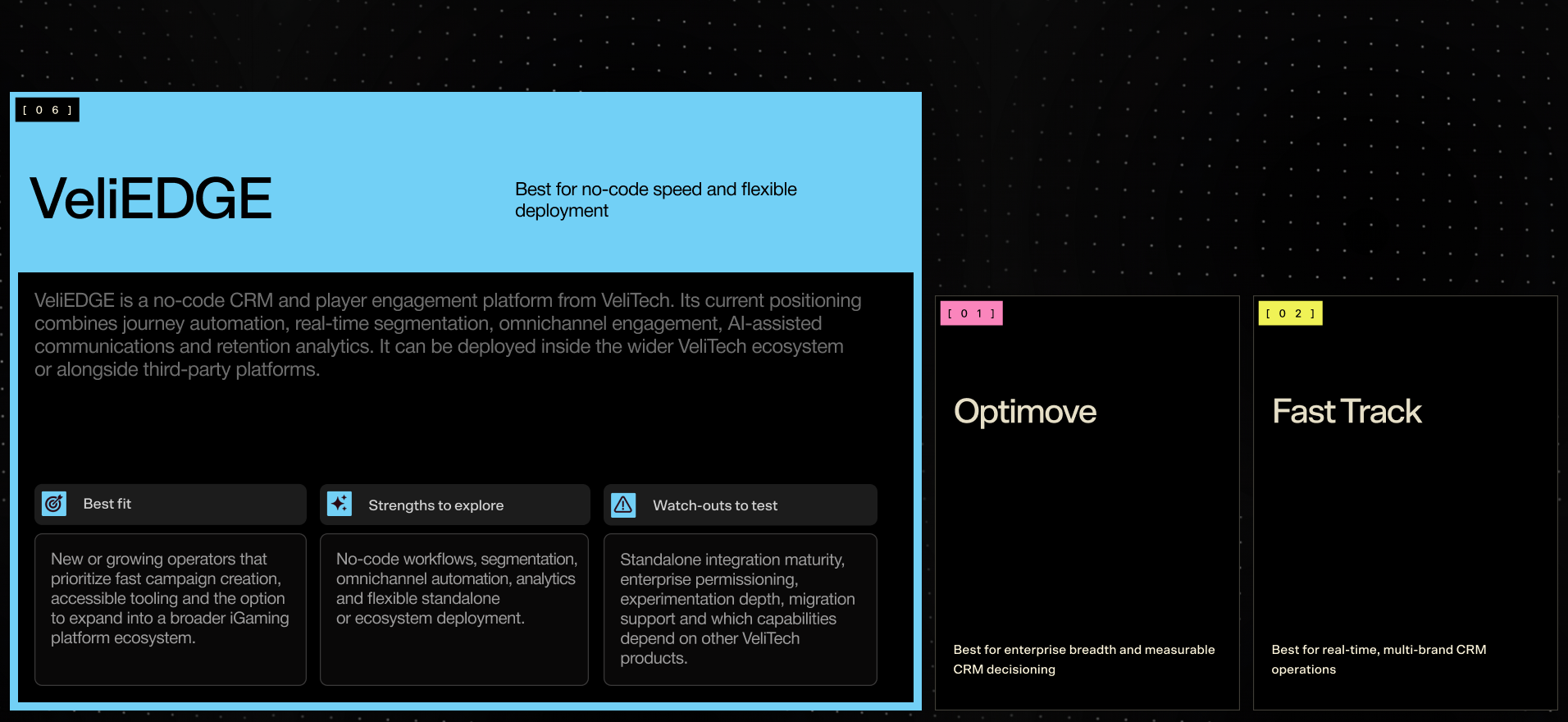
VeliEDGE is a no-code CRM and player engagement platform from VeliTech. Its current positioning combines journey automation, real-time segmentation, omnichannel engagement, AI-assisted communications and retention analytics. It can be deployed inside the wider VeliTech ecosystem or alongside third-party platforms.
Best fit: new or growing operators that prioritize fast campaign creation, accessible tooling and the option to expand into a broader iGaming platform ecosystem.
Strengths to explore: no-code workflows, segmentation, omnichannel automation, analytics and flexible standalone or ecosystem deployment.
Watch-outs to test: standalone integration maturity, enterprise permissioning, experimentation depth, migration support and which capabilities depend on other VeliTech products.
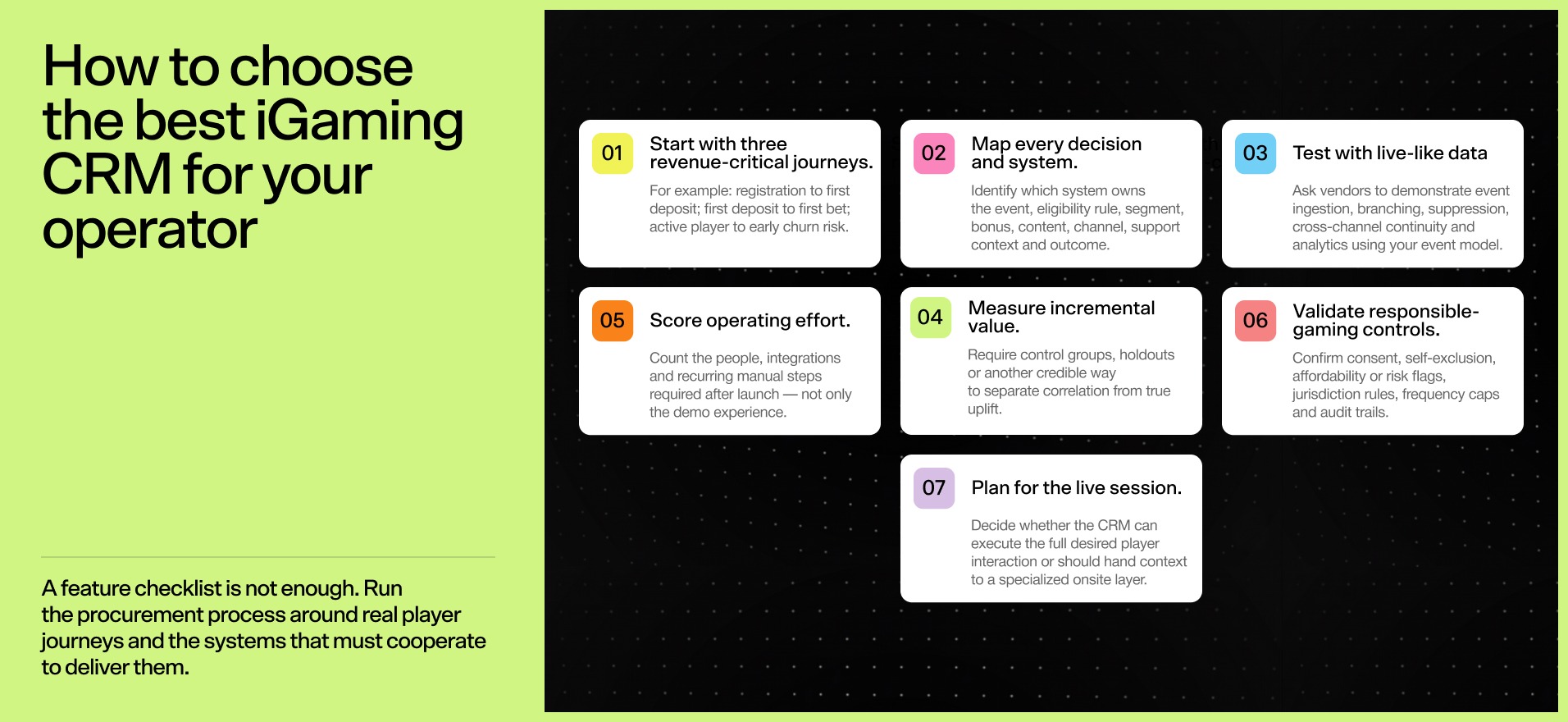
How to choose the best iGaming CRM for your operator
A feature checklist is not enough. Run the procurement process around real player journeys and the systems that must cooperate to deliver them.
1. Start with three revenue-critical journeys. For example: registration to first deposit; first deposit to first bet; active player to early churn risk.
2. Map every decision and system. Identify which system owns the event, eligibility rule, segment, bonus, content, channel, support context and outcome.
3. Test with live-like data. Ask vendors to demonstrate event ingestion, branching, suppression, cross-channel continuity and analytics using your event model.
4. Measure incremental value. Require control groups, holdouts or another credible way to separate correlation from true uplift.
5. Score operating effort. Count the people, integrations and recurring manual steps required after launch — not only the demo experience.
6. Validate responsible-gaming controls. Confirm consent, self-exclusion, affordability or risk flags, jurisdiction rules, frequency caps and audit trails.
7. Plan for the live session. Decide whether the CRM can execute the full desired player interaction or should hand context to a specialized onsite layer.
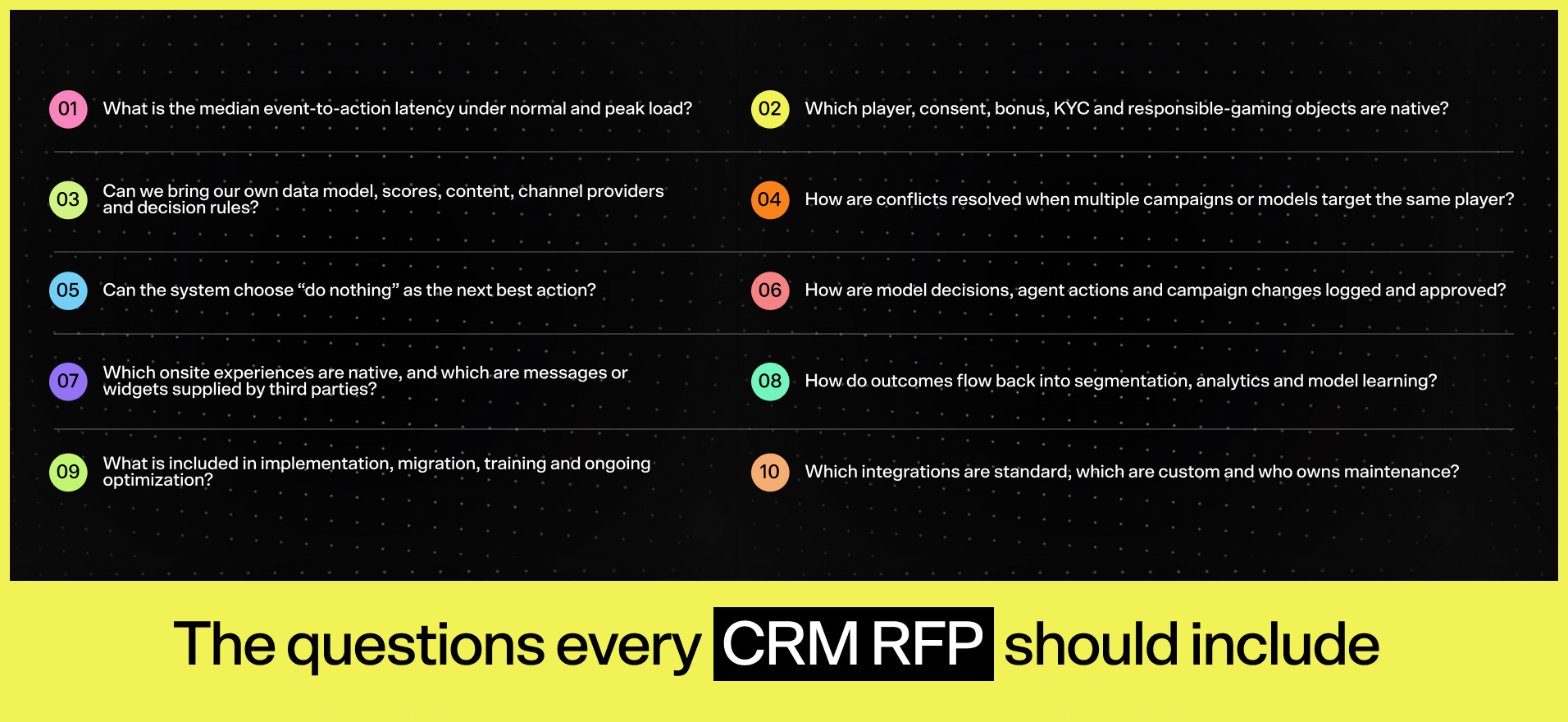
The questions every CRM RFP should include
What is the median event-to-action latency under normal and peak load?
Which player, consent, bonus, KYC and responsible-gaming objects are native?
Can we bring our own data model, scores, content, channel providers and decision rules?
How are conflicts resolved when multiple campaigns or models target the same player?
Can the system choose “do nothing” as the next best action?
How are model decisions, agent actions and campaign changes logged and approved?
Which onsite experiences are native, and which are messages or widgets supplied by third parties?
How do outcomes flow back into segmentation, analytics and model learning?
What is included in implementation, migration, training and ongoing optimization?
Which integrations are standard, which are custom and who owns maintenance?
What iGaming CRM still doesn't always cover
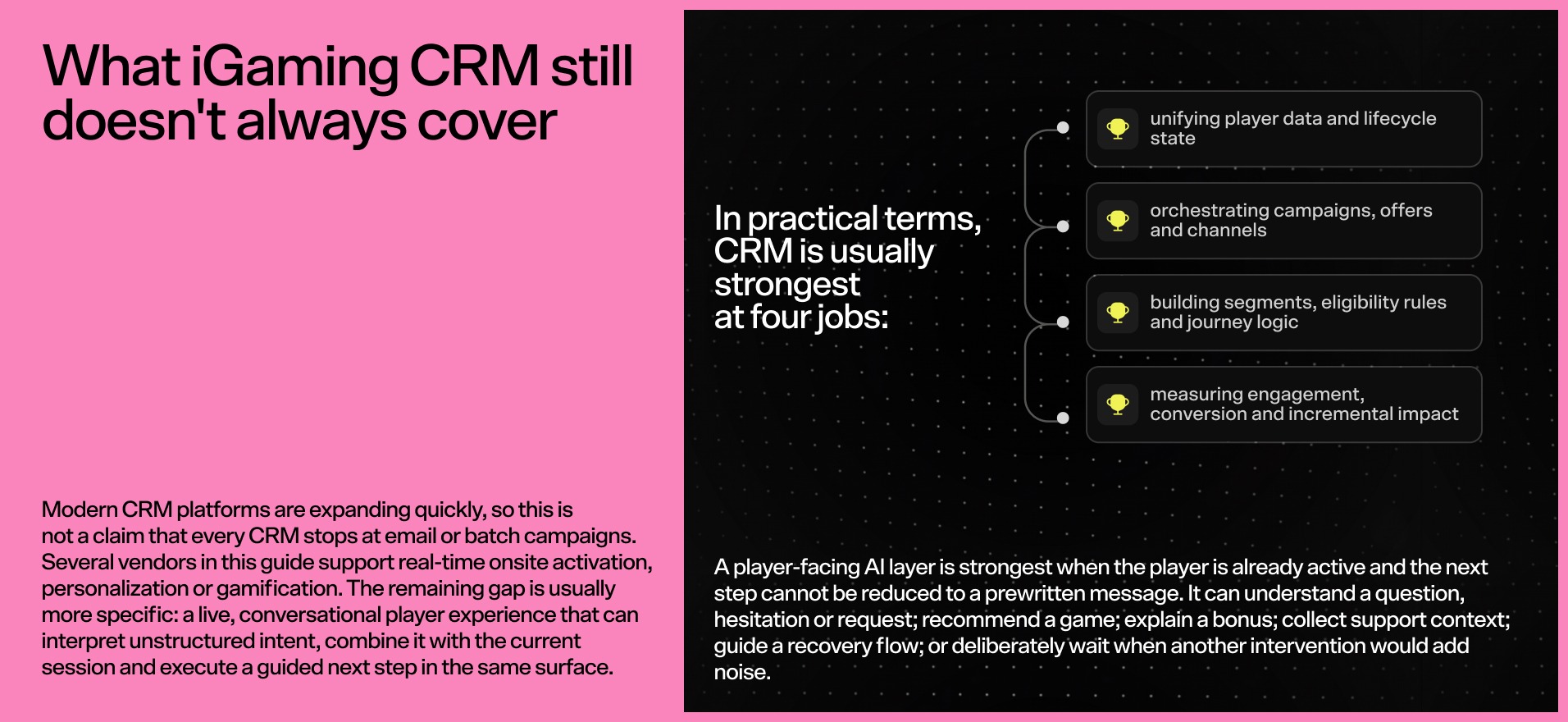
Modern CRM platforms are expanding quickly, so this is not a claim that every CRM stops at email or batch campaigns. Several vendors in this guide support real-time onsite activation, personalization or gamification. The remaining gap is usually more specific: a live, conversational player experience that can interpret unstructured intent, combine it with the current session and execute a guided next step in the same surface.
In practical terms, CRM is usually strongest at four jobs:
unifying player data and lifecycle state;
building segments, eligibility rules and journey logic;
orchestrating campaigns, offers and channels;
measuring engagement, conversion and incremental impact.
A player-facing AI layer is strongest when the player is already active and the next step cannot be reduced to a prewritten message. It can understand a question, hesitation or request; recommend a game; explain a bonus; collect support context; guide a recovery flow; or deliberately wait when another intervention would add noise.
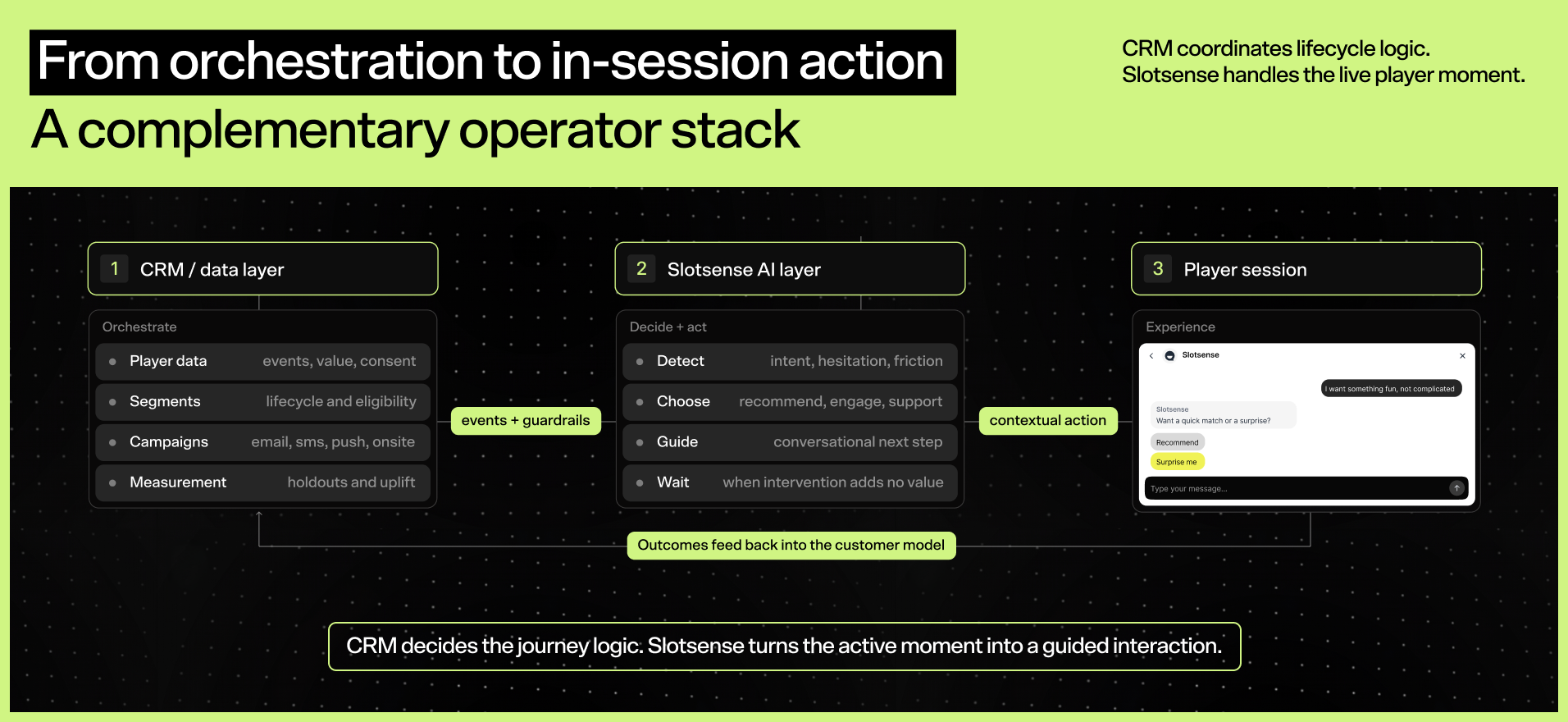
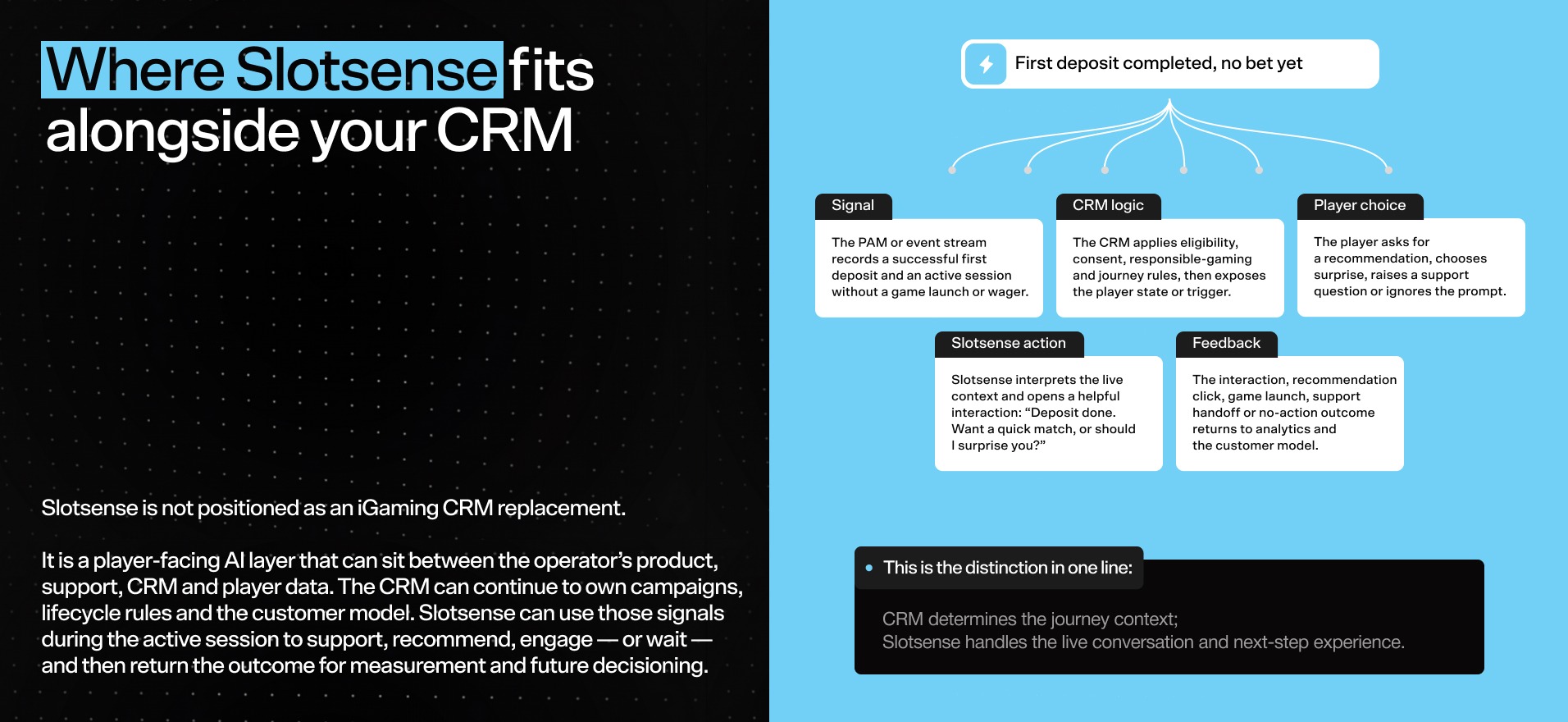
Figure 1. CRM orchestrates lifecycle logic; Slotsense turns the active moment into a guided interaction.
Where Slotsense fits alongside your CRM
Slotsense is not positioned as an iGaming CRM replacement. It is a player-facing AI layer that can sit between the operator’s product, support, CRM and player data. The CRM can continue to own campaigns, lifecycle rules and the customer model. Slotsense can use those signals during the active session to support, recommend, engage — or wait — and then return the outcome for measurement and future decisioning.
Example: first deposit completed, no bet yet
1. Signal: The PAM or event stream records a successful first deposit and an active session without a game launch or wager.
2. CRM logic: The CRM applies eligibility, consent, responsible-gaming and journey rules, then exposes the player state or trigger.
3. Slotsense action: Slotsense interprets the live context and opens a helpful interaction: “Deposit done. Want a quick match, or should I surprise you?”
4. Player choice: The player asks for a recommendation, chooses surprise, raises a support question or ignores the prompt.
5. Feedback: The interaction, recommendation click, game launch, support handoff or no-action outcome returns to analytics and the customer model.
This is the distinction in one line: CRM determines the journey context; Slotsense handles the live conversation and next-step experience.
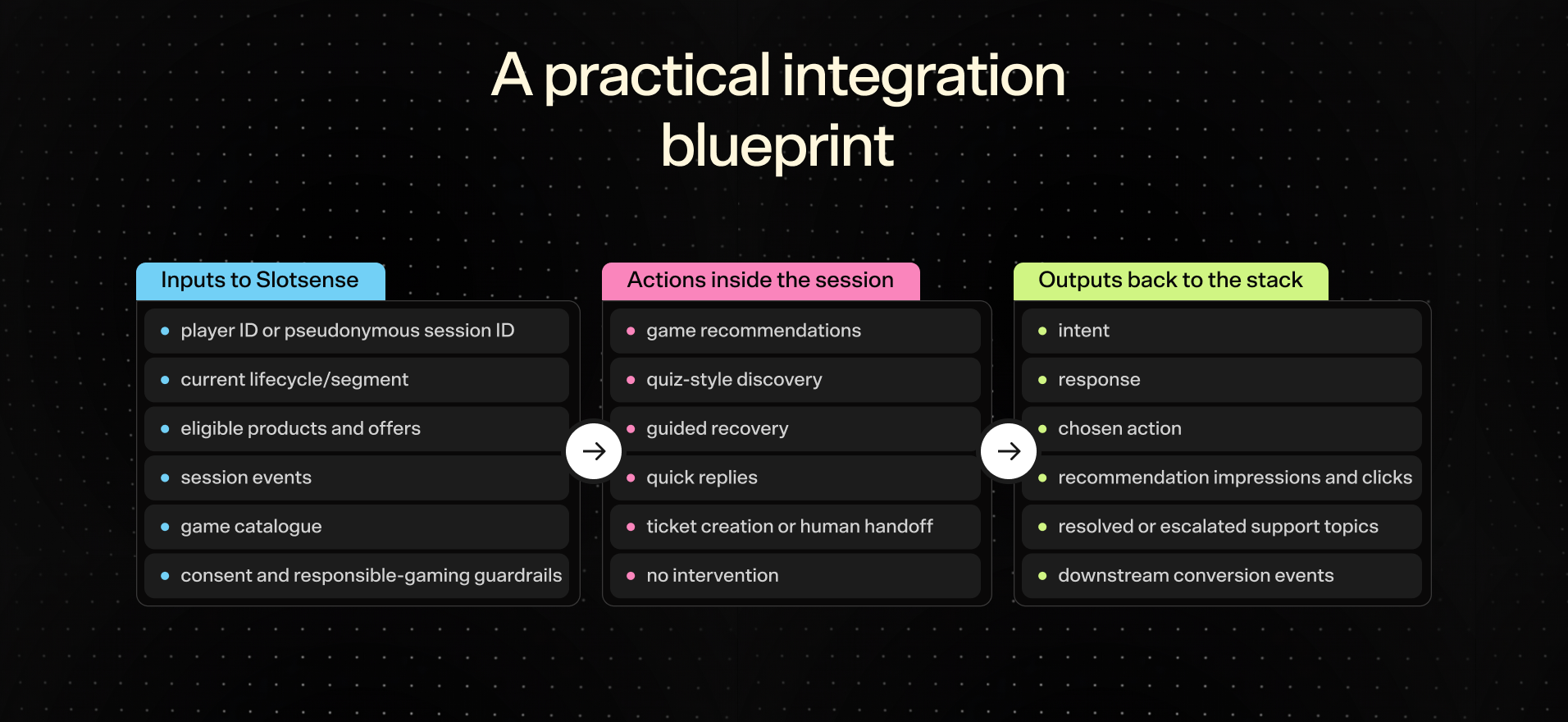
Inputs to Slotsense: player ID or pseudonymous session ID; current lifecycle/segment; eligible products and offers; session events; game catalogue; consent and responsible-gaming guardrails; help content and escalation rules.
Actions inside the session: contextual support; game recommendations; quiz-style discovery; proactive retention prompts; guided recovery; quick replies; ticket creation or human handoff; no intervention.
Outputs back to the stack: intent; response; chosen action; recommendation impressions and clicks; game launches; resolved or escalated support topics; experiment exposure; downstream conversion events.
Bottom line
The best iGaming CRM platform is the one that fits your event model, operating team, jurisdictions and retention strategy — and can prove incremental value after integration. Optimove, Fast Track, Smartico, Xtremepush, Solitics and VeliEDGE each offer a credible path, but they solve the problem with different centers of gravity.
Do not choose on feature count alone. Choose the system that can reliably decide who is eligible, what the objective is, which action is appropriate and how success will be measured. Then check whether the active player moment needs a specialized conversational layer to turn that decision into a useful experience.
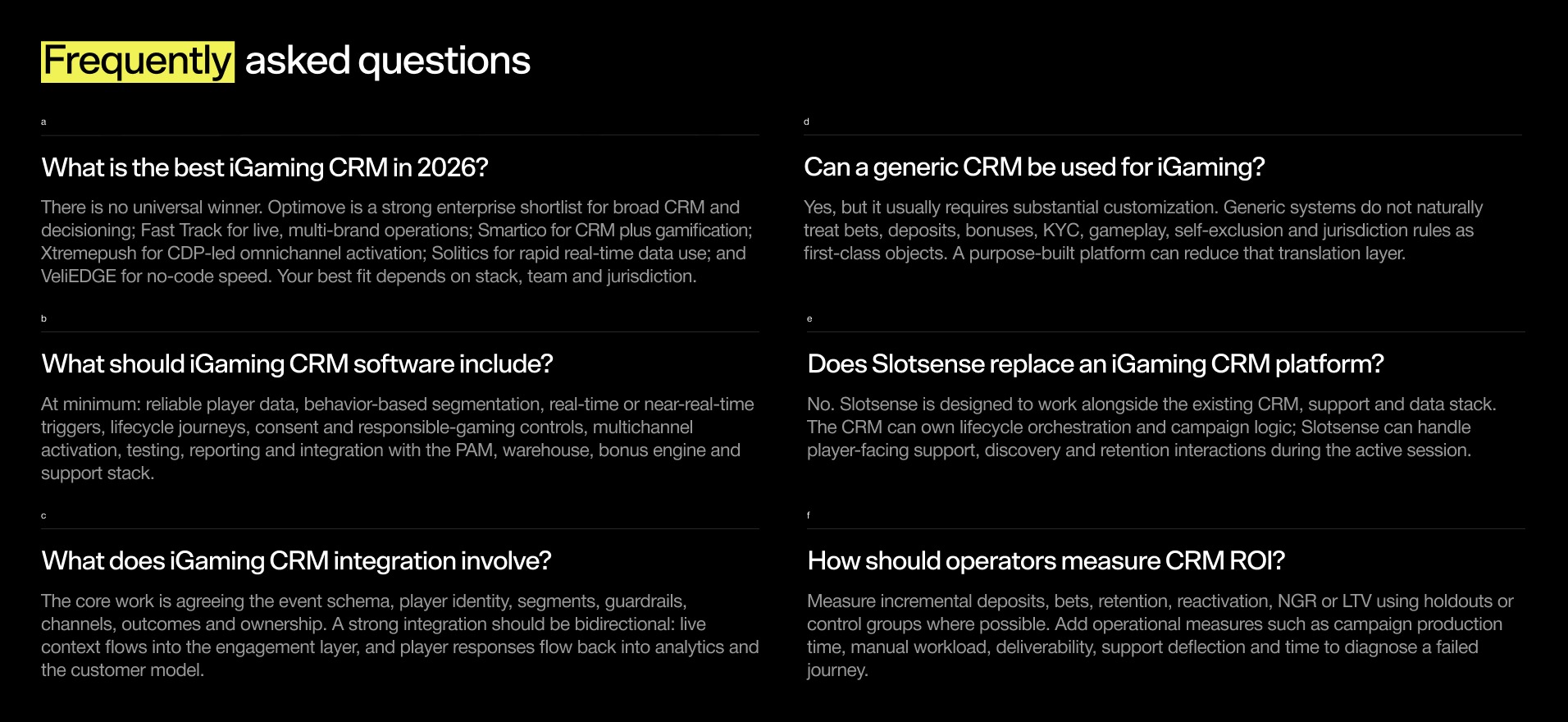
There is no universal winner. Optimove is a strong enterprise shortlist for broad CRM and decisioning; Fast Track for live, multi-brand operations; Smartico for CRM plus gamification; Xtremepush for CDP-led omnichannel activation; Solitics for rapid real-time data use; and VeliEDGE for no-code speed. Your best fit depends on stack, team and jurisdiction.
What should iGaming CRM software include?
At minimum: reliable player data, behavior-based segmentation, real-time or near-real-time triggers, lifecycle journeys, consent and responsible-gaming controls, multichannel activation, testing, reporting and integration with the PAM, warehouse, bonus engine and support stack.
Can a generic CRM be used for iGaming?
Yes, but it usually requires substantial customization. Generic systems do not naturally treat bets, deposits, bonuses, KYC, gameplay, self-exclusion and jurisdiction rules as first-class objects. A purpose-built platform can reduce that translation layer.
Does Slotsense replace an iGaming CRM platform?
No. Slotsense is designed to work alongside the existing CRM, support and data stack. The CRM can own lifecycle orchestration and campaign logic; Slotsense can handle player-facing support, discovery and retention interactions during the active session.
What does iGaming CRM integration involve?
The core work is agreeing the event schema, player identity, segments, guardrails, channels, outcomes and ownership. A strong integration should be bidirectional: live context flows into the engagement layer, and player responses flow back into analytics and the customer model.
How should operators measure CRM ROI?
Measure incremental deposits, bets, retention, reactivation, NGR or LTV using holdouts or control groups where possible. Add operational measures such as campaign production time, manual workload, deliverability, support deflection and time to diagnose a failed journey.
.png)
.png)