Customer Journey Orchestration for iGaming: From CRM Workflows to Real-Time AI
A practical guide for operators deciding where fixed CRM journeys end, how real-time decisioning begins, and why execution inside the active player experie
16 mins
·
September 11, 2026
From fixed automation to contextual action selection inside the live player experience.
Journey orchestration is not a bigger flowchart
Customer journey orchestration is often presented as a more sophisticated way to draw campaign paths. That definition is too narrow for iGaming. A journey is not orchestrated merely because an event triggers an email, an on-site banner, or a branch in a canvas. Those are useful workflows—but the response was still chosen in advance.
Real-time customer journey orchestration begins when the system can reassess the situation at the moment of interaction. It uses the latest player context, identifies the objective that matters now, considers the actions that are actually eligible, and selects what should happen next. The action may be a recommendation, a quiz, support guidance, an escalation—or no intervention at all.
That distinction matters because an iGaming player can move from discovery to friction, support intent, deposit failure, gameplay, or risk in the same session. A static branch can react to an event. An orchestration layer has to understand what the event means now.
What is customer journey orchestration?
Customer journey orchestration is the coordinated use of live signals, decision logic, channels, and feedback to determine and deliver the next appropriate interaction for an individual. The emphasis is not only on sequencing touchpoints; it is on continually aligning the interaction with the customer’s current context and the operator’s permitted objective.
Adobe’s current guide describes customer journey orchestration as using real-time data and behavioural signals instead of relying only on static segments or personas, including “same-session re-decisioning.” Adobe: Customer journey orchestration
For an iGaming operator, that translates into six practical capabilities:
Listen for meaningful player and product events in real time.
Assemble the current player state from available data and prior interactions.
Choose the objective that should govern this moment.
Filter actions through eligibility, responsible-gaming, jurisdiction, frequency, and brand rules.
Execute the selected action in the relevant player-facing surface.
Use the outcome to improve the next decision.
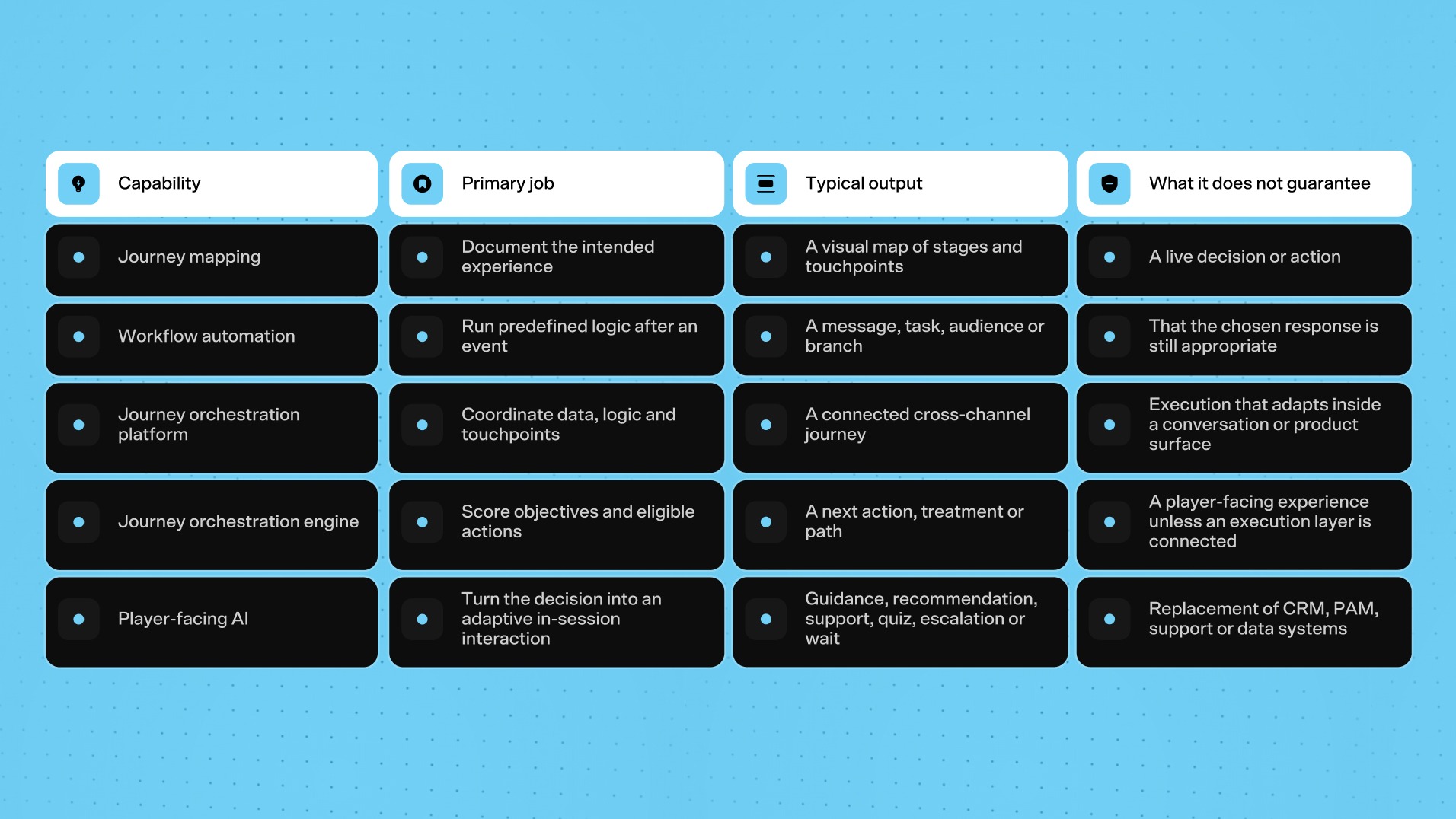
Journey mapping, workflows, orchestration and player-facing AI are different jobs
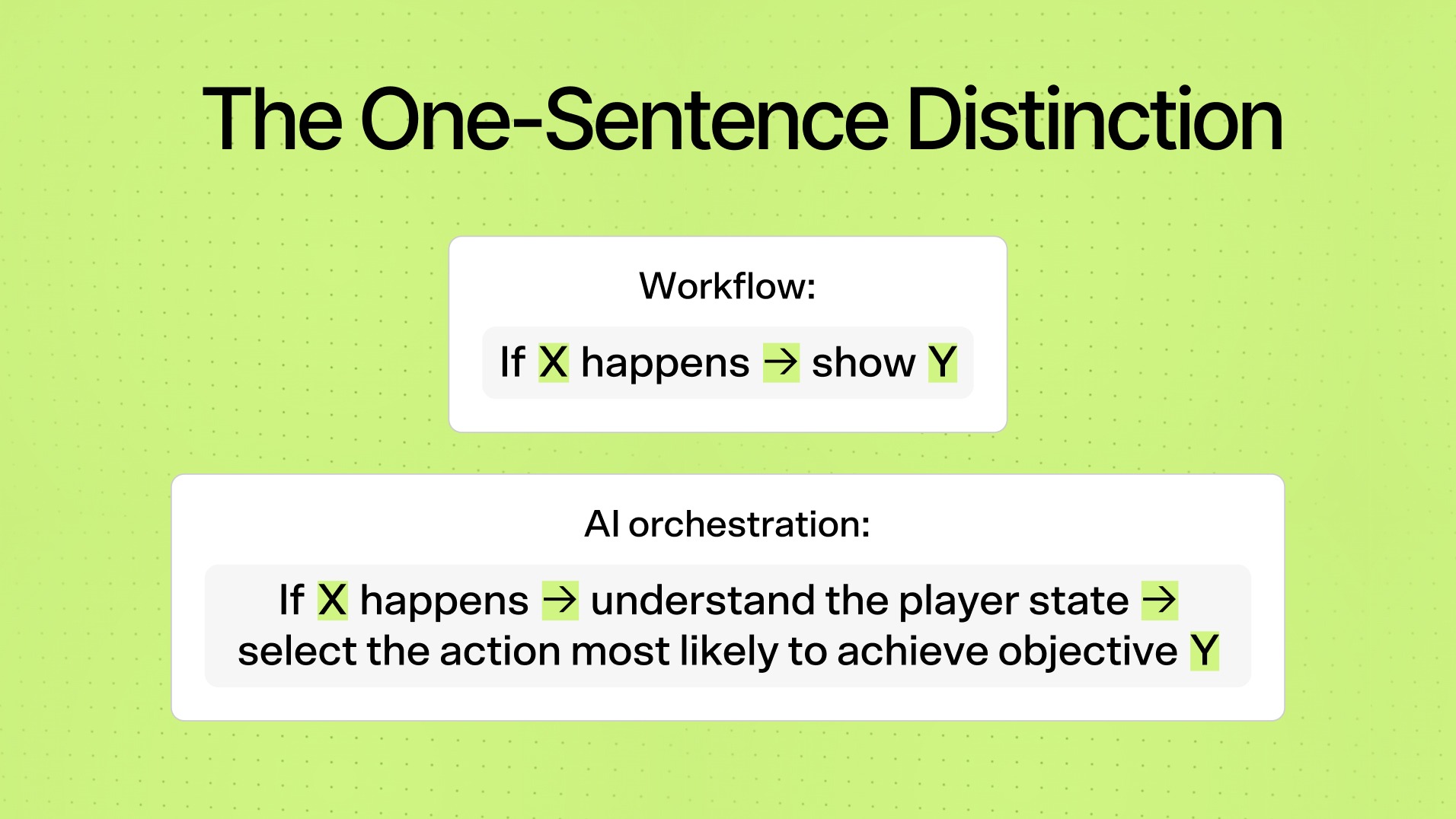
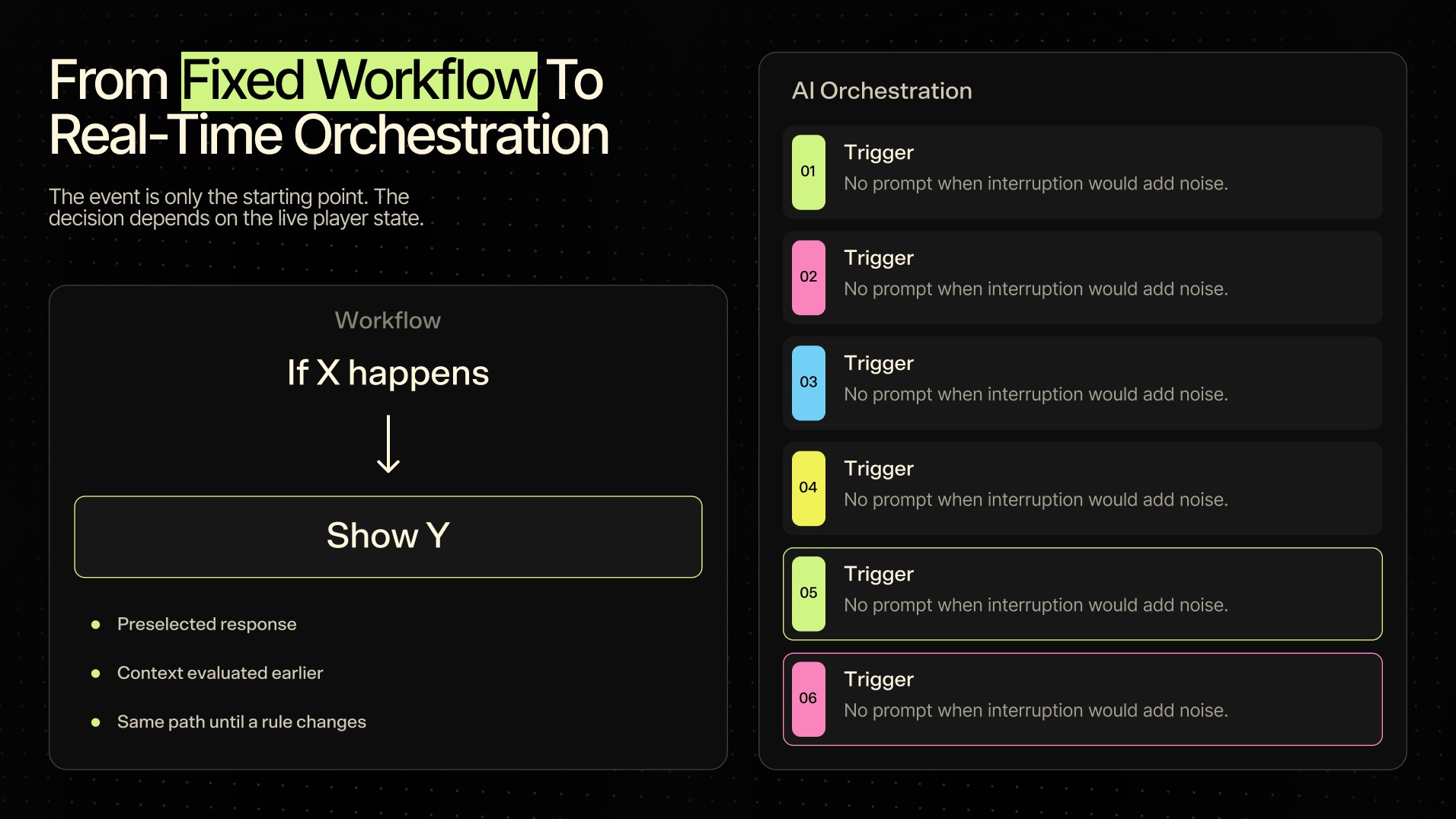
Workflow vs. AI orchestration
A trigger starts the process; it should not predetermine the response.
Why fixed workflows still matter—and where they stop
Fixed workflows remain the right choice when the required action is deterministic, legally prescribed, operationally simple, or low variance. A KYC reminder, a verified account-status message, or a service outage notice should not become an open-ended AI decision simply because AI is available.
The limitation appears when several responses could be valid and the best one depends on context. In that situation, adding more branches creates a larger ruleset, not intelligence. Operators eventually face:
Rule collisions: multiple journeys become eligible at the same time.
Stale context: the event was correct, but the player state has changed since the rule fired.
Message fatigue: each workflow optimizes locally, while the player experiences the combined pressure.
Objective conflict: conversion, support, retention and safer-gambling priorities compete for the same moment.
Channel blindness: the system chooses a send, but not the best experience inside the active session.
Maintenance debt: every new edge case adds another branch, suppression rule or manual exception.
The real-time orchestration model for iGaming
A useful journey orchestration engine does not jump directly from signal to message. It moves through a decision sequence that can be inspected, governed and measured.
1. Trigger
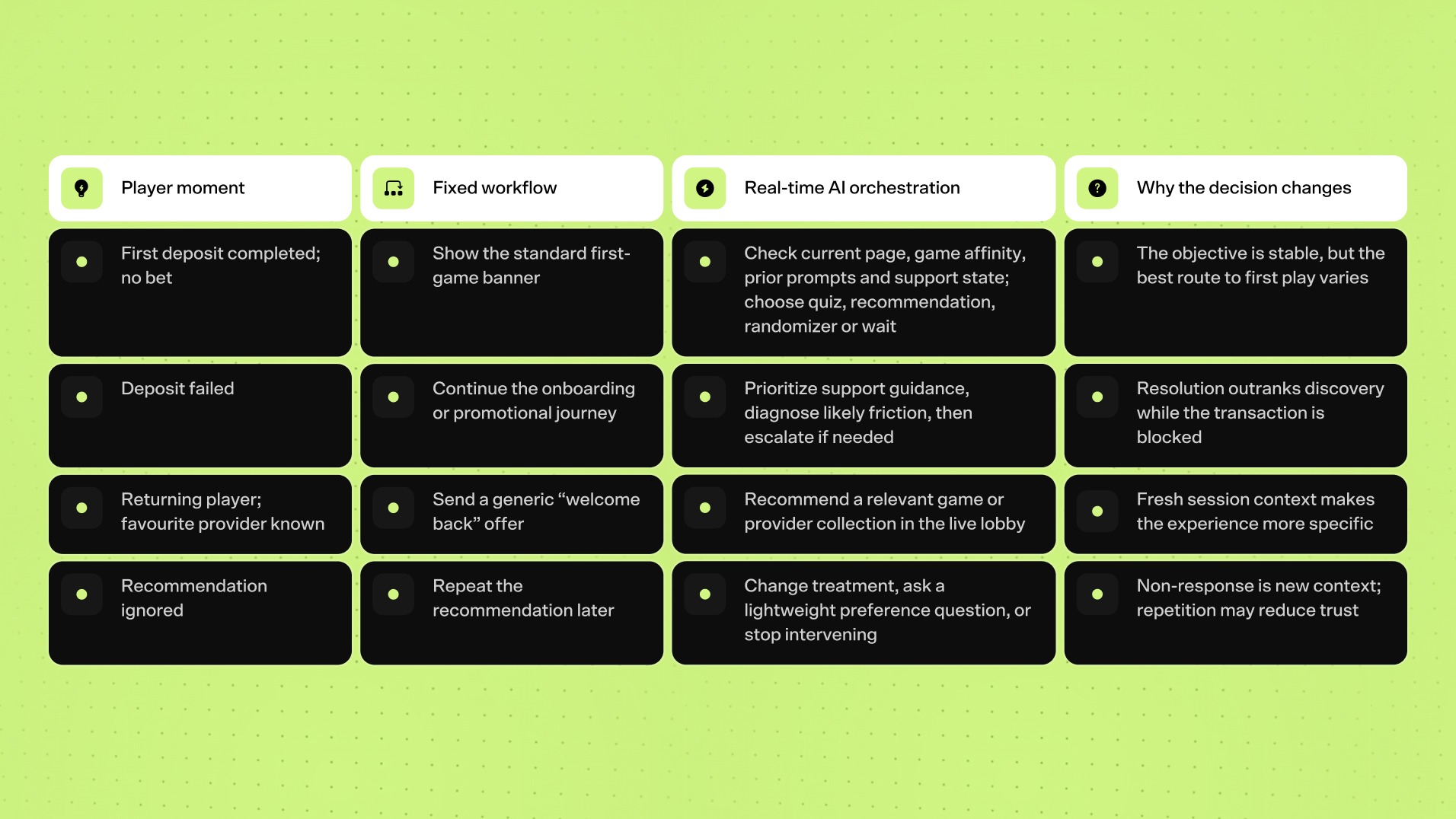
A trigger is the change that makes a decision worth considering: first deposit completed, deposit failed, game session ended, player returned, recommendation ignored, support intent detected, balance changed, or a responsible-gaming signal appeared. It opens the decision window; it does not dictate the answer.
2. Player context
The engine assembles the state that is relevant now. Depending on integration depth, that may include lifecycle stage, current page, market and language, game or provider affinity, deposit status, balance or account status, previous prompts, ignored recommendations, support history, and risk or suppression flags.
3. Objective
The operator defines the outcome the system is allowed to pursue. Examples include completing the first meaningful play, resolving friction, helping the player discover a relevant game, reducing unnecessary support escalation, or leaving the player uninterrupted. Objectives need precedence rules: resolving a failed deposit or a safety issue should outrank promotional engagement.
4. Possible actions
The action set is broader than a collection of messages. It can include opening a guided quiz, presenting a recommendation, offering a randomizer, explaining a deposit step, asking one clarifying question, handing off to support, suppressing another campaign, or waiting.
5. AI decision
The decision layer ranks the eligible actions against the current state and objective, after hard rules remove anything unsuitable. This is where AI adds value: the same trigger can lead to a different action for a different player—or for the same player five minutes later.
6. Outcome and feedback
The system records what happened: accepted recommendation, quiz completion, issue resolved, first bet, dismissal, escalation, continued play, or no response. That feedback should inform measurement and future decisions without turning every short-term click into a new preference.
Four iGaming journey orchestration examples
“Do nothing” is a valid orchestrated action
Real-time decisioning should not be measured by how often it produces an intervention. A mature journey orchestration engine treats “wait” as a legitimate candidate when confidence is low, the player has ignored recent prompts, another journey has priority, the moment is not appropriate, or the expected value of interruption is negative.
This is one of the clearest differences between orchestration and campaign pressure. The goal is not to maximize messages. It is to improve the next player decision while protecting the quality of the experience.
What customer journey orchestration tools should operators compare?
The market uses customer journey orchestration tools, journey builders, decisioning engines and customer engagement platforms as overlapping labels. Buyers should ignore the category name long enough to test what the product actually controls.
Data freshness: Can the platform act on the current session, or only on the latest synchronized profile?
Decision scope: Does it choose among objectives and actions, or only route users through authored branches?
Identity and state: Can it combine anonymous session context, known player data, previous interactions and support intent?
Action model: Are actions limited to messages and channels, or can the system guide, recommend, ask, escalate and wait?
Player-facing execution: Can it change what the player experiences now, inside the site or app?
Conflict resolution: How are competing journeys, frequency limits and priority rules handled?
Guardrails: Can compliance and responsible-gaming conditions veto promotional or engagement actions?
Explainability: Can CRM, product and support teams see why an action was selected or suppressed?
Experimentation: Can teams compare policies, journeys and actions against a control?
Integration: Does the journey orchestration platform complement the existing CRM, PAM, data and support stack?
The market is moving from workflow automation to agentic CRM
Fast Track is publicly educating iGaming buyers around this transition. Its current positioning describes a progression from workflow CRM to real-time CRM, 1:1 experiences, AI-assisted CRM and AI-native agentic CRM. Fast Track: The future of CRM
In a separate product announcement, Fast Track says its agentic workflows can interpret a goal, plan and execute actions across tools and data, and adapt as conditions change. Fast Track: Fully agentic workflows for CRM
That direction is important because it changes the buyer’s question. “Can the CRM automate this workflow?” becomes “What can the AI decide and execute on my behalf?” The useful comparison is no longer AI versus no AI. It is where the AI operates, which decisions it owns, and how close it sits to the player moment.
Fast Track’s stated center of gravity is AI-native CRM: analysis, planning, campaign and lifecycle execution across a real-time customer model. Slotsense’s center of gravity is the active, player-facing experience: the guided conversation, recommendation, support response, quiz, escalation or deliberate pause that happens while the player is present. These layers can work together.
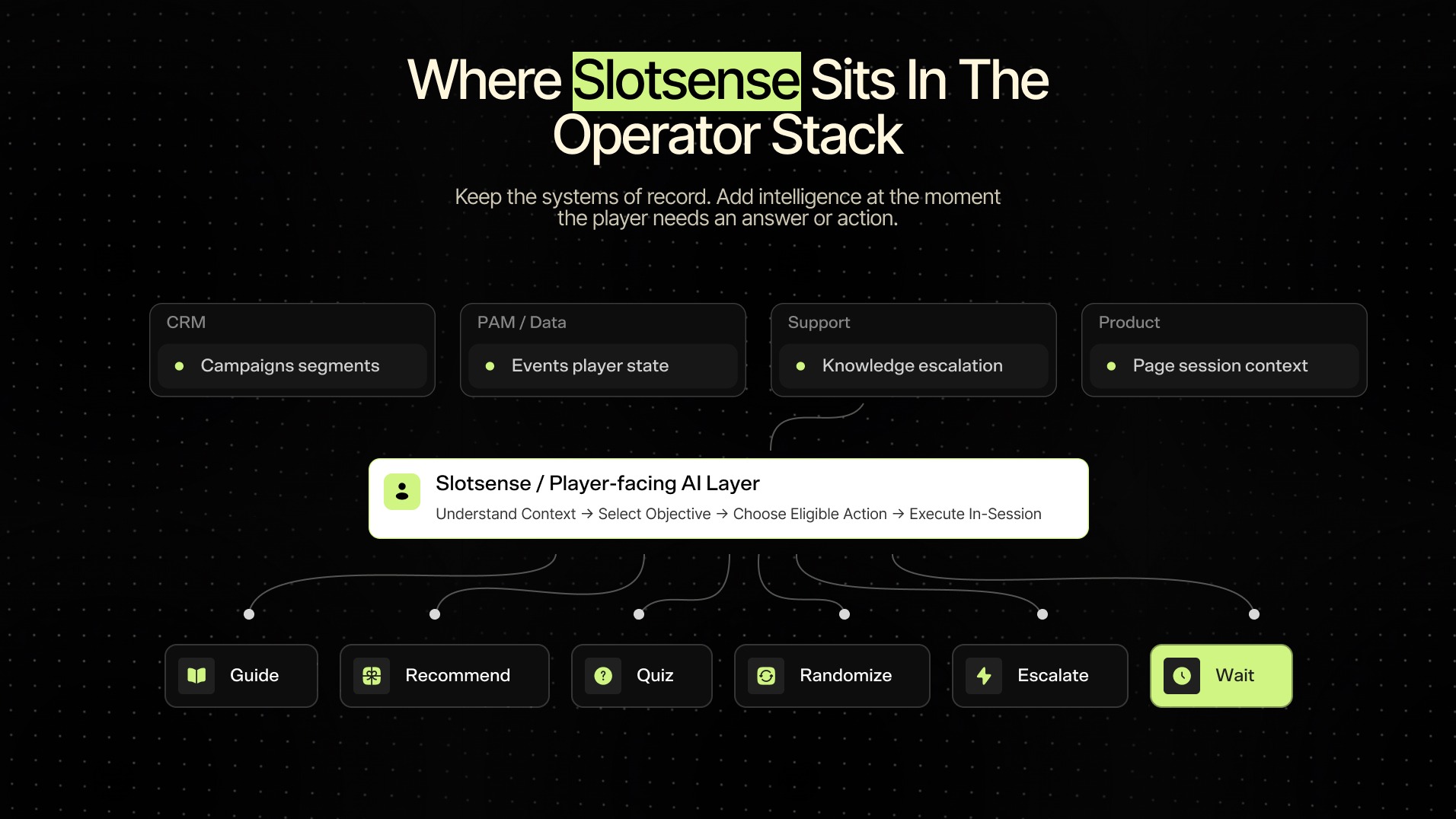
Where Slotsense fits: execution inside the player-facing experience
Slotsense uses signals from the existing stack to select and execute an in-session action.
Slotsense is not a CRM replacement. The CRM can continue to manage campaigns, segments and lifecycle logic. The PAM and data layer can remain the source of player events and status. The support stack can own tickets, knowledge and agent workflows. Slotsense connects those inputs to the live interaction where a player is choosing, asking, hesitating or encountering friction.
The Slotsense website describes the product as a player-facing AI layer that works with the existing product, CRM, support and data stack, with Retention AI using trigger and player-state data to react in real time. Slotsense: Player-facing AI for iGaming
What player-facing execution changes
The action can be conversational. A player can clarify intent instead of being forced down a prewritten branch.
Support and retention can share context. A deposit problem can suppress a game recommendation and surface guidance instead.
The active page becomes part of the decision. A lobby, cashier and help surface should not receive the same treatment.
The system can re-decide within the session as the player responds, ignores or changes direction.
The outcome loop becomes shorter because the system observes the response where the action occurred.
A responsible real-time decision must be constrained
In regulated iGaming, the “best” action is never an unconstrained optimization. Eligibility rules, account restrictions, market requirements and responsible-gaming protections must sit ahead of commercial ranking. A safety or compliance rule should veto an action; it should not compete with it as one more weighted signal.
The UK Gambling Commission’s remote customer-interaction guidance says operators should use all available information to build a complete picture, identify risk in real or near real time, act promptly, and keep meaningful records of actions and interactions. UKGC: Remote customer interaction guidance
For an orchestration design, that implies a clear precedence model:
Mandatory service, account and safety actions override promotional objectives.
Suppression, exclusion and jurisdiction rules are hard constraints.
Low confidence should route to clarification, human review or no action—not an aggressive guess.
The decision and the data used should be auditable.
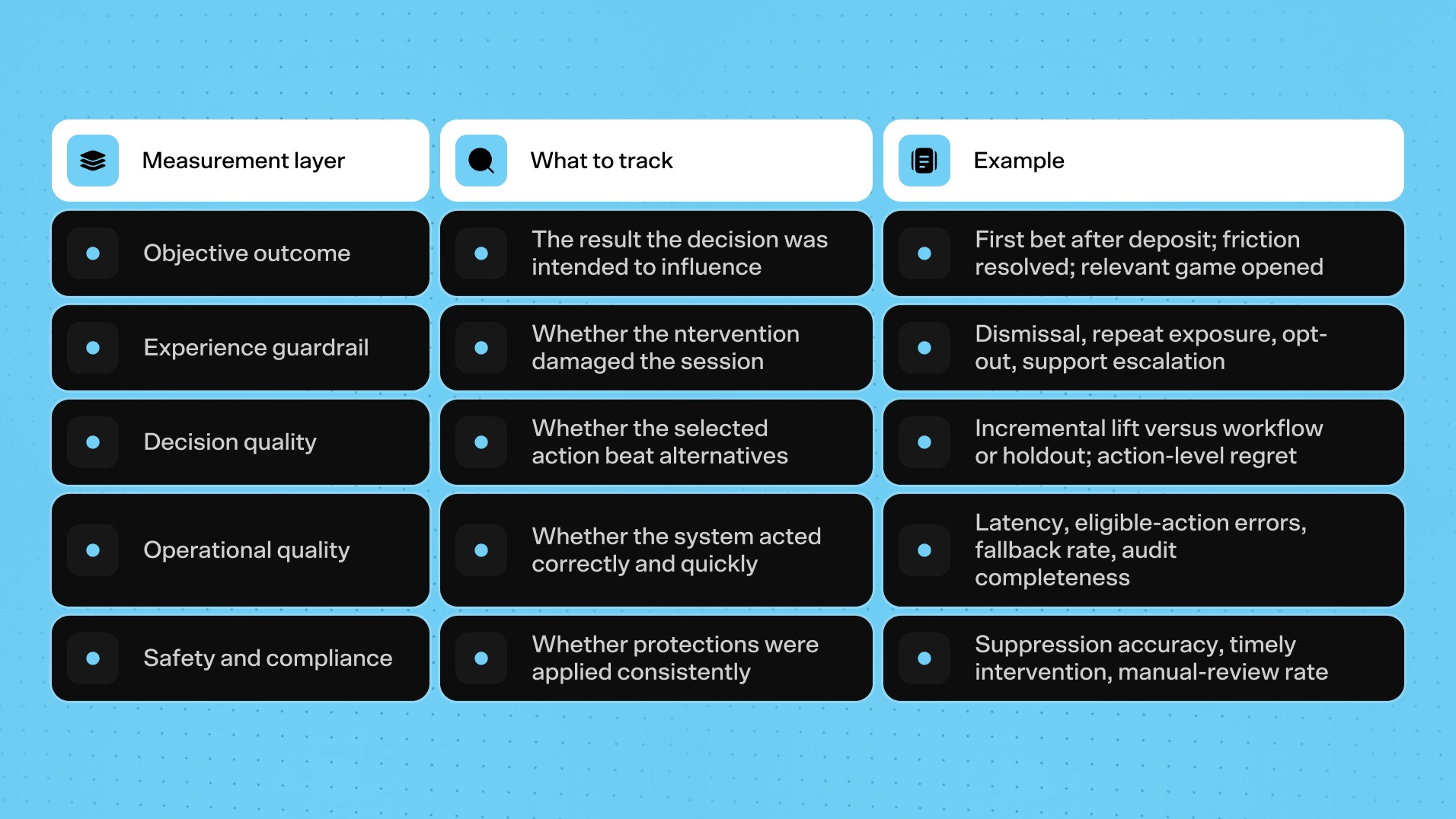
Teams should measure negative outcomes, not only conversion lift.
How to build the first real-time journey orchestration use case
Choose one high-value moment. Start with a clear event such as first deposit with no bet, deposit failure, or returning-player game discovery.
Define one primary objective. Make the desired outcome measurable and state which objectives can override it.
List the minimum context. Use only the signals that can materially change the decision.
Create a small action set. Include a control, an escalation path and “wait.”
Write eligibility and guardrails first. Remove actions that are unsuitable before the model ranks anything.
Connect one player-facing surface. Prove the loop in a lobby, cashier, support widget or guided assistant before expanding.
Compare against the existing workflow. Run a holdout or policy test so improvement is attributable.
Review outcomes and failure modes. Look for repeated prompts, incorrect priorities, unresolved friction and unsafe optimization.
Expand by objective, not by channel. Add new moments once the decision quality is trustworthy.
Measurement: prove decision quality, not message volume
The strategic takeaway
Customer journey orchestration is becoming a buying category because operators want more than campaign automation. But the category will remain confusing unless teams separate three questions:
What data and events describe the player now?
What objective and action should be selected?
Where and how will that action be executed for the player?
CRM and journey platforms are essential for data, campaigns, channel coordination and lifecycle control. Real-time AI adds contextual decisioning. Slotsense completes the loop in the active player-facing experience—where the decision becomes guidance, support, discovery, escalation or restraint.
It is the coordinated use of real-time signals, decision logic, channels and feedback to select and deliver the next appropriate interaction for an individual.
How is journey orchestration different from workflow automation?
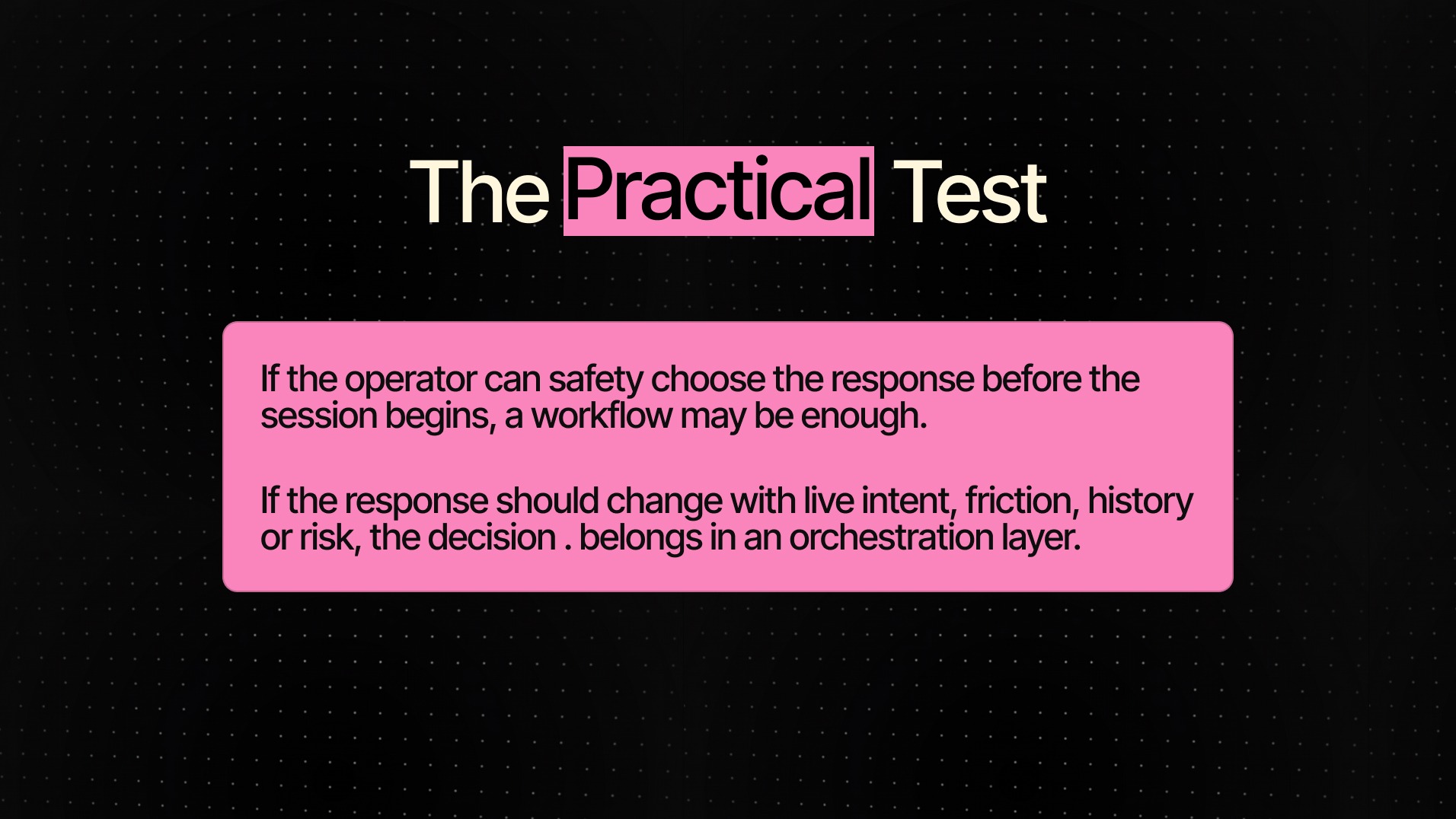
A workflow follows predefined logic: if an event happens, execute a selected response. Orchestration evaluates the current state, chooses the governing objective and selects among eligible actions at decision time.
What do customer journey orchestration tools do?
Most tools connect customer data, event triggers, journey logic, channels, testing and measurement. Capabilities differ: some mainly provide visual journey builders; others add real-time decisioning or in-product execution.
What is a journey orchestration engine?
It is the decisioning component that evaluates context, objectives, eligibility and possible actions. It may sit inside a larger journey orchestration platform or connect to separate execution surfaces.
Does a journey orchestration platform replace CRM?
Usually no. CRM remains central for customer data, segmentation, lifecycle logic and campaign operations. An orchestration layer can use those inputs to make more contextual decisions.
What makes customer journey orchestration real time?
It can ingest fresh behavioural or session signals, re-evaluate the player state, and change the action while the moment is still active—not only at the next batch refresh.
Can “do nothing” be the next action?
Yes. Waiting can be the best decision when confidence is low, another journey has priority, the player has ignored recent prompts, or an interruption would reduce experience quality.
Where does Slotsense fit?
Slotsense is a player-facing AI layer. It works alongside CRM, product, support and player data to select and execute contextual actions inside the active player journey.
.png)
.png)