Game Recommendation Engines for Online Casinos
A practical casino-specific guide to candidate generation, catalogue controls, cold start, ranking, recovery and experimentation.
15 mins
·
September 18, 2026
A practical casino-specific guide to candidate generation, catalogue controls, cold start, ranking, recovery and experimentation.
.png)
A useful recommendation engine is not a larger carousel. It is a governed decision system that reduces choice friction.
Online casinos do not have a content shortage. They have a relevance problem. A player may face thousands of games, overlapping categories and promoted placements, while the operator must respect market availability, provider agreements, player preference, commercial objectives and responsible-gambling policy.
The central idea: a casino game recommendation engine should first determine which games are eligible, then rank the remaining catalogue for the player and the current moment. Commercial priorities can influence that ranking, but they should not turn the result into an undisclosed paid shelf.
The strongest system also knows how to handle uncertainty. It can ask a short question, offer a constrained randomizer, recover after a rejected recommendation or choose not to intervene.
A game recommendation engine is a system that selects and orders games for a specific player or context. In an online casino, it usually powers experiences such as Recommended for You, Because You Played, Continue with a Favourite Provider, Something New, Trending in Your Market or a conversational game assistant.
This is different from a manually curated lobby. Editorial curation applies the same decision to many players. It is also different from search, which requires the player to know what to ask for. A recommendation system uses explicit preferences, observed behaviour and current context to reduce the effort of choosing.
It is also different from consumer casino game recommendations or affiliate lists. Those pages recommend casinos or games to a broad audience. An operator-side engine works inside the product, from the brand’s live catalogue and the player’s eligible choices.
The category is already taking shape. Future Anthem describes models based on significant activity, content sequencing, collaborative filtering and content similarity. iGP positions its engine around real-time behaviour, prediction, profitability optimisation and A/B testing. The opening for Slotsense is to explain the operating logic clearly and execute the recommendation as a player-facing journey, not only return a ranked feed.
Official source: Future Anthem game recommendations
Official source: iGP game recommendation engine
A production engine is a sequence of decisions. The model is only one stage.
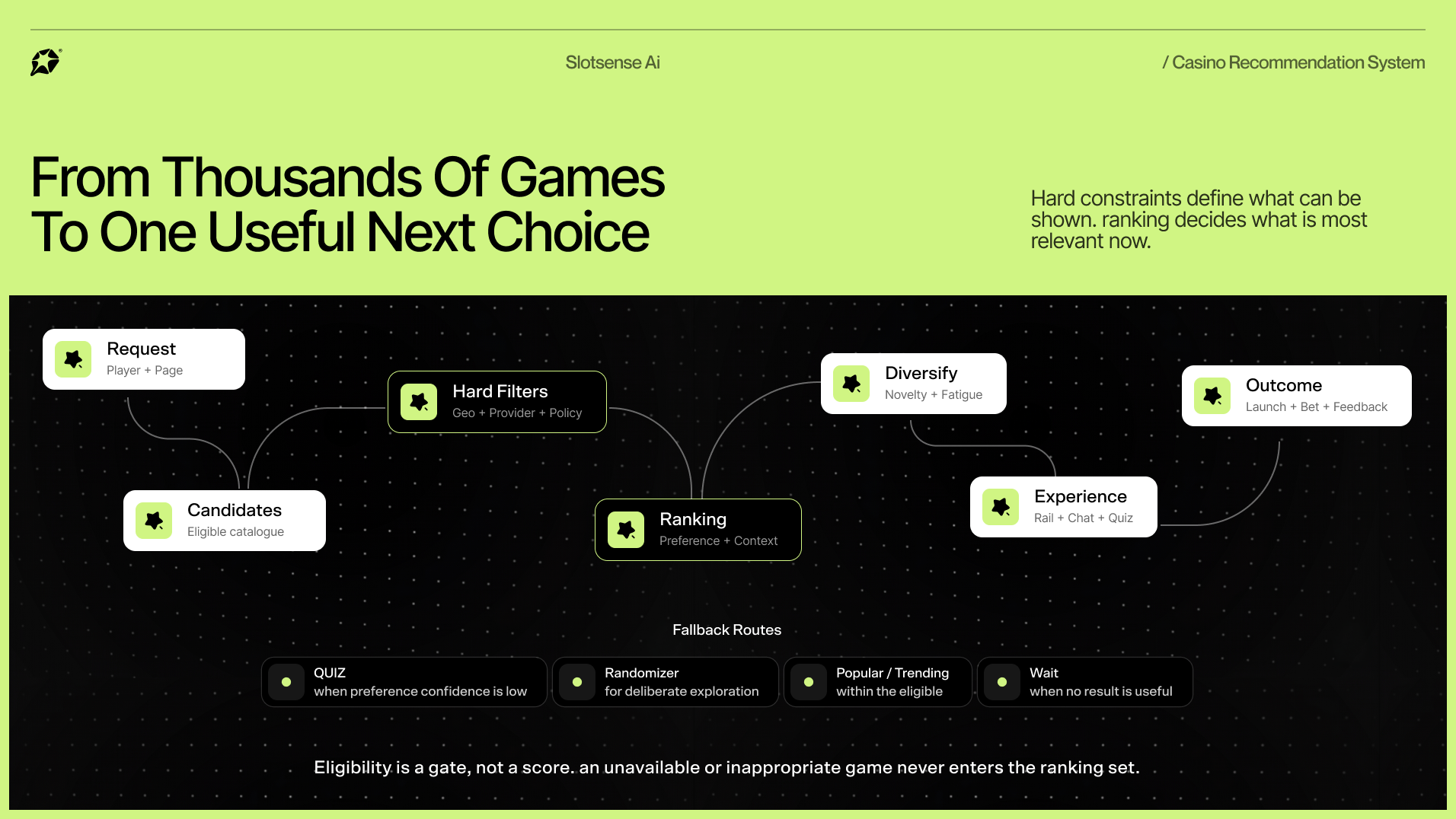
More data is not automatically better. The engine needs a reliable contract between player evidence, live context and an accurate game catalogue. Missing eligibility data is more dangerous than missing preference detail: a weak preference score can trigger a fallback, while a false availability flag can produce a broken recommendation.
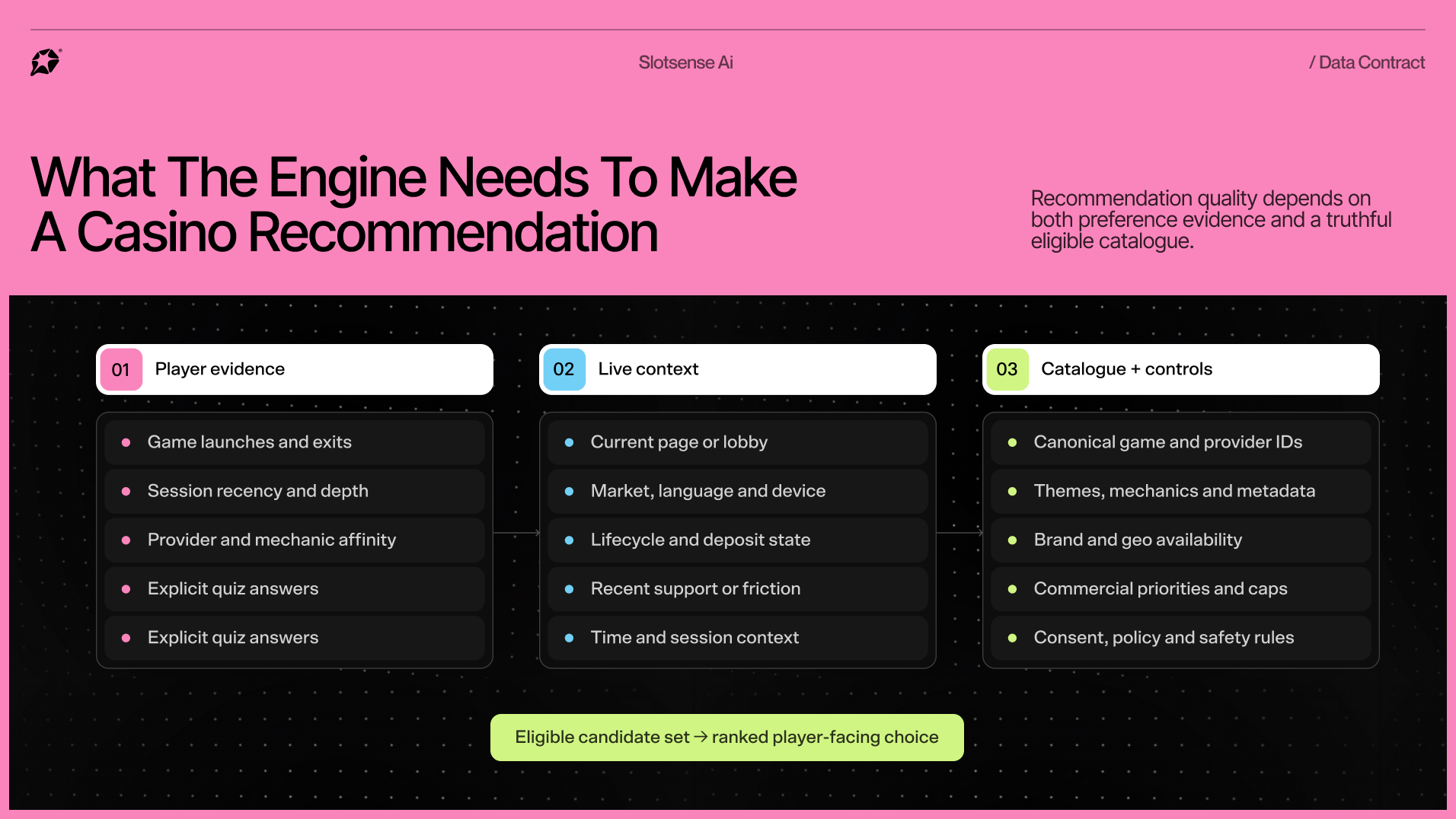
To run without friction, a casino game recommendation engine requires a reliable contract between player evidence, live context, and an accurate game catalogue. The system relies on eight core data layers to generate governed, high-value choices:
Official source: Amazon Personalize data types
The engine cannot learn around a broken catalogue. Operators often receive the same game through different aggregator IDs, provider names or brand configurations. Titles can be renamed, removed, geo-blocked, temporarily unavailable or supplied with inconsistent metadata.
A practical catalogue layer needs one canonical identity for each playable item and a mapping to every operator-facing ID. Metadata should be versioned, availability refreshed frequently and launch failures fed back into suppression. New games require enough attributes to be placed before behavioural evidence accumulates.
Not every metadata field should be treated as objective truth. Volatility, mechanic and theme labels can vary by provider, and sensitive or promotional descriptors may need local review. The model should distinguish verified availability fields from softer descriptive features.
Cold start appears when the system lacks evidence about a new player, a new game or a new market. Traditional behavioural methods need interactions before they can calculate useful similarity. Academic reviews treat new-user and new-item cold start as distinct problems because they require different remedies.
Official source: IEEE Access systematic review of user cold start
For a new player, start with the eligible catalogue and add evidence progressively. A short quiz can capture immediate intent. First-session browsing, search, launch and exit events can update the ranking within the session. Until confidence improves, use diversified popular or converting games within the player’s market rather than pretending the recommendation is deeply personal.
A new game has no interaction history, so content metadata, provider context, controlled exploration and editorial classification matter more. Exposure should be capped and measured. A model that only reinforces historical popularity will struggle to learn whether new content is relevant.
A new jurisdiction may have both sparse behaviour and a different eligible catalogue. Do not transfer a model blindly. Local availability, language, brand positioning, player mix and responsible-gambling policy can change both candidates and outcomes.
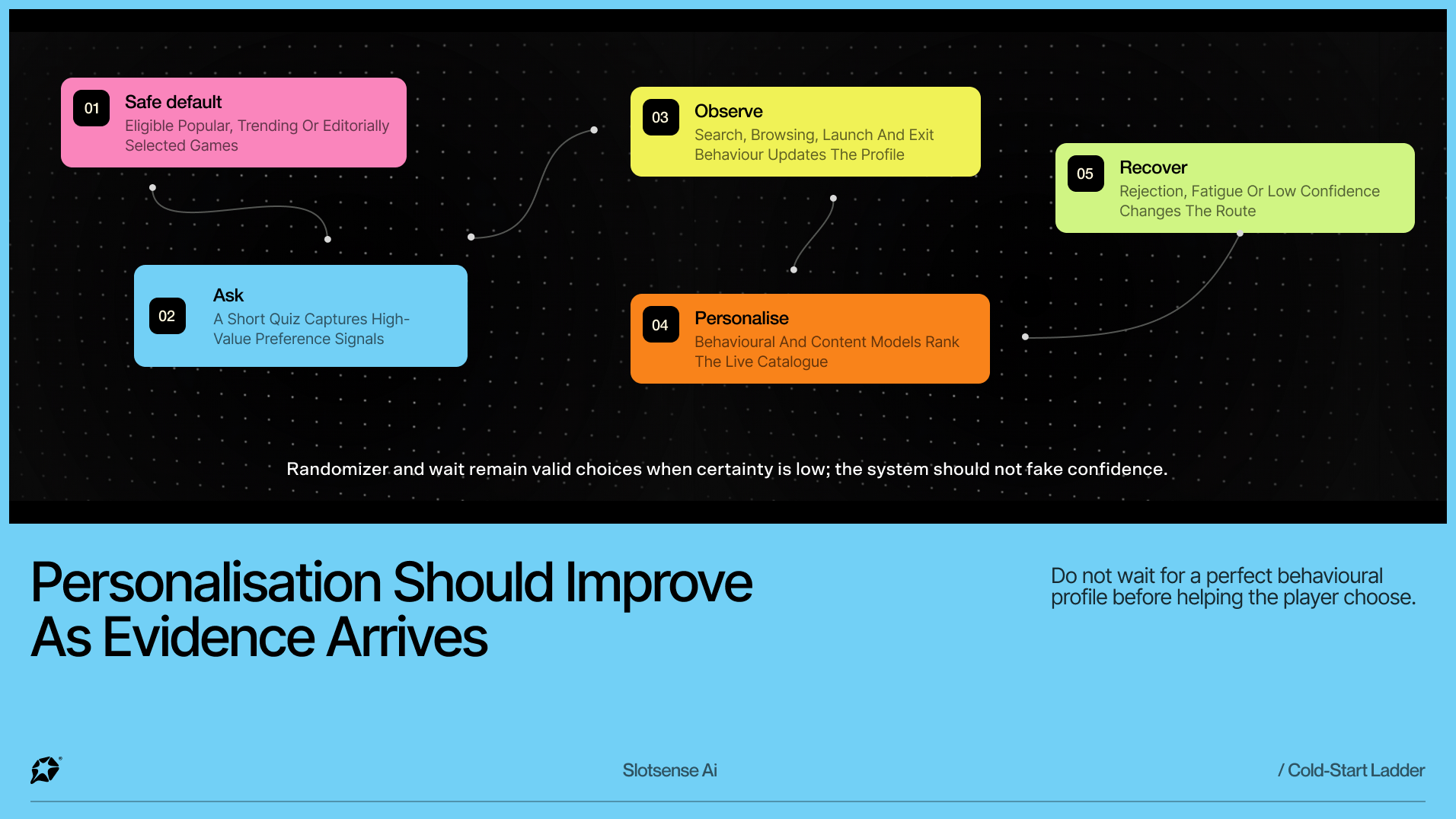
Quiz and behavioural recommendation are not competing philosophies. They solve different evidence problems and work best as a hybrid. Depending on the scenario, a system can deploy six different approaches:
A useful quiz asks only questions that materially change the candidate set or ranking. Mood, pace, familiarity, theme, mechanic and desired complexity may be helpful. Questions about traits the engine cannot map to catalogue metadata create theatre rather than personalisation.
For casino game recommendations, eligibility must be computed before predicted relevance. A high-scoring game that cannot legally or technically be shown is not a weaker recommendation. It is not a candidate.
Providers may be enabled only for selected brands, markets, devices or commercial agreements. Maintenance, certification and aggregator status can change availability. The engine needs current provider and game-level flags, not a quarterly spreadsheet.
A recommendation request should carry market and jurisdiction context. The catalogue service should return only games permitted in that configuration. Where rules differ by product type or game feature, policy should be explicit and versioned.
Operators may need to prioritise a provider, new release or commercial campaign. The defensible pattern is bounded re-ranking: commercial weight may reorder games that are already eligible and sufficiently relevant. It should have an exposure cap, reason code, expiry and holdout. The player-facing label should not imply a purely personal result when placement is paid or commercially constrained.
A recommender should consume the operator’s suppression and player-protection status. In Great Britain, remote operators are required to identify risk, take appropriate action and evaluate the effect of interactions. Other markets differ, so compliance and safer-gambling teams must approve the action policy market by market.
Official source: UK Gambling Commission remote customer interaction requirements
After hard filters, the ranking stage can combine several signals. A conceptual score may include preference fit, contextual fit, recent intent, content freshness, diversity and a bounded business priority, minus repetition, fatigue and low-confidence penalties.
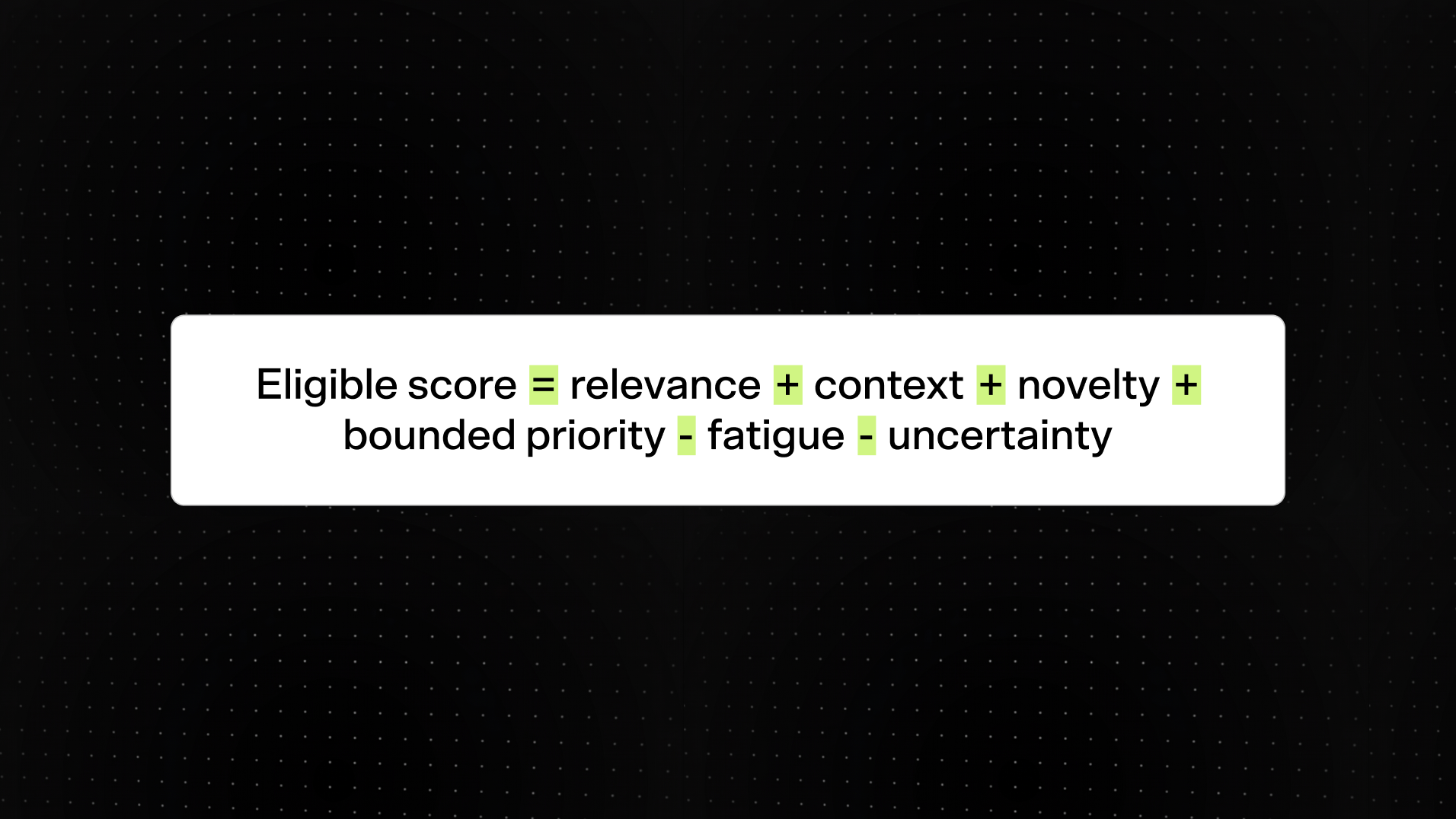
The formula is not universal. What matters is the order of operations: eligibility is a gate; business priority is a controlled feature; exploration is measurable; and uncertainty can produce a fallback or no recommendation.
The engine should return reason codes that product and CRM teams can understand, such as favourite provider, similar mechanic, recent search intent, new-player fallback, controlled exploration or commercial boost. Explainability improves QA even when the underlying model is complex.
A recommendation engine is not finished when it returns a list. It needs recovery logic for the moments that teach the most. Here is how the system should read and respond to seven key user signals:
Negative feedback should not be treated as failure alone. It is new preference and context data. The system should distinguish dislike of one game, rejection of a category, fatigue with a provider and rejection of the recommendation surface itself.
A randomizer is useful when the player wants a quick choice without a long explanation, or when the engine has too little evidence to justify a personalised ranking. It should not pick blindly from the entire catalogue.
A casino randomizer should start from the same eligible set as every other recommendation. It can then sample across relevant categories, cap repeated providers, exclude recently rejected games and show a simple explanation such as “A surprise from games available in your market.”
Randomness changes the experience; constraints protect relevance. The outcome should still be logged so the system can learn whether surprise intent led to a game launch, first bet, session continuation or another request.
Offline accuracy is useful for model development, but an operator ultimately needs incremental evidence inside the real journey. The cleanest first experiment compares the current lobby or post-deposit journey with one clearly defined recommendation experience.
To build a reliable experiment, map out your test architecture across these seven core components:
In a randomised test with new Portuguese FTD users who had no previous casino bet, the standard post-deposit journey was compared with treatment experiences built around one Surprise Randomizer recommendation. One treatment variant delivered the same logic through an AI Avatar.
Here is how the treatment group performed compared to the control group:
Treatment cohorts also recorded a 52.8% seven-day repeat depositor rate versus 43.7% for control, a 9.1 percentage-point or 21% relative uplift. Repeat deposit volume was approximately 48% higher across similarly sized cohorts.
Interpretation note: the treatment combined randomizer-only and avatar-plus-randomizer variants. The result supports a clear low-friction recommendation after FTD but does not isolate the avatar effect.
A separate randomised test with loyal non-VIP Portuguese players compared a quiz-only experience with the same quiz and recommendation logic introduced through a female AI Avatar.
Here is how adding the AI Avatar shifted player behavior:
The delivery format changed while the underlying recommendation logic stayed the same. That distinction matters: model quality, interaction design and delivery format should be tested separately whenever the sample allows.
Here are ten core capabilities to evaluate, along with the exact technical questions you should ask each vendor:
A demo should use the operator’s own scenario. Ask the vendor to show a new player with no history, a returning player with a provider preference, a game restricted in the current GEO, a commercially prioritised provider and a player who rejects the first suggestion. A polished Recommended for You carousel is not enough.
Slotsense is a player-facing AI layer for iGaming operators. It can work alongside the existing product, PAM, aggregator, CRM and data stack rather than replacing them.
For Game Discovery, Slotsense can combine quiz flows, conversational recommendations, behavioural and contextual signals, randomizers, segmentation and A/B testing. The distinctive job is execution inside the active player experience: helping the player express intent, receive a relevant option, ask for something different and recover when the first recommendation misses.
The catalogue and operator systems remain authoritative for availability, market, provider, policy and player state. Slotsense turns that governed data into an interaction and returns the outcome for measurement and future decisioning.
Official source: Slotsense player-facing AI for iGaming
A game recommendation engine selects and ranks games for a player or context using catalogue data, interaction history, explicit preferences, live context and operator controls.
It generates candidates, removes unavailable or restricted games, ranks the eligible set, diversifies the result, delivers it in the player experience and learns from outcomes.
At minimum, it needs a canonical game catalogue, availability by brand and market, player interaction events and outcome tracking. Explicit preference, live context and commercial controls improve the decision.
Use eligible popular or converting defaults, short preference quizzes, content metadata, live session behaviour and controlled exploration. Personalisation should deepen as evidence arrives.
Neither is universally better. A quiz is strongest when history is sparse or intent is explicit. Behavioural models work well when reliable interaction history exists. A hybrid can switch between them.
Yes, but commercial influence should apply only inside an eligible and sufficiently relevant set. Use caps, expiry, reason codes, disclosure where appropriate and a holdout to measure the trade-off.
The engine should record the rejection, avoid immediate repetition, update preference confidence and choose a recovery route such as an adjacent recommendation, a clarifying question, a quiz, randomizer or wait.
Randomise at user level, keep assignment stable, define one primary metric and window, log the candidate set and reason code, preserve a control group and measure experience guardrails as well as business outcomes.
Content:
.png)