iGaming Personalization in 2026: From Static Segments to Real-Time Player Decisions
A practical maturity model for moving from fixed cohorts to live, context-aware player experiences.
15 mins
·
August 27, 2026
A practical maturity model for moving from fixed cohorts to live, context-aware player experiences.
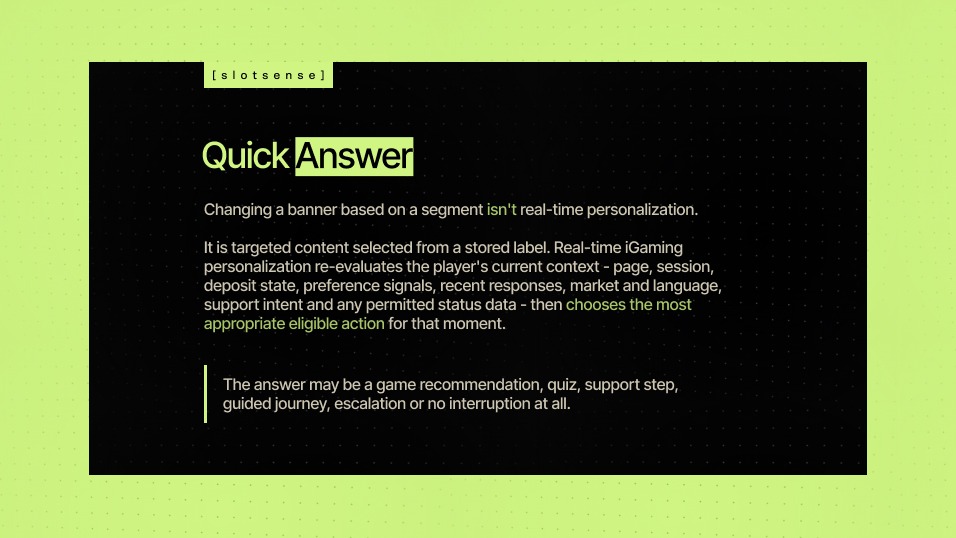
Changing a banner based on a segment isn't real-time personalization
The word personalization is often applied to any experience that varies by audience. A new depositor sees one banner; a VIP segment sees another; a player tagged as a slots fan gets a carousel of slot games. These treatments can be useful. They are also usually decided before the live moment begins.
A segment answers a descriptive question: who does this player resemble? Real-time personalization in iGaming answers an operational question: given what is happening now, what should the experience do next?
That difference matters because the same person can need a recommendation in one minute and support in the next. A returning player browsing the lobby may benefit from a familiar provider. The same player on a failed-deposit screen should not receive a game recommendation simply because the profile still says 'high game affinity.' The current state has changed, so the action must change too.
Current personalization systems illustrate the distinction. Real-time recommendations can update as new interactions arrive, while broader decisioning can use live profile, item, segment and behavioral data to determine eligibility and select content. The essential property is not how quickly a banner renders; it is whether the decision uses current context at the point of action.
Official source: Amazon Personalize - Recording real-time events
Official source: Salesforce - Personalization and Data 360
Personalization maturity is not a switch from “manual” to “AI.” It is a progression in what the system is allowed to decide. Each stage can create value, but each answers a different question.
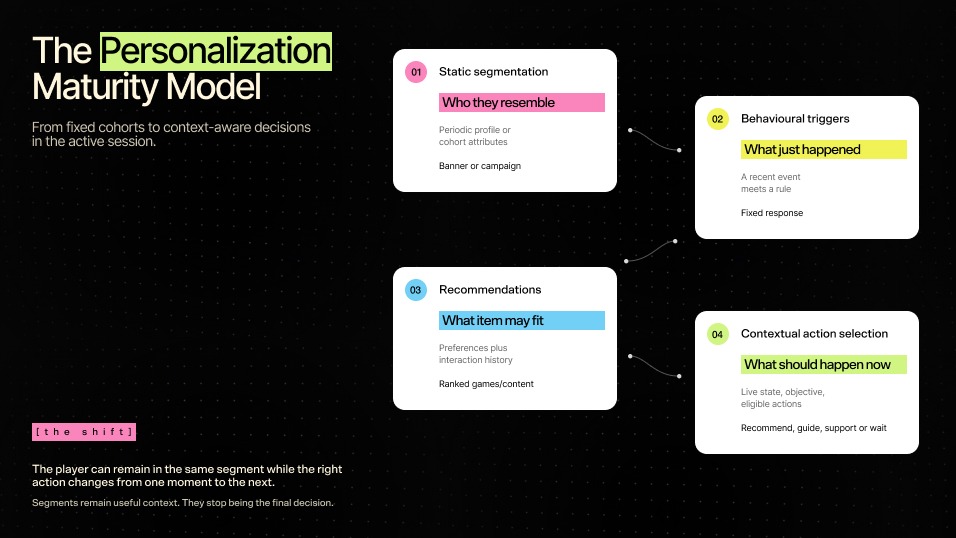
Figure 1. The player can stay in the same segment while the right action changes from one moment to the next.
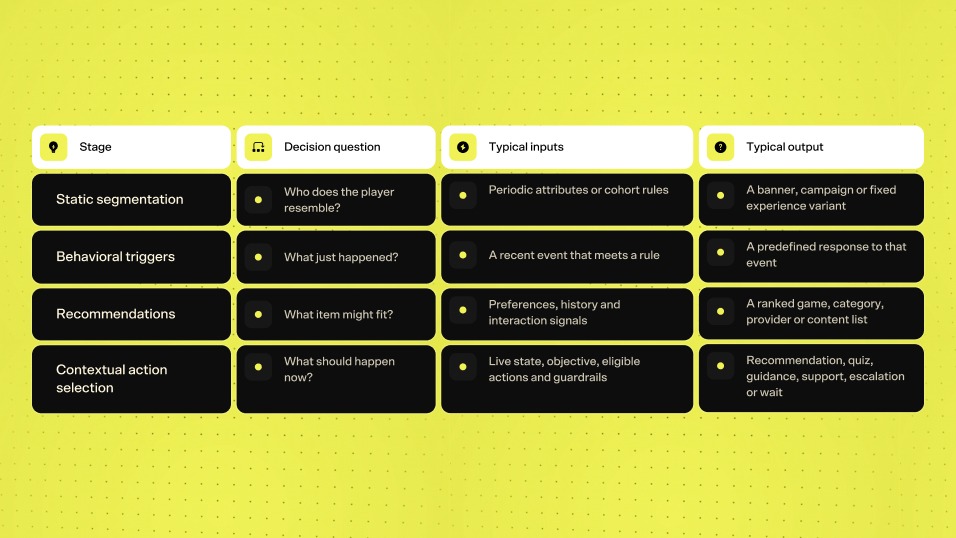
Static segmentation groups players by attributes or summarized behavior: lifecycle stage, declared preference, value band, market, product affinity or historical activity. It is useful for reporting, campaign planning, eligibility and broad experience design.
Its limitation is freshness. A segment can remain unchanged while the player moves from the homepage to the cashier, dismisses two prompts, opens a support question or resolves the original need without help. When a segment directly controls the experience, the label becomes the decision.
Behavioral triggers improve timing. Registration completed, deposit failed, game exited quickly, bonus terms opened or return after inactivity can all create a decision opportunity. But a trigger alone does not create personalization if it always launches the same response.
A rule such as “deposit failed -> show recovery message B” is timely automation. A contextual system asks whether guidance, a status explanation, a help article, human handoff or wait is the best response for this player and this failure state.
Recommendation models add preference sensitivity. They can rank games, providers, categories or content using interaction history, current behavior and item metadata. This is a meaningful step beyond fixed carousels because the order can change for the individual.
A recommender still solves a bounded problem: which item should be shown? It does not necessarily decide whether showing an item is the right action. If the player has support intent, an unresolved payment issue or has repeatedly ignored recommendations, another action may be more appropriate.
Official source: Amazon Personalize - Real-time item recommendations
At the most mature stage, recommendations become one candidate inside a wider action set. The decision layer considers current context, the operator objective, action eligibility, safety and policy constraints, recent interaction history and confidence. It can select a recommendation, quiz, explanation, support route, guided recovery, escalation or deliberate wait.
This is the distinction behind Slotsense Retention AI: player data and CRM segments remain inputs, but the player-facing action is chosen inside the active session rather than inherited from a static label.
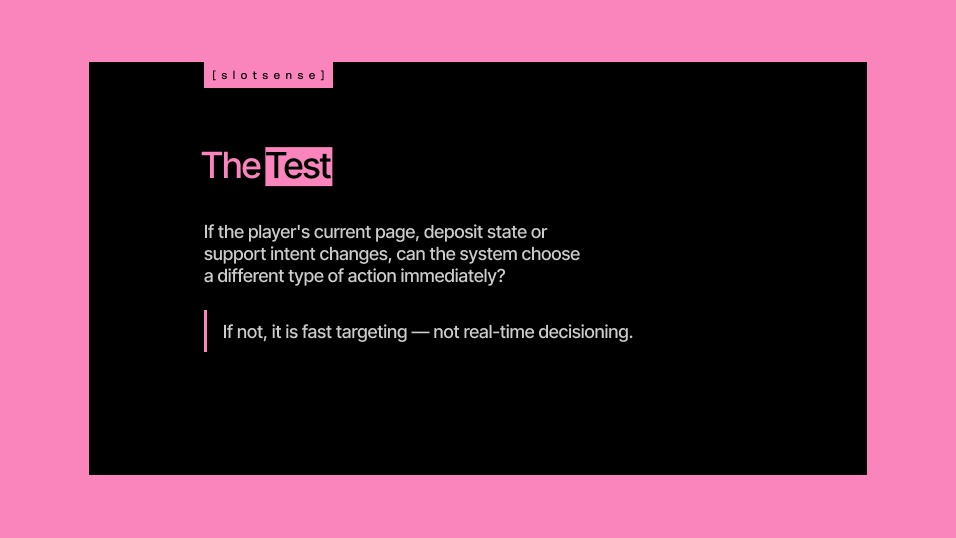
Real-time is a decision property, not a delivery claim. A banner can load in milliseconds and still be based on a stale cohort. A useful real-time system needs five operating capabilities:
• Context freshness: the decision can use what the player is doing now, not only a nightly or campaign-time profile.
• Moment-level re-evaluation: a new event can change the eligible action set and the objective before another message is shown.
• Action choice: the system can choose among meaningfully different interventions, not only swap copy or creative inside one fixed placement.
• Guardrails before ranking: consent, market, availability, safer-gambling policy, frequency, support and operational rules remove actions before relevance is scored.
• Outcome feedback: clicks, dismissals, ignored recommendations, issue resolution, game launch, conversion, escalation and no action update future decisions.
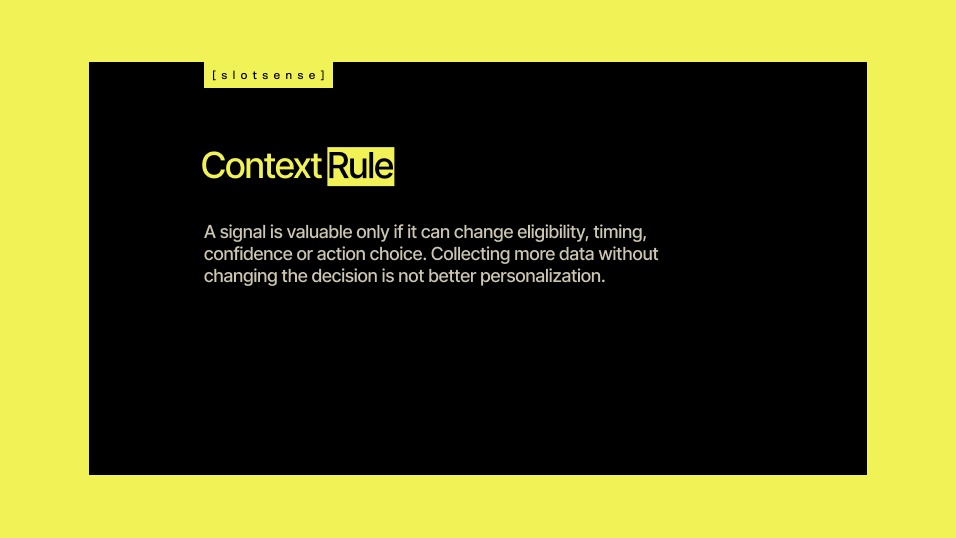
iGaming data-driven personalization is not a contest to collect the most fields. The goal is to assemble the smallest set of trustworthy signals that materially changes eligibility, timing or action choice.
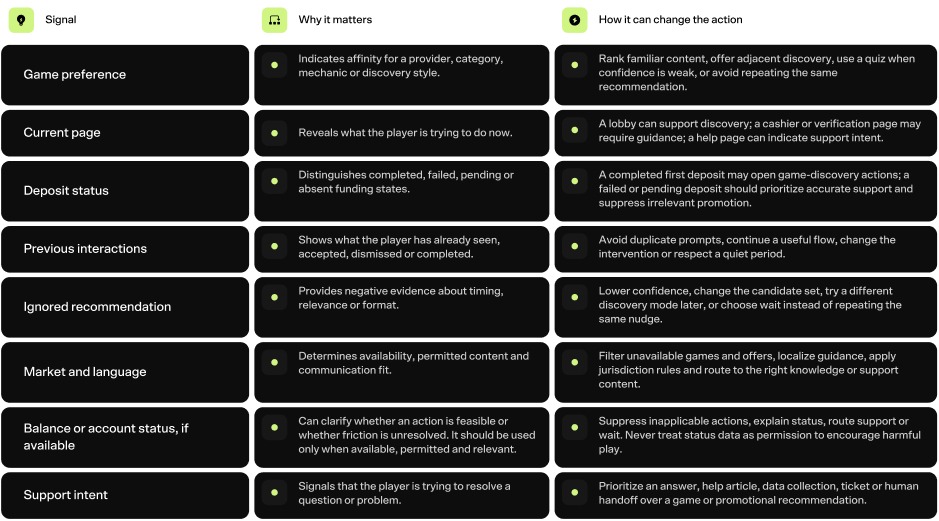
Signals do not choose an action in isolation. Deposit status is not an objective. Balance is not a message. An ignored recommendation is not a permanent preference. Each signal changes the interpretation of the moment when combined with the operator objective and the actions that are currently appropriate.
Four Slotsense examples: the same player can need a different experience
Stored context: Returning player, strong affinity for a favourite provider, preferred language known.
Live context A: The player is browsing the lobby with no unresolved support or payment issue.
Possible action: Recommend a familiar provider, a newly available title from that provider, or an adjacent discovery path.
Live context B: The player moves to a failed-deposit state.
New action: Suppress the game recommendation and provide accurate payment guidance, verified troubleshooting, a ticket or human handoff. The segment did not change; the decision did.
Trigger: The first deposit is confirmed and no game has launched.
Context: The current page, browsing history, known preference confidence, market availability, language and recent prompts are checked.
Action set: A direct recommendation, short preference quiz, surprise-me randomizer, contextual explanation or wait.
Decision: Use a recommendation when confidence is strong; use a quiz when the player needs discovery help; use a randomizer when the player has asked for spontaneity; wait when the player is already exploring or recently dismissed a prompt.
A static personalization system may keep showing the “right” game because the preference score remains high. A contextual system treats the ignored interaction as new evidence. It can lower the action score, change the timing or surface, offer a different discovery mode, ask a lightweight question or stop interrupting.
The purpose is not to increase pressure until a click happens. It is to improve fit between the player state and the intervention. An ignored recommendation can mean the item was wrong, the timing was wrong, the format was wrong or no help was needed.
A player asks why a deposit is pending while the current profile indicates strong game affinity. The correct action is not a better recommendation. Support intent changes the objective from engagement to friction resolution. Slotsense can surface guidance, collect context, suggest the right help article, create a ticket or escalate to a human.
Once the issue is resolved, the eligible action set can be evaluated again. Real-time personalization preserves context across the shift instead of forcing the player through disconnected engagement and support flows.
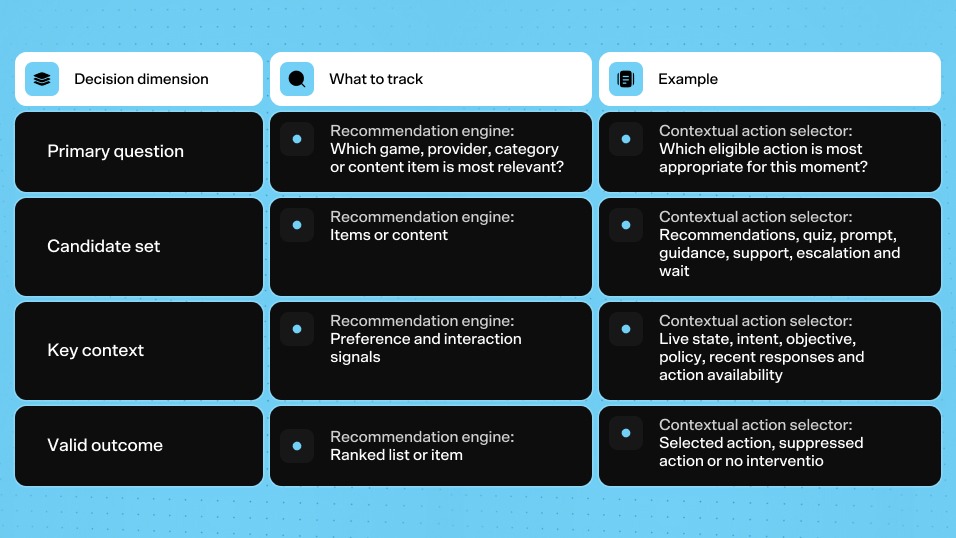
Recommendation and contextual action selection are complementary, not competing, capabilities. A recommendation engine is excellent at ranking items. A decision layer determines whether an item recommendation is the appropriate intervention at all.
Slotsense is a player-facing AI layer for the active session. It can connect with an operator's product, CRM, PAM, support and data stack rather than replacing those systems. The CRM can continue to manage campaigns and lifecycle logic; the support platform can continue to own tickets and agents; the PAM remains the system of record for player and account data.
The Retention Agent uses available player signals to interpret likely intent or friction and helps select the next step across onboarding, engagement, recovery and retention. Recommendations guide discovery. AI support can answer questions, surface help content, collect context and escalate. A/B testing and outcome tracking help improve which action is chosen for which state.
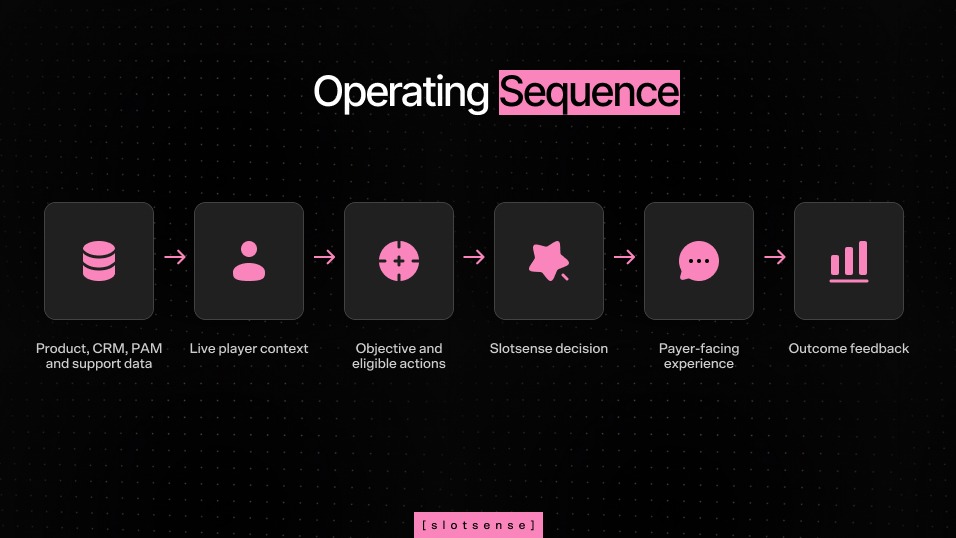
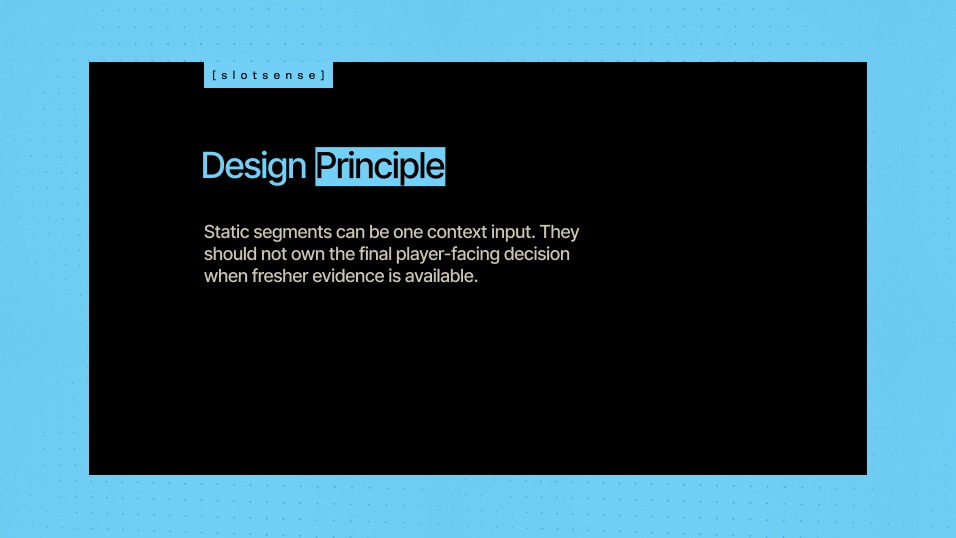
Operators do not need to replace segmentation to move forward. They need to stop treating the segment as the final instruction. A workable decision sequence is:
Responsible personalization: appropriateness before propensity
Real-time decisioning increases the need for control, not the permission to engage more often. Commercial actions must remain subordinate to consent, eligibility, market rules, product availability, frequency limits, support state and responsible-gambling policy.
Great Britain provides a concrete example. Remote operators must embed identify, act and evaluate into ongoing customer interaction, tailor action to indicators of harm, prevent marketing and new bonus take-up where strong indicators are identified, and evaluate the effect of interactions. Other markets have their own requirements, so operators must configure policies by jurisdiction and validate them with compliance and safer-gambling teams.
Official source: UK Gambling Commission - Remote customer interaction requirements
In practice, the action selector should be able to change the objective, suppress engagement, route a protective or support interaction, create a review path or choose no message. A high predicted click rate never makes an action appropriate by itself.
A 360-degree profile is not the starting requirement. The fastest useful pilot is one visible player moment with a small action set and measurable outcomes.
The metric should match the decision. A game recommendation, support route and deliberate wait do not share one useful success measure. Use a balanced scorecard:
The feedback loop should answer two questions: did the selected action improve the intended outcome, and should a different action - including wait - be chosen next time?
Frequently asked questions
iGaming personalization adapts a player experience using known attributes, preferences, behavior and context. It can include segmented content, triggered journeys, game recommendations, support guidance and real-time selection of the next eligible player-facing action.
Real-time personalization uses current session events and player state at the moment a decision is required. It can change the type, timing or eligibility of an action as the player moves through the journey, rather than relying only on a stored segment.
It is a form of targeting or segment-based personalization, but it is not real-time decisioning unless the system re-evaluates current context and can choose a different intervention when the player state changes.
Segmentation groups players using selected attributes or summarized behavior. Data-driven personalization can use those labels plus current interactions, recent responses, eligibility and context to make an individual decision at a specific moment.
A recommender ranks games, providers, categories or content. Contextual action selection decides whether to recommend at all, or whether a quiz, explanation, support route, escalation or no intervention is more appropriate.
The minimum depends on the workflow. Retention AI needs trigger integration and enough player-state data to interpret the selected moment. Operators can start with a small set such as current page, deposit state, market, language, recent interactions and known preferences, then expand when additional signals prove useful.
Yes. Waiting is appropriate when the player is progressing naturally, confidence is low, a similar recommendation was ignored, a quiet period applies, the state is unresolved or no eligible action is useful enough to justify interruption.
Content:
.png)
.png)