Screenshots, Voice Notes, and Messy Player Questions: The Next Layer of iGaming Support Automation
A practical framework for processing screenshots, voice notes, and unstructured player context before human escalation.
15mins
·
October 11, 2026
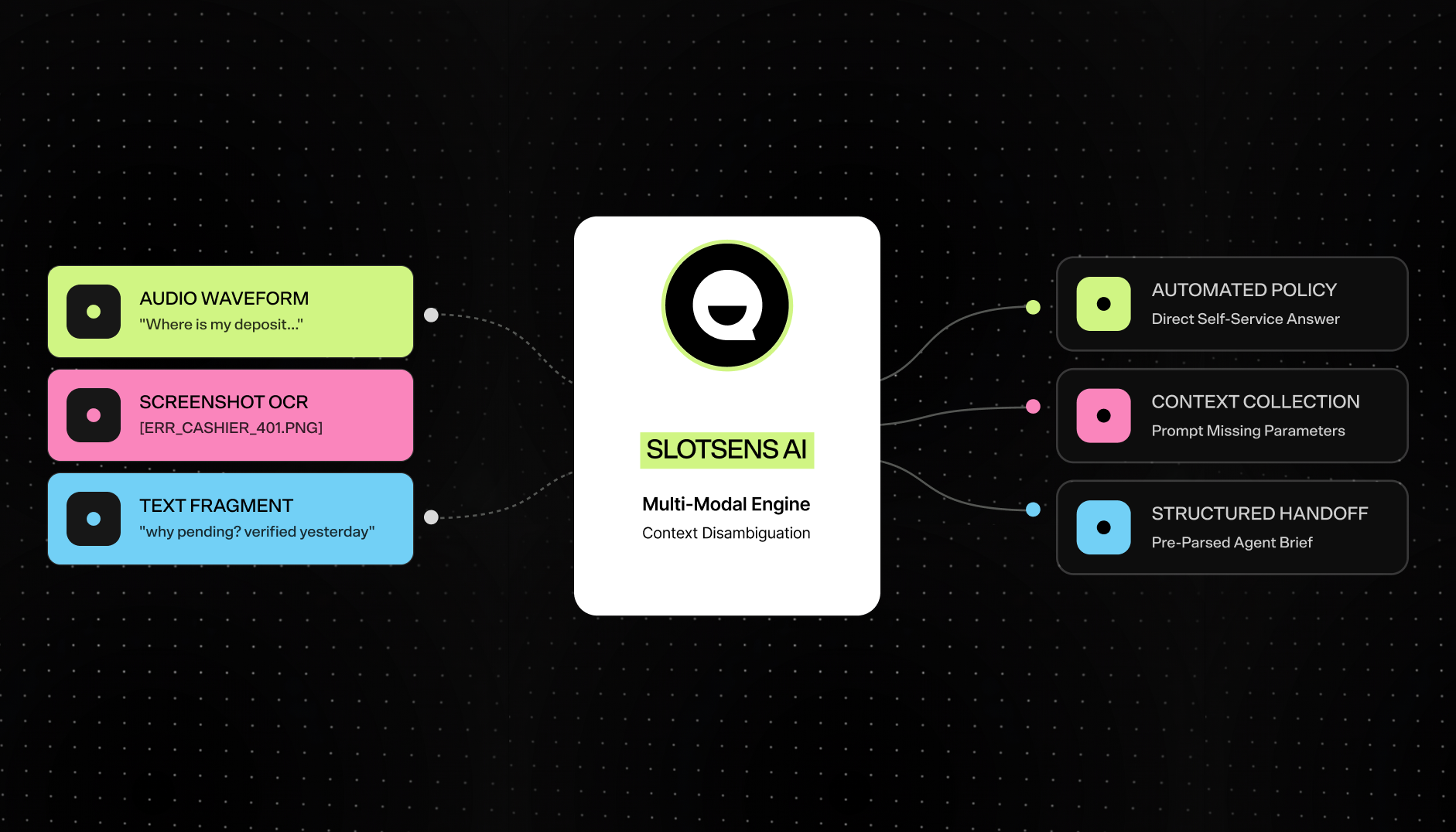
iGaming support automation is a multi-modal decisioning layer that processes unstructured player signals—including text fragments, screenshots, audio notes, and account telemetry—to resolve tickets or prepare structured context for human agents. Unlike legacy text-only chatbots that rely on basic keyword matching, context-aware automation evaluates real-time player state, missing transactional parameters, and risk indicators before taking action. The resulting output may be an immediate policy response, an automated follow-up request, targeted help documentation, queue escalation, or deliberate inaction.
Figure 1. Text chat represents a fraction of support interactions; multi-modal context capture processes visual, vocal, and historical signals before decisioning.
Text Matching Isn't Support Automation: Why Clean Chatbots Fail in iGaming
Traditional customer support automation relies on clean, structured text inputs. Standard decision trees expect explicit queries such as "How do I upload verification documents?" or "What are the wagering requirements for the welcome bonus?" Legacy rules engine frameworks process these inputs by matching keywords against static knowledge base entries.
In online casino and sportsbook operations, player communication rarely follows structured syntax. Players submit half-sentences ("why pending?"), attach uncropped mobile screenshots of cashier errors, or leave 20-second voice notes while frustrated about a delayed withdrawal.
When an automation layer evaluates text isolated from operational context, it fails in two distinct directions:
Incorrect Auto-Resolution: The system generates generic FAQ links based on partial keyword matches, increasing player frustration and generating repeat contacts.
Unstructured Escalation: The system transfers raw, unparsed messages directly to live support queues, forcing human agents to manually gather basic transaction data, request screenshots, or transcribe audio notes.
Real support automation does not start with matching a query to an answer. It starts with extracting multi-modal context across visual attachments, voice transcripts, and backend player states before determining the optimal decision path.
The Multi-Modal Context Resolution Framework
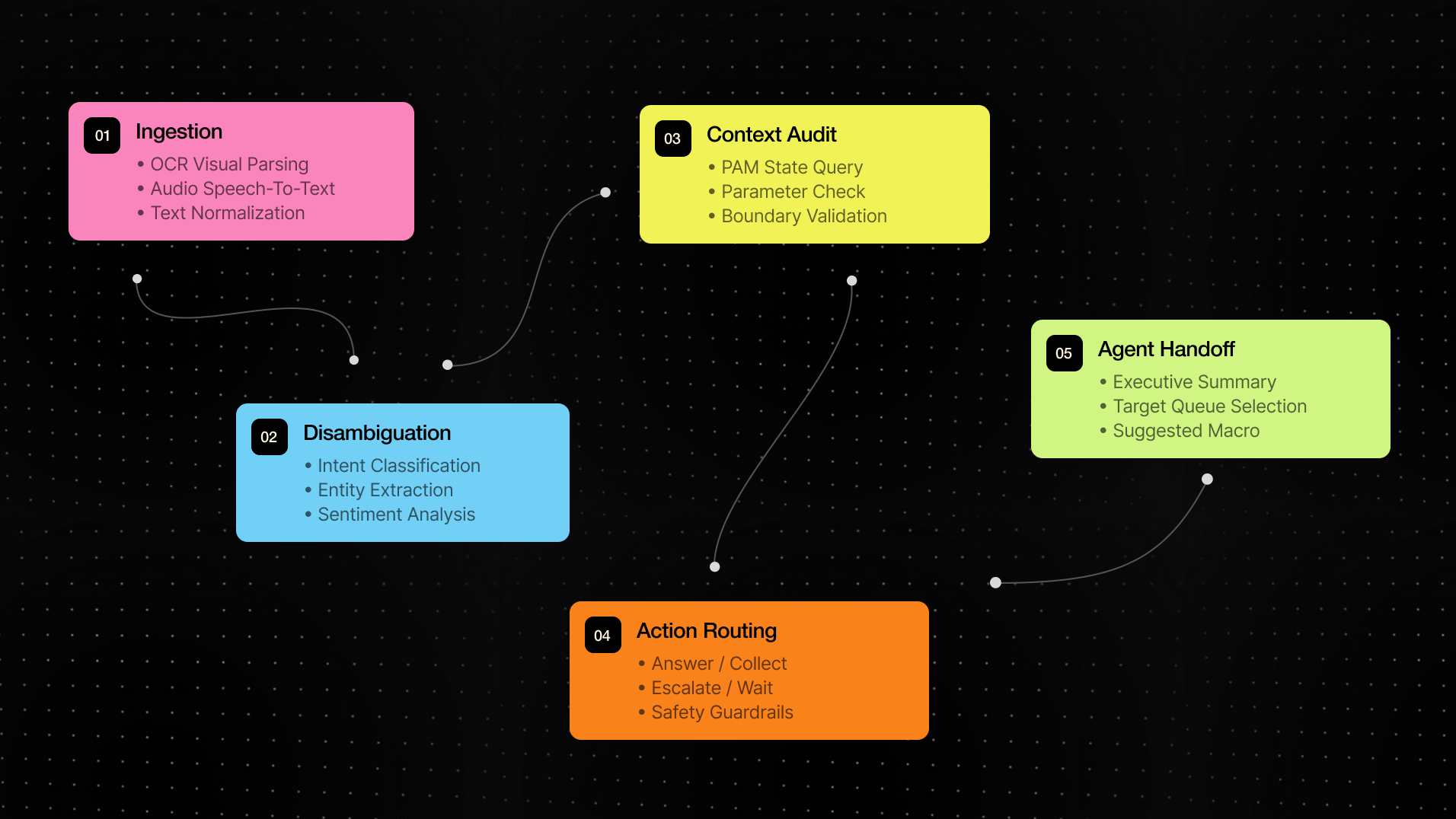
To process unstructured player inquiries effectively, operators must move beyond standalone chatbot scripts. The Multi-Modal Context Resolution Framework structures incoming support interactions through five sequential processing stages.
Figure 2. The Multi-Modal Context Resolution Framework structures messy inputs into actionable context before triggering resolution or escalation.
Stage 1: Multi-Modal Ingestion
Input Signals: Unstructured text fragments, image upload files, and raw audio streams.
System Evaluation: Performs signal normalization, visual Optical Character Recognition (OCR), and speech-to-text conversion.
Primary Output: Generates a standardized text transcript accompanied by clean image metadata payloads.
Stage 2: Intent & Telemetry Disambiguation
Input Signals: Normalized text strings, extracted image elements, active player ID, and current session state.
System Evaluation: Conducts contextual entity recognition, domain intent mapping, and emotional sentiment scoring.
Primary Output: Establishes a structured intent category linked to account telemetry.
Stage 3: Missing Context Evaluation
Input Signals: Live PAM account record, historical KYC status, and recent transaction ledger logs.
System Evaluation: Evaluates operational boundary conditions and checks for absent transactional parameters.
Primary Output: Produces a verified data completeness score specifying required missing data.
Stage 4: Dynamic Action Routing
Input Signals: Resolved intent category combined with context completeness indicators.
System Evaluation: Processes inputs against policy matrices and risk boundary conditions.
Primary Output: Selects a specific action path: execute automated response, request missing information, escalate case, or maintain wait state.
Stage 5: Structured Agent Handoff
Input Signals: Accumulated case file data and full interaction history.
System Evaluation: Compiles executive summaries, assigns target agent queues, and packages metadata payloads.
Primary Output: Delivers a pre-formatted agent ticket containing pre-parsed context.
What Multi-Modal Support Automation Actually Requires
Deploying an automated support layer capable of handling messy inputs requires specific infrastructure capabilities. Operators auditing their technical stack should evaluate five essential technical competencies:
Computer Vision and Document OCR: The ability to parse uncropped mobile screenshots, identify UI element types (cashier error, bonus progress bar, document rejection banner), and extract textual transaction reference numbers automatically.
Speech-to-Text and Audio Analytics: Automated transcription of multi-lingual voice messages, capable of isolating key facts despite ambient noise, accents, or emotional delivery.
Bi-Directional PAM & CRM Integration: Real-time API connectors capable of querying player status, deposit logs, active bonus states, and document verification flags within sub-second latency windows.
Contextual Entity Extraction: Natural language processing configured specifically for iGaming terminology (e.g., separating "wagering requirements" from "withdrawal limits" or recognizing specific slot title errors).
Automated Ticket Summarization: Machine learning models trained to condense complex multi-message threads and visual payloads into concise 3-sentence operational summaries for tier-2 or specialist support agents.
Signal, Context, and Input Inventory
An effective multi-modal automation engine relies on converting unstructured signals into structured operational triggers. The following inventory outlines common player inputs, their operational significance, and how context changes the system's output:
Payment Error Screenshot
Extractable Telemetry: Error code, payment provider logo, and monetary amount.
Operational Significance: Differentiates specific payment gateway failures from generic deposit questions.
Action Modification: Triggers specific gateway status queries and routes directly to the Payments team if the gateway is operational.
Frustrated Voice Note
Extractable Telemetry: Text transcript, audio duration, and emotional urgency score.
Operational Significance: Signals rising player dissatisfaction or high-value friction.
Action Modification: Elevates priority scores and bypasses standard self-service FAQ loops for fast-track human routing.
"Why Pending?" Text Fragment
Extractable Telemetry: Player ID and active withdrawal transaction logs.
Operational Significance: Identifies unverified withdrawal requests or pending KYC audits.
Action Modification: Queries the PAM for withdrawal hold reasons and prompts the player for missing documents if required.
Game Freeze Screenshot
Extractable Telemetry: Game title, round ID on screen, and visible balance display.
Operational Significance: Confirms active technical session errors versus user interface display delays.
Action Modification: Cross-references provider status pages and logs a technical ticket with exact round details.
"Verified Already" Text Fragment
Extractable Telemetry: KYC document status and upload history.
Operational Significance: Highlights discrepancies between player expectations and verification pipeline states.
Action Modification: Checks the document review queue and delivers exact document rejection rationale if applicable.
Bonus Terms Screenshot
Extractable Telemetry: Promotion name and wagering progress bar graphics.
Operational Significance: Clarifies specific locked bonus states or expiration issues.
Action Modification: Fetches exact promotional balance states and explains remaining wagering requirements.
Responsible Gaming Keyword Fragment
Extractable Telemetry: Responsible gambling markers and financial loss references.
Action Modification: Immediately suppresses commercial offers and routes the ticket to the dedicated Safer Gambling team.
Worked Examples
The following scenarios demonstrate how multi-modal context capture processes varied player inputs across operational workflows.
Example 1: Uncropped Pending Withdrawal Screenshot
Trigger: A player submits a mobile screenshot showing a cashier screen with the word "Pending" alongside the message: "Where is my money?"
Player/Stored Context: Verified account (KYC Level 2 complete), VIP Tier 1, no active bonus locks.
Live Context / Objective: Screenshot OCR extracts a bank transfer withdrawal request for €1,500 submitted 14 hours prior. The standard processing window for bank transfers is 24 hours.
Possible Actions:
Send generic payment FAQ link.
Prompt player to type out transaction ID.
Provide exact status explanation based on payment channel timelines.
Escalate to the Payments team immediately.
Wait for processing window expiration.
AI Decision: Option 3. The system parses the withdrawal method and time elapsed from the screenshot and PAM log, confirms KYC is complete, and generates a personalized update: "Your bank transfer withdrawal of €1,500 requested yesterday at 18:30 is processed normally within its 24-hour window."
Outcome: Case resolved at first touch point; transaction status logged; support ticket updated without human agent intervention.
Example 2: Frustrated Voice Note Regarding Bonus Expiration
Trigger: A player sends an 18-second voice note saying: "I was playing the free spins you sent yesterday, got disconnected, and now the balance is zero. Fix this."
Player/Stored Context: Active player account, registered in the Great Britain market, opted into weekly promotional campaigns.
Live Context / Objective: Speech-to-text transcribes the audio; sentiment analysis tags high frustration. PAM records show a 20 Free Spin promotion expired 2 hours prior to the message; total winnings were subject to a 10x wagering requirement that was not met before expiry.
Possible Actions:
Output automated text transcription to player asking for confirmation.
Send general bonus policy terms document.
Explain specific promotion expiry timeline and unfulfilled wagering parameters.
Escalate voice file to VIP support lead.
Wait for the player to submit a written follow-up.
AI Decision: Option 3. The engine synthesizes the transcript with promotional logs and responds in clear text detailing the exact campaign duration, time of expiry, and unfulfilled wagering criteria, while referencing the automated save state of the game session.
Outcome: Educational response delivered instantly; transcription and account log attached to case record in CRM.
Example 3: Incomplete Game Error Reporting
Trigger: A player submits a text string "game broke" attached to an image of a frozen slot interface.
Player/Stored Context: Mobile web session (iOS/Safari), low historical support ticket volume.
Live Context / Objective: Vision OCR extracts game title (Gonzo's Quest) and error code (ERR_SESSION_TIMEOUT). PAM logs show the last game round was recorded successfully on the server side with balance correctly updated.
Possible Actions:
Escalate to tier-2 technical support queue immediately.
Provide standard browser troubleshooting steps (cache clearing).
Confirm server-side round settlement and provide browser troubleshooting instructions.
Issue immediate bonus compensation.
Wait for a secondary message from the player.
AI Decision: Option 3. The system validates that the game round is completed safely on the server side, reassures the player regarding their balance integrity, and provides step-by-step mobile browser reset instructions.
Outcome: Reduced technical ticket inflation; verified server balance state communicated to player.
Example 4: Responsible Gaming Override Moment
Trigger: A player sends a screenshot of their transaction history showing multiple failed deposits accompanied by a short voice note: "I keep losing, let me deposit or I'll lose control."
Player/Stored Context: Account open 6 months, recent increase in deposit frequency over the past 48 hours.
Immediately trigger safer gambling workflow, restrict commercial messaging, and escalate the case to human Compliance team with priority flag.
Wait for the payment gateway retry signal.
AI Decision: Option 4. Commercial messaging and deposit assistance are instantly suppressed. The system tags the interaction as high-risk, applies temporary account safety flags per operator rules, and routes the structured transcript and case file to the dedicated Safer Gambling operational team.
Outcome: Operational compliance policy enforced; immediate human escalation triggered; risk profile recorded in CRM.
Legacy Text Chatbots vs. Multi-Modal Context Automation
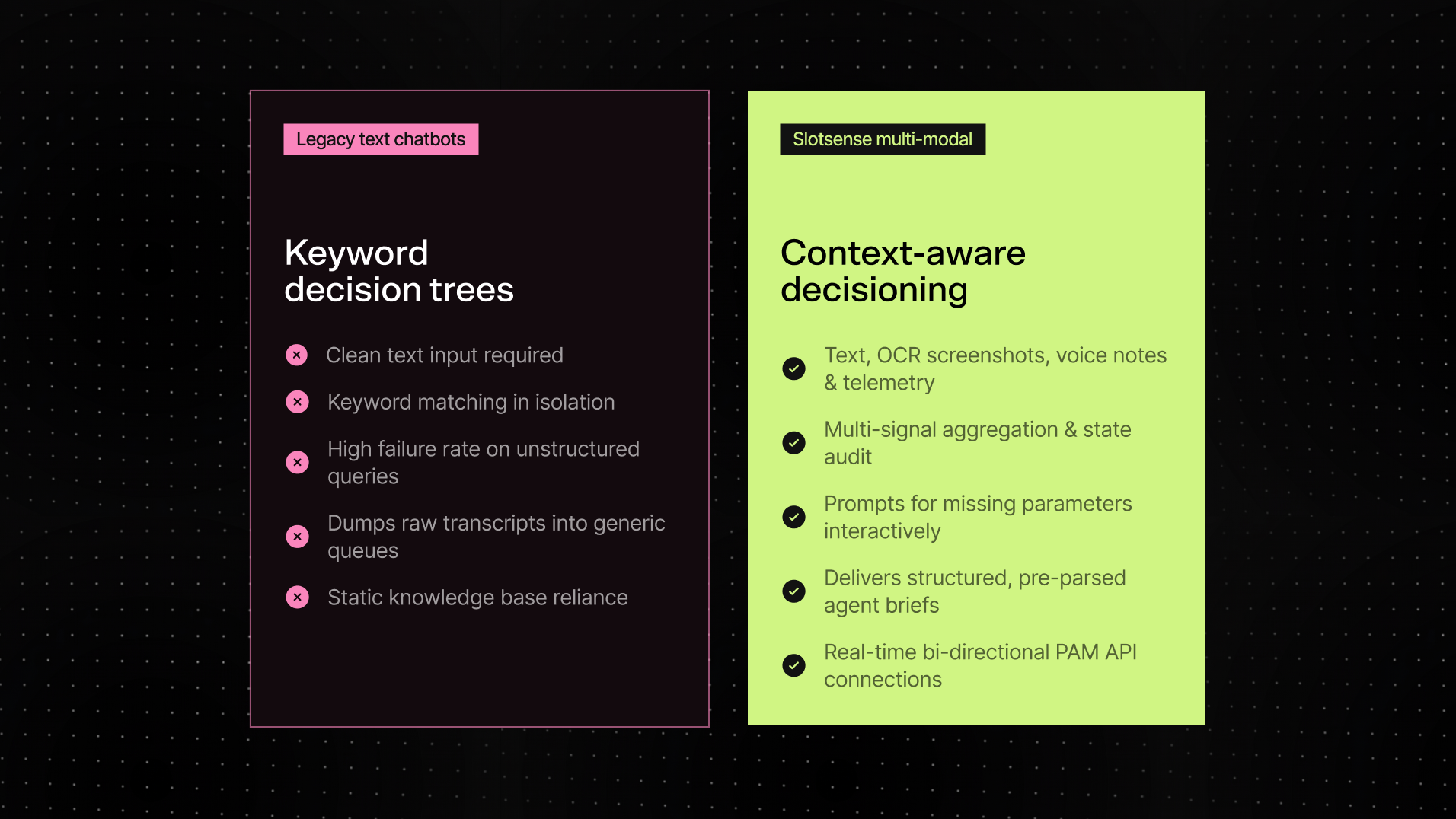
Primary Input Types: Legacy chatbots process structured, clean text strings exclusively. Multi-modal automation ingests incomplete text fragments, OCR image payloads, raw audio files, and live PAM account telemetry simultaneously.
Context Processing Capabilities: Legacy tools rely on surface-level keyword matching and static intent models. Multi-modal context engines perform real-time signal aggregation across visual, vocal, and historical account sources.
Handling Unstructured Queries: Legacy chatbots suffer high failure rates on messy queries, routinely defaulting to irrelevant FAQ links. Multi-modal automation extracts specific data entities, detects missing parameters, and interactively prompts the player for clarification.
Escalation Handoff Quality: Legacy platforms dump raw, unparsed message threads directly into standard support queues. Multi-modal automation compiles pre-parsed case briefs containing thread summaries, OCR findings, audio transcripts, and account logs.
Agent Preparation Time: Legacy transfers require agents to read raw logs and manually request missing transaction parameters. Multi-modal handoffs deliver pre-populated context and suggested next actions, minimizing agent prep work.
Regulatory Safety Protocols: Legacy keyword filters miss subtle risk contexts embedded in images or voice notes. Multi-modal engines continuously evaluate sentiment and visual markers with automatic safety override triggers.
Infrastructure Integration: Legacy bots operate against static knowledge bases. Multi-modal automation relies on bi-directional API connections to PAM databases, payment gateways, and CRM platforms.
Why Inaction and Wait States Are Legitimate AI Decisions
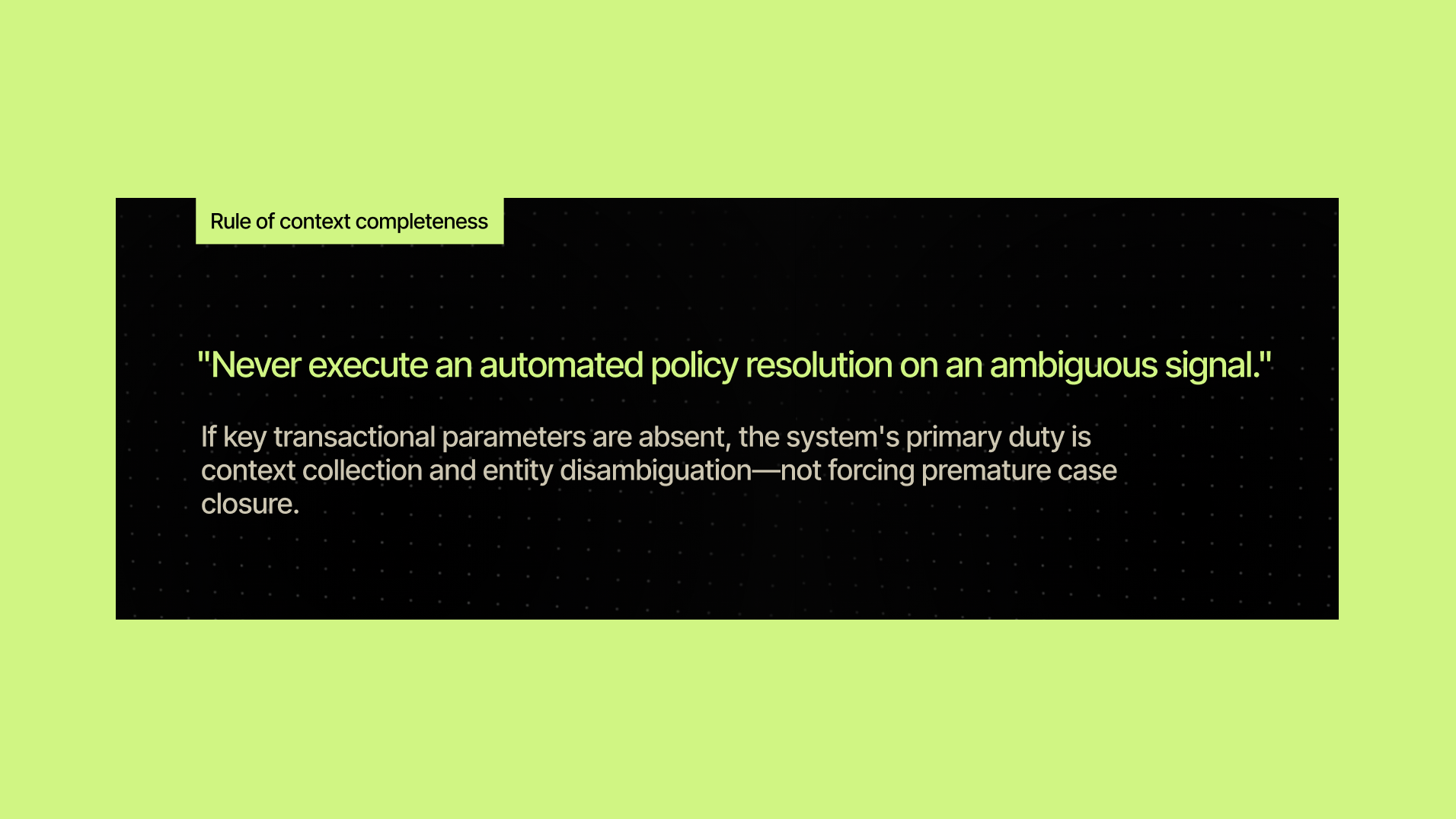
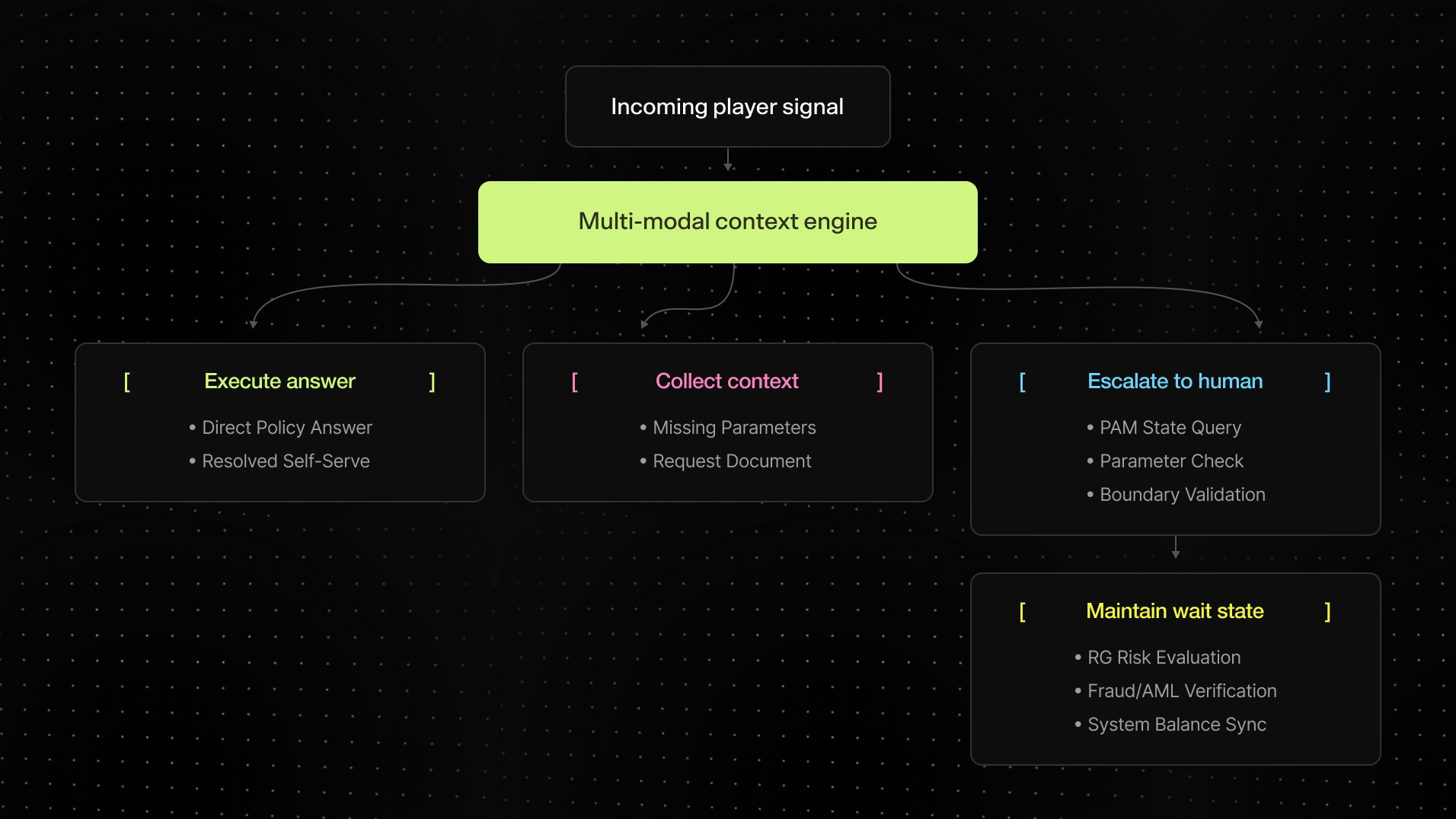
In customer support decisioning engines, the assumption is often that every incoming interaction must receive an immediate text response or an instant queue transfer. However, in regulated iGaming operations, executing deliberate inaction—a controlled wait state—is frequently the correct operational decision.
Inaction is a deliberate decision path executed when background events, regulatory overrides, or ongoing system verifications make immediate player messaging counterproductive
Figure 3. Decision flow architecture for handling player signals and enforcing deliberate wait states during risk or verification audits.
Key scenarios where maintaining a wait state is the optimal AI action include:
Active Automated Fraud/AML Audits: When a payment anomaly triggers an automated risk inspection, emitting immediate responses regarding transaction status can compromise fraud protocols.
Pending Safer Gambling Reviews: If a player's interaction triggers potential harm indicators, automated promotional or standard informational responses are halted until responsible gaming thresholds are evaluated.
Mid-Session Payment Gateway Syncs: When webhooks indicate a deposit is in an intermediate state between gateway processing and PAM ledger updates, sending an instant failure message creates unnecessary duplicate deposits.
Cooling-off Period Enforcement: When accounts enter temporary self-exclusion or cooling-off windows, automated support communications must cease to ensure compliance with contact restrictions.
How Slotsense Fits the iGaming Support Architecture
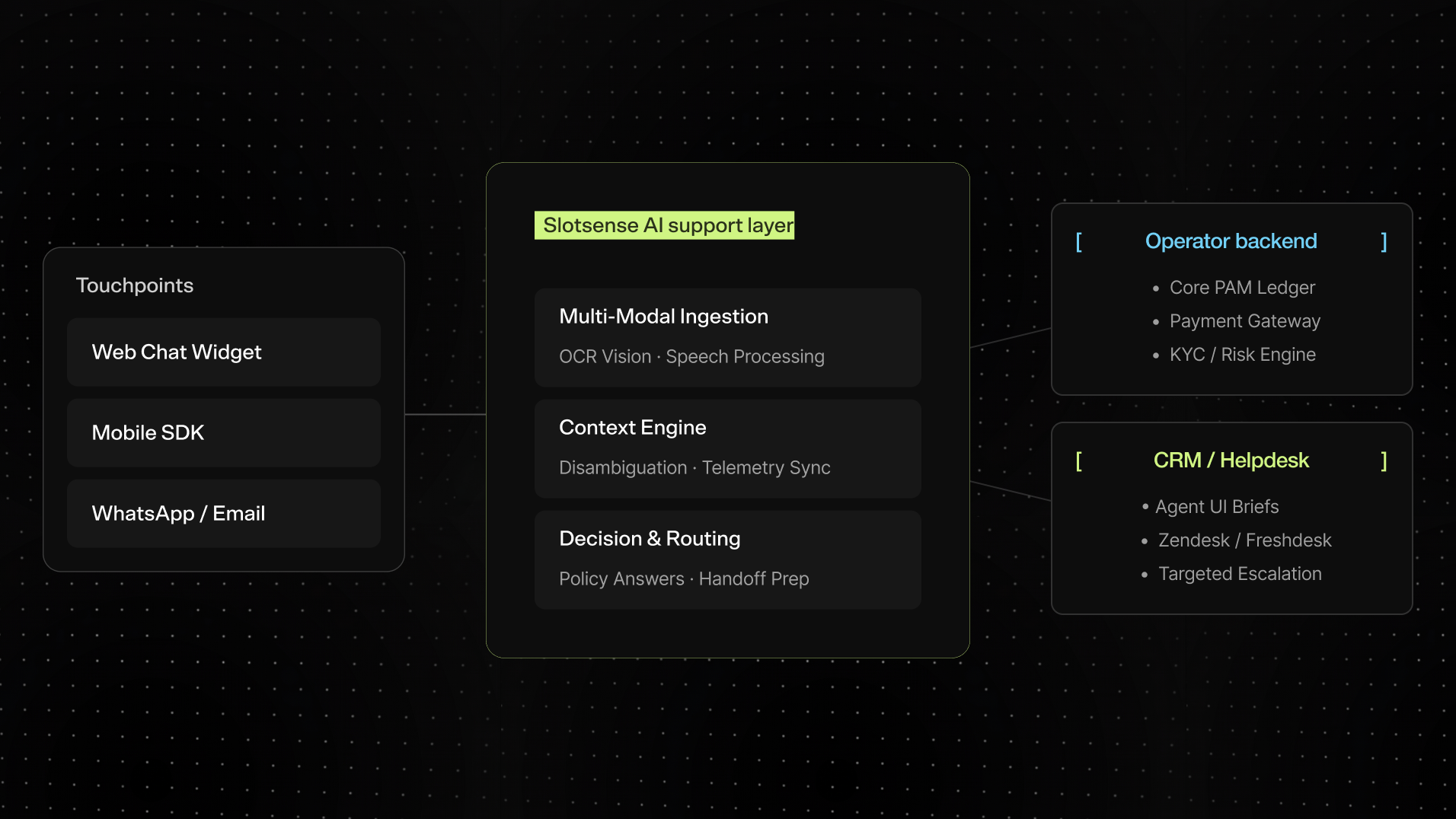
Slotsense provides an intelligence and decisioning layer that integrates alongside existing enterprise infrastructure. It does not replace the operator's Core PAM, CRM, or primary Ticketing Desk (e.g., Zendesk, Freshdesk, Gladly). Instead, Slotsense sits between incoming player communication channels and backend platforms to orchestrate multi-modal context processing, route requests, and prepare agent handoffs.
Figure 4. Slotsense operates as a context and decisioning layer between customer touchpoints and core operator backend infrastructure.
Channel Integration: Ingests unstructured inputs from web chat widgets, mobile SDKs, email streams, and instant messaging channels (e.g., WhatsApp).
Data Layer Connection: Queries PAM ledgers, document verification pipelines, payment gateway webhooks, and historical player profiles via secure REST APIs.
Decision Engine: Applies multi-modal OCR, speech processing, and domain-specific context rules to select the appropriate resolution path.
Agent Handoff Output: Formats case summaries, extracted parameters, and suggested response macros directly into existing helpdesk agent UI interfaces.
Compliance, Safer Gambling, and Regulatory Guardrails
Automating player communications within regulated gambling jurisdictions requires strict adherence to player protection mandates and regulatory standards. Support automation systems must enforce safety controls before executing automated responses or routing decisions.
Key compliance protocols include:
Mandatory Risk Keyword and Sentiment Overrides: Real-time scanning of text and voice transcripts for indicators of distress, financial hardship, or gambling harm. Detection of these signals must instantly bypass standard FAQ loops and trigger compliance escalation.
Auditability of Automated Decisions: Every automated interaction—including confidence scores, retrieved context parameters, and decision rationale—must be logged to satisfy regulatory record-keeping audits.
Data Protection and PII Masking: Visual inputs containing sensitive personal financial data (e.g., full credit card numbers in deposit screenshots) must undergo automated redaction before permanent database storage or agent presentation.
Regulatory Disclaimer: Other markets have their own requirements. Regulatory examples referring to Great Britain provide a concrete example, not a universal standard. Operators must validate support automation workflows against specific local licensing frameworks.
Practical Implementation: 8 Steps to Multi-Modal Support Automation
Implementing context-aware support automation requires a structured rollout process focused on baseline data collection, system integration, and iterative rule tuning.
Audit Unstructured Communication Volume: Analyze historical ticket logs to determine the proportion of incoming interactions involving screenshots, voice notes, and incomplete text queries across target markets.
Define Category Telemetry Requirements: Establish minimum required parameters for core support categories (e.g., requiring method, amount, and timestamp before evaluating payment inquiry tickets).
Establish Bi-Directional API Connectors: Deploy secure API integrations between the decision engine, PAM database, payment gateway logs, and CRM platform.
Configure Multi-Modal OCR and Audio Ingestion: Train visual parsing models on common operator UI screens (cashier, bonus progress, verification portal) and configure speech-to-text models for key market languages.
Implement Risk and Compliance Overrides: Set explicit safety triggers to handle safer gambling indicators, VIP escalation paths, and fraud alerts.
Design Structured Agent Handoff Templates: Standardize ticket summaries delivered to human support agents to ensure uniform presentation of extracted metadata, transcripts, and suggested actions.
Conduct Shadow Mode Validation: Run the multi-modal context engine in parallel with existing support operations to evaluate decision accuracy and OCR extraction precision without live player impact.
Deploy Iterative Auto-Resolution Rules: Enable automated self-service resolution incrementally, starting with high-volume, low-risk categories (e.g., basic deposit status checks and game rule inquiries).
Measuring Success: The iGaming Support Scorecard
Evaluating multi-modal support automation performance requires a balanced scorecard spanning operational efficiency, player experience, decision accuracy, and compliance adherence.
Objective Outcome: Reduction in overall human ticket volume for repetitive, low-risk support queries; improvement in overall operational handling capacity.
Experience Outcome: Decrease in average First Response Time (FRT) and Total Resolution Time (TRT); reduction in player re-contact rates caused by incomplete initial answers.
Decision Quality: Classification accuracy of incoming multi-modal inputs; percentage of cases correctly assigned to appropriate operational queues on first transfer.
Incremental Outcome: Average handling time saved per escalated ticket due to pre-parsed screenshots, voice transcripts, and pre-populated account context summaries.
Guardrail Outcome: Zero missed responsible gambling risk triggers; 100% compliance with local PII redaction and audit logging requirements.
Transform Messy Player Inputs Into Structured Context
Map your operator's support workflows and evaluate multi-modal context processing for your operational stack.
Multi-modal support automation is a decisioning layer that ingests and evaluates multiple communication formats—including text fragments, screenshots, voice notes, and backend account data—to resolve support requests or route structured context to human agents.
How does vision OCR assist in handling player deposit or withdrawal issues?
Vision OCR parses submitted screenshots to extract critical transaction details such as payment provider logos, error codes, timestamps, and balance figures. This data is cross-referenced with payment gateway logs to deliver accurate status updates without requiring manual parameter typing from the player.
Is speech recognition reliable for multi-lingual iGaming support?
Yes. Speech recognition models transcribe and summarize audio messages in real time across multiple languages. The extracted transcript and sentiment score are attached directly to the case file, enabling support teams to review voice notes without listening to full audio files.
Is multi-modal context capture identical to traditional NLP text matching?
No. Traditional NLP matching evaluates text strings against knowledge base articles in isolation. Multi-modal context capture combines text parsing with visual processing, audio transcription, and live PAM account telemetry to evaluate the complete operational situation before taking action.
What data access does Slotsense require for support decisioning?
Slotsense interfaces via secure APIs with the operator's PAM, CRM, payment gateway, and ticketing platforms to query relevant status flags, transaction logs, and account verification states required for decision execution.
Can maintaining a "wait state" be a valid automated support action?
Yes. Maintaining a wait state is the correct action when background audits are active, such as pending responsible gambling checks, ongoing automated fraud evaluations, or temporary payment gateway processing delays where immediate messaging could create operational friction.
How does multi-modal support automation streamline case escalation?
When escalation is required, the automation layer packages a condensed case summary containing the primary issue, extracted image metadata, voice transcripts, PAM parameters, and recommended resolution steps directly into the human agent's helpdesk dashboard.