Next Best Action in iGaming: How AI Decides What a Player Should See Next
Learn how next best action AI uses triggers, player context, objectives and guardrails to choose a recommendation, support step - or no action.
14 mins
·
September 3, 2026
Learn how next best action AI uses triggers, player context, objectives and guardrails to choose a recommendation, support step - or no action.
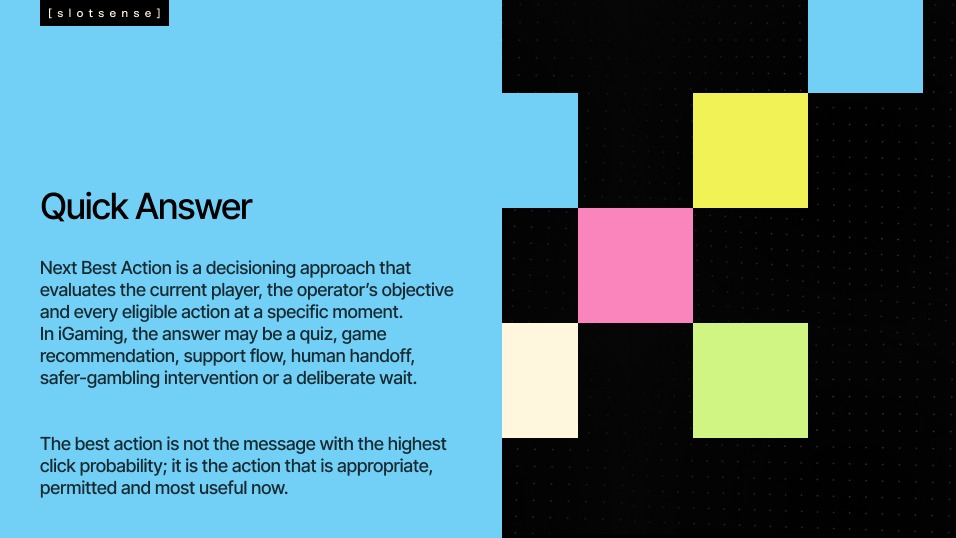
Next Best Action (NBA) moves retention from fixed campaign logic toward moment-level decisions. Instead of asking, “Which campaign does this segment receive?”, the system asks, “Given this signal, this player's current context and the operator's constraints, what should happen next?”
That distinction matters because the same surface can serve very different needs. A player who has just completed a first deposit may need help choosing a game. A player whose deposit failed needs support, not a recommendation. A returning player with a clear provider preference may benefit from a familiar shortcut. A player already progressing smoothly may need nothing at all.
Across industries, NBA is generally described as using real-time interaction data, a library of potential actions, business rules and AI to choose a contextually relevant next step. The iGaming version needs an additional discipline: commercial objectives must sit beneath consent, eligibility, product availability, responsible-gambling policy and jurisdiction-specific controls.
Official source: Pega - What is Next Best Action?
Slotsense Retention AI can be understood through one operating sequence:
Trigger -> Player context -> Objective -> Possible actions -> AI decision -> Outcome
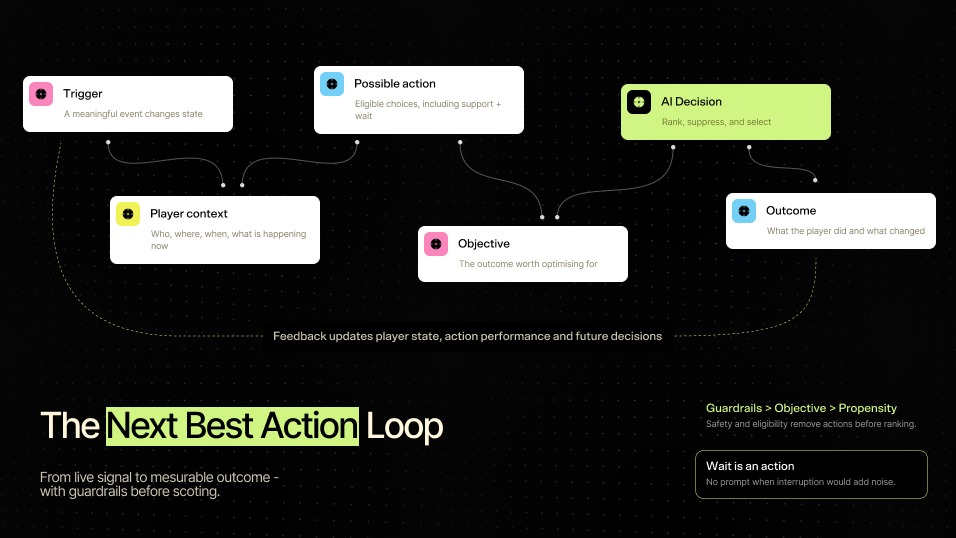
Figure 1. The decision is made from an eligible action set; outcomes feed the next decision.
1. Trigger: A meaningful event changes the player's state. Examples include registration completed, first deposit completed, deposit failed, game exited quickly, support question opened, return after inactivity or a detected risk signal. A trigger creates a decision opportunity; it does not predetermine the action.
2. Player context: The engine assembles what is known now: lifecycle stage, session activity, preferences, recent interactions, device and market, product availability, consent, support history, responsible-gambling indicators and what the player has already seen. Context should be fresh enough for the moment being decided.
3. Objective: The operator defines the outcome that matters for this state. It may be first bet, resolved payment friction, faster game discovery, successful support resolution, reactivation or reduced interruption. Objectives need a hierarchy so a safety or service need can override a commercial goal.
4. Possible actions: The system starts from an action library. In Slotsense, that can include a quiz, a specific recommendation, a surprise-me randomizer, contextual guidance, a help article, ticket creation, human handoff, an onsite prompt or wait. Each action has eligibility, frequency, market and policy rules.
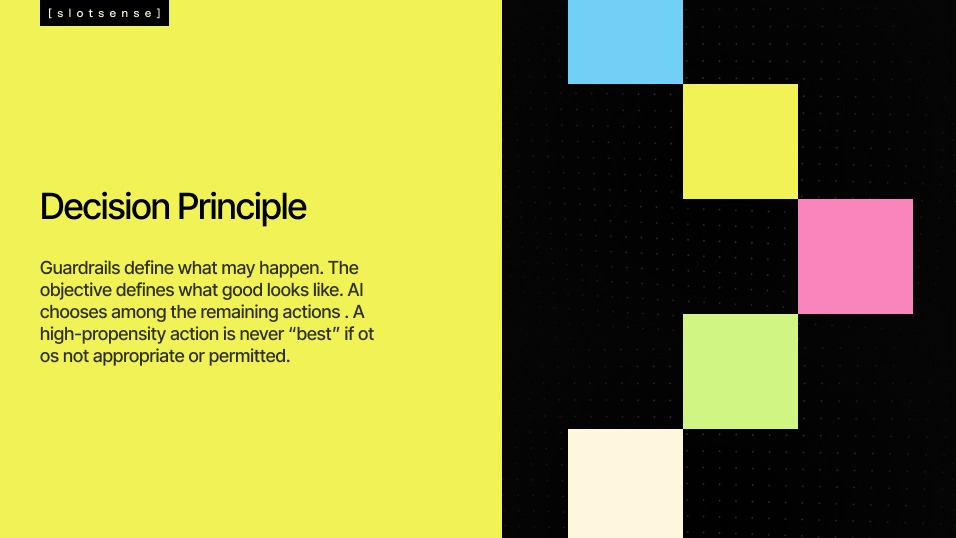
5. AI decision: Rules first remove actions that are unavailable, unsafe, repetitive, ineligible or inappropriate. The remaining actions can be ranked using predicted relevance, the player's likely response, objective fit, expected value, timing and confidence. If no action clears the threshold, the result is wait.
6. Outcome: The platform records what happened: impression, response, dismissal, quiz completion, recommendation click, game launch, first bet, issue resolution, escalation, no action or a later downstream event. Outcomes update measurement, experiments and future decisions.
The examples below use the same logic but produce different actions because the player context and objective change.
Trigger: The player's first deposit is confirmed.
Player context: The player is active but has not launched a game or placed a bet. Preferences may be known from browsing, registration questions or previous quiz data - or may be unknown. Consent, market availability and safety checks are clear.
Objective: Help the player reach a confident first-bet decision without adding unnecessary friction.
Possible actions: Short preference quiz; relevant game or category recommendation; surprise-me randomizer; contextual explanation; wait.
AI decision: Use a direct recommendation when preference confidence is strong. Use a quiz when the player needs discovery help. Use the randomizer when the player has asked for spontaneity or has low-friction intent. Wait when the player is already exploring, recently dismissed a prompt or does not meet the intervention threshold.
Outcome: Quiz response, recommendation click, game launch, first bet, prompt dismissal, support question or no action. The decision window and attribution rule should be defined before launch.
Trigger: A deposit attempt fails or remains unresolved.
Player context: The system checks the failure state, repeated attempts, support history, payment-method eligibility, market rules and any account or safer-gambling signals.
Objective: Resolve friction accurately and safely. The goal is not to push the player toward a game while the payment issue is unresolved.
Possible actions: Explain the current status; surface verified troubleshooting guidance; offer a relevant help article; collect context; create a ticket; hand off to an agent; wait while the payment status is pending.
AI decision: Support and resolution actions outrank commercial actions. Game recommendations, bonus nudges and deposit-pressure messages are suppressed. Repeated failures or risk indicators can change the route again, based on operator policy.
Outcome: Issue resolved, status understood, ticket created, agent handoff, retry completed where appropriate, session ended or further review required.
Trigger: A known player returns after a meaningful gap or opens the lobby.
Player context: The player has a stable provider or category preference, the relevant content is available in the current market, there is no unresolved support issue and frequency controls allow an intervention.
Objective: Reduce discovery friction and help the player find a relevant experience quickly.
Possible actions: Continue with a familiar provider; recommend a newly available title from that provider; open a preferred category; offer something new based on adjacent tastes; wait.
AI decision: A familiar recommendation is strong when preference confidence and availability are high. A discovery route may be better when recent behaviour shows variety-seeking. Wait when the player already navigates directly to a preferred game.
Outcome: Game view, launch, browse depth, recommendation response, dismissal or no intervention.
A next best action engine must be able to change objectives, not merely rank marketing content. When operator-defined indicators suggest elevated risk, promotional and retention actions should be removed from the eligible set. The appropriate next step may be a protective interaction, account control, safer-gambling information, automated action under policy, human review or no promotional message.
In Great Britain, remote operators are required to embed an ongoing identify-act-evaluate process, tailor action to indicators of harm, prevent marketing and new bonus take-up where strong indicators are identified, and evaluate the impact of interactions. Other markets have their own requirements, so the action policy must be configured by jurisdiction and reviewed by the operator's compliance and safer-gambling teams.
Official source: UK Gambling Commission - Remote customer interaction requirements
Many decisioning systems fail because they are optimized to fill every available surface. More messages create more measurable impressions, but not necessarily more value. A useful NBA engine must compare every intervention with the cost of interruption.
Wait should remain eligible when:
• the player is already progressing naturally;
• the signal is weak or the model's confidence is below threshold;
• the player recently dismissed or ignored a similar prompt;
• a frequency cap or quiet period applies;
• the available actions are not sufficiently relevant;
• the current state is still resolving, such as a pending payment status;
• a safety, consent, market or responsible-gambling rule suppresses engagement.
This is not inactivity. It is a recorded decision with a reason code, a duration and a next evaluation point. Measuring wait against active interventions also protects the model from learning that any message is better simply because messages generate clicks.
The model is only one component. A production-grade next best action engine needs the surrounding decision infrastructure:
Live events: Reliable triggers from the product, PAM, payment, support and analytics stack.
Player context: A current state assembled from lifecycle, session, preference, support and policy data.
Objective hierarchy: Clear commercial, service, experience and safety priorities for each player state.
Action library: Every action the system may take, with content, delivery surface, cost and expiry.
Eligibility and guardrails: Consent, jurisdiction, availability, frequency, responsible-gambling and operational rules.
Decision policy: Rules and models that suppress, rank, explore, threshold and select actions.
Execution layer: The player-facing surface that can deliver a conversation, quiz, recommendation, guidance, ticket or no action.
Outcome instrumentation: Events that show what happened and connect the decision to downstream results.
Experimentation and review: Control groups, A/B tests, audit logs, model monitoring and human governance.
Machine learning can improve ranking, but operators do not need to wait for a perfect model to start. A first workflow can use explicit rules and a small action set, provided the trigger, context, objective, guardrails and outcomes are measurable. As evidence accumulates, the engine can introduce propensity, adaptive learning and controlled exploration.
Official source: Amazon Personalize - Next-Best-Action recipe
Official source: Salesforce - Suggest options with recommendation strategies
Next Best Action should not be a black box with permission to invent objectives. Operators retain control of the decision environment:
Within that environment, AI can interpret current context, estimate which eligible action is most useful, choose timing and presentation, and learn from outcomes. The separation is important: governance defines the playing field; the model makes a bounded decision inside it.
Slotsense is the player-facing layer that acts during the active session. It can connect with the operator's product, CRM, support and player data rather than replacing them. Retention AI needs trigger integration and player-state data; the CRM can continue to own campaigns and lifecycle logic; the support stack can continue to own tickets and agents.
The distinctive job is the moment between systems and player: interpreting likely intent or friction, selecting an eligible next step, and delivering it as a conversation, recommendation, quiz, support flow, guided recovery, escalation or wait. Player responses and downstream outcomes then return to analytics, experimentation and the next decision.
This is why Next Best Action is more than a recommendation widget. The engine can move between engagement and support without losing context - and it can decide not to interrupt when the player does not need help.
Official source: Slotsense - Player-facing AI for iGaming support and retention
A single click-through rate is not enough. Use a balanced scorecard:
• Objective outcome: first bet, successful game discovery, issue resolution, reactivation or another defined goal.
• Experience outcome: prompt dismissal, repeat interruption, time to resolution, support handoff quality or session continuation.
• Guardrail outcome: consent compliance, frequency-cap compliance, suppressed-action accuracy, complaints and safer-gambling review signals.
• Incremental outcome: lift against a control or holdout, not only correlation among exposed players.
• Learning outcome: action coverage, confidence distribution, reason codes, data freshness and model or rule drift.
The feedback loop should answer two questions: Did the selected action improve the intended outcome? And should a different action - including wait - be chosen next time?
Frequently asked questions
Next Best Action is a decisioning approach that selects the most appropriate eligible step for a specific customer at a specific moment. It combines context, objectives, possible actions, rules and often AI or predictive models.
It receives a trigger, builds current context, removes ineligible actions, ranks the remaining choices against an objective and confidence threshold, selects an action, and learns from the outcome.
The engine is the operating system around the model: event ingestion, context, objectives, action catalogue, guardrails, decision policy, execution surfaces, outcome tracking and governance.
Examples include guiding a first depositor to a suitable game, routing a failed deposit to support, recommending a familiar provider to a returning player, escalating a risk signal, or choosing not to interrupt.
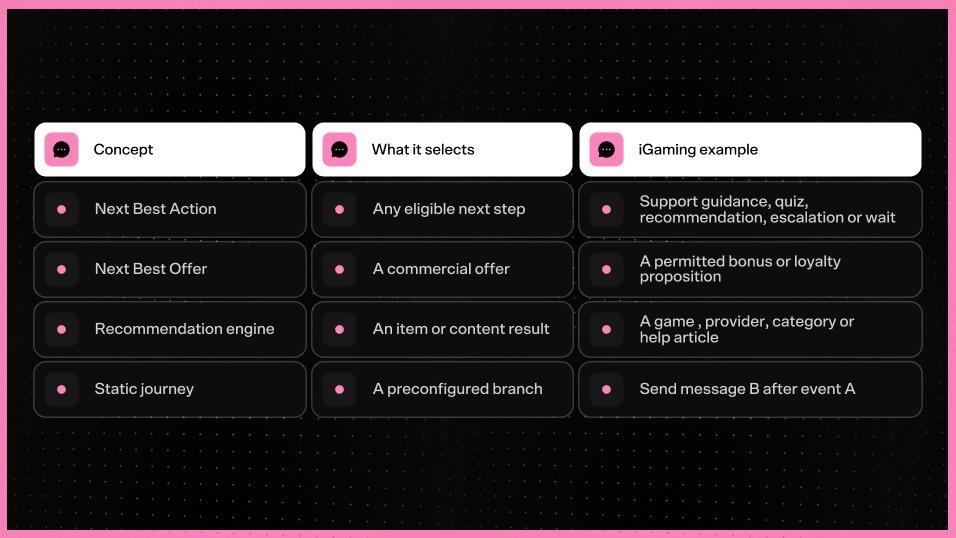
Next Best Offer chooses a commercial proposition. Next Best Action is broader: it can select service, education, recommendation, engagement, protection, escalation or no action.
No. A useful first workflow can combine rules, eligibility and a small action set. AI becomes valuable as action choices, contexts and feedback grow, but it should remain bounded by operator-defined objectives and guardrails.
Yes. Wait is appropriate when the player is progressing naturally, confidence is low, frequency limits apply, the state is unresolved or no eligible action is useful enough to justify interruption.
A CRM usually orchestrates lifecycle campaigns and rules. Retention AI can interpret live session context and choose the player-facing next step inside the moment, then return the outcome to the wider stack.
Content:
.png)
.png)