Real-Time Trigger Architecture in iGaming: From Player Event to Safe In-Session Action
A practical guide to turning real-time player events into contextual, eligible and measurable in-session actions across the iGaming stack.
16mins
·
October 18, 2026
A real-time trigger in iGaming is not simply an event or webhook. It is a controlled decision window opened by a meaningful change in player or product state.
A useful trigger architecture combines that event with fresh player context, checks eligibility and hard constraints, selects an allowed next action, executes it inside the active player experience and records what happened afterwards.
The output may be a game recommendation, guided recovery, support step, escalation, suppression or no intervention at all.
A Real-Time Trigger Is Not a Webhook
Operators already generate large volumes of events.
The PAM records registration, verification and account-state changes. Payment systems record successful and failed deposits. Casino platforms know which games start, stop or fail to launch. CRM systems know segments, campaigns and prior communications. Support platforms know open cases and repeated questions.
None of that automatically creates a good player decision.
A webhook can report that deposit_failed occurred. It cannot, by itself, explain whether the player should retry, see an alternative method, receive help, complete KYC, wait for a provider issue to clear or encounter no commercial messaging at all.
That distinction is fundamental.
In event-driven architecture, an event represents a meaningful change in state. Producers emit events and consumers decide how to react. The architecture deliberately separates the system that reports what happened from the systems that respond to it. AWS and Salesforce both describe event-driven systems in these terms: events communicate state changes, while downstream consumers remain decoupled from the producer.
The event should open a decision. It should not predetermine the response.
This extends the same principle used in Next Best Action in iGaming: the same trigger can produce different actions depending on player context, current objective and operator constraints. The journey-orchestration layer adds another requirement: that decision may need to be made again inside the same active session as the player state changes.
The Event-to-Action Gap in the iGaming Stack
The technical problem is rarely that operators have no data.
The harder problem is that the data is distributed across systems with different jobs and different refresh cycles.
A common architecture looks roughly like this:
PAM → identity, account status, KYC, balance, restrictions Casino / aggregator → game availability, launch events, provider data Payments → deposit attempts, failures, method status CRM / CDP → segments, lifecycle context, campaign history, consent Support → intent, open cases, prior resolution attempts Product UI → current page, browsing behaviour, search and session state
Each system may be correct on its own.
The gap appears when an action is chosen using only one of them.
A CRM may know that a player belongs to a high-value retention segment but not that a payment just failed.
A payment system may know a card was declined but not that the player is still completing KYC.
A recommendation engine may know a provider affinity but not that a support case is open.
A product surface may know the player returned to the lobby three times but not whether the relevant games are eligible in that market.
The active player experience sits downstream from all of these facts.
That is why real-time trigger integration is not only a messaging problem. It is a state-resolution and decision problem.
The existing Slotsense personalization framework makes the same broader distinction: fixed cohorts describe who the player has been, while live context is needed to decide what matters now. The current blog positions personalization as a move from static segments toward live, context-aware player experiences.
The Event-to-Outcome Contract
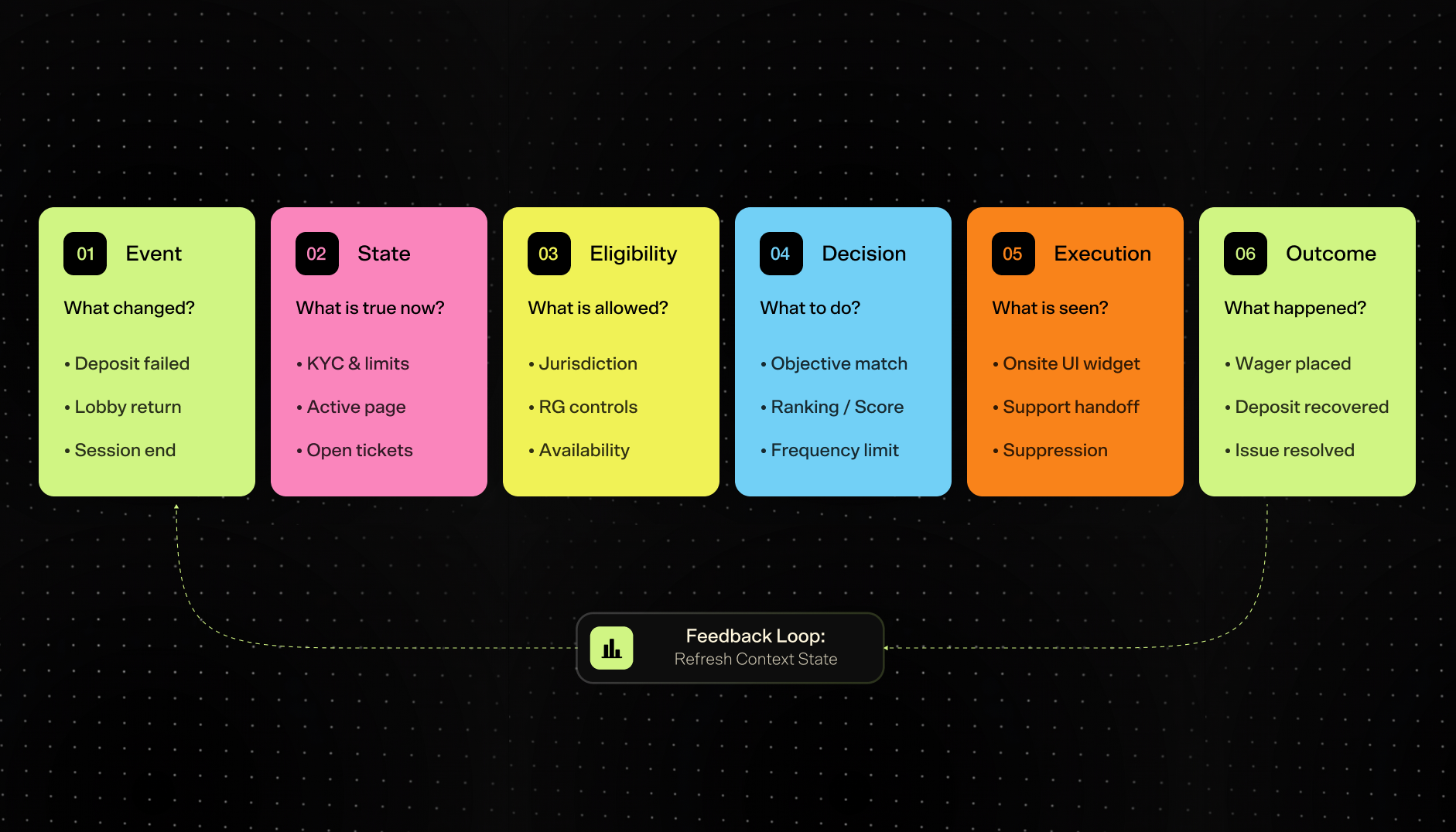
A useful trigger architecture can be expressed as six stages:
Figure 2. The Event-to-Outcome Contract prevents a raw trigger from becoming an automatic player intervention.
Event
Core question: What changed?
Typical iGaming inputs: deposit failure, lobby return, game exit, search failure, support intent
Failure if skipped: Decision never reaches journey
Outcome
Core question: What happened next?
Typical iGaming inputs: wager, resolution, dismiss, escalation, no response
Failure if skipped: No learning or causal measurement
The contract is deliberately broader than a trigger rule.
A rule such as:
IF deposit_failed → show bonus
jumps from Event directly to Execution.
A stronger architecture asks what the failure means before selecting an action.
1. Event: Record What Happened, Not What It Means
An event should describe an observable state change.
Examples include:
registration_completed — the account was created.
deposit_failed — an attempted payment did not complete.
lobby_reopened — the player returned to a discovery surface.
game_session_ended — gameplay stopped.
recommendation_dismissed — a player rejected an intervention.
support_intent_detected — the player expressed a support need.
limit_changed — a player-protection state changed.
Events should be stable enough that multiple downstream systems can consume them without redefining their meaning.
AWS describes event buses as routers that receive events from sources and deliver them to one or more targets. Salesforce makes a similar distinction between event producer, channel and consumer. That separation matters because CRM, analytics, player-facing AI and support may all need the same event for different purposes.
Rule: an event says what happened. The decision layer determines what, if anything, should happen next.
2. State: Refresh the Player Context Before Acting
The event may be recent while the decision context is stale.
Consider a campaign selected at 10:00.
The player opens it at 19:42.
Between those two moments, the player may have completed a deposit, opened a support case, changed a financial limit, entered a different lifecycle state or produced a player-protection signal.
The original campaign context is no longer enough.
Real-time journey orchestration requires the system to evaluate contextual information from current events, platform state and connected data sources. Adobe describes journey orchestration as using contextual event and data-source information for real-time orchestration, and its current decisioning documentation describes rules and ranking against current profile context.
Session state: page, device, active game, recent game exits.
Lifecycle state: new, active, returning, dormant, VIP or another operator-defined state.
Commercial context: active campaign, bonus state, previous offer exposure.
Discovery context: recent search terms, game categories, providers, ignored recommendations.
Support context: unresolved tickets, current conversation, repeated requests.
Protection context: responsible-gambling or vulnerability indicators and suppression state.
The architecture does not need every possible field for every decision.
It needs the smallest set of fields that can materially change the next action.
3. Eligibility: Remove Invalid Actions Before Ranking Anything
Personalization should not rank every conceivable action and then hope the highest-scoring one is acceptable.
Hard constraints come first.
This is particularly important in iGaming because eligibility can depend on product availability, jurisdiction, consent, account status, financial controls, bonus terms and player-protection logic.
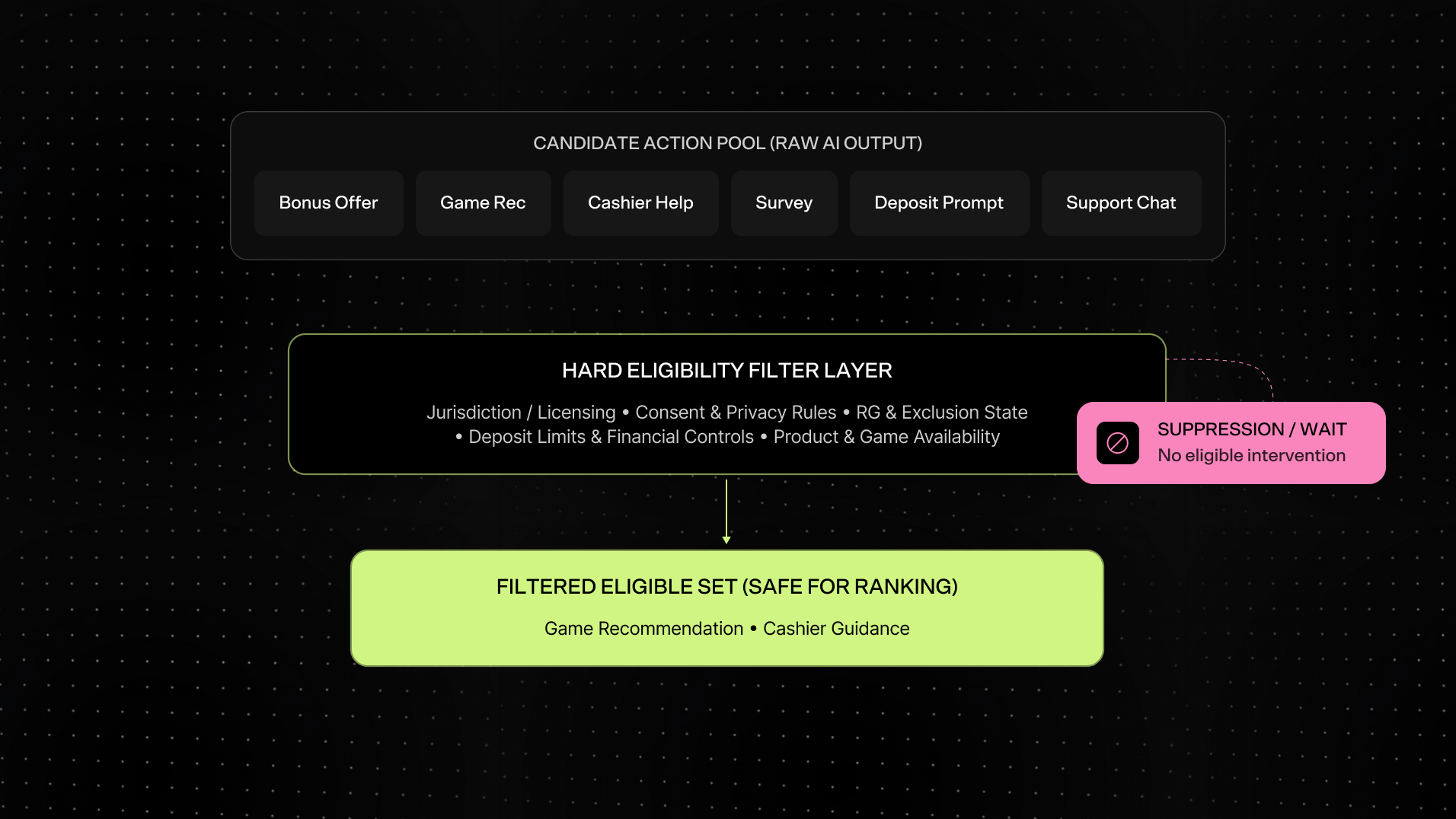
The order should be:
candidate action → hard filter → eligible set → ranking
A game may be highly relevant by behavioural similarity but still unavailable in the player’s jurisdiction or inappropriate under an active restriction. Availability is therefore not a preference score. It is a hard filter.
The same principle applies outside recommendations.
A bonus may look commercially attractive but be suppressed.
A game-discovery prompt may be eligible while a payment issue is unresolved.
A support flow may outrank an engagement action.
And sometimes the eligible action set should contain only one result:
No action.
Figure 3. The iGaming Hard Eligibility Filter Layer prioritizes safety and compliance.
4. Decision: Choose the Objective Before Choosing the Experience
A trigger does not have one universal objective.
deposit_failed might open a decision window around friction resolution.
first_deposit_completed may open a game-discovery decision.
lobby_reopened ×3 may suggest uncertainty, but not necessarily churn.
support_intent_detected changes the objective from engagement to issue resolution.
The Next Best Action framework already formalizes this distinction: the system evaluates the current signal, player context, operator objective and eligible action set before selecting an action. A failed deposit may require support rather than recommendation; the same player may need a different action several minutes later.
A useful decision layer therefore needs at least:
Objective hierarchy. Service and protection can override commercial engagement.
Candidate actions. The system chooses among genuinely different actions, not five versions of the same message.
Confidence threshold. Low confidence should not become forced personalization.
Frequency memory. Previous prompts and dismissals matter.
Reason code. The system should be able to explain why the action or suppression occurred.
This is the part of the architecture where predictive models or generative AI may contribute.
But generation is downstream from control.
The AI can help interpret likely intent, rank an eligible action set or formulate a response. It should not bypass the policy layer.
5. Execution: The Decision Must Reach the Active Player Experience
Many architectures stop too early.
They calculate a score.
They update a segment.
They send an event back to CRM.
But the player is still looking at the same lobby, cashier or support surface.
Real-time orchestration becomes materially different when the selected action can execute inside the experience where the decision is still relevant.
That action might be:
Guided recovery: explain a failed deposit state and surface an allowed next step.
Game discovery: ask one clarifying question or present a short contextual recommendation set.
Support: open the relevant help flow with known context already attached.
Human handoff: route the case with intent, transaction and conversation state.
Navigation: take the player directly to the required account or verification step.
Suppression: prevent an inappropriate campaign or prompt from appearing.
Wait: preserve the existing journey because intervention would add noise.
Journey orchestration defines the need for same-session re-decisioning. Trigger architecture defines how the current event, state and decision reach the execution surface reliably. The live Slotsense orchestration guide explicitly separates CRM lifecycle control from execution inside the player-facing experience.
6. Outcome: Close the Loop With a Business Event
An intervention without an outcome event is difficult to improve and difficult to prove.
The outcome should correspond to the objective.
If the objective was payment recovery, the outcome may be:
deposit_recovered
If the objective was first meaningful play:
real_bet_placed_within_24h
If the objective was game discovery:
game_launched or, where appropriate, a downstream wager event.
If the objective was support:
issue_resolved, human_handoff_completed or repeat_contact.
If the decision was no action:
no_action_selected, with a reason code such as low confidence, active protected state, frequency suppression or no eligible candidate.
This distinction matters because interaction metrics are not the same as business outcomes.
The Slotsense A/B-testing framework explicitly treats quiz completion, recommendation opens, avatar views and message responses as diagnostic metrics rather than proof of incremental business impact. Its recommended primary analysis compares all eligible assigned players using intention-to-treat, with a predefined business outcome such as conversion to a real bet within 24 hours.
A trigger architecture therefore needs measurement events from the beginning.
Measurement should not be bolted on after rollout.
What Real-Time Trigger Architecture Actually Requires
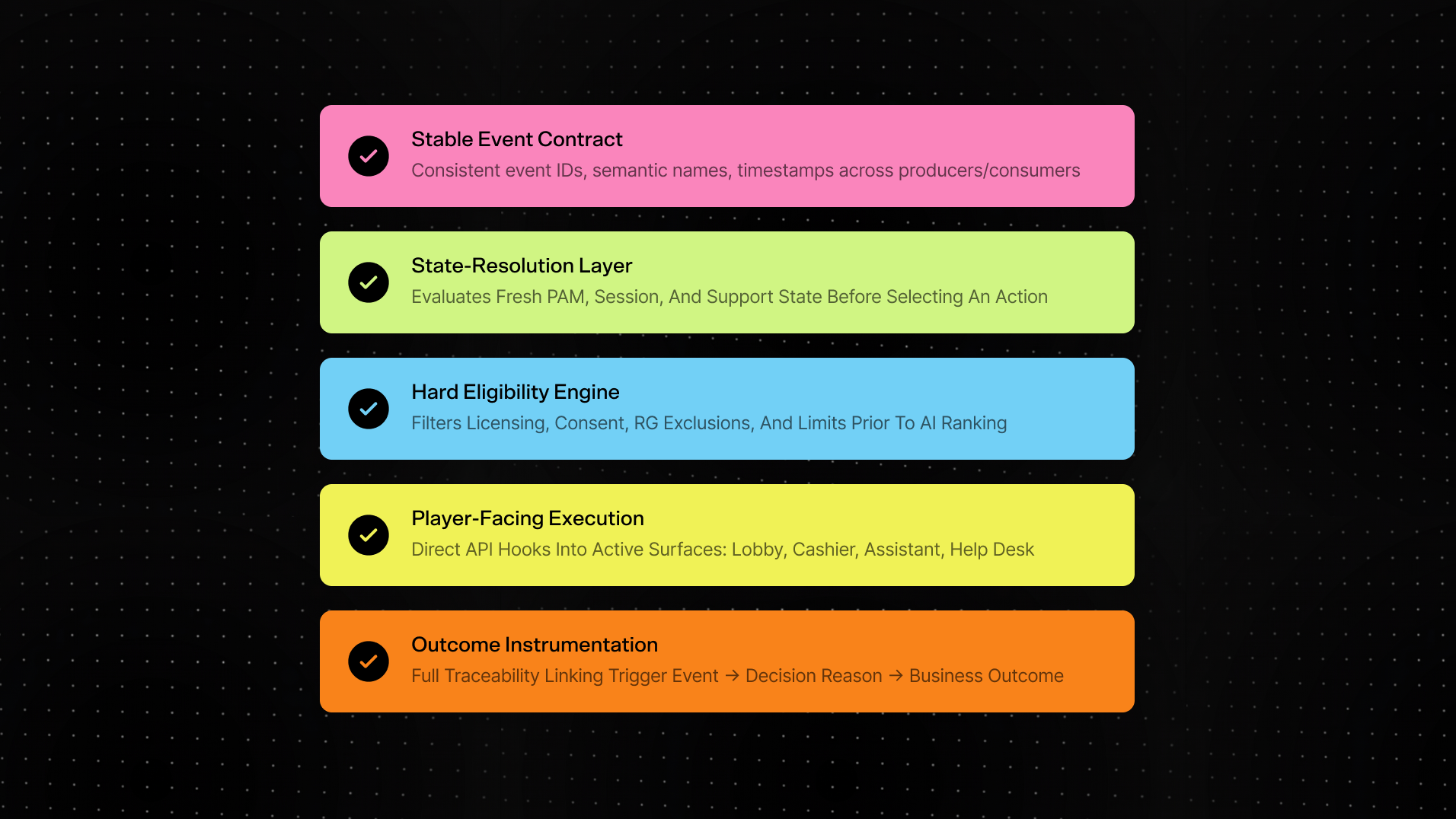
Figure 4. Core operational requirements for a production real-time trigger system.
A production trigger system needs more than low latency.
A stable event contract. Event names, IDs, timestamps and semantic meaning should remain consistent across producers and consumers.
A state-resolution layer. The decision system needs a current view of the player and session, not only the event payload.
Hard eligibility and suppression. Invalid actions must be removed before AI ranking or content generation.
Player-facing execution. The selected action needs a supported surface: lobby, cashier, onsite assistant, help layer or another approved interface.
Outcome instrumentation. Assignment, decision, action, reason and downstream result need a traceable chain.
Latency still matters.
But “real time” should not become an arbitrary infrastructure vanity metric.
The required latency depends on the decision window.
A support answer during an active chat has a different tolerance from a lifecycle update. A failed payment recovery step may need to execute while the cashier context is still visible. A downstream retention evaluation can operate on a longer horizon.
The useful technical question is not:
“Is the event pipeline fast?”
It is:
“Does the complete Event → State → Eligibility → Decision → Execution path finish before the decision loses value?”
Signal Inventory: Which Inputs Can Actually Change the Action?
Deposit result
Why it matters: Separates successful funding from friction
How it can change the action: Recovery, support, or no payment prompt
KYC status
Why it matters: Explains why some account actions are blocked
How it can change the action: Verification guidance instead of promotion
Current page
Why it matters: Shows immediate journey context
How it can change the action: Cashier recovery vs lobby discovery
Recent game behaviour
Why it matters: Indicates discovery pattern, not guaranteed preference
How it can change the action: Recommendation, quiz or wait
Support case state
Why it matters: Prevents contradictory experiences
How it can change the action: Suppress engagement and continue resolution
Market / jurisdiction
Why it matters: Controls available product and messaging
How it can change the action: Remove invalid games/actions
Consent / frequency state
Why it matters: Determines communication eligibility
How it can change the action: Suppress or delay intervention
Protection indicators
Why it matters: Can override commercial objectives
How it can change the action: Protected flow, suppression or review
Rule: a signal belongs in the decision context only if it can change the selected objective, eligible action set or execution.
Collecting more fields does not automatically create better decisions.
Worked Example 1: Failed Deposit in the Cashier
Trigger: deposit_failed
Player / stored context: Returning player. Previous deposits succeeded. No open support case.
Live context / objective: The player is still on the cashier. The immediate objective is to resolve payment friction.
Possible actions: Explain status, surface an eligible alternative method, offer contextual support, retry guidance, wait.
AI decision: The system checks whether the failure reason is known, whether another method is available and whether KYC or account limits are involved. It does not default to a bonus.
Outcome: Successful deposit recovery, support handoff, abandonment or another failure.
The main architectural point is that deposit_failed does not encode its own solution.
Worked Example 2: Three Lobby Returns Without a Game Wager
Trigger: Repeated return to the lobby after a funded session.
Player / stored context: Limited preference history. No clear provider affinity.
Live context / objective: The player appears to be exploring, but the system does not know whether this is friction, normal browsing or indecision.
Possible actions: Three contextual recommendations, short preference quiz, one clarifying question, no action.
AI decision: If preference confidence is low but repeated discovery friction is clear, a short guided-discovery flow may be appropriate. If the player is actively browsing normally, the system waits.
Outcome: Game launch, qualifying wager, quiz completion, dismissal or continued browsing.
This connects directly to the game-recommendation layer: contextual signals can guide discovery, but recommendation exposure is not itself the business outcome.
Worked Example 3: CRM Campaign Click With Changed State
Trigger: Player clicks a CRM campaign.
Player / stored context: The player was eligible when the campaign audience was built.
Live context / objective: Several hours have passed. State is refreshed before the destination experience is selected.
Possible actions: Continue the intended offer, explain conditions, route to a neutral experience, suppress promotion, no action.
AI decision: Current consent, account status, limits, active support context and protection rules are checked again before execution.
Outcome: Eligible offer interaction, neutral navigation, suppression or downstream conversion.
CRM still owns the campaign intent.
The live layer determines whether that intent remains executable now.
Worked Example 4: Player-Protection Override
Trigger: A commercial journey becomes eligible while a strong protection signal is active.
Player / stored context: The player would otherwise qualify for a retention or bonus action.
Live context / objective: The protection state overrides the commercial objective.
Possible actions: Protected interaction, marketing suppression, manual review where required, wait.
AI decision: Promotional candidates are removed before ranking.
For Great Britain, current UK Gambling Commission requirements provide one concrete regulatory example. SR Code Provision 3.4.3 requires remote operators to implement customer-interaction systems covering identify, act and evaluate; use a range of harm indicators; take timely action; prevent marketing and new bonus take-up where strong indicators are identified; and use automated processes for strong indicators with individual manual review of those automated decisions.
Other markets have their own requirements. Great Britain is one concrete architecture and governance example, not a universal regulatory standard. Operators need local compliance validation for every target market.
Trigger Architecture vs. Journey Orchestration vs. Next Best Action
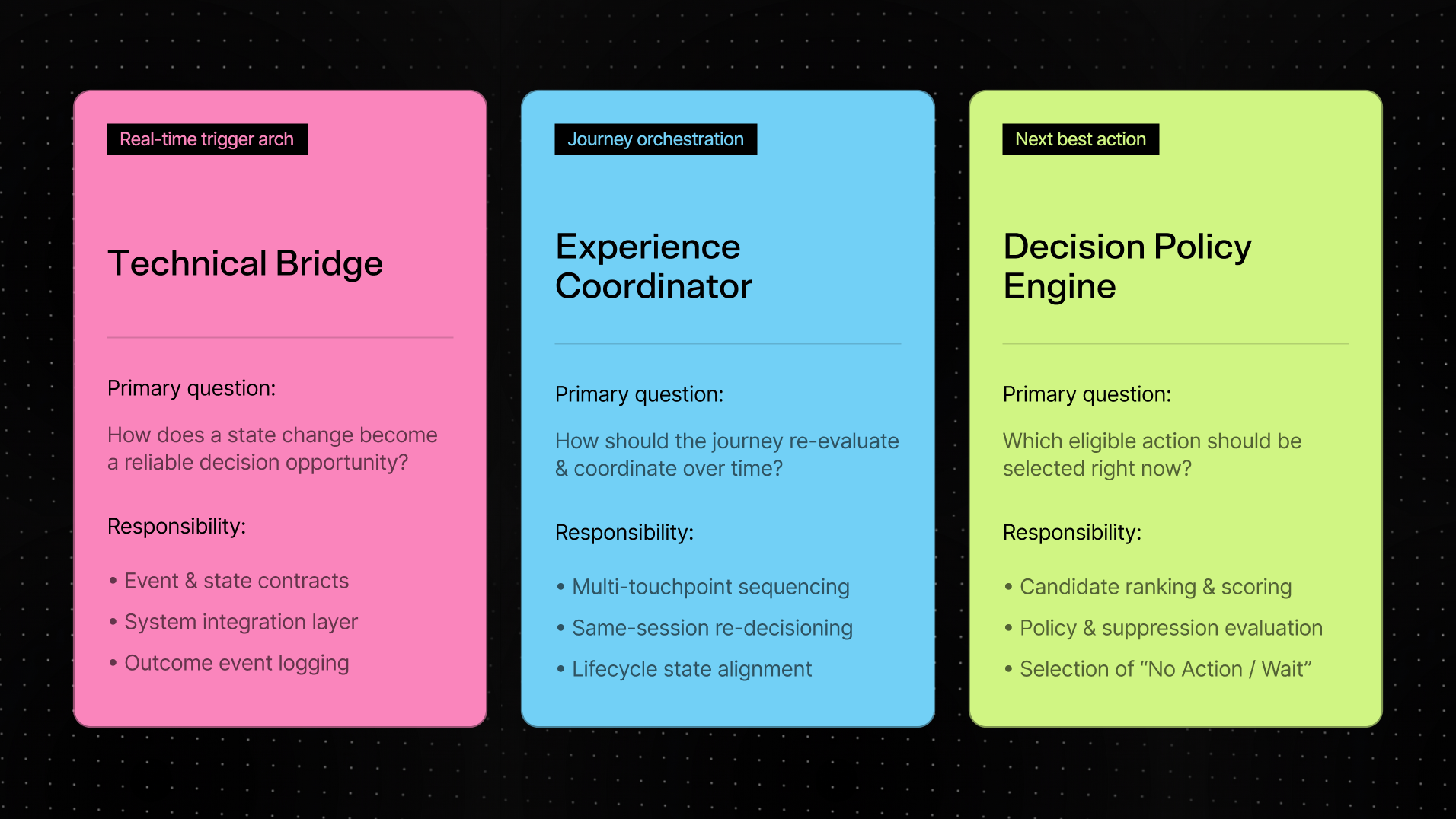
Figure 5. The architectural boundaries between real-time trigger pipelines, journey orchestration platforms, and next-best-action decision models.
Real-time trigger architecture
Primary question: How does a state change become a reliable decision opportunity?
Main responsibility: Event, state, contracts, integration and outcome flow
Journey orchestration
Primary question: How should the journey re-evaluate and coordinate interactions over time?
Main responsibility: Objective, sequencing, channels and same-session re-decisioning
Next Best Action
Primary question: Which eligible action should be selected now?
Main responsibility: Candidate selection, ranking, suppression and wait
These concepts should not compete for the same definition.
Trigger architecture is the technical bridge.
Journey orchestration coordinates the wider experience.
Next Best Action chooses among eligible actions at a particular decision point.
Together, they create the loop:
Something changed → understand what is true now → decide what is allowed → choose what should happen → execute → measure.
“Do Nothing” Is a Valid Trigger Outcome
Real-time infrastructure can create an unhealthy design instinct:
If the system detected something quickly, it should respond quickly.
That does not follow.
A low-latency pipeline can still produce the correct decision to wait.
No action may be appropriate when:
Confidence is low.
The player is progressing normally without help.
Recent interventions were ignored or dismissed.
Another journey already has priority.
No eligible action remains after filtering.
A protected state suppresses commercial treatment.
The expected benefit of interruption is lower than its cost.
The decision should still be logged.
decision = no_action
reason = low_confidence
is operationally different from:
delivery_failed = true
That distinction matters for both monitoring and experiments.
The A/B-testing framework explicitly warns against treating intentional non-exposure as a technical failure when the AI policy deliberately chooses to wait.
How Slotsense Fits the Operator Stack
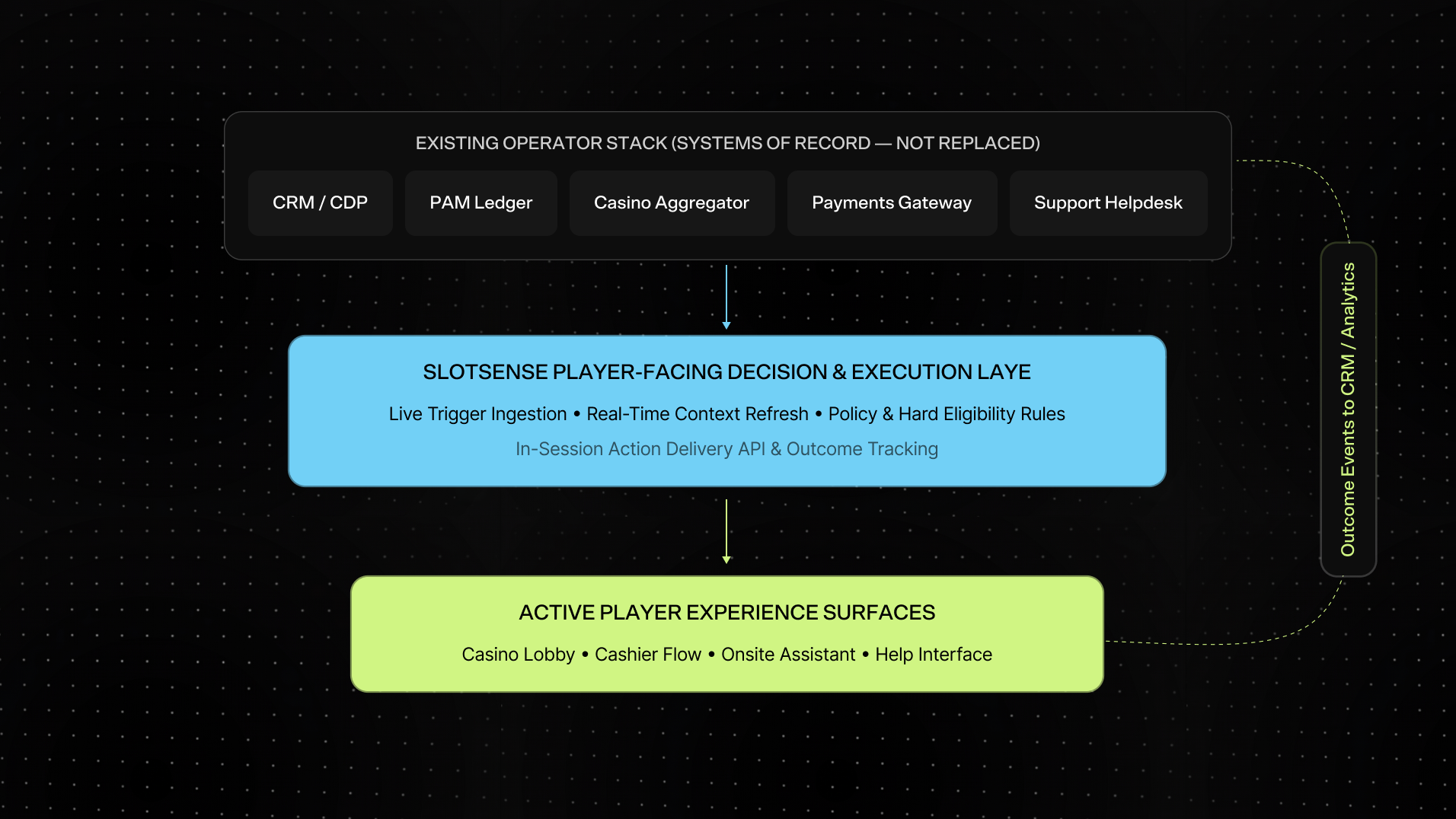
Figure 6. Integration topology of the modular player-facing layer within a production operator stack.
Slotsense is not positioned as a replacement for CRM, PAM, casino aggregation or the support stack.
Those systems keep their core responsibilities.
CRM / CDP owns segments, campaigns, lifecycle logic and communication history.
PAM remains authoritative for account and player state.
Aggregator / casino product remains authoritative for game availability and gameplay events.
Payments remain authoritative for transaction state.
Support continues to own tickets, approved knowledge and human-agent workflows.
Slotsense sits closer to the active player interaction. It consumes relevant triggers and state, applies decision logic and guardrails, executes the permitted player-facing experience and returns an outcome event into the operator’s analytics and CRM environment.
The existing Slotsense journey-orchestration article describes the same boundary: CRM can continue to manage campaigns and lifecycle logic, while PAM and data systems remain sources of player status and events; Slotsense connects those inputs to the live interaction.
The current Slotsense product site likewise states that the platform connects to the existing product, CRM, support and data stack rather than replacing it.
Responsible Real-Time Decisioning Requires Precedence, Not Just Prediction
The fastest action is not always the correct action.
A production architecture needs explicit precedence.
A simple hierarchy may look like:
1. Mandatory protection / account controls 2. Service and unresolved friction 3. Player-requested support 4. Journey objective 5. Commercial optimization
This is not a universal legal hierarchy. It is an architectural pattern.
It prevents a predicted commercial value score from competing on equal terms with a hard suppression rule.
The UK Gambling Commission’s current remote-customer-interaction framework is useful as one concrete example because it combines identification, timely action and evaluation. It also requires operators to understand the impact of interactions and evaluate the effectiveness of the overall approach.
That maps cleanly to:
Signal → Decision → Action → Outcome
But local rules differ.
Every market requires a separate compliance review.
How to Build the First Real-Time Trigger Use Case
Choose one narrow decision window.
Start with failed deposit, post-deposit discovery, repeated lobby returns or another event with a clear operational owner.
Define the business objective before the action.
Specify what successful behaviour looks like. Do not start with “show a widget.”
Write the event contract.
Define event name, producer, timestamp, player identifier, event ID, required fields and replay/idempotency expectations.
List only states that can change the decision.
Avoid turning the pilot into a full customer-360 rebuild.
Write eligibility and suppression first.
Jurisdiction, consent, player-protection state, limits and product availability should narrow the action set before ranking.
Create a small candidate library.
Three to five genuinely different actions are enough for an initial pilot. Include support or escalation where relevant and include no action.
Connect one execution surface.
A cashier recovery layer, lobby assistant or contextual onsite surface is easier to evaluate than a cross-channel launch.
Instrument reason and outcome events.
Record why each action was selected, suppressed or skipped and what happened afterwards.
Run against a credible control.
Stable player-level assignment and intention-to-treat analysis should remain the primary experimental read.
Expand by decision quality, not event count.
Adding twenty more triggers is not progress if the first trigger cannot be explained, governed and measured.
Measurement: Prove the Trigger Changed a Business Outcome
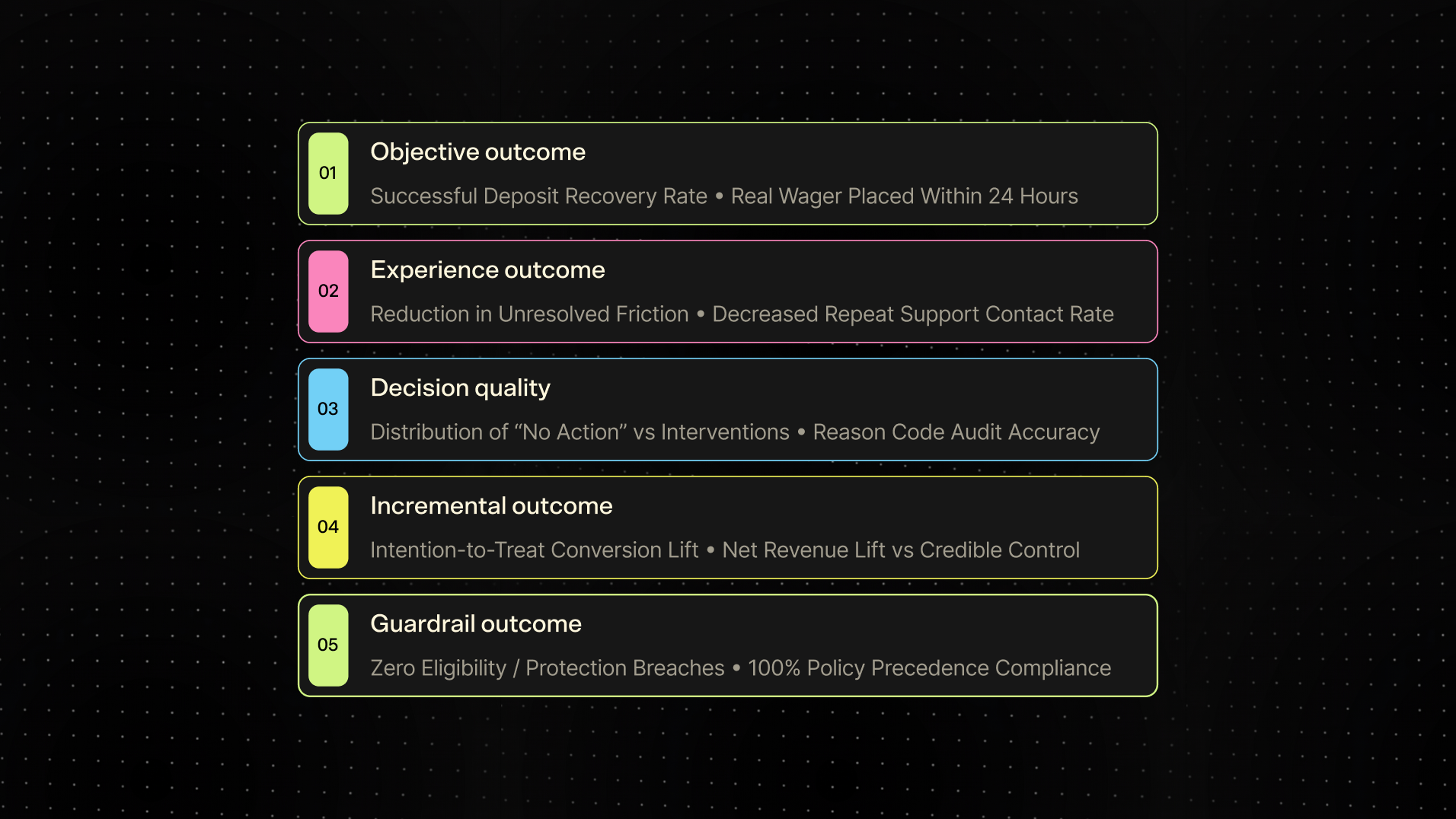
Figure 7. The real-time balanced trigger scorecard categories.
A real-time system creates many attractive diagnostic metrics:
The experiment should test whether access to the decision policy changed the predefined business outcome versus control, not whether engaged users looked successful.
The Architectural Test
A trigger architecture is mature when the operator can answer one sentence:
For any player-facing action, can the team reconstruct which event opened the decision, which state was evaluated, which actions were suppressed, why the final action was selected and which business outcome followed?
If the answer stops at “the webhook fired,” the operator has event integration.
It does not yet have real-time decision architecture.
Frequently Asked Questions
What is a real-time trigger in iGaming?
A real-time trigger is a meaningful change in player, account, payment, product or session state that opens a decision window while the context is still relevant. The trigger should not automatically determine the action.
Is a real-time trigger the same as a webhook?
No. A webhook is one delivery mechanism for notifying another system that something occurred. A real-time trigger architecture also requires current state, eligibility, decision logic, execution and outcome measurement.
How is real-time trigger architecture different from Next Best Action?
Trigger architecture moves a state change into a reliable decision process. Next Best Action selects the most appropriate option from the eligible action set at that decision point.
How is it different from customer journey orchestration?
Journey orchestration coordinates decisions and interactions across a broader journey and can re-decide as context changes. Trigger architecture provides the event, state and execution contract that makes those real-time decisions operational.
What data does a real-time iGaming trigger need?
It depends on the use case. Common inputs include PAM status, live session behaviour, payment state, CRM context, game availability, support context, consent, limits and player-protection state. Only inputs that can materially change the action should be included in the first pilot.
Does Slotsense replace the CRM or PAM?
No. Slotsense is designed as a modular player-facing layer alongside the existing CRM, PAM, product, support and data stack. Those systems retain their core ownership while Slotsense handles contextual decisioning and execution inside the active experience.
Can no action be the result of a real-time trigger?
Yes. No action is a valid decision when confidence is low, the player is progressing normally, another journey has priority, recent interventions create fatigue, protection rules suppress treatment or no eligible action remains.
How should operators measure a real-time trigger?
The primary measure should be the business outcome associated with the decision window, tested against a credible control where causal impact matters. Event counts, latency, CTR and interaction rates should be treated as operational or diagnostic metrics rather than automatic proof of incremental value.