iGaming Player Retention Beyond Bonuses
A practical playbook for retaining players through better decisions inside the active journey - without turning every interaction into another bonus.
15 mins
·
October 3, 2026
A practical playbook for retaining players through better decisions inside the active journey - without turning every interaction into another bonus.
.png)
Player retention becomes more useful when the operator can choose among many relevant actions.
The central idea: bonuses remain a valid retention tool, but they should be one eligible action among many - not the automatic response to every sign of hesitation, inactivity or return.
A player may leave because the lobby is overwhelming, a preferred game is hard to find, a payment failed, a rule is unclear, a recommendation missed the mark or an onsite message interrupted a journey that was already progressing. None of those moments is automatically a discount problem.
The stronger operating model is to understand the player state, define the objective, choose the most useful eligible action and measure the downstream outcome. Sometimes that action is a recommendation. Sometimes it is support, education, continuity or a short quiz. Sometimes it is no intervention at all.
iGaming player retention is the operator's ability to help suitable players continue finding value in the product and return over time. It is visible in repeat active days, session continuity, successful game discovery, resolved friction, repeat deposits, sustainable betting activity and longer-term player value. It should not be reduced to the number of offers sent or the size of the bonus budget.
Retention therefore sits across CRM, product, support, content, payments, player protection and onsite experience. Campaigns remain important, but many decisive moments happen while the player is active: after a deposit, during lobby exploration, after several quick game exits, when a help question appears or when a returning player looks for something familiar.
This is the same moment-level logic described in the Slotsense Next Best Action guide: a trigger creates a decision opportunity, but context and guardrails determine what should happen next.
Bonuses can be effective when the player is eligible, the economics are sound and the offer addresses a real commercial objective. The problem begins when every retention signal is translated into the same response: send an incentive.
A bonus cannot repair a broken deposit flow. It does not explain an unfamiliar game. It may not help a player who wants a quick recommendation, and it adds noise when the player is already navigating confidently. Repeated incentive-first logic can also hide the underlying problem: the operator records a campaign response without learning whether the player needed discovery, continuity, service or simply time.
The objective is not bonus elimination. It is better action selection. Rewards should compete with other possible actions and lose whenever another step is more relevant, safer, less intrusive or more efficient.
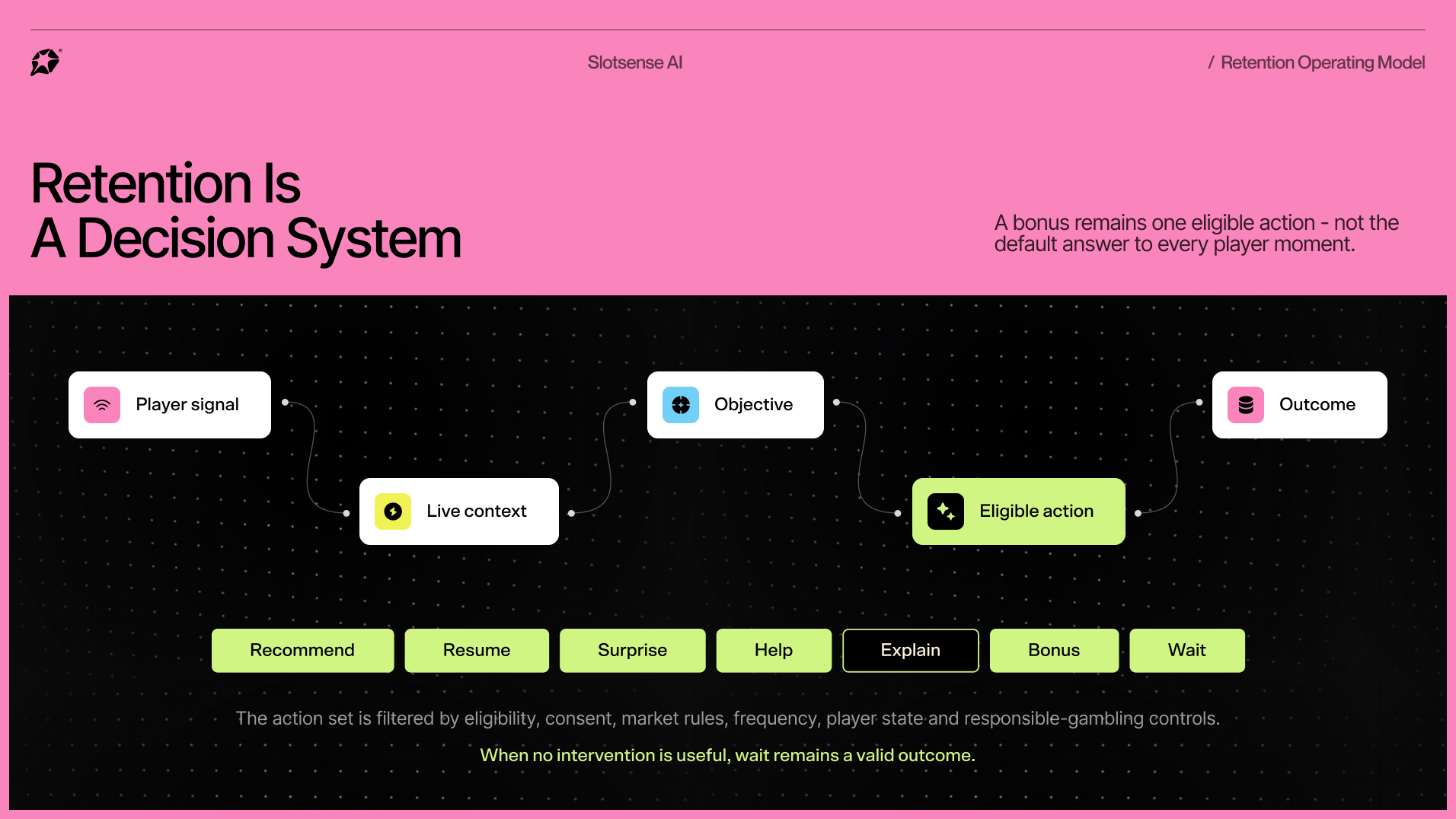
The model can be expressed as one operating sequence:
Trigger -> Player context -> Objective -> Eligible actions -> Decision -> Outcome
For example, repeated game switching may trigger a discovery decision. Strong provider affinity may make a familiar shortcut useful. A failed deposit changes the objective from engagement to resolution. Recent prompt dismissals may remove every intervention from the action set. The system should make these distinctions while the moment is still active.
Every decision also needs operator-defined eligibility, consent, frequency and responsible-gambling controls. In Great Britain, remote operators must identify risk, act appropriately, evaluate the effect of the action and restrict marketing or new bonus take-up where strong indicators of harm are identified. Other jurisdictions apply their own requirements, so policy must be configured and reviewed market by market.
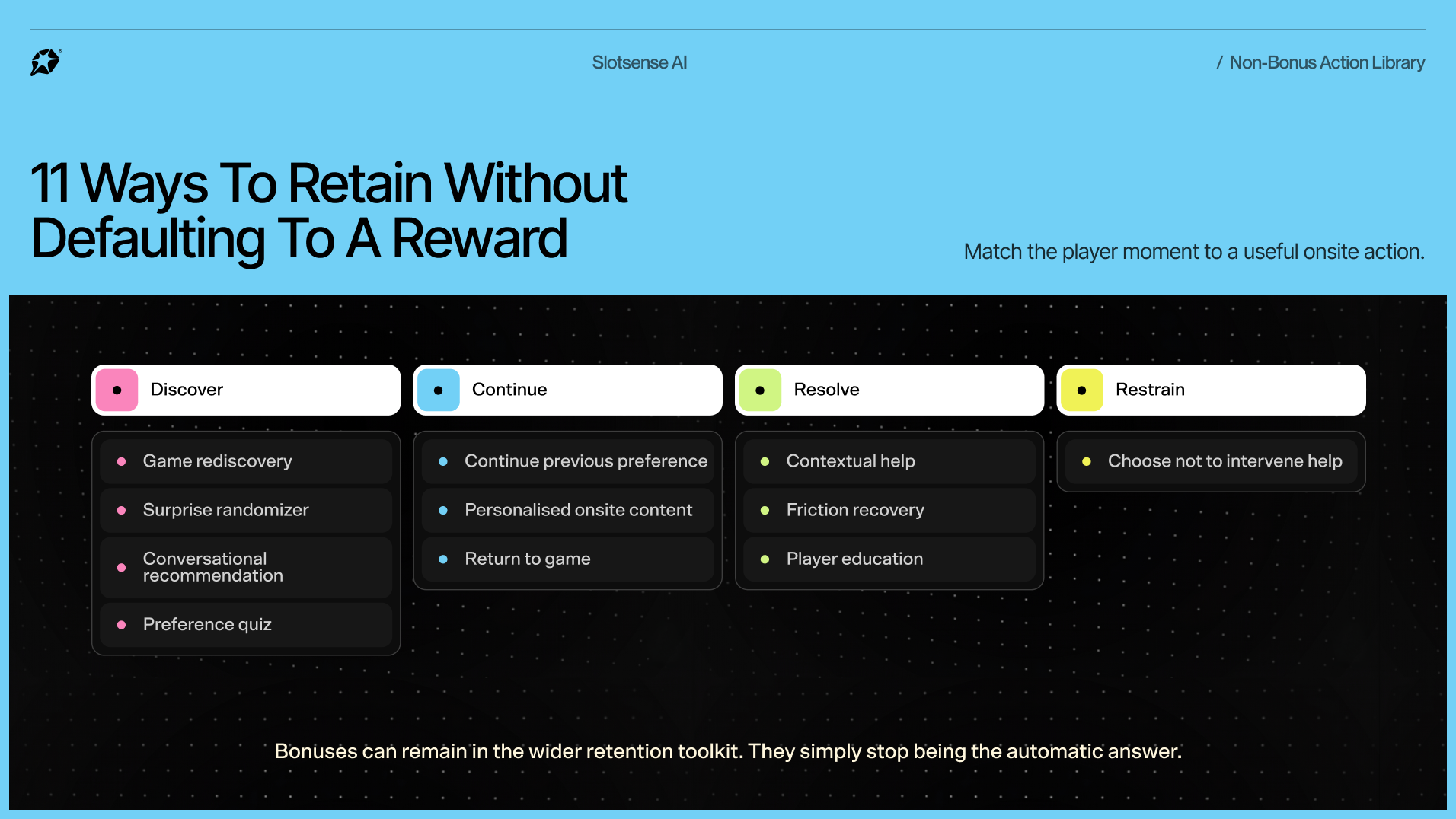
The strategies below are not eleven disconnected campaigns. They are an action library. The operator chooses among them according to the player's moment, the objective and the available evidence.
A player does not need to be dormant to experience retention friction. Long lobby dwell time, repeated searches and several short game exits can indicate that the catalogue is not helping the player decide what to try next.
Game rediscovery turns the existing library into a retention surface. Instead of promoting the same popular titles to everyone, surface a small set of relevant categories, providers or adjacent games based on current behaviour and known preferences. Explain the recommendation briefly so the player understands why it is relevant.
Useful triggers: long lobby dwell, repeated game switching, search with no launch, return after catalogue change.
Measure: time to relevant game launch, recommendation-to-launch rate, session continuation and return rate.
Some players do not want a questionnaire or a long recommendation list. Their intent is closer to “pick something for me.” A constrained randomizer can remove choice friction with one clear action.
The randomizer should not select from the entire catalogue blindly. It should respect jurisdiction, product availability, player state, exclusions and any known preference boundaries. Randomness changes the experience; governance keeps it relevant.
Useful triggers: explicit surprise intent, low preference confidence, prolonged browsing without selection.
Measure: first game launch, time to first bet, session continuation, repeat activity and downstream value.
In a test with new Portuguese FTD users who had no previous casino bet, the standard post-deposit journey was compared with treatment experiences built around one Surprise Randomizer recommendation. One treatment variant delivered the same logic through an AI Avatar.
The data shows a massive acceleration in player activation across multiple tracking windows:
Treatment cohorts also recorded a 52.8% seven-day repeat depositor rate versus 43.7% for control, a 9.1 percentage-point or 21% relative uplift. Repeat deposit volume was approximately 48% higher across similarly sized cohorts.
Interpretation note: because the treatment combined randomizer-only and avatar-plus-randomizer variants, the test supports the value of a clear low-friction recommendation after FTD. It does not isolate the avatar effect.
Retention does not always require novelty. When a returning player has stable provider, category or game-mechanic affinity, the most useful step may be a shortcut back into familiar territory.
Continuity can mean reopening a preferred category, showing a newly available title from a favourite provider or offering a small set of adjacent options. The system should use fresh evidence: an old favourite should not override more recent behaviour, availability or policy.
Useful triggers: return after inactivity, repeat provider affinity, frequent category visits, previous recommendation acceptance.
Measure: shortcut use, time to launch, repeat session depth and preference stability.
A recommendation carousel assumes the system already understands the player. A conversational recommendation can handle ambiguity by asking one useful question: mood, pace, familiarity, game type or desired complexity.
The conversation should be short and purposeful. Ask only what changes the decision, then present a small number of options with a clear route to launch. If the player rejects the suggestion, treat that response as new preference data rather than repeating the same content.
Useful triggers: uncertain search intent, repeated recommendation rejection, broad browsing or a direct player question.
Measure: conversation completion, recommendation acceptance, game launch, time to choice and repeat use.
A quiz is useful when behavioural history is limited or contradictory. It can create first-party preference data before the operator has enough observed gameplay to personalise confidently.
Keep it short. Each question should reduce uncertainty, and the journey should stop once the system has enough information to act. Avoid using a reward as the only reason to finish; otherwise the quiz may capture incentive behaviour rather than genuine preference.
Useful triggers: cold start, first casino visit, new vertical, weak preference history or explicit discovery intent.
Measure: step completion, preference coverage, recommendation launch, downstream betting and repeat activity.
A separate randomised Slotsense test with loyal non-VIP Portuguese players compared a quiz-only experience with the exact same quiz and recommendation logic introduced through a female AI Avatar.
Adding the AI Avatar layer generated a clear lift across the entire interaction funnel:
The avatar version produced the strongest experience while the underlying recommendation logic remained unchanged. That matters for retention design: content quality and delivery format should be tested separately whenever the sample size allows it.
Support is a retention function when it removes uncertainty before the player gives up. The player should not need to leave the deposit, withdrawal, verification or game journey to search a generic help centre.
Contextual help can surface a verified answer, the relevant help article, a short guided flow or a clean human handoff. The response should use the current page and account state when available, while staying within the operator's approved knowledge and escalation policy.
Useful triggers: help intent, repeated visits to the same step, error states, unclear status or support search.
Measure: issue resolution, re-contact, abandonment, escalation quality and successful journey continuation.
A failed deposit, unresolved KYC step, account-access problem or error loop changes the objective. The next best action is resolution, not game promotion.
Friction recovery should explain what is known, identify the next safe step and escalate when the system should not act alone. Commercial prompts should be suppressed until the blocking issue is resolved. This protects both the experience and the integrity of the measurement.
Useful triggers: failed or pending payment, repeated verification error, account lock, broken deep link or unresolved support case.
Measure: recovery completion, time to resolution, successful retry where appropriate, re-contact and later return.
Player education is more useful when it is connected to a live question. Explain game mechanics, product navigation, withdrawal steps, bonus terms, account controls or safer-gambling tools when the player needs that information.
Education should be factual and easy to exit. It should not imply that a strategy guarantees a win, encourage loss-chasing or use complexity to prolong play. The objective is understanding and confidence, not pressure.
Useful triggers: new feature view, repeated rules search, bonus confusion, unfamiliar game category or account-control question.
Measure: content completion, resolved intent, reduced repeat questions, successful navigation and player feedback.
Changing one banner for a static segment is not the full personalisation opportunity. Onsite content can respond to the current page, recent game exits, deposit status, market and language, previous interactions, ignored recommendations and support intent.
Personalisation should change the usefulness of the experience, not only its appearance. That may mean reordering entry points, changing a prompt, hiding an irrelevant action, surfacing help or choosing a different interaction format.
Useful triggers: new session context, changed lifecycle state, recommendation rejection, support intent or live behavioural signal.
Measure: incremental action rate, session progression, repeat activity, suppression effectiveness and downstream value.
A returning player may not need discovery at all. A clear resume path can reconnect the player with a recent eligible game, unfinished discovery journey or saved preference without forcing another lobby search.
Return-to-game logic is more specific than broad preference continuity: it restores the immediate context the player left. It should be disabled when the game is unavailable, the prior session ended in a support or risk context, or the player has since expressed a different intent.
Useful triggers: return within a relevant period, interrupted session, recent game exit or saved journey state.
Measure: resume rate, time to launch, session continuation and later return.
Retention systems often optimise for message volume because impressions are easy to count. That creates a bad incentive: fill every available surface even when the player is already progressing.
Wait should remain eligible when confidence is low, the player has ignored recent prompts, another journey has priority, frequency limits are reached or an interruption would reduce experience quality. Promotional action should also be removed when responsible-gambling policy requires suppression.
Useful triggers: natural progression, recent dismissal, low decision confidence, journey conflict, frequency cap or risk signal.
Measure: incremental lift against a holdout, prompt fatigue, dismissal, session continuity and negative-response rate.
Player retention tools for iGaming should help the operator sense, decide, execute and learn. A long feature list is less useful than a clear answer to the questions below.
Player retention software for iGaming may sit in different categories. CRM usually owns customer data, segments, campaigns and lifecycle journeys. A CDP unifies identity and events. A bonus engine governs reward eligibility. A support platform owns tickets and agents. A player-facing decisioning layer handles the moment between those systems and the active player.
The buying question is therefore not “Which platform has the most retention features?” It is “Which system can recognise the player moment, select the right eligible action, execute it in the journey and prove the outcome?”
Do not optimise the interaction in isolation. A quiz completion, recommendation click or avatar view is a diagnostic signal, not the final business outcome.
Define one primary metric and decision window before launch. Keep treatment assignment stable at the user level, preserve a control group and record which action was shown. Measure immediate behaviour and downstream value separately. A mechanism can attract attention without improving retention, while a quiet action can improve the journey without generating a dramatic click-through rate.
Useful metrics include time to first or next relevant action, game launch, repeat active days, Day 7 and Day 21 retention, repeat deposit, session count, resolution and re-contact. Where wagering or deposit measures are used, interpret them alongside player-protection controls and operator policy.
Slotsense is a player-facing AI layer for iGaming operators. It works alongside the operator's product, CRM, support and player data rather than replacing them.
CRM can continue to manage lifecycle logic, campaigns and segments. Slotsense can use those signals during the active session to recommend, guide, support, recover, educate or wait. The outcome then returns to analytics and future decisioning.
This makes retention less dependent on building another manual workflow for every player state. The operator defines objectives and guardrails; the system helps select and execute the next useful player-facing action.
The strongest retention strategy is not the one with the largest number of mechanics. It is the one that responds correctly to the reason the player may stop progressing.
Use rewards when a reward is genuinely the best eligible action. Use discovery when the problem is choice. Use support when the problem is friction. Use education when the problem is uncertainty. Preserve continuity when the player already knows what they want. Wait when the player does not need help.
Map your first non-bonus retention workflow with us ->
iGaming player retention is the ability to keep suitable players finding value in the product and returning over time. It is measured through repeat activity, session continuity, resolved friction, repeat deposits, sustainable betting behaviour and longer-term player value.
Reduce friction and decision effort. Useful approaches include game rediscovery, contextual recommendations, preference quizzes, return-to-game paths, inline support, player education, real-time personalisation and deliberate non-intervention.
Look for live player context, an action library beyond offers, onsite execution, experimentation, downstream measurement, operator control, stack integration and jurisdiction-aware guardrails.
Usually no. CRM remains central for data, segmentation and campaigns. A player-facing retention layer can use CRM and product signals to make and execute contextual decisions during the active session.
Yes. The objective is not to remove bonuses. It is to stop treating them as the default response when a recommendation, support step, explanation, resume path or no intervention would be more appropriate.
When the player is progressing naturally, decision confidence is low, recent prompts were dismissed, another journey has priority, frequency limits are reached or promotional action should be suppressed under operator policy.
Content:
.png)